

Which marketing jobs a founder can hand GPT-6 Astra for a full day before hiring


Which marketing jobs a founder can hand GPT-6 Astra for a full day before hiring
Your marketing backlog says “hire a marketer,” but the work is more specific: refresh commercial pages, inspect a lead form, and get inquiries to the right salesperson. Give GPT-6 Astra those bounded assignments for a day before opening a role. Measure usable work and correction time. Use the unresolved decisions to define the hire.
Start with Eric Siu’s operating evidence, not a staffing forecast. In his discussion of marketing-agent adoption, Eric cites 17 of 100 companies using AI agents in marketing, with agents covering 3.5% of marketing staff. Those figures have different denominators and do not establish productivity gains. They support a narrower recommendation: ship one owned workflow and measure human hours saved before announcing an AI-first marketing organization.
What it means to hand a founder marketing job to Astra for a day
A full day means scoped assignments using available files, exports, and tools. It does not imply uninterrupted autonomous operation or guarantee that your configuration can edit websites or videos. When access is missing, request a specification or edit-decision list. Record the limitation. A proposed change and an implemented change are different deliverables.
Eric’s one-job-per-bot guidance determines the unit of work: one pipeline job, a success definition, a safety bar, and a human verifier. Refuse “run marketing.” Search analysis and lead routing need different evidence. Bundling them under “grow revenue” makes errors harder to locate and useful work harder to price.
Write the business question, input packet, expected artifact, and acceptance criteria before starting. Track preparation, execution, verification, and correction time separately. If gathering inputs consumes the day, fix access and data ownership before hiring someone else to navigate the same mess.
For Single Grain, the useful connection runs from SEO and AEO to the lead journey. A refresh brief connects a buyer question to a commercial page. A form audit follows the inquiry into sales handling. That is the hiring test: can the workflow advance a buyer toward a qualified conversation without creating more cleanup?
The job list worth running before you hire
In Eric’s Astra job walkthrough, the concrete assignments include SEO/AEO workflows, lead-form audits, video editing, design review, website concepts, thumbnails, and turning strategy memos into work. The walkthrough moves across recognizable marketing artifacts rather than a vague department mandate. What emerges is a useful backlog, not evidence that every marketing responsibility belongs to one agent. Take that list into your day test and select the jobs with inspectable outputs.
- Search refreshes: map declining commercial pages to buyer questions and produce evidence-backed briefs.
- Lead-form audits: inspect field usefulness, routing rules, and response handling.
- Video and thumbnails: prepare edit decisions or variants against supplied reference assets.
- Design and website concepts: identify gaps between the current experience and the customer’s stated task.
- Strategy memos: extract tasks, dependencies, and stated owners. Flag missing ownership.
Run search refreshes and the form audit first. They expose two burdens often hidden inside a generalist job description: evidence assembly and operational handoffs. Keep creative production in reserve until you have a usable brief and someone capable of judging the output.
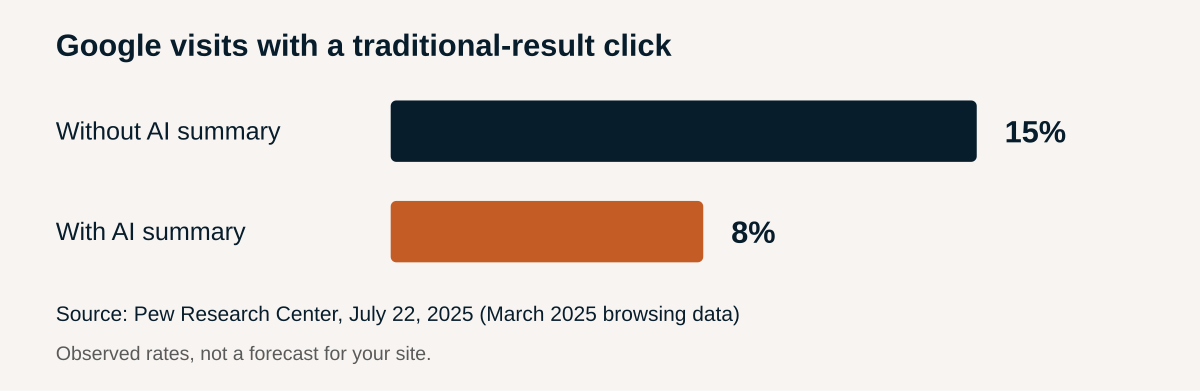
Search needs a second success lens beyond rankings. Pew Research Center’s March 2025 browsing analysis found traditional-result clicks in 15% of Google visits without an AI summary versus 8% with one. Users clicked an in-summary source in approximately 1% of visits containing a summary. These observations do not forecast your traffic loss. They change the brief: inspect answer coverage, supporting evidence, and the next step available to a buyer who reaches the page.
Single Grain’s SEO and AEO integration framework connects those concerns within one content program. Keep ranking performance and observed answer visibility separate so the agent cannot substitute one for the other.
The human ship gate (observation → recommend → approve)
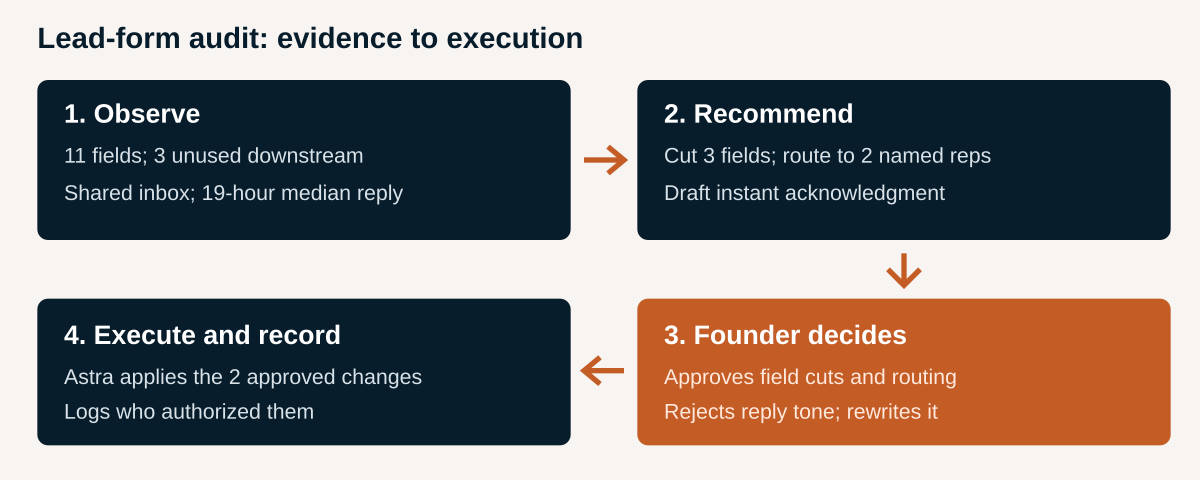
Eric’s observation, recommendation, then action sequence sets the permissions. First deploy in observe-and-recommend mode. Enter the founder’s actual name as the day’s accountable verifier. Nothing publishes, sends, spends, or changes production records without that person’s approval. Keep observations, decisions, and execution logs together. The following two worked applications illustrate the walkthrough’s job categories; they are not reported Single Grain client results.
The SEO/AEO refresh begins with Search Console exports, commercial pages, and buyer questions from sales calls. Astra identifies declining pages, groups the relevant query patterns, and assembles refresh briefs. Search Console supports the performance findings. Actual answer observations are required to establish missing citations; without them, the citation question stays unresolved.
Each brief connects a page to a query pattern, a buyer question, and a proposed update. It identifies sections to revise, claims needing evidence, and a next step matched to buyer intent. The founder discovers that the assembly work is useful but one proposed angle misses the offer’s positioning. That angle returns for revision; the supported briefs enter the writing queue. Keep evidence assembly with the agent if the briefs survive review. Reserve positioning for the marketer. Single Grain’s AI tools for SEO workflows guide provides context for connecting that queue to production.
The lead-form audit makes the handoff problem concrete. In this illustrative application, the form has eleven fields, three unused downstream, and leads route to a shared inbox. Median first reply is nineteen hours. These are example inputs, not sourced performance statistics. Astra recommends removing the unused fields, routing by company size to two named reps, and drafting an instant acknowledgment. The audit exposes a problem beyond the page: an easier submission still reaches an unattended queue.
The founder accepts the field cuts and routing, rejects the acknowledgment’s tone, and rewrites it. With implementation access available, Astra applies the accepted changes and records the authorization. The team tests the remaining fields and the company-size routing boundary. The useful outcome is a tested handoff plus a clear judgment gap: repeatable implementation can stay in the workflow, while customer-facing voice still needs an experienced owner.
Harvard Business Review’s 2011 research on online sales leads associated faster contact with greater qualification likelihood. That older evidence supports inspecting response handling, not promising a conversion lift from this audit. Revisit the response-time baseline after implementation and distinguish an acknowledgment from a salesperson’s substantive reply.
What you still should not automate
Keep ownership of brand voice, pricing, legal interpretation, and customer relationships with people. Astra can assemble evidence, calculate scenarios, and surface inconsistencies. Those capabilities do not establish which commercial promises the business can sustain or which customer objection deserves a positioning change.
Judge the reasoning behind an output, not just its polish. A clean search brief can target a low-value question. A shorter form can remove information sales needs. In the audit, downstream nonuse justified the proposed field cuts. A blanket rule that shorter forms perform better would not justify removing arbitrary fields.
Track where corrections concentrate. Repeated factual corrections point toward weak inputs or unreliable execution. Repeated positioning corrections expose missing judgment. Disputes over ownership reveal an organizational problem. Give each problem an owner instead of generating another draft and counting it as progress.
How this changes the hire vs agent decision
At day’s end, compare accepted deliverables against total preparation, checking, and correction effort. Count usable briefs and verified fixes, then record the human time required to obtain them. The adoption figures Eric cites are a reason to measure the workflow’s contribution carefully, not a basis for cutting a percentage of headcount.
Keep the scoped agent job when inputs are stable, evidence is traceable, and repeated runs reduce human effort. Buy a purpose-built tool when the remaining gap is dependable routing, scheduling, or file handling. Build a custom workflow only after the recurring job and handoffs are clear. Price that defined pipeline job rather than vague access to an AI system.
Hire an experienced marketer when the constraint is customer insight, positioning, prioritization, or coordination across teams. The strongest hiring brief names the decisions the day test could not resolve and separates them from production work the agent already handles. Repeat the assignment across several cycles before removing production capacity from the hiring plan.
If the unresolved work spans commercial search and answer visibility, Single Grain’s AI SEO services and AEO services are relevant options to evaluate. Bring the input packet, accepted outputs, correction log, and unresolved decisions to Single Grain. That evidence makes the next conversation specific: which job to keep, which system to buy, and which human responsibility to hire for.