

AI-Powered CRO Agency Buying Guide


TABLE OF CONTENTS:
- Quick Overview
- What "AI-powered CRO" should mean in a contract
- Compare agency models on one scorecard
- RFP questions that expose theater
- When to hire AI-native versus classic CRO
- Red flags that should end the call
- A practical shortlist process
- Failure modes after you hire
- Budget and pilot design that protects you
- Evaluate Single Grain as a CRO partner
Quick Overview
This buying guide is for marketing and growth leaders evaluating an AI-powered CRO agency. The job is faster test design and analysis without handing ship decisions to a model. The mechanism is a shortlist scored on experimentation cadence, evidence standards, human ship gates, and measurement hygiene. The outcome is a partner that speeds hypothesis work while keeping brand, UX, and stats culture intact.
- Hire AI-assisted CRO for speed only if human ship gates stay real.
- Demand pre-registered hypotheses and a decision log for every test.
- Compare classic CRO shops, AI-native experimentation teams, and full-funnel growth partners on the same scorecard.
- Reject vendors that invent variants without measurement or brand review.
- Ask for a rejected test story before you sign.
One recent benchmark: the median Google Ads search conversion rate in 2026 was 8.18%, across 13,474 US campaigns from April 1, 2025 to March 31, 2026. Business services was 4.85%, with a median cost per lead of $93.69. Source: WordStream and LocaliQ, updated September 16, 2026. This is a paid-search benchmark, not a landing-page test result.
A VP of Growth sat through three vendor decks that all promised the same miracle: AI would invent winning landing page variants overnight. The slides looked confident. The sample creatives looked polished. Nobody could show a rejected test, a pre-registered hypothesis, or a human who had stopped a bad ship. That is the buying problem this guide solves.
Closest live Single Grain work covers software in the conversion tooling conversation and service context on the CRO agency page. This guide owns the agency buying decision for AI-assisted experimentation, not a tools roundup.
Watch the landing-page funnel investigation here: Eric walks a synthetic funnel and what to test next.
Before you let an AI CRO partner rewrite a hero, take Eric’s traffic-first rule seriously. Don’t change your landing page until you’ve checked your traffic data. Suspicious segments can look like conversion problems when they are acquisition problems. The same bar shows up when he talks about agent scores: a high score is not proof that the work is good. Use Jev-style checks, then keep a human on the ship decision. When you need a second operator scene for experiment cadence, Eric’s short-form loop in The Short-Form Growth Loop That Compounds Reach is the same pattern: AI proposes candidates, humans approve what ships.
What “AI-powered CRO” should mean in a contract
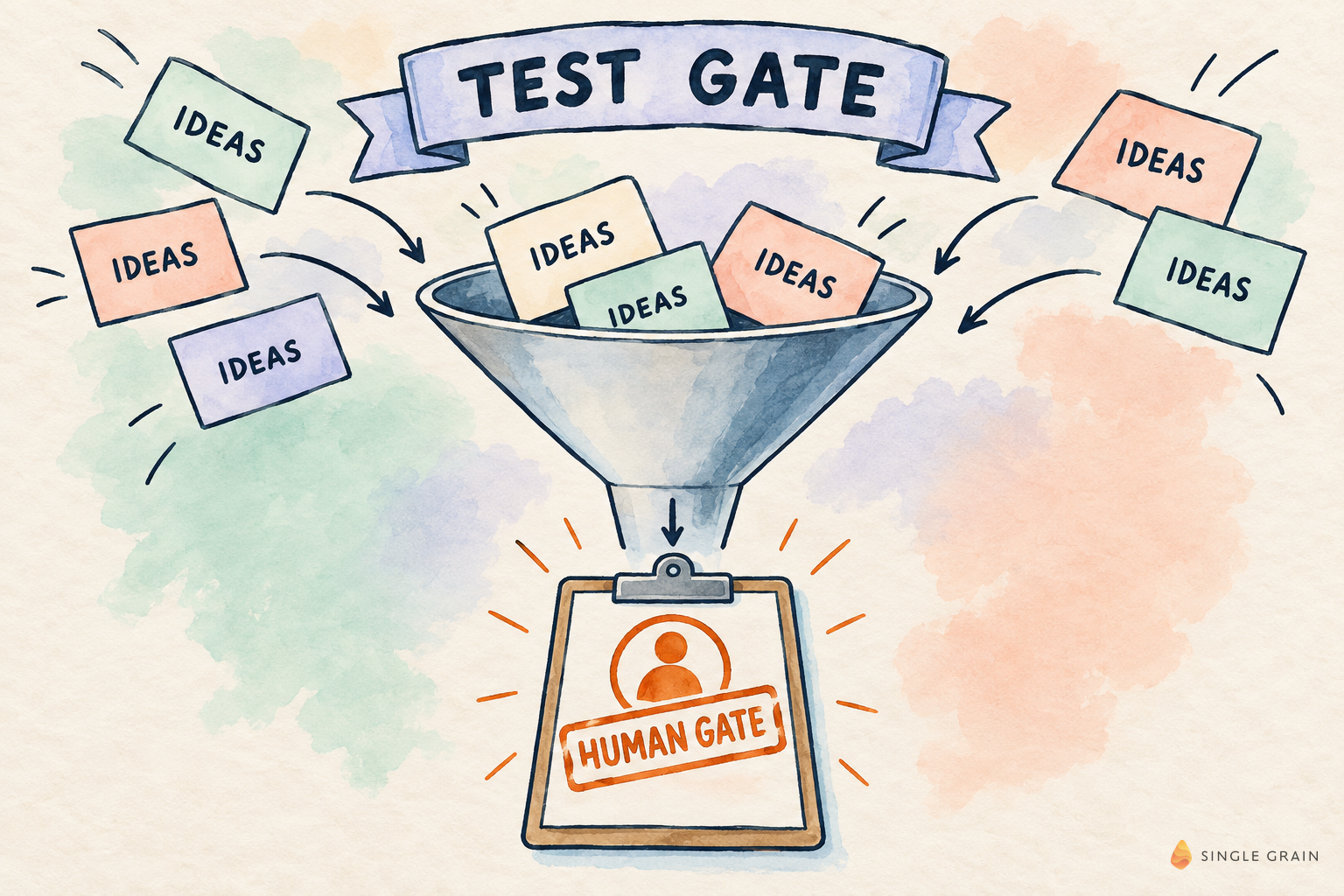
AI-powered should mean faster research synthesis, variant drafting, and post-test analysis under a human gate. It should not mean autopilot publishes. If the agency cannot name who stops a bad test, they are selling theater.
Write that into the SOW: the model proposes, the human ships. Novelty is not lift. A prettier hero image that fails sample size rules is still a failed test, even if the generator is proud of it.
Signals of a real experimentation culture
- Hypotheses are written before creative is generated.
- Primary metrics and guardrails are named before launch.
- Rejected tests are logged with reasons.
- Brand and UX have a named approver, not a Slack emoji reaction.
- AI outputs are labeled as drafts until a human stamps them.
Compare agency models on one scorecard
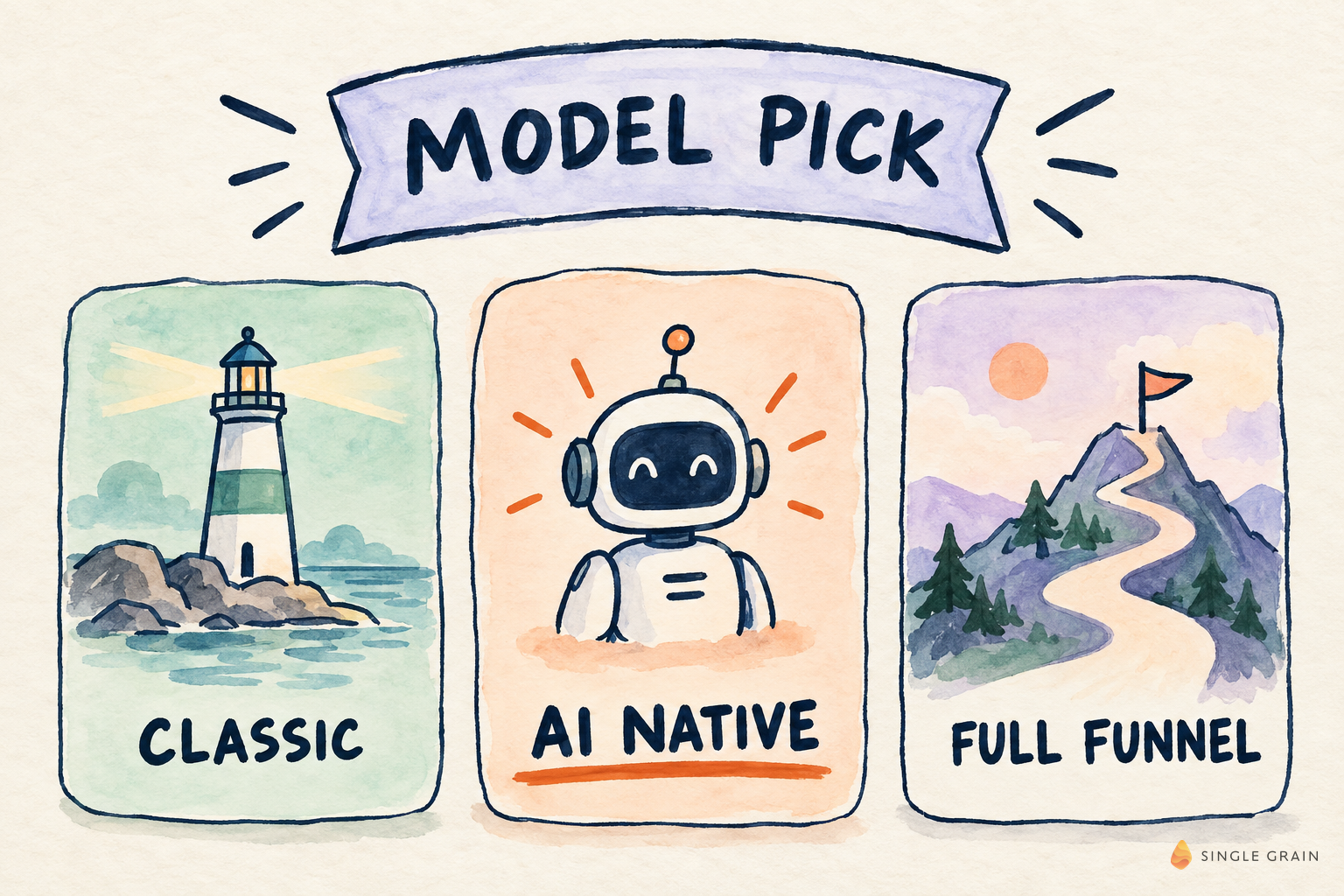
| Model | Best for | Watch-outs |
|---|---|---|
| Classic CRO shop with light AI | Strict stats culture | Slow creative throughput |
| AI-native experimentation | High test velocity | Hallucinated copy or weak logging |
| Full-funnel growth plus CRO | Pipeline-tied tests | CRO diluted by other lanes |
Most buyers need a hybrid: AI for throughput, classic discipline for ship gates. Score vendors on the weakest link. A fast AI studio with soft measurement will burn trust faster than a slower classic shop with clean logs.

In that Marketing School walkthrough, Eric looks at a synthetic cohort where people land on a landing page, some click the call to action, and fewer start or finish a form. The model then recommends what to fix. That is useful as investigation. It is dangerous if anyone treats the recommendation as a ship order without a human gate and a real measurement plan. Your RFP should force vendors to show how they keep that distinction.
RFP questions that expose theater
- Show a rejected test and why AI did not auto-ship it.
- How do you separate novelty from lift?
- What is the human approval gate on UX and brand?
- Where do hypotheses live before creative is generated?
- How do you handle conflicting metrics between CRO tools and CRM outcomes?
- What happens when a winning variant hurts brand voice or support load?
Listen for specifics. “We use AI throughout the process” is not an answer. “A strategist freezes the hypothesis, a producer drafts three variants, a brand lead rejects one for voice, and we launch two” is an answer.
Measurement hygiene you should require
Ask how the agency connects page experiments to pipeline reality. Page-level conversion lifts that never show up in qualified opportunity rates are a common failure mode. Pair CRO work with clean event naming and CRM stage definitions. If your team also needs ownership help on that plumbing, keep AI digital marketing agency and analytics partners in the shortlist conversation, but do not let attribution rebuild bury CRO cadence.
When to hire AI-native versus classic CRO
Choose AI-native experimentation when you already have a stats culture and need creative and analysis throughput. Choose a classic CRO shop with light AI when your team is still learning experiment design and would be harmed by hallucinated confidence. Choose a full-funnel partner when tests must tie to pipeline jobs across paid, landing, and sales follow-up, and you accept that CRO may share calendar with other lanes.
Landing page craft still matters. If your pages are structurally broken, no model will save the test plan. Use landing page agency context when the bottleneck is page architecture, and conversion rate optimization service framing when the bottleneck is experimentation operating system.
Red flags that should end the call
- No decision log and no rejected tests.
- Promises of guaranteed lift percentages with no sample size discussion.
- AI variants shipped without brand review.
- Inability to explain how a test could hurt support or brand.
- Tool names substituted for a methodology.
If a vendor leans on invented case study numbers, stop. Ask for process artifacts instead: hypothesis sheets, reject notes, and a week-in-the-life of their human gate.
How managed agents change the buy
Some partners will propose managed agents that draft variants, summarize tests, or watch funnels. That can be useful when ownership is clear. Use the same standard as managed marketing agents: the agent owns a job with an input, an output, and a kill switch. It does not own brand ship decisions. If the vendor cannot pause the agent in one step, you bought a chatbot with a retainer.
A practical shortlist process
- Write the problem: velocity, evidence quality, or both.
- Score three models on the table above with the same RFP pack.
- Require one rejected test story and one measurement diagram in the pitch.
- Run a paid pilot on a single funnel with a written human gate.
- Keep or kill based on decision-log quality, not slide polish.
During the pilot, watch how the team handles uncertain results. The best partners say “no ship” more often than weak partners say “the AI is confident.”
Failure modes after you hire
Even a good partner can drift. Log these monthly.
- Hypothesis quality drops while variant volume rises.
- Brand review becomes a rubber stamp.
- Tests optimize micro-conversions that ignore pipeline.
- AI drafts start appearing on live pages without the decision log.
When any of those show up, pause new tests. Fix the gate. Do not buy more seats in the creative generator.
Owners should schedule a monthly teardown with five wins and five misses. Change one process rule. Only one. Broad resets every month recreate the same theater you screened out in the RFP.
Keep screenshots out of the source of truth. The hypothesis sheet and the decision log are the source of truth. If a stakeholder wants a demo instead of a job, show the reject pile. Demos without rejects are how chatbot theater returns.
Budget and pilot design that protects you
Price the pilot against a single funnel with a written success definition: decision-log completeness, ship-gate adherence, and at least one test that was correctly refused. Do not define pilot success as “we launched N variants.” Volume without refuse is how bad culture sneaks in during the honeymoon period.
Ask who owns creative production when AI drafts are weak. Some AI-native shops assume the model is the producer. Classic shops assume a human designer. Hybrid shops name both. Your brand team needs to know who they are reviewing before week two of the pilot, not after a bad hero ships.
Support and sales should get a seat in the pilot kickoff. CRO wins that spike demo requests with unqualified traffic create downstream pain. A good partner invites those teams to define guardrail metrics before launch. A weak partner discovers the pain in a QBR.
When comparing retainers, normalize for strategist hours and human gate hours, not only tool access. Cheap retainers that bury human review inside “AI efficiency” often cost more in brand cleanup. Ask for a sample week calendar with named humans on the critical path.
If the vendor proposes managed agents inside the engagement, require the same kill switch language you would require for any production job. Who pauses the agent. How fast. What happens to drafts in flight. Put that in the SOW next to the confidentiality clause, not in a slide appendix.
Document the handoff if you later bring CRO in-house. You should leave the pilot with hypothesis templates, decision-log samples, and a measurement dictionary, not only a folder of winning screenshots. If the vendor cannot leave you smarter, they only left you dependent.
Keep a shared glossary for “hypothesis,” “guardrail,” and “ship.” Teams that argue about words mid-pilot waste the weeks they meant to spend learning. Put the glossary in the kickoff deck and in the decision log template so nobody can claim surprise later.
Evaluate Single Grain as a CRO partner
Single Grain runs experimentation with human ship gates and AI for throughput, not autopilot. If you need a partner that can reject a bad test as cleanly as it ships a good one, talk to Single Grain or start from the CRO agency page.