

Attention Is Not Pipeline: Converting Social and Webinar Reach Into Subscribers and Meetings


How do you turn social and webinar reach into subscribers and meetings?
Social and webinar distribution need a conversion system before they need more volume. Eric’s contrast supports choosing content by buyer response, then giving that audience a relevant capture offer. The system must preserve source context, separate subscription from sales intent, and assign the next action. Single Grain’s Attention→Pipeline Ladder makes those decisions explicit without pretending views predict revenue.
- Rank content ideas using buyer and lead evidence before drafting.
- Offer a useful subscription path before defaulting to a meeting request.
- Carry asset, campaign, permission, and intent fields into the CRM.
- Give every qualified handoff an owner and an exception path.
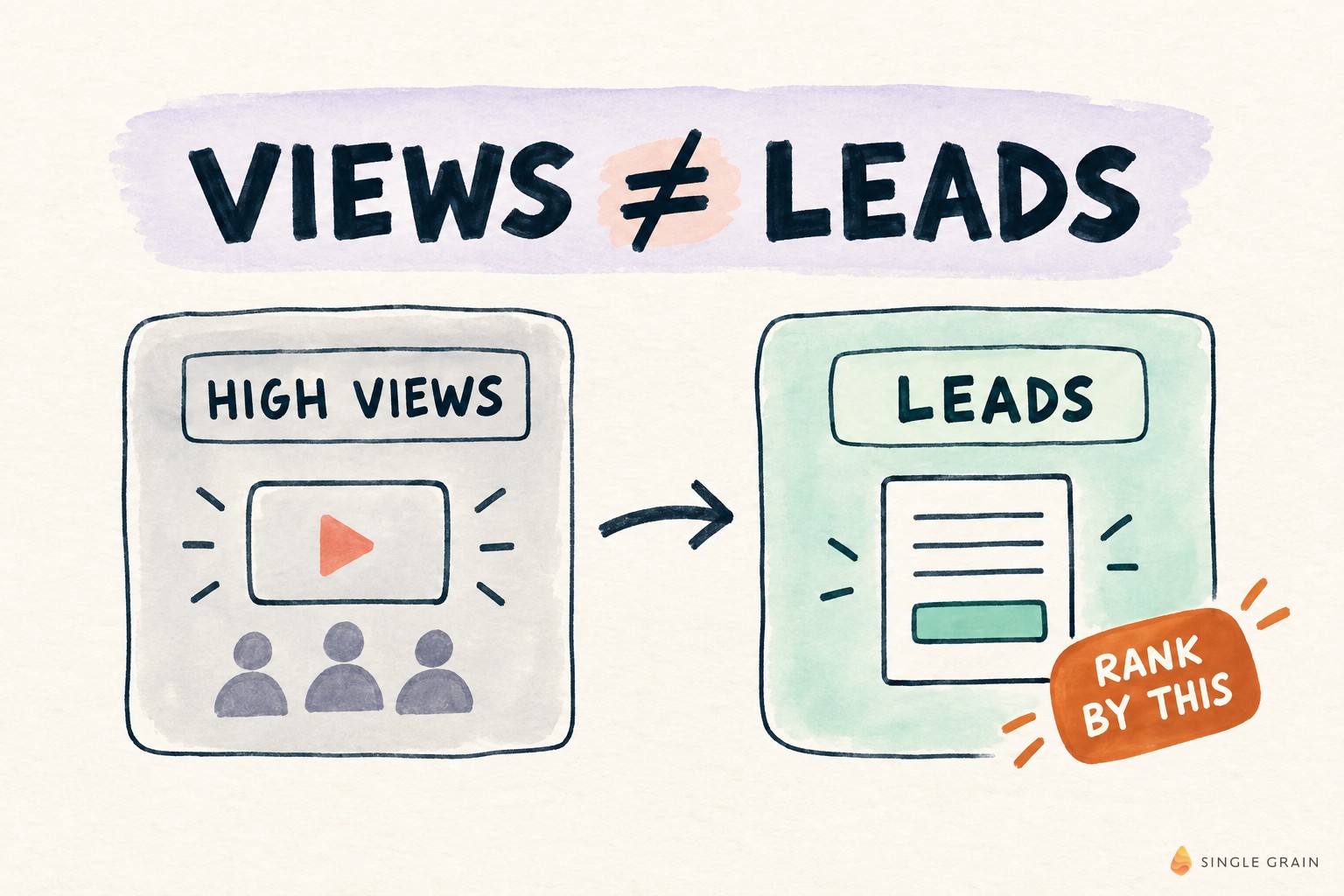
In Eric Siu’s September views-versus-leads postmortem, the artifact is a blunt comparison: 731,000 views brought zero leads; 134,000 buyer-relevant views brought leads. For the content lead reviewing that episode, the failure is a scorecard that rewards the larger audience without asking what happened next.
At the post-webinar review, the demand generation operator faces a related failure: an attendance report, an email list, and no owner for moving subscribers toward meetings. This second worked example is an operating design, not a reported Single Grain client result. The missing artifact is a handoff contract connecting attention to an identifiable buyer and a next action.
Job delta: Closest live content pages optimize for reach. This page ladders attention into CRM fields, qualify rules, and a meeting path : reach stays context, not the decision.
Operator artifact : attention→pipeline ladder (illustrative social asset; not a client result). RevOps blocks meeting routing until CRM field + qualify rule are written:
| Asset | Reach metric | Capture offer | CRM field | Qualify rule | Owner |
|---|---|---|---|---|---|
| Buyer-relevant social episode | Platform views | Editable source-field checklist | capture_asset=social_source_checklist | ICP title + company size | Sam, RevOps (example) |
Forrester (2026-09-08) reports 83% implementing agentic AI, so attention without a handoff owner is not pipeline.

Eric’s Jev as the fast cheap middle layer: classify, apply criteria, route between models and ops changes where control sits before the next expensive write. The same review applies Reusable workflows beat custom premium work; build them, then hand them to the team, so uncertain rows route to a human instead of auto-publishing. Together with the embedded scene above, that is three on-angle Eric tape inputs for this job, not a link dump.
TABLE OF CONTENTS:
- Why a distribution calendar is not a conversion system
- Worked scene: high-view episode that produced zero meetings
- Worked scene: handoff fields from attention to subscriber to meeting
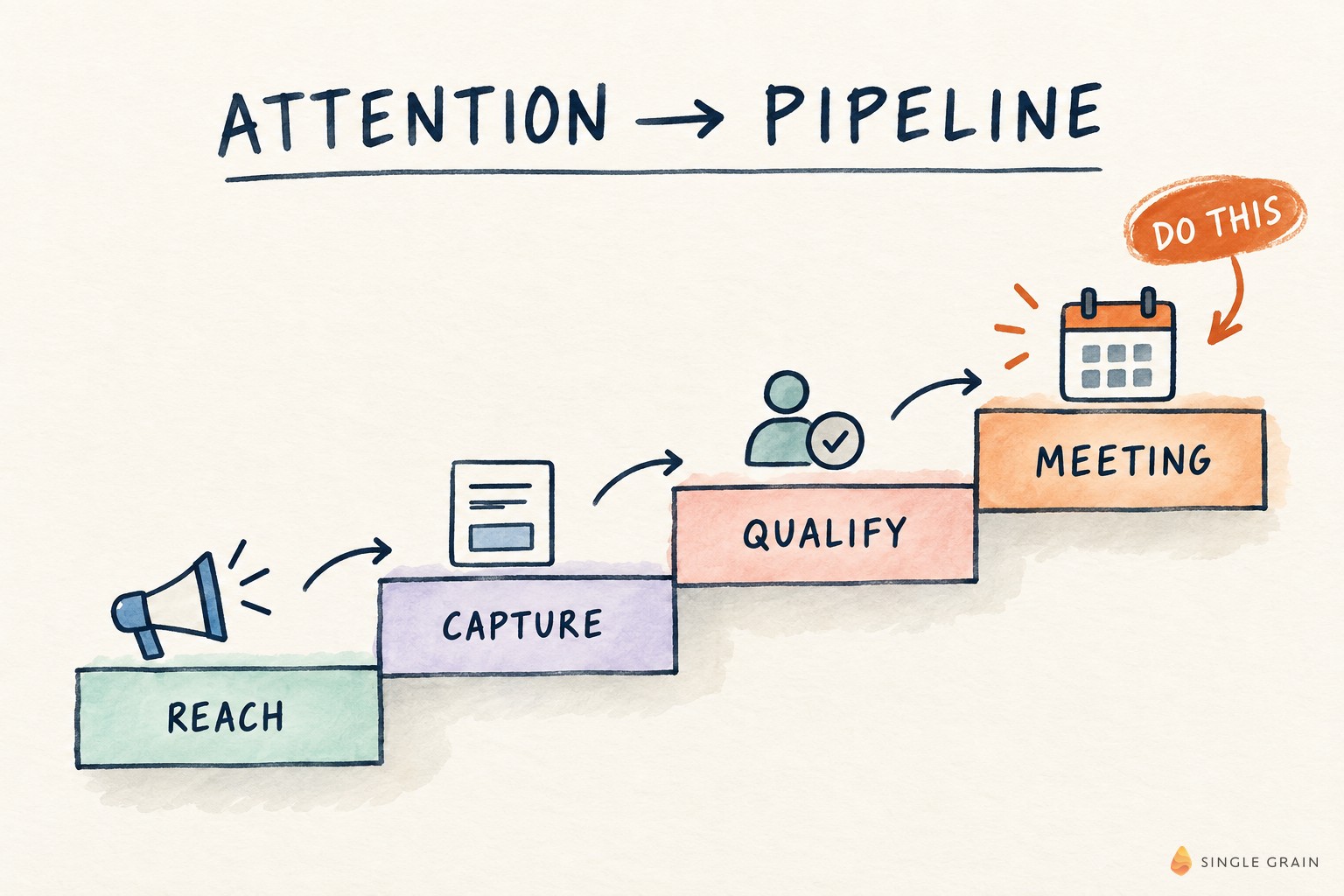
- Attention→pipeline conversion ladder (reach, capture, qualify, meeting, owner)
- Single Brain installs the system; Single Grain runs it when you need the team
Why a distribution calendar is not a conversion system
A calendar specifies where and when an asset appears. It rarely specifies what the viewer receives next, which record changes, or who handles a qualified response. That gap lets teams optimize publishing throughput while losing the evidence needed to choose the next asset.
Eric’s recommendation to give AI a way to choose better content before creating it changes the order of operations. Feed selection with buyer questions, attributed inquiries, and meeting outcomes before asking for scripts. An idea supported only by reach belongs in an awareness experiment, not automatically in the next buyer-acquisition campaign.
The Open Future Forum September report reports that 81% of 230 marketing and growth leaders were past exploring agentic AI. Attribution was the most frequently named challenge, appearing in 20 of 96 open answers. Those are different bases, not a combined adoption-to-attribution rate. The practical recommendation: establish source capture before adding more agents that generate activity.
This article starts upstream of Single Grain’s lead qualification and handoff contracts. That framework governs a lead’s onward routing. Here, the first job is choosing an asset and creating the capture event that makes a usable lead record possible.
Worked scene: high-view episode that produced zero meetings
The heading’s meeting question needs an evidence boundary: Eric reported leads, not meeting counts. In the Leveling Up views-versus-leads short, he first gives the larger figure, 731,000 views with zero leads, then contrasts it with 134,000 buyer-relevant views that brought leads. The postmortem moves from audience size to buyer relevance. It supplies no lead count for the smaller audience and no conversion rate.
Apply that lesson to the viral-post failure: the post has no email capture or meeting CTA. That missing path is the worked operating example, not an asserted cause of Eric’s result. The content lead keeps the buyer-relevant subject and tests a specific follow-on offer, such as an editable source-field checklist. Broad reach can retain an awareness budget, but it does not win the acquisition budget by default.
Success means the team can trace subscriptions and buyer inquiries to the asset, then inspect their relevance. A click or download alone does not earn “pipeline” status. The next content decision uses those downstream records alongside reach.
Worked scene: handoff fields from attention to subscriber to meeting
Return to the webinar operator’s attendance export. The topic is source attribution, and the follow-on offer is a source-field worksheet. Attendance describes engagement; an explicit subscription captures permission; a request for implementation help creates a different next action. Combining those events into one “hot lead” label destroys useful distinctions.
The operator attaches the webinar asset ID and campaign context to capture, records subscription status, and preserves the attendee’s stated implementation question. Marketing operations owns a missing-source exception. The revenue owner receives a meeting task only when buyer fit and expressed intent support it. Existing subscribers retain their original acquisition context while the webinar becomes a separate touch.
Eric’s Jev middle-layer recommendation changes the architecture: use a fast, inexpensive classification layer to apply criteria and route records before paying for elaborate follow-up drafts. Keep deterministic field validation in code. Use model judgment for interpreting a buyer’s free-text question, with an “unclear” outcome rather than forced qualification.
Use HubSpot’s property documentation to check the actual object and source fields in your portal. Do not treat deal properties, contact acquisition properties, and custom UTM fields as interchangeable. Make campaign-field population a capture-time requirement and test it on both new and existing records; do not assume the CRM will reconstruct missing context.
Attention→pipeline conversion ladder (reach, capture, qualify, meeting, owner)
The filled Attention→Pipeline Ladder below contains illustrative operating values, not performance results. Its rows describe the two scenes already covered. Reach remains visible, but each row also specifies the next offer, record write, qualification decision, and accountable role.
| Asset | Reach metric | Capture offer | CRM field written | Qualify rule | Meeting path | Owner | Next experiment |
|---|---|---|---|---|---|---|---|
| Buyer-relevant social episode | Platform views | Editable source-field checklist | capture_asset=social_source_checklist; subscription_status=opted_in when selected | Buyer fit plus explicit implementation request | Request-help form to revenue owner | Content lead; revenue owner accepts handoff | Checklist CTA versus direct help CTA |
| Source-attribution webinar | Live attendees | Source-field worksheet | capture_asset=attribution_webinar; latest_campaign=source_workshop | Relevant responsibility plus stated attribution problem and request for help | Worksheet follow-up to owned scheduling task | Demand generation lead; marketing operations handles exceptions | Worksheet offer in follow-up versus on registration page |
Turn each row into a reusable job card: inputs, allowed writes, qualification criteria, exception destination, and completion evidence. Eric’s recommendation to build reusable workflows and hand them to the team argues against commissioning a bespoke premium sequence for every webinar. Reuse the control; change the topic, offer, and campaign identifiers.
Single Grain’s CRM field contracts provide the field-level discipline. Its lead-source contracts for agent-booked meetings extend that evidence into scheduling. Count held meetings separately from booked meetings, and retain the originating capture record.
Single Brain installs the system; Single Grain runs it when you need the team
Single Brain is the AI implementation OS for agents, eval, and kill switches. For this job, the operating surface should expose the capture record, classifier decision, missing fields, assigned owner, and next action. Evaluate whether source context survives, ambiguous intent routes correctly, and subscriber-only records stay out of meeting queues. Stop routing when those controls fail.
Name the demand generation lead as the human ship gate for changes to offers, qualification rules, and outbound sequences. This is the single approval point before those changes go live.
Eric’s point that a better model still needs a better workflow supplies the walk-away rule. Do not buy a stronger model to compensate for an undefined schema. If nobody owns the next action, permission is unclear, or the offer has no buyer relevance, keep the process manual while fixing those decisions.
Build internally when your team can maintain the fields, evaluation cases, and exception queue. Hire Single Grain to install and run the system when you need the operating team without staffing it yourself. Start with one social asset and one webinar path, then expand only when their downstream evidence is usable.


