

‘Make it better’ is not feedback. The three-line revision prompt that gets a draft to shippable.



On September 7 OpenAI published its official guide to prompting GPT-6 Astra. The post announcing it, from @sairahul1, called it the most important prompting update for anyone using Astra and passed 350,000 views. Two days later Eric Siu posted his own version of the problem: “Here’s how I turn GPT-6 Astra’s first draft into something I can actually SHIP.”
The gap between a first draft and a shippable one is not the model. It is the feedback you hand back. “Make it better” gives the model nothing to act on, so it guesses. It rewrites the parts that were already fine and misses the part that actually failed.
A revision that names what to keep, what to change, and why gets a usable draft in one pass instead of five. By the end of this you will have the exact three-line prompt Eric runs on Astra drafts and the two checks that tell you when a draft is actually done.
TL;DR
- “Make it better” gives the model no target, so it swings between extremes and rewrites the parts that were already fine.
- A three-line revision prompt fixes that: KEEP names what works, REVISE BECAUSE names the exact miss and why, NEEDS TO states what the fixed version has to do.
- Save every corrected instruction as the new baseline and your prompts get sharper, dropping revisions from five rounds to one or two.
Why “Make It Better” Produces a Worse Draft
A vague instruction gives the model no fixed point to converge on, so it swings between extremes.
Eric posted the cleanest example of this. “My first GPT-6 Astra charts were too stiff. The next ones were too busy.” He told the model to loosen up, so it overcorrected. He told it to pull back, and it went stiff again. That is what “make it better” does. It builds a pendulum.
A specific instruction converges in one pass because it names three things: what to protect, what to cut, and what the result should look like. “Keep the axis labels, add one accent color, remove the gridlines” leaves nothing to guess. Better inputs, compounded over time, produce better outputs. That holds across every AI for marketing workflow, not just charts.

The Three-Line Revision Prompt
How do you give an AI clear enough feedback to get a first draft to shippable instead of telling it to make it better? You split the feedback into three lines, and each line does a different job. Skip any one of them and the pendulum comes back.
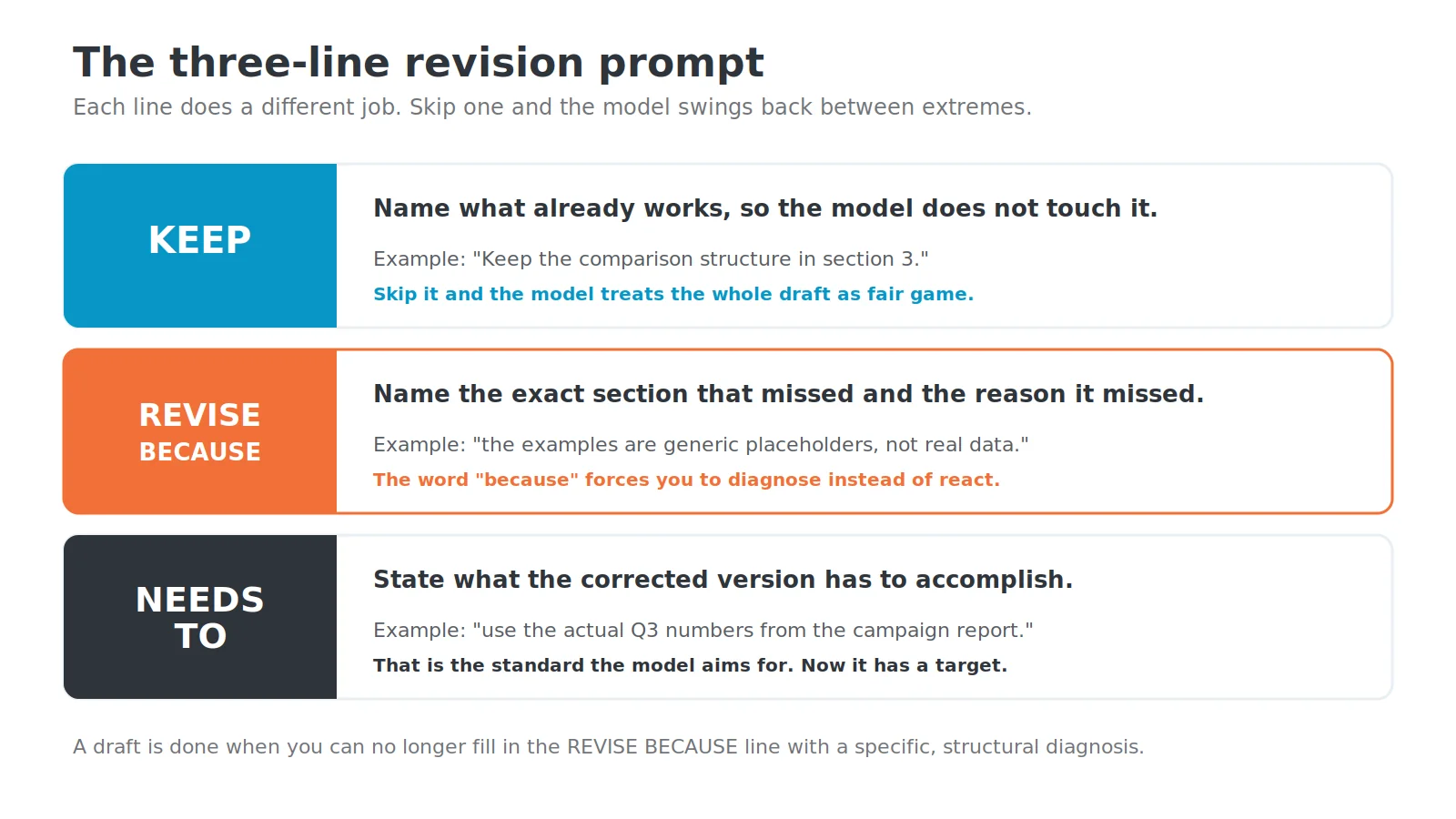
KEEP names what is already working so the model does not touch it. Drop this line and it treats the whole draft as fair game and rewrites sections you were happy with.
REVISE BECAUSE names the exact section that missed and the reason it missed. The word “because” forces you to diagnose instead of react.
NEEDS TO states what the corrected version has to accomplish. That is the standard the model aims for: “the revised intro needs to state the failure rate in the first two sentences and connect it to the reader’s last failed draft.” Now it has a target instead of a mood.
I run every Astra draft through those three lines before I read it as prose, and it is the single change that cut my own revision rounds the most.

Name the Miss, Not the Mood
Most revision prompts describe a feeling. “This feels off.” “Too corporate.” “Not punchy enough.” The model cannot act on a feeling. It needs a location and a mechanism: which section, and what that section was supposed to do but didn’t.
A question comes up constantly here: what happens when the part you want to keep is the same section that missed the mark? It is more common than it sounds. The framing of a section can be exactly right while the execution under it falls apart.
Separate the two in the same prompt. “KEEP the comparison structure in section 3. REVISE BECAUSE the examples are generic placeholders instead of real data. NEEDS TO use the actual Q3 numbers from the campaign report.” You are telling the model to protect the skeleton and replace the muscle. One prompt, two jobs, no full rewrite.
Keep Your Brand Context Current
The second question is quieter but costs more over time: how do you keep the brand context current as feedback piles up? The fonts, the colors, the examples of what sounds like you. If you retype that context every time, you lose it, and you type it slightly differently each round so the model gets conflicting instructions.
The answer is a re-save step. Every time a revision prompt produces a good result, you save the corrected instruction as the new baseline. Draft one taught the model “not that stiff.” Draft two taught it “not that busy.” The corrected instruction after draft two reads “one accent color, clean gridlines, axis labels in 11pt Inter,” and it replaces both vague notes.
Now the context compounds instead of resetting. You stop re-explaining what on-brand means because the saved instruction already encodes it. That matters most when several people prompt the same model, since a shared, updated instruction keeps everyone converging instead of each person rediscovering the brand rules. If you already keep a library of ChatGPT prompts, the re-save step turns those static templates into living documents.

Turn the Fix Into a Saved Skill
The real time savings show up in every draft after the one you just fixed. When you diagnose a failure, write the fix, and confirm it works, you have made a reusable piece of knowledge. Save it and label it. A saved skill is not a full prompt, it is a labeled correction pattern:
- Problem: the model defaults to generic examples when asked to add proof.
- Fix: “REVISE BECAUSE the examples are hypothetical. NEEDS TO pull from the named data source and cite the actual metric.”
- Result: the model stops inventing case studies and references the real source.
Stack enough of these and your prompt library stops looking like a pile of templates and starts reading like an operating manual. Teams already running AI tools across their marketing find this compounding effect is what actually drops the revision rounds from five to one or two.
It also tells you when to stop. A draft is done when you can no longer fill in the REVISE BECAUSE line with a specific, structural diagnosis. “I don’t love it” is not a diagnosis. “The CTA restates the headline instead of naming a next step” is. If you can write the second version, you have one more pass to make. If you can only write the first, you are done, or you are too close and need a second set of eyes.
Build Your AI Revision System With Single Grain
If you want a team that builds these revision systems, saved skill libraries, and brand-aware prompting workflows for you, Single Grain’s AI content agency sets up the feedback loops so your team ships faster drafts with fewer rounds. Book a free consultation and we will show you how the system works on your own content.


