How to Optimize Brand Mention in AI: Get LLMs to Name You


Are you panicking because ChatGPT recommended rival brands to a buyer, while you still can’t tell how to optimize brand mention in AI? Listen, we’ve ALL been there.
If you want to learn how to earn accurate brand mentions and citations in answers from ChatGPT, Gemini, Perplexity, and Google AI Overviews, you’ve come to the right place. I’ve been at the forefront of AEO since the beginning, and I’ve learned quite a few tricks to see more success!
Your job here is to earn a fair mention in the answers buyers already trust. The sections below cover what a brand mention is, the proof behind a stronger mention, how to get cited by ChatGPT, and a simple loop for improving those mentions over time.
TL;DR
- A mention is a name in the answer. You want the assistant to name you accurately, and ideally to cite a page buyers can trust.
- Earn the mention with proof buyers can quote. Put a clear claim, evidence, and your product name on a durable page, then get the same facts repeated off your site.
- Citations and mentions work together. A source link helps, and a clean name-drop in the spoken answer is what a buyer often remembers.
- Recheck a small set of real buyer questions. Log what the model says, fix the facts on the page, and run the same prompts again after you publish changes.
What Brand Mentions in AI Actually Mean
When a buyer asks an assistant for recommendations, the model usually returns a small set of names, a short reason, and sometimes a link. Brand mentions in AI are those appearances of your company, product, or distinctive offer inside the answer itself.
This is adjacent to generative engine optimization, which focuses on being selected and described fairly in AI answers. The mention is the unit a buyer hears. The page you publish is the evidence the model can lean on.
Google explains how AI features in Search draw on web content and still depend on helpful, reliable pages. The same idea shows up in chat assistants. If your facts are hard to quote, the model will often reach for a competitor whose description is easier to repeat.
The 3 Outcomes You Should Score
Before you change a page, write down what the assistant is already doing. Score each buyer question against three outcomes so the work stays specific.
Named in the answer means the model says your brand out loud in the response. Cited as a source means it points to a page you control or a page discussing you. Named with a wrong claim means you appeared, yet the description is outdated, too narrow, or simply false.
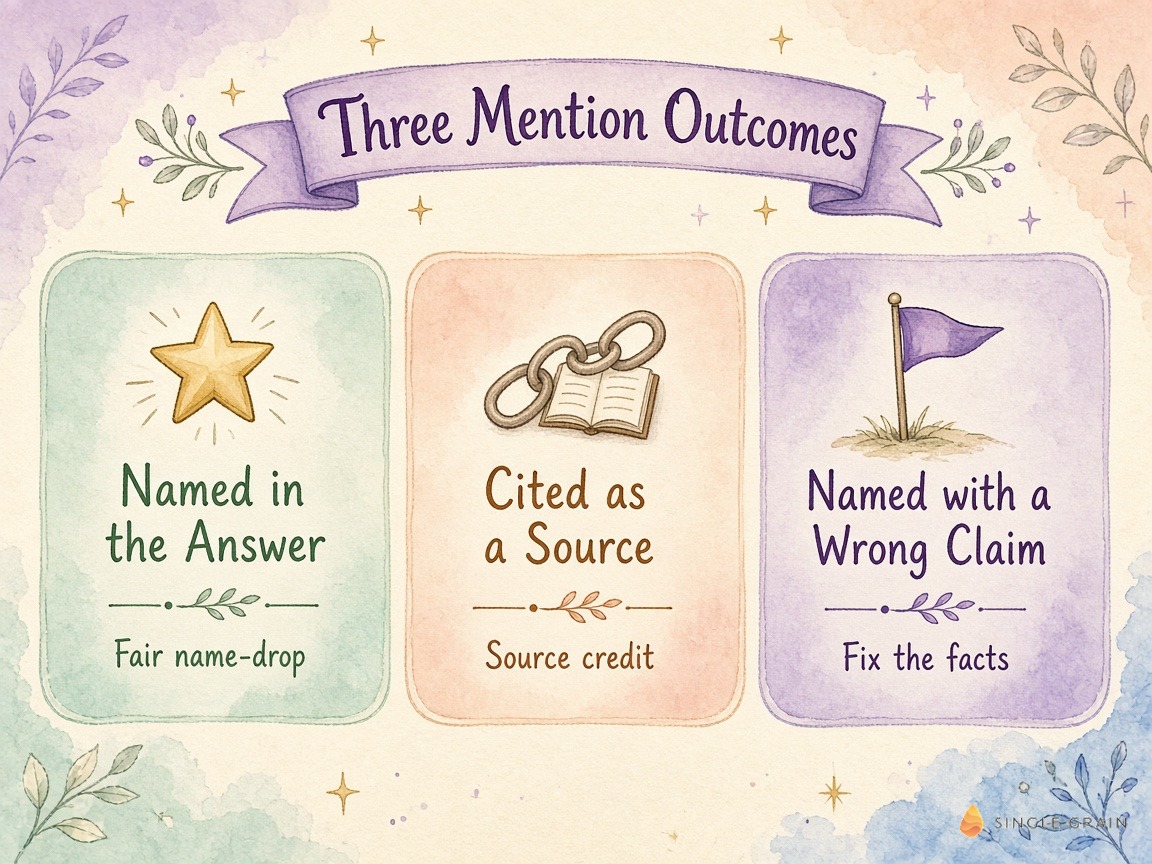
Each outcome asks for a different next action. A missing name usually means the model cannot match you to the job the buyer described. A citation without a name still helps a careful reader, yet many buyers never click. A wrong claim needs a factual correction on a page the model can find again.
Keep this scoring light. You are not building a full monitoring program here. You are giving the rest of the work a clear target so you can earn a better mention on the next pass.
How to Optimize Brand Mentions in AI With Proof Buyers Can Quote
Assistants do not invent a stable brand story from a slogan. They borrow language from pages stating a claim, showing proof, and keeping the product name next to both. If you want a durable mention in a sales conversation, start by making this language easy to lift.
The moves below work together. A strong page without outside corroboration is easier to ignore. Outside mentions without a durable source page give the model nothing clean to quote.
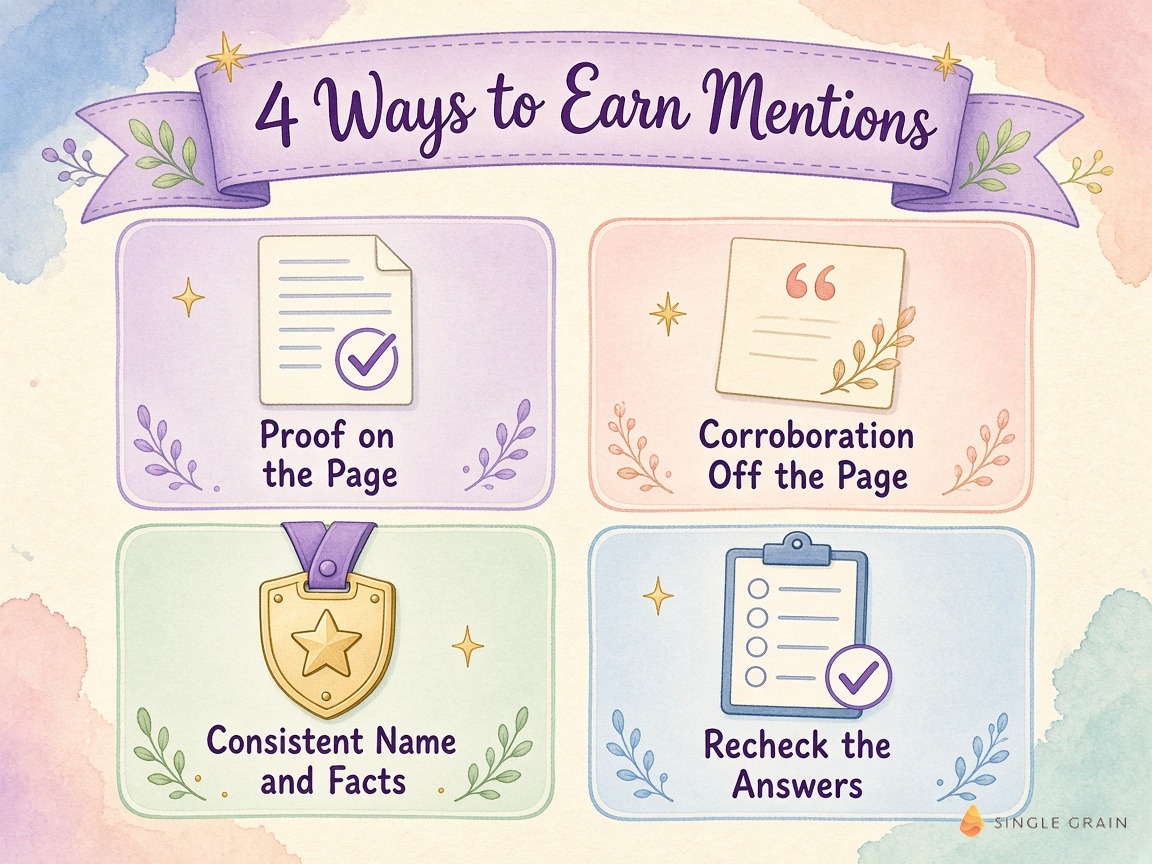
Use the first three moves to change what the model can learn. Save the fourth move, the recheck, for the loop later in this post so you can see whether the work landed.
1. Put Proof on the Page
Pick one buyer question you actually hear, then write one page answering it in plain language. State who the product is for, what result it supports, and the evidence behind the claim. Keep your brand name in the same paragraph as the proof so the two travel together.
Evidence can be a method, a constraint, a before-and-after workflow, or a documented customer result you are allowed to share. Vague praise is easy to skip. A concrete sentence is easier for a model to reuse and easier for a buyer to trust.
| Pro-Tip |
|---|
| Write one quotable sentence naming the product, the buyer job, and the proof in the same line. If a stranger can repeat it after one read, you are closer to a mention the assistant can copy without guessing. |
Google’s guidance on creating helpful, reliable, people-first content is a good test for this page. If a human would still find the answer useful after the click, you have given an assistant better raw material too.
2. Get Corroboration Off the Page
Models look for the same facts in more than one place. A comparison article, a documentation page, a well-sourced community thread, or digital PR work earning ChatGPT citations can repeat your claim in language you do not fully control. This outside agreement is often what turns a buried page into a mention.
Stay honest in this work. Ask for a correction when a review is wrong, and offer a clearer description when a partner page is vague. The goal is the same fact appearing in enough trusted places, so the assistant has less reason to improvise.
Media campaigns can support this, especially when ads shape the queries and content models later encounter. Paid search can seed brand mentions in AI models when the campaigns reinforce the same name, offer, and proof you publish organically. Treat ads as one input, then keep the source page current so the mention stays accurate.
3. Keep the Name and Facts Consistent
Assistants get shaky when your site uses three product names, two pricing stories, and an old category label on a high-traffic page. Choose the official name, the official descriptor, and the official proof point, then repeat them on the homepage, the product page, and the article a buyer is most likely to find.
Add structured organization details where they belong, including the official name and URL in Organization markup. Markup will not earn a mention on its own. It does reduce ambiguity when the model is trying to attach a name to a product.
If a rebrand is in progress, put a clear line on the old URL naming the current product and explaining the change. Leave both names unexplained, and you may get a half-right mention and confuse the buyer. Once the name and the proof are stable, the next job is getting the assistant to cite a page worth showing.
How to Get Cited by ChatGPT and Other Assistants
A citation is the trail of evidence behind the mention. How to get cited by ChatGPT starts with a page the model can retrieve, understand, and trust enough to show as a source. The citation is useful. The spoken name in the answer is still the part most buyers repeat in a meeting.
Write the page as if someone will quote two sentences from it and nothing else. Lead with the answer, then add the proof, then add context. Include the product name near the claim so a citation and a mention can come from the same passage.
How LLM Brand Mentions Differ From Classic Press Mentions
Classic press mentions often live in a story a reader may never finish. LLM brand mentions show up as a compact recommendation, a comparison, or an example inside an answer. The bar is tighter because the model has to summarize you in a few words.
This is why a long thought-leadership essay can lose to a clear product page. The essay may be insightful and still be hard to compress. The product page can be plain and still be easy for the assistant to repeat without dropping an important fact.
For Google-facing answers, the same discipline applies to optimization for Google AI Overviews. You want the page to be extractable, current, and easy to attribute. A tidy source link plus a correct name is the best version of this outcome.
When a citation appears without your name in the spoken answer, strengthen the quotable sentence. A name without a citation needs stronger page evidence and off-site corroboration so the model has a source worth showing. Those fixes land better when you recheck the same buyer questions after you publish.
A Practical Loop for Improving LLM Brand Mentions
Once the page and the corroboration are in place, you need a way to see whether the mention improved. Keep the loop small enough to repeat. A huge dashboard can wait. A handful of real buyer questions is enough to start.
Here’s what I would do. Write eight to twelve prompts in the language your buyers actually use, then run them in the assistants those buyers already open. Log the date, the prompt, whether you were named, whether you were cited, and any wrong claim in the answer.
Build a Short Prompt Set From Real Questions
Pull questions from sales calls, search queries, and support tickets. Include comparison questions, “best for” questions, and the job-to-be-done wording people use when they are in a hurry. Avoid stuffed keyword phrases you would never say out loud.
Run the same set after you publish a change, and give the assistants time to see the new page. You will not get a perfect laboratory result. You will get a clear before-and-after picture of whether the mention got more accurate.
If you need a dedicated measurement stack later, use a tool for monitoring AI citations and answer engine visibility, or a workflow for tracking your ChatGPT mentions. Those resources help you watch the answers. The loop in this post is for changing them.
Fix What the Answers Get Wrong
Take the wrong claim literally. If the assistant describes an old plan name, update the plan name on every page still ranking for this question. For a wrong category, write one clarifying paragraph naming the category you do serve and the one you do not.
Then look for a second source already telling the truth and, if needed, ask for a correction there too. One fixed page is a start. The same fact in two or three trusted places is harder for a model to ignore.
Close the loop by rerunning the original prompts and recording what changed. Keep the sheet simple enough for someone else on the team to continue it next month without a briefing. The loop will also surface a few patterns that quietly weaken mentions, and those are worth fixing early.
Common Mention Mistakes to Fix First
Most weak mentions come from avoidable confusion rather than a missing trick. If you recognize one of these on your site, fix it before you add more content.
First and foremost, let’s address the elephant in the room: Poor quality content. Five thin variations of the same article dilute the proof. The model then has to choose among near-duplicate pages and may pick none of them. Combine the best evidence onto one durable URL and point related pages to it.
Another common miss is treating mentions as a reporting job only. Logs and screenshots are useful, and they will not put your name into the next answer. Earn the mention first, then measure it.
A third miss is letting paid campaigns and organic pages tell different stories. If the ad promises one outcome and the landing page buries this outcome, the assistant has no stable fact to reuse. Align the claim, then let each channel repeat it.
For a broader operating system around this work, the complete guide to generative engine optimization walks through how GEO fits beside classic SEO. Use this post for the mention itself. Turn to the broader guide when you are ready to build the rest of the program around it.
Get Your Brand Named in the Answers Buyers Already Trust
Buyers are already asking assistants for recommendations, and those answers can shape the first short conversation they have about you. You do not need a sprawling stack to start. You need one honest page, a few outside sources in agreement, and a short recheck loop on the questions you care about.
If you want help earning stronger mentions in assistant answers, talk with Single Grain about SEO services and generative engine optimization for the pages and proof your buyers already ask about.
Frequently Asked Questions About Brand Mentions in AI
-
What does it mean to optimize brand mentions in AI?
It means earning accurate name-drops and citations in answers from tools such as ChatGPT, Gemini, Perplexity, and Google AI Overviews, then improving how often and how fairly those answers describe you.
-
How is this different from tracking brand mentions?
Tracking tells you what an assistant already said. Optimization work changes the pages and corroboration a model can use, so the next answer is more likely to name you correctly. Use tracking after you publish changes, or see Single Grain’s guides on monitoring tools and ChatGPT mention tracking.
-
How do I get cited by ChatGPT?
Publish a durable page that answers a real buyer question with a clear claim, proof, and your product name in the same passage. Then get the same facts repeated on trusted pages you do not fully control, and recheck the original prompts after the changes go live.
-
Can paid search help me earn mentions in AI answers?
Yes, paid search can support the same name, offer, and proof you publish organically, and it can seed mentions when campaigns reinforce those facts. Keep the source page current so the mention stays accurate.
-
How often should I recheck assistant answers?
Run a short set of real buyer questions after you publish a meaningful change, then keep a monthly pass so someone else on the team can continue the sheet without a long briefing. Give assistants time to see the new page before you judge the result.