

AI Avatar Video: Should Your Digital Twin Post Daily?


Filming a video every day sounds great until you get to day three. I get it, because I’ve felt the same pull. But trust me, it gets old fast. Luckily, AI avatar video promises a way out.
You record yourself once, and a licensed digital twin keeps putting out new episodes in your face and voice. Ryan Serhant, a well-known real estate entrepreneur, is already running a daily video series just like this.
Should your digital twin take the mic? Here’s where an AI avatar video helps, where viewers push back, and how to run it well.
TL;DR
- AI avatar video turns one recording session into ongoing content. A digital twin can deliver scripted videos in your likeness, so filming stops being the bottleneck.
- Scripts become the hard part. With production solved, the quality of your ideas and the person who approves each script decide whether the series works.
- Trust is the open question. Viewers wonder whether the connection and confidence of a real person carry over, especially for personal or high-stakes topics.
- Disclose, own the approvals, and measure cost per video. Label avatar content, keep final sign-off with the real person, and track full production cost before you scale.
How AI Avatar Video Works
An AI avatar is a digital likeness of a real person, trained on recorded footage and voice recordings. Once it exists, you feed it a script, and it produces a video of “you” delivering those words. A digital twin is the same idea used on an ongoing basis, often with the person’s formal permission and brand rules attached.
The workflow changes in a clear way. Before, every video required a person on camera, lighting, takes, and editing. Now, the person records once, a team writes scripts, someone approves them, and the avatar renders each episode.
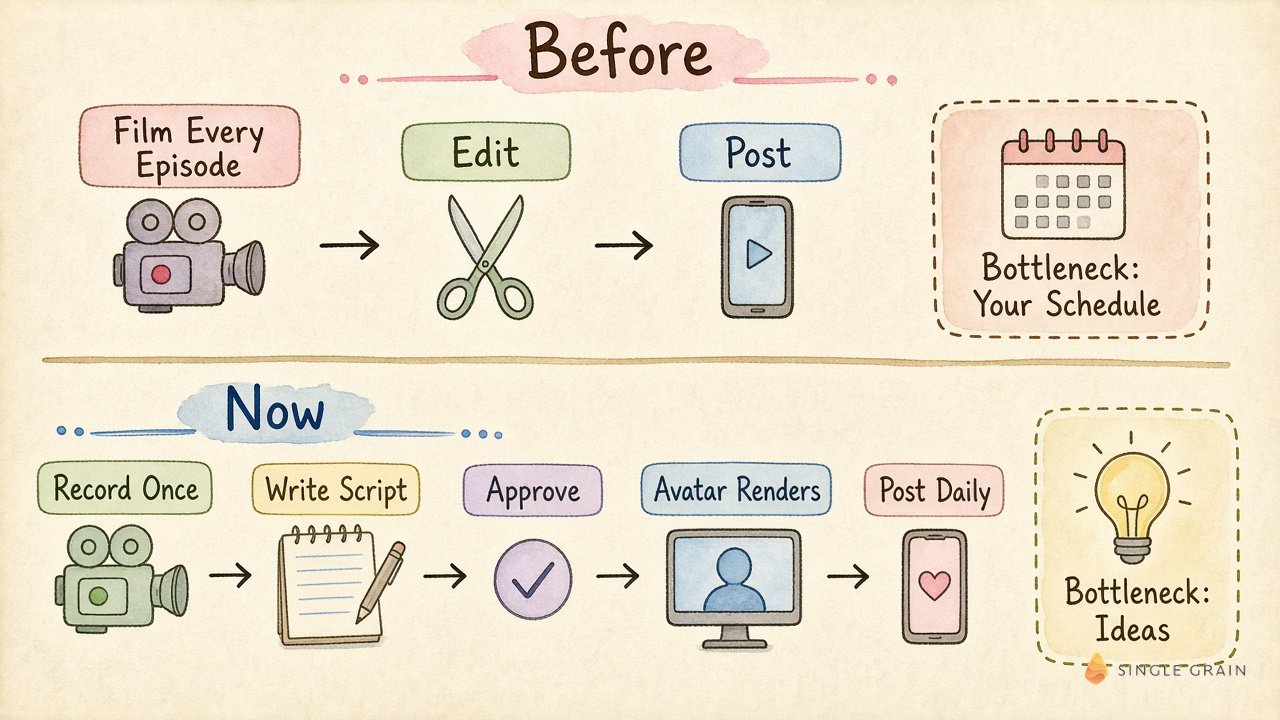
Seen side by side, the shift looks like this:
| Step | Traditional Video | AI Avatar Video |
|---|---|---|
| Filming | Every episode | One initial session |
| Scripting | Often loose or improvised | Fully written for each video |
| Approval | Happens on set | Needs a clear sign-off owner |
| Main bottleneck | The person’s calendar | Ideas and script quality |
So why are people raving about this? Cheaper production is only part of the story. Avatars also remove the need for a perfect on-camera day, which is why so many advocates call it a natural fit for busy consultants, founders, and educators.
All you have to do is record yourself once. Then each video moves from script to approval to avatar render to a daily post.
Where AI Avatar Video Helps Most
When it comes to AI avatars, this is what I’ve found.
Avatar video shines when the message is useful, repeatable, and low risk. Good fits include:
- Educational tips such as weekly sales lessons or product how-tos.
- Market updates that follow a set format and can be fact-checked.
- Onboarding and training videos that need frequent refreshes.
- Localized versions of a strong video in other languages, which this overview of AI video voiceovers explores further.
One reply put the dividing line well:
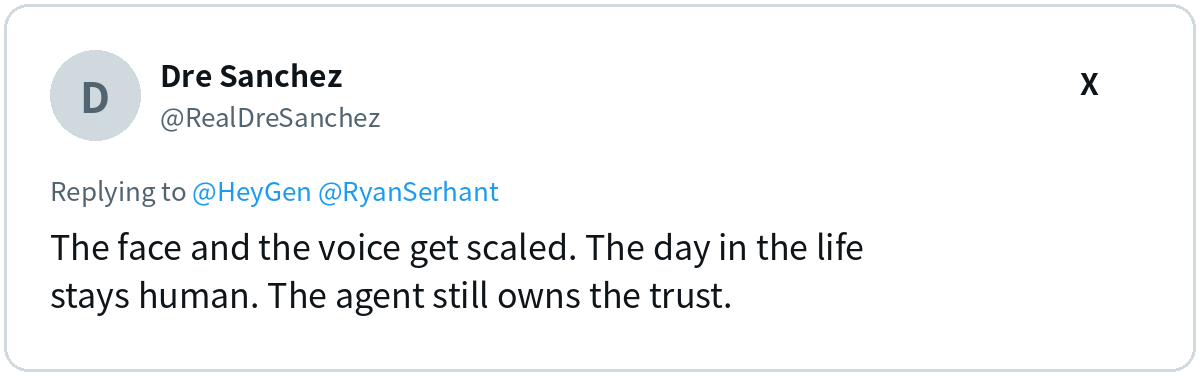
My team at Single Grain sees it the same way, and our view matches this split. Let the avatar handle frequency, and keep the moments that build relationships, such as live calls, events, and personal stories, with the real person.
| What You Should Do |
|---|
| List your ten most-asked customer questions. Turn each into a 60-second script, and use those as your first avatar episodes, since answers to real questions are easy to verify and genuinely useful. |
Who Makes AI Avatar Video Tools?
You do not need a custom build to try this. A handful of platforms already sell digital-twin and stock-avatar video, and they solve different jobs.
- HeyGen for creator and marketing twins. This is the tool behind many of the founder-style daily series you see on X. It is strong for lip-synced translations and short social clips, and it is the platform the real estate entrepreneur in this post used.
- Synthesia for enterprise training at scale. Large companies lean on it for onboarding and compliance video, with a big stock-avatar library and heavy language support. It is less about your personal twin and more about polished, repeatable internal video.
- Colossyan for interactive learning. Teams building scenario-based training with quizzes and branching paths often land here. Think L&D modules, not a public-facing personal brand channel.
There are smaller options too, like D-ID for lighter creative work.
For a founder or executive trying to post daily in their own face and voice, start by comparing a HeyGen-style twin against filmed content for the same script. For internal training, Synthesia or Colossyan are usually the better first look. Either way, I recommend pricing the full episode cost (software plus scripting and review), not just the monthly plan. More on this later!
3 Questions to Answer Before You Launch
Let’s play devil’s advocate. The skeptics on these AI avatars were less about the technology and more about how a series is run. Each one of these questions maps to a decision you should make up front.
1. Who Approves Each Script?
In response to Ryan Serhant’s use of AI avatars, people asked who signs off when an episode takes a hot stance on housing prices: the person or the team?
This question matters a lot because an avatar says exactly what it’s given, in a voice people trust. My recommendation is to always name one approver and require their sign-off on the opinion, number, or prediction that is stated by the AI.
2. What Does a Finished Video Really Cost?
Software pricing is easy to find. But the full cost of one publish-ready episode is much harder to pin down, because monthly plans and per-second rates leave out scripting, review, and editing time.
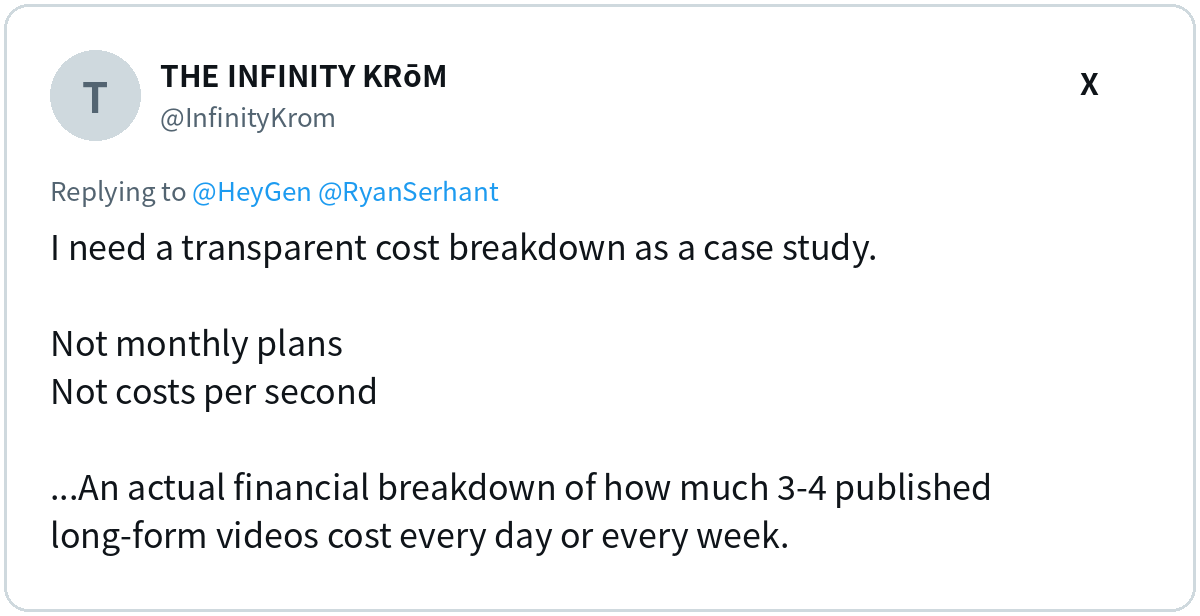
This request is fair, and most teams should build the breakdown themselves. Include software fees, scriptwriting time, review time, editing, and distribution. I like to compare total per video against my current production cost to see whether the series truly saves money.
3. Is the Content Worth Watching?
A digital twin solves the filming problem, but it can’t solve the “what do I say today?” problem. Daily output burns through ideas fast, and a perfectly rendered avatar reading a thin script still feels thin. Viewers also notice when the energy of a real person is missing, so the script has to carry more weight than it would on camera.
Here’s how I’d keep a daily avatar series worth watching:
- Build a topic bank before launch. Aim for at least a month of ideas pulled from sales calls, customer questions, support tickets, and industry news, so you never start a day from a blank page.
- Give every episode one job. Answer a single question, share one opinion, or break down one result. Episodes trying to cover three ideas in 60 seconds lose people.
- Write for the ear, not the page. Short sentences, a strong first line, and a clear takeaway help an avatar sound natural. Read each script out loud before it goes to the tool.
- Bring in real proof. Specific numbers, client stories, and your actual opinions are what make content feel like you. Generic tips are exactly what makes an avatar feel synthetic.
- Mix in real footage. Film yourself for the big moments, like launches, hot takes, or personal stories, and let the twin handle the routine explainers.
- Watch retention, not just views. If people drop off in the first few seconds, fix the hook. If they drop off midway, the script is running long.
I like to treat the avatar as the delivery system and my ideas as the product. If the ideas are strong, the format scales. If they’re weak, posting daily just shows more people the weakness.
Disclosure and Brand Safety for Avatar Content
Viewers deserve to know when they are watching an avatar. YouTube asks creators to disclose altered or synthetic content that looks realistic, and other platforms have similar labels. If any video promotes a paid partner, the FTC’s guidance on endorsement disclosures still applies.
Build these safeguards into your process:
- Get written consent and usage terms covering how the likeness may be used and when it must stop.
- Label every avatar video in the video itself and in the caption.
- Set off-limits topics, such as personal news, crises, and legal matters, which the real person handles directly.
- Plan for change. One reply asked what happens when the real person’s public image shifts, so review the avatar’s look and voice on a regular schedule.
Your personal brand is the asset being scaled, and it took years to build. There are good reasons why CMOs invest in their personal brand, and those same reasons are why you should protect it before handing it to a digital twin.
| Starter prompt for an avatar episode |
|---|
| Write a 60-second video script in my voice answering this customer question: [question]. Use short sentences, one concrete example, and one clear takeaway. Flag any statistic or opinion I need to confirm before recording. |
Scale Your Voice Without Losing Your Audience
So should you use an AI avatar for your brand? The truth is AI avatar videos can turn an occasional poster into a daily presence. But the series that last must have strong scripts, a named approver, clear labels, and a real person who still shows up where trust is built.
Want help making video a real growth channel? Single Grain’s creative strategy and YouTube ads teams help brands plan, produce, and scale video content. Let’s talk.
Frequently Asked Questions About AI Avatar Video
-
What is AI avatar video?
AI avatar video uses a digital likeness of a real person, trained on their footage and voice, to deliver new scripted videos without filming each one.
-
Is it okay to use an AI avatar of myself for marketing?
Yes, with care. Get clear usage terms in writing, label avatar videos as AI-generated where platforms require it, and keep personal or sensitive topics for the real you.
-
How much does AI avatar video cost?
Costs vary by tool and volume. Add software fees, scriptwriting, review, editing, and distribution to find a true cost per finished video, then compare it with your current production.
-
Do viewers trust AI avatar videos?
Trust depends on usefulness and honesty. Clearly labeled videos that answer real questions tend to hold up, while hidden avatars or personal stories told by an avatar risk backlash.
-
What content works best for AI avatars?
Educational tips, market updates, onboarding videos, and translated versions of strong content work well because they are repeatable and easy to fact-check.