

How to Know When a Marketing Agent Job Should Be Shut Down for Good


At a weekly growth-ops review, the lifecycle lead opens a recurring nurture job card. The scheduler is active, the audience query still resolves, and the copy points to an offer that has ended. This worked example starts with a misleading artifact: a successful run log for a job that has lost its purpose.
Beside that card, the AI-ops owner opens the retirement record: offer sunset date, queued messages, access credentials, and retention requirements. The immediate question is whether to stop this job permanently and what must survive its removal. Adding another operator would leave the underlying problem intact.
TABLE OF CONTENTS:
- Quick Overview
- Why hire-human capacity is not a decommission decision
- Worked scene: a recurring agent job that still runs after the offer died
- Worked scene: kill criteria, retention, and who turns the key
- Decommission checklist (kill signal, rollback, retention, owner stamp)
- Single Brain installs the system; Single Grain runs it when you need the team
Quick Overview
Decommission a marketing agent job when its business purpose has ended, its authorization has been withdrawn, or its necessary controls cannot be made dependable. Separate permanent retirement from a temporary incident pause. Preserve enough evidence to explain the decision, remove execution paths, and verify that the job stays off. Single Grain’s teardown approach starts with the job card, not a model upgrade.
- Tie kill criteria to business facts, including offer sunset dates.
- Separate stopping future actions from repairing previous actions.
- Assign retention rules by data class, not by convenience.
- Close every restart path, including retries and copied schedules.
Why hire-human capacity is not a decommission decision
The hire-human capacity decision asks whether valuable work needs more operating capacity. Decommissioning asks whether a particular job should continue to exist. A retired offer does not become relevant because someone has time to supervise its nurture sequence.
Use three dispositions. Keep a job whose purpose and controls remain valid. Pause a job with a repairable defect and a defined return condition. Decommission a job whose purpose has expired or whose required access is no longer justified. Poor attribution alone does not prove a job is worthless; it means the evidence needs inspection before a permanent decision.
That distinction matters as deployment expands. Open Future Forum’s September report reports that 81% of 230 marketing and growth leaders are past exploring agentic AI. Attribution was the leading named challenge, appearing in 20 of 96 open answers. Those different denominators support a practical recommendation: inventory deployed jobs and label uncertain value evidence rather than manufacturing a teardown ROI.
Worked scene: a recurring agent job that still runs after the offer died
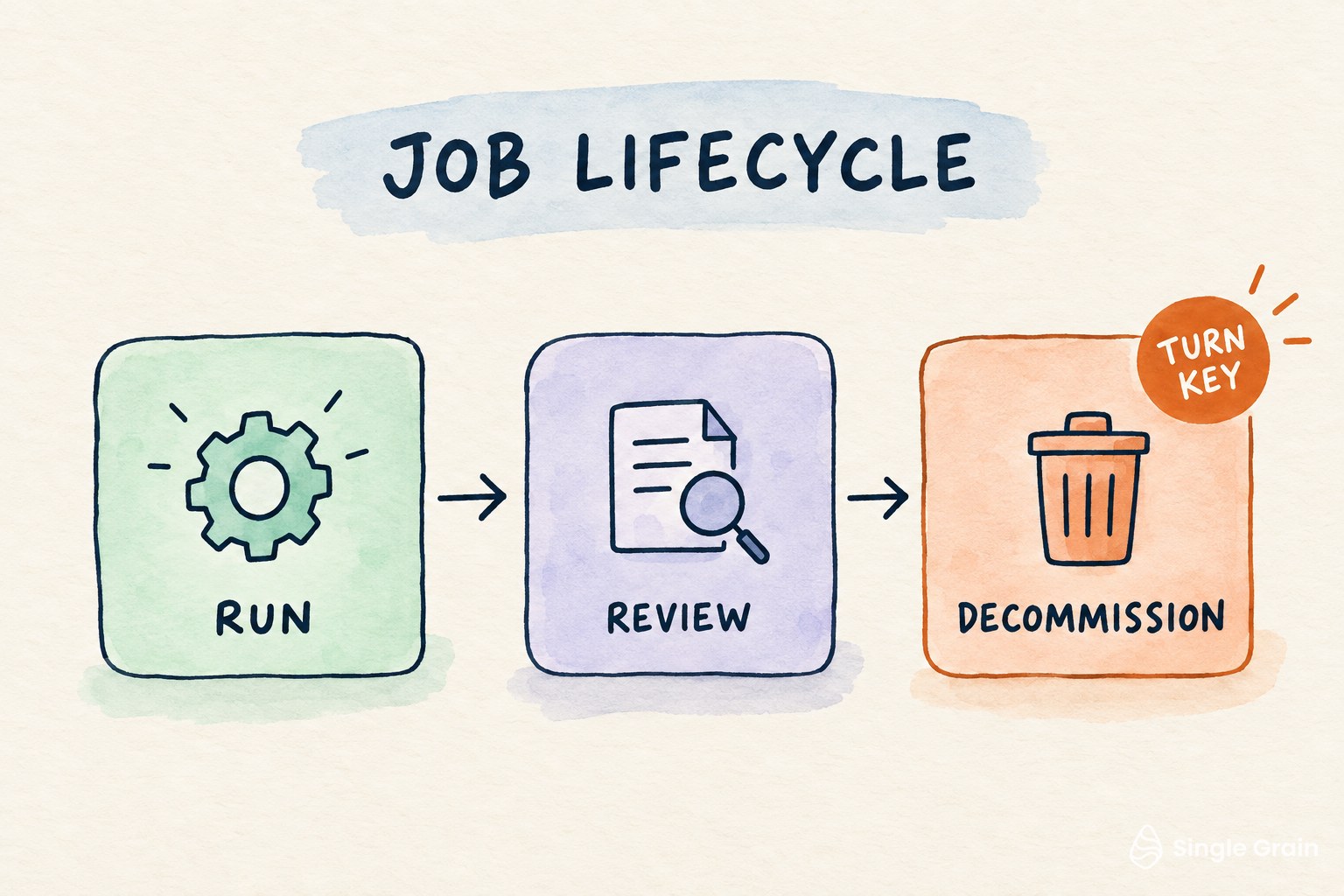
In Eric’s Leveling Up discussion of agency services becoming AI workflows, the operating sequence is straightforward: turn agency work into reusable workflows, then hand those workflows to the team to run again. Repetition is the benefit. The teardown implication is that repeatability also needs an expiration rule.
Return to the nurture job in the opening example. Its inputs are an audience query, approved offer details, and a sequence template. Its output is a scheduled message batch. The lifecycle lead compares the offer’s sunset date with the next scheduled run and finds that the job’s eligibility has ended. A clean execution log cannot override that business fact.
Mark the job DECOMMISSION on its reusable card. Record the reason, the last valid offer version, the queued batch identifiers, and a retention deadline derived from the applicable records policy. Do not invent a universal storage window. If the campaign contains consent records, those records may follow a different schedule from generated copy.
Eric’s workflow recommendation changes the artifact here: productize the retirement control along with production. Every reusable job card should carry a purpose, authoritative input source, expiration condition, and removal procedure. Single Grain’s company-brain approach to preventing agents from guessing the ICP is relevant because the offer’s status must come from an owned source, not the agent’s interpretation of old copy.
Worked scene: kill criteria, retention, and who turns the key
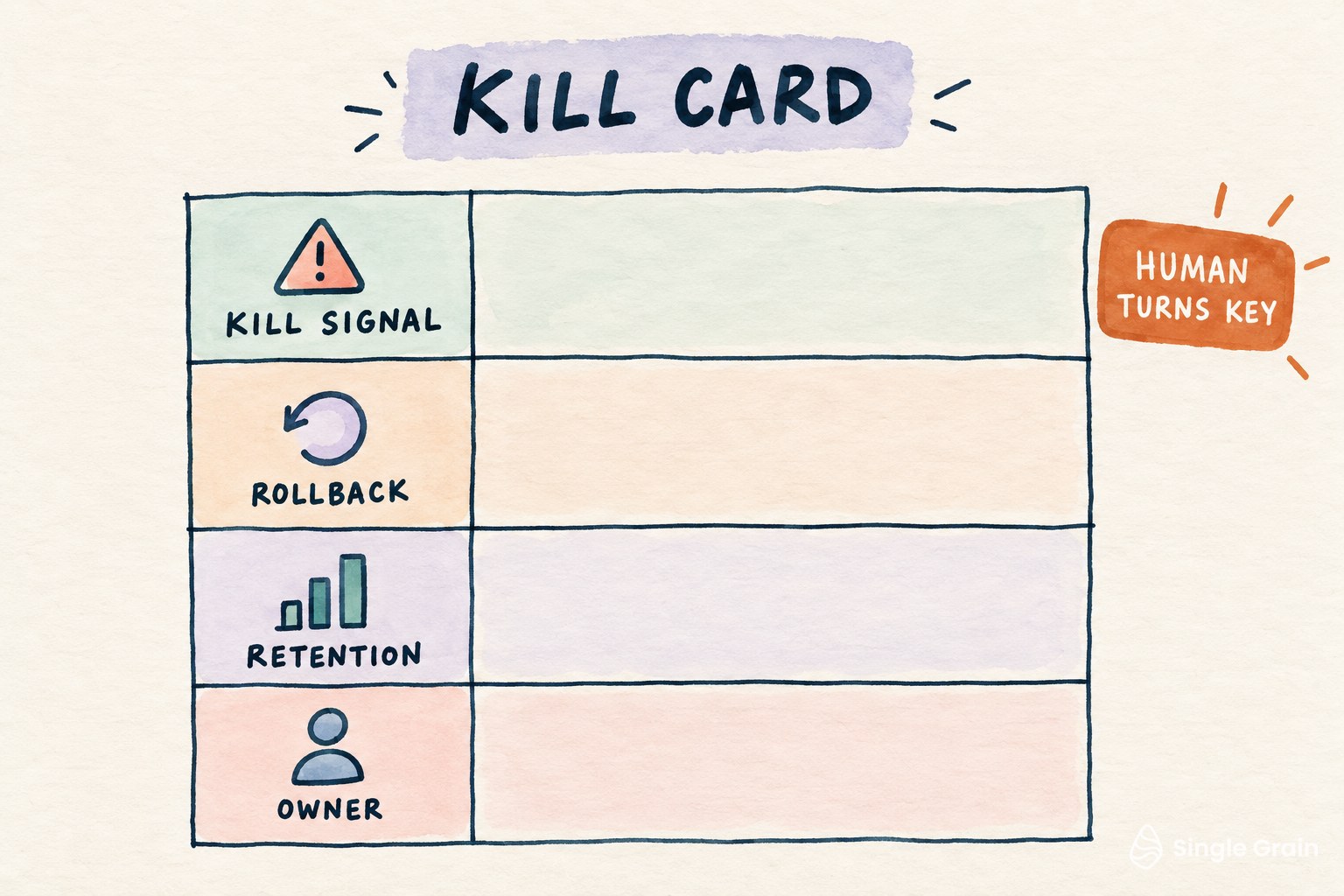
The AI-ops owner now takes the marked card through teardown. In this illustrative continuation, the offer has expired, but a retry queue and a shared campaign credential remain active. Disabling the visible scheduler alone would leave another execution path open.
Eric’s point that people still supply taste, review, and workflow management determines the ship gate: the named lifecycle owner approves irreversible writes and teardown, and the named AI-ops owner executes the stop. Record their names on the card. The agent may assemble evidence, but it cannot authorize deletion, send a final batch, or revive itself.
Apply the same boundary to ambiguity. Eric’s Jev discussion emphasizes classification, test criteria, and routing uncertain cases. If the offer record conflicts with a campaign brief, route the discrepancy into that review instead of automatically deleting the job. His decision-layer discussion also allows for thin evidence and improving checks through feedback. Label the conflict unresolved, then add it to the retirement evaluation set.
The operator cancels queued sends, disables retries and webhook subscriptions, and revokes job-specific access. For shared credentials, remove this job’s permission without breaking unrelated workflows. Rollback restores affected configuration or audience membership where feasible; it cannot unsend delivered email. Use Single Grain’s agent incident-response guidance for that remediation track.
Forrester reports 83% of B2C marketing decision-makers are implementing agentic AI, spanning seven categories and 52 use cases. That breadth argues for dependency checks before revocation. It does not establish a failure rate or prove that any individual job deserves retirement.
Decommission checklist (kill signal, rollback, retention, owner stamp)
Use one closure record per job. The marketing-agent pipeline RACI supplies the ownership structure; the retirement card supplies the evidence.
- Kill signal: record the expired purpose, revoked authorization, or unmet control requirement. Distinguish confirmed facts from missing evidence.
- Execution stop: enumerate schedules, queues, webhooks, credentials, and downstream triggers. Verify each disabled path.
- Rollback: identify changed assets and available snapshots. Document irreversible effects and remediation separately.
- Retention: classify logs, prompts, audience data, consent records, and configuration. Assign policy-based deadlines, access restrictions, and any legal holds.
- Owner stamp: preserve the decision record, completion evidence, unresolved dependencies, and closure date. Require a new job authorization for any replacement.
Walk away from automation when nobody can define the authoritative offer status, permitted action, or termination condition. Eric’s better-model, better-workflow discussion changes the purchase decision: do not buy a stronger model to compensate for a missing schema or control. Establish the source fields and checks first. Until then, keep the task manual or stopped.
Bloomberg’s September coverage of Newsom’s proposed AI kill switch and additional oversight adds a policy reason to document an off-ramp. Treat it as proposal coverage, not an enacted marketing-agent requirement.
Single Brain installs the system; Single Grain runs it when you need the team
Single Brain is the AI implementation OS for agents, evaluations, and job-specific kill switches. For retirement, the installation should connect each job’s purpose and permissions to its evaluation checks, stop procedure, retained evidence, and restart restrictions.
Hire Single Grain to install and run that operating system without staffing the function yourself. Bring your active job inventory, offer records, and access map. Talk to Single Grain about identifying what should keep running, what needs repair, and what should end permanently.