

Simplify Before You Automate: Marketing Agents & the 64→3 Click Lesson


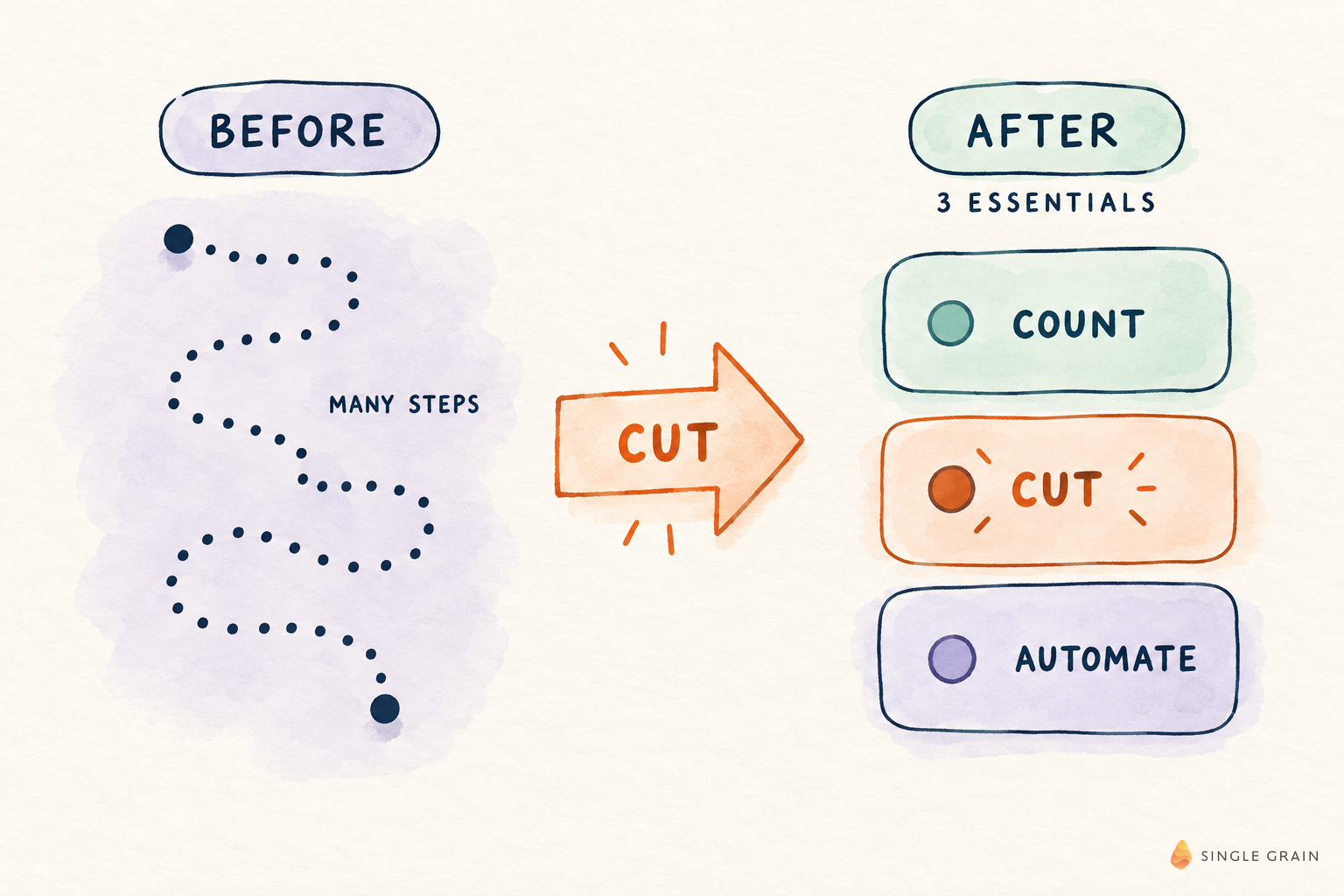
On the September 17 Marketing School episode, Eric Siu and Neil Patel discussed a website purchase path with 64 clicks. The artifact was Tesla’s checkout journey. Their account: compressing that path to three clicks accompanied a 20-fold increase in website sales. For a growth lead reviewing an agent proposal, the immediate question is how much of the proposed work should exist at all.
At the pre-deployment review, a marketing operations lead faces the same problem in a different artifact: an agent job card containing fields, routing rules, and exceptions inherited from the existing funnel. This is the operating decision explored below, not a reported Single Grain client result. Before buying execution capacity, the lead needs to separate necessary work from accumulated friction.
TABLE OF CONTENTS:
- Quick Overview
- Why reliability frameworks fail on a bloated click path
- Worked scene: field-count audit before any agent write access
- Worked scene: agent use-case readiness score before the next deploy
- Simplify-first checklist (count, cut, prove, then agentize)
- Single Brain installs the system; Single Grain runs it when you need the team
Quick Overview
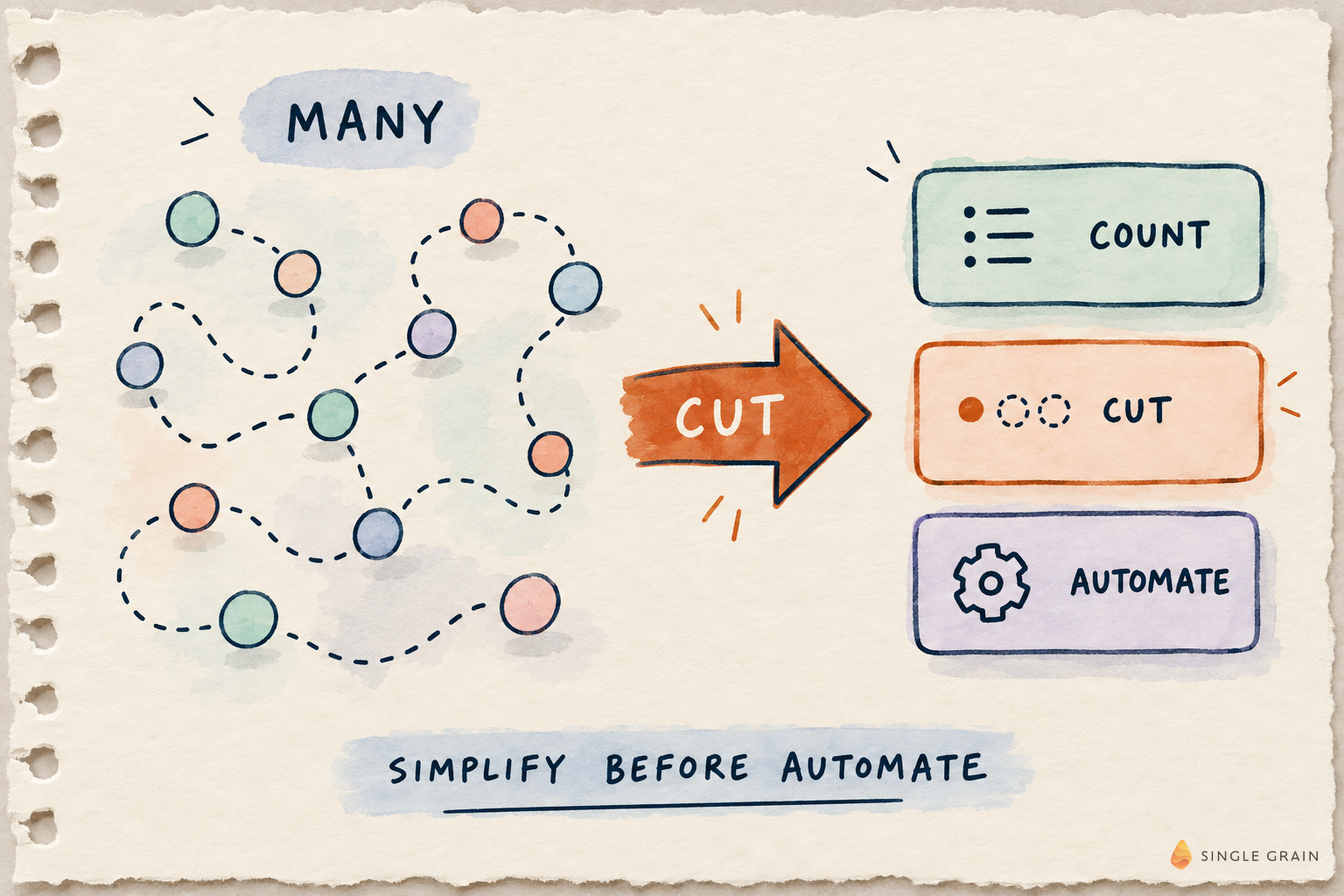
Simplify the customer and operator path before assigning it to a marketing agent. The Tesla lesson gives the sequence: question, delete, simplify, speed up, then automate. Checkout research helps identify what to remove, while a readiness review determines whether the remaining job deserves an agent. Single Grain’s recommendation is to make compression an explicit prerequisite, rather than another task inside an automation project.
- Count clicks, visible fields, handoffs, and duplicate data entry before selecting a model.
- Require a business reason for every retained input and transition.
- Decline automation when ownership, inputs, or success criteria remain unstable.
- Package the simplified path as a reusable workflow before adding agent execution.
Why reliability frameworks fail on a bloated click path
A reliable agent can execute an unnecessary process consistently. It can populate duplicate CRM fields, route a lead through redundant queues, and request information the business already holds. Better execution preserves the waste unless someone changes the job.
Single Grain’s five-step framework for reliable marketing bots addresses quality loops once automation is the chosen approach. This article addresses the earlier decision: whether the workflow should survive in its current form. A long path needs subtraction before it needs reliability engineering.
In the Tesla discussion on Marketing School, Eric and Neil describe the purchase-path reduction and resulting sales jump. That is their account of Tesla, not a Single Grain result or a forecast for your checkout. The actionable recommendation is narrower: make a click-and-field audit part of the agent proposal, and refuse to agentize the original 64-step path.
The tape’s ordering also changes procurement. Question the requirement, delete unnecessary work, simplify what remains, accelerate it, and only then automate. Tools such as Instinct and Muse come after compression. Buying them first can make the old process harder to challenge because the team has already invested in reproducing it.
Worked scene: field-count audit before any agent write access
The CRO lead starts with a checkout recording, a field inventory, and the destination schema. This is a worked audit using research benchmarks, not a claim that a particular store has already improved. The lead records every visible input, explains why it exists, and checks whether its value is already available elsewhere.
Baymard’s June 2024 checkout research reports an average of 5.1 steps and 11.3 form fields, while most sites need approximately eight fields. It also reports that 17% of shoppers abandoned because checkout was too complicated. That changes the audit priority: inspect the information requested, rather than merely combining screens to lower the step count.
The lead works from the 11.3-field benchmark toward approximately eight visible fields where the business requirements permit. An optional company field becomes a deletion candidate. A repeated address entry becomes a reuse candidate. A field needed only for a particular purchasing condition becomes a conditional-input candidate. Tax, fulfillment, and payment requirements still have to be satisfied; eight is a research reference, not permission to remove essential information.
The output is a revised field schema and a shorter, testable checkout path. Success means necessary purchase information still reaches the correct systems, customers can complete the task, and removed inputs do not reappear as downstream manual work. Measure completion and validation failures against the existing path without assuming a conversion lift.
Eric’s point that people still supply taste, review, and workflow management assigns accountability here: name the CRO lead on the job card as the human ship gate. That person owns the friction audit and approves the compressed path before agent write access. Do not allow autonomous publication or changes to the live checkout.
The buying decision follows Eric’s warning that a better model still needs a better workflow. If the unresolved problem is duplicate fields or conflicting validation rules, decline the model upgrade. Fund the schema cleanup first.
Worked scene: agent use-case readiness score before the next deploy
The marketing operations lead brings a lead-routing proposal to deployment review. Its inputs are a submitted form, CRM account data, routing definitions, and exception history. The proposed output is a correctly assigned lead with a recorded routing reason. Before selecting an agent, the lead scores readiness across priority, people, process, and technology using documented evidence rather than a fabricated precision score.
Priority asks whether routing addresses a material delay. People asks who maintains definitions and handles exceptions. Process asks whether duplicate enrichment and redundant handoffs have been removed. Technology asks whether the remaining fields have stable meanings and supported destinations. An unresolved dimension sends the proposal back for redesign; a strong business priority cannot compensate for contradictory routing rules.
The checkout comparison above illustrates the kind of evidence a readiness review needs: an observed burden and a defensible simplification target. For lead routing, use the actual field inventory and handoff map, not checkout benchmarks transplanted into a different job.
Forrester’s September 2026 discussion reports 83% of B2C marketing decision-makers implementing agentic AI and 85% reporting meaningful value. It also stresses implementation, maintenance, and monitoring resources. Budget those responsibilities before deployment instead of treating adoption figures as evidence that this particular routing job is ready.
Gartner predicts over 40% of agentic AI projects will be canceled by the end of 2027, citing escalating costs, unclear value, or inadequate risk controls. This is a forecast, not an observed client cancellation rate. Its practical implication is to refuse deployment when the job lacks a value definition or a maintenance owner.
Simplify-first checklist (count, cut, prove, then agentize)
- Count the existing path. Capture customer actions, required inputs, system transitions, and internal handoffs separately.
- Cut unjustified work. Challenge each requirement before making it faster. Preserve obligations, not historical preferences.
- Prove the compressed version. Check task completion, downstream data usability, and exception handling against the original job.
- Package the stable workflow. Define inputs, field meanings, permitted outputs, ownership, and success criteria.
- Agentize only the remaining valuable work. Choose deterministic automation when fixed rules already solve it.
Eric’s recommendation to favor reusable workflows over custom premium work changes what Single Grain should install: a repeatable compressed path, not a bespoke chain of exceptions. When every campaign requires a different schema, standardize the shared job before building another agent.
Use Single Grain’s hire-or-build guide for pipeline-owning agents after that decision. Walk away from automation when the job is unnecessary, low-value, or still changing fundamentally. Walk away from a stronger model when the missing purchase is a coherent schema.
Single Brain installs the system; Single Grain runs it when you need the team
Single Brain is the AI implementation OS for job-specific agents, evaluations, and kill switches. The installation should begin with the compressed workflow and its success definition. Then add the execution controls described in Single Grain’s guide to managed marketing agents, SLAs, and kill switches.
Hire Single Grain to install and run that system when you need the team without staffing the function internally. Bring the current form, routing map, or checkout recording to a conversation with Single Grain. Start by deciding what to delete. Automate the work that earns its place.


