

Why Top Startups Test Thousands of Ads at Once


Why Top Startups Test Thousands of Ads at Once
If your team ships four ads a month, a losing concept can consume weeks before you learn anything useful. Build a repeatable creative-testing loop: batch concepts, generate bounded variants, run controlled tests, and move budget toward qualified winners.
Eric Siu’s Leveling Up framing is that top startups test thousands of ads at a time. Treat that as an operating pattern, not a claim about Single Grain client volume or a spending target. The recommendation is to build production and measurement capacity together. Copying the number without the infrastructure buys noise.
For Single Grain, the brief should connect paid creative, the landing-page promise, and the business outcome. A persuasive hook that sends the wrong prospect to the wrong offer does not become valuable because you can generate more versions.
A few ads a month cannot beat a volume OS
The production choice in Eric’s volume-testing discussion is concrete: leading startups put thousands of ads into testing instead of depending on a small monthly batch. That shifts the operator’s question from “Which headline do we like?” to “How many useful hypotheses can our system evaluate?” Build for that second question before increasing output.
Keep three counts separate: concepts proposed, variants produced, and ads funded. A concept tests a customer objection, use case, or proof point. A variant changes its execution. Ten opening-hook rewrites may explore one concept, not ten independent reasons to buy. Your reporting needs to preserve that distinction.
Eric makes the next step tangible in his measurable-goal discussion. He moves from a vague growth assignment to an illustrative conversion target: 1% to 1.5% in eight weeks. The example gives the operator a baseline, destination, and deadline. The practical lesson is to put those fields in the creative brief before asking AI for candidates. Those figures are a tape example, not Single Grain client ROI.
For paid acquisition, add an acquisition-cost ceiling and a customer-quality check. Otherwise, a generator can satisfy an easy proxy, such as clicks, while the business loses money. Single Grain’s case studies are a place to examine outcome-specific engagements, not a source of forecasts to paste into your account. Set the finish line from your own economics.
Worked scene: high-volume creative testing cadence
Here is a proposed cadence for a subscription startup, not a reported client engagement. At the weekly planning meeting, the paid media lead brings acquisition costs, conversion data, customer objections, approved claims, and the landing-page offer. The strategist batches concepts around switching friction, the product workflow, and customer proof. Each concept gets a hypothesis before anyone generates an asset.
The production team then generates variants that change one main execution element, such as the opening hook. Every asset retains its concept ID and links back to its supporting evidence. That structure lets the team distinguish a weak idea from a weak execution instead of discarding an entire message because one version failed.
The measurable goal governs the test. A winner must produce purchases within the agreed acquisition-cost ceiling, with acceptable customer quality and enough evidence for the decision. Click-through rate remains diagnostic. If clicks improve while purchase conversion deteriorates, the readback investigates message-to-page alignment rather than celebrating the hook.
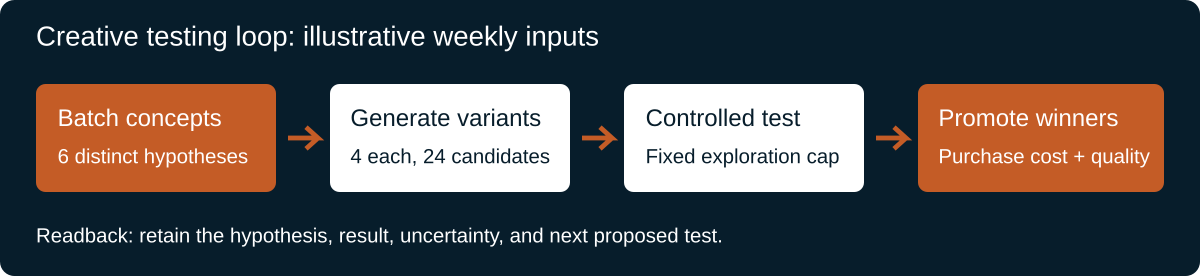
The buyer funds only the candidates the exploration budget can evaluate. Where practical, the controlled comparison holds the offer, destination, and audience conditions steady. If several variables change together, the ledger records that limitation. The team uses a predefined review window and stop conditions rather than reacting to an early spike.
At the readback, the strategist sorts findings into supported, rejected, and unresolved hypotheses. Qualified winners move into the scaling queue. Unresolved candidates do not become losers merely because a reporting deadline arrived. The next batch uses the strongest findings to choose new objections and executions. This is how higher volume produces cumulative learning instead of a larger asset folder.
Worked scene: capped creative bot + human gate before spend
Now scope a bot to one pipeline job: propose no more than four creative candidates from an approved brief. Four is a starting cap adapted from Eric’s bounded-candidate discussion, not a universal optimum. Inputs include supported claims, existing assets, prohibited language, and prior readbacks. Outputs include the candidate, concept ID, changed variable, and expected result.
Eric’s one-job framework requires a success definition, safety bar, and human verifier. Here, success means useful, traceable candidates within the cap. The safety bar excludes fabricated proof and offer changes. Name the account’s paid media lead in the brief as the ship gate. That person approves which candidates enter testing; the bot cannot publish ads or change budgets.
In this proposed cycle, the bot returns its capped batch. The lead keeps candidates with distinct, supported hypotheses and rejects duplicates. Rejection reasons stay in the ledger so the next batch improves. Do not fill the test queue merely because production capacity is available.
Spend remains inside a preapproved Meta creative-test allocation. Meta’s learning-phase guidance supports protecting delivery stability while the system learns. Fund a manageable test queue, avoid unnecessary edits, and do not fragment a small budget across excessive ad sets. There is no universal testing percentage to label “Meta-approved.” Use the account’s budget, optimization event, and delivery conditions to set the cap.
Deployment follows Eric’s observation, recommendation, then approved-action progression. Start with observation and recommendations. Use the 7-, 14-, 30-, and 60-day checkpoints discussed on tape to review readback accuracy and operating reliability, not as automatic declarations of statistical significance. Expand responsibility only after the bot consistently reconciles its predictions with actual outcomes. Report assembly or candidate ranking can come next. Unsupervised spend does not follow from a clean first batch.
What you do not automate (or fake)
Refuse invented evidence. Customer quotations need provenance. Performance claims need supporting records. Product demonstrations must match the product. A polished asset with an unsupported promise creates commercial risk and contaminates what the test appears to teach you.
Also refuse false certainty. Platform delivery is uneven, conversion reporting can lag, and testing more variants creates more opportunities for a lucky early result. Set evidence requirements before launch. Record uncertainty when the account cannot support a confident comparison, and check whether apparent improvements persist before expanding investment.
For lead generation, include sales handling in the measurement plan. A historical Harvard Business Review audit of 2,241 U.S. companies found that 37% responded to a web lead within an hour, while 23% never responded. These are 2011 findings, not current Meta benchmarks. They support a specific recommendation: log response time alongside creative performance.
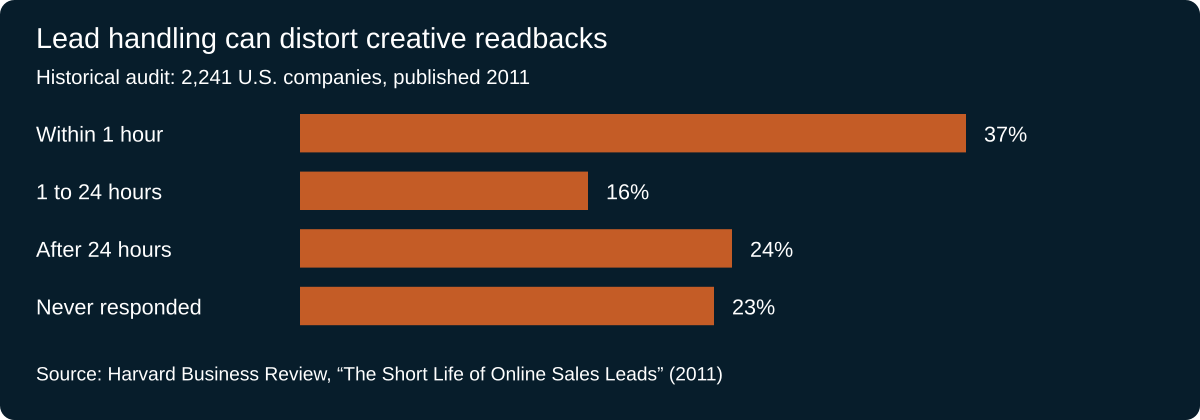
The percentages describe separate response categories, not an exhaustive breakdown. Their relevance is the measurement confound: different follow-up can change downstream results. Add qualification status, response time, and customer quality to lead-generation readbacks. Without them, you may reward an ad for receiving better sales coverage or reject one because its leads sat untouched.
How to install the loop + CTA
Install the operating loop before buying an elaborate agent platform. Single Grain’s guide to AI tools for SEO workflows offers an adjacent workflow perspective: evaluate tools against the work they support. Keep this deployment scoped to paid creative. Search production and ad experimentation need different inputs and success definitions.
- Write the commercial brief: baseline, numeric finish line, deadline, acquisition-cost ceiling, quality check, and exploration budget.
- Create a test ledger connecting concepts, variants, supporting evidence, spend, conversion outcomes, and unresolved questions.
- Run a complete concept-to-readback cycle with existing tools. Identify whether production, review capacity, or measurement is the bottleneck.
- Buy or build automation for that bottleneck. Price a bounded pipeline job rather than vague access to a “marketing super-agent.”
- Increase candidate capacity only when test funding and measurement can support the additional decisions.
Hire for the missing capability. If nobody can interpret acquisition economics, add an experienced paid media operator before another generation tool. If the strategy and measurement work but production stalls, automate variant assembly. Single Grain’s AI coverage can help frame the tooling discussion, but the purchase decision belongs to the workflow owner.
Thousands of ads become useful when every batch leaves behind reusable evidence. Start with the smallest loop that connects a supported concept to a measurable commercial result, then expand its capacity. If you need help connecting creative production, paid testing, and landing-page performance, contact Single Grain to scope that loop around your budget and business goals.