

Which AI marketing services to buy when you need pipeline, not another content calendar


Which AI marketing services to buy when you need pipeline, not another content calendar
If your agency delivers articles every month while sales keeps hearing the same unanswered objections, buy an objection-to-page workflow before buying more content. The immediate job is to turn buyer evidence into better commercial pages, ads, and sales handoffs. More production will not repair a broken handoff.
Eric Siu’s sales-objection workflow gives Single Grain buyers a concrete starting point: use what prospects say on calls to decide what marketing changes. Access to sales evidence becomes a buying requirement. A vendor who never asks for it is writing for assumed buyers.
What “AI marketing services” should mean for pipeline
Start with the adoption figures Eric discusses: 17 of 100 companies use AI agents in marketing, and those agents cover 3.5% of marketing staff. Those figures describe limited deployment, not an established case for replacing a marketing department. Buy one owned workflow, measure the staff hours it consumes before and after deployment, and track whether its output helps sales. Refuse an “AI-first organization” package whose deliverable is tool access.
Eric’s one-job-per-bot guidance makes the scope concrete: one job, a success definition, a safety bar, and a human verifier. Apply that to procurement. Price objection extraction, commercial-page drafting, or inquiry enrichment separately. Reject a super-agent proposal that combines research, messaging, publishing, and sales outreach under one vague promise.
Each job needs accessible inputs, a baseline, and a business owner. Separate demand work that earns relevant attention, conversion work that helps buyers evaluate fit, and operations work that gets inquiries to sales. A proposal should state which responsibility it covers and exactly where your team takes over.
Define a sales-accepted conversation with sales before signing. Specify the customer profile, evidence of a relevant need, and conditions under which a seller accepts the handoff. Track opportunities separately. Otherwise, a vendor can label every form submission “pipeline” while account executives reject the queue.
For Single Grain’s AI SEO services, ask for a scope tied to commercial pages, buyer questions, and qualified inquiries. For AEO services, identify the questions where your business should appear and the evidence your pages need. Visibility belongs in the measurement chain, but a citation alone does not establish buying intent.
Services worth buying vs skipping
Buy specialized execution when the missing capability is clear. Commercial-page refreshes, objection-led conversion work, useful acquisition features, and lead-routing integrations can qualify. Sequence them around the constraint. Fix the destination and follow-up process before buying more ad variants that send prospects into the same leak.
In Eric’s feature-as-lead-magnet discussion, the acquisition offer shifts from a gated PDF to a useful feature a prospect can use. The prospect receives a useful result instead of another document behind an email field. That changes what Single Grain buyers should commission: an entry point into their product or expertise, with a relevant next step, rather than another batch of downloads.
For this engagement, the business supplies product logic, relevant inputs, and limits on what the result can promise. The vendor builds the bounded feature, explains its output, instruments usage, and connects the commercial next step to the CRM. Acceptance requires a useful result and a working handoff. Evaluate sales-accepted conversations and opportunities, not just email captures.
Keep maintenance in the scope. Name who owns the feature when product facts change, inputs fail, or users need help. If nobody can support it, or its users do not resemble your buyers, refuse the build. The tape changes the asset worth buying, but the business still needs to own its logic.
- Skip unlimited articles without a buyer question, distribution purpose, and conversion path.
- Skip strategy-only retainers that leave implementation and measurement unassigned.
- Buy existing CRM automation before commissioning a custom agent for stable, rules-based routing.
- Keep positioning, pricing, customer promises, and product logic inside the business.
Hire when the work requires enduring internal judgment and daily ownership. Buy software when a stable process already exists. Use an agency when coordinated specialist execution is missing. Do not pay agency rates indefinitely to compensate for an unfilled internal owner role.
Selection criteria and red flags
Ask vendors to walk through their inputs, the system they will change, and the result they expect to measure. Request an example deliverable and acceptance criteria. Require a baseline for staff hours as well as commercial outcomes. Time saved only creates capacity if someone can use it, and faster production can still produce unusable work.
Review Single Grain’s case studies with the same discipline you apply to another agency. Look for a comparable constraint, a clear intervention, and an outcome with context. Ask what your team must supply to reproduce the process. A recognizable client logo does not establish fit for your sales cycle.
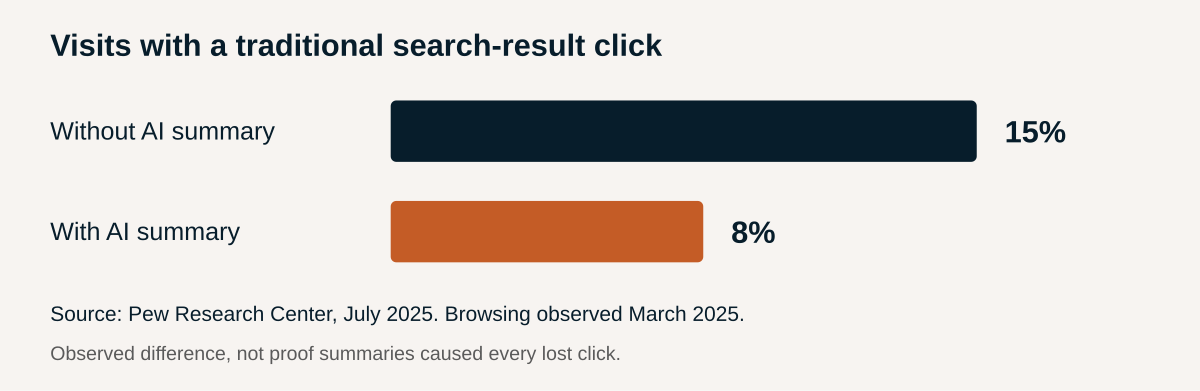
Then test the acquisition assumptions. In Pew Research Center’s analysis of U.S. browsing behavior in March 2025, users clicked traditional results on 15% of visits without an AI summary versus 8% with one. Only about 1% of visits with a summary produced a click on a source within it. These are observed behaviors, not a forecast for your account.
The buying consequence: reject plans that multiply projected rankings by historical click rates without adjustment. Require separate reporting for rankings, citations, clicks, accepted inquiries, and opportunities. Single Grain’s AEO and SEO integration approach should connect those discovery surfaces to useful destinations, not count mentions as revenue.
Reject guaranteed AI-answer placement, dashboards without CRM reconciliation, and attribution that awards every touched opportunity entirely to the vendor. Ask how missing data and overlapping channels are handled. The proposal should also specify account ownership, exportable deliverables, integration maintenance, and what remains usable when the engagement ends.
How to run vendors with a human ship gate
Eric’s AEO and content-bot guidance keeps production in draft until a human approves the exact output. Make that a contractual requirement covering PR pitches, citation assets, live ads, and commercial pages. Name the person with shipping authority in the brief. Buy research and drafting capacity, not unattended external publishing.
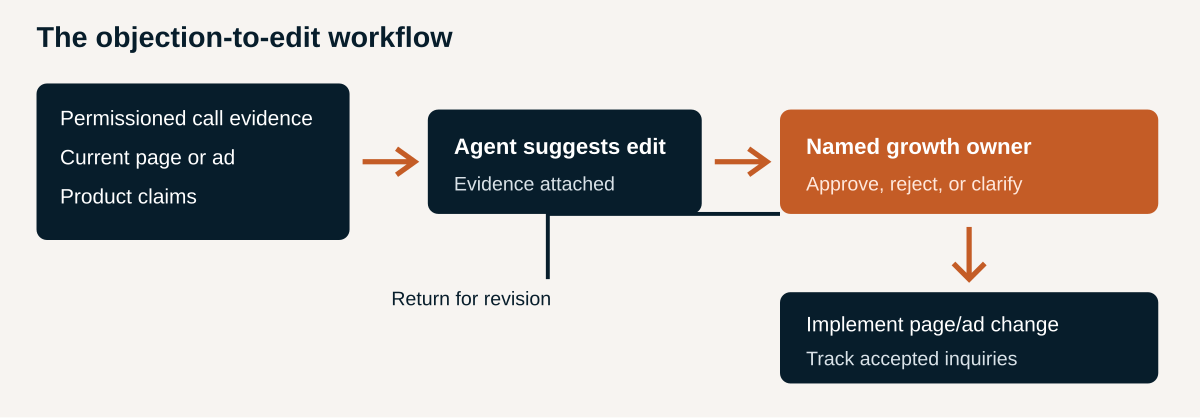
The second worked scene follows the sales-objection loop from Eric’s tape: objections surface on sales calls, those objections drive proposed page or ad changes, and an agent suggests an edit for human approval. The useful signal is the buyer’s unresolved question. The recommendation is to buy a bounded clarification workflow instead of a generic persona-based rewrite.
Operationalize that sequence with permissioned call evidence, current copy, and supported product claims. Put suggested edits into a Monday review queue. Each item carries the source objection, existing copy, proposed change, and supporting evidence. Enter your head of growth’s actual name as the verifier. That person approves, rejects, or returns the exact edit for clarification; the vendor implements accepted changes and preserves the history.
Measure evidence quality, turnaround, staff hours, accepted inquiries from affected pages, and whether the targeted objection persists in later calls. Low volume warrants directional findings and unresolved questions. A handful of conversions does not justify a confident causal claim.
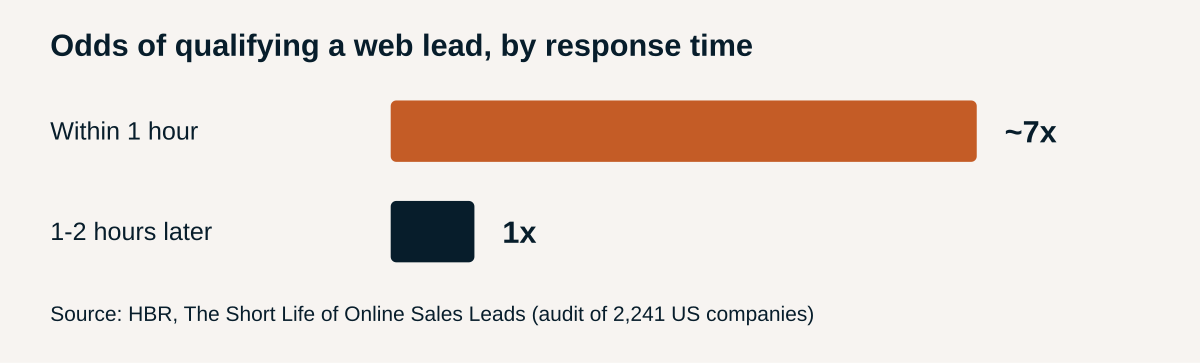
Check the downstream handoff too. Harvard Business Review’s 2011 audit of 2,241 U.S. companies found that 37% responded to a web lead within an hour, while 23% never responded. This is an older operational warning, not a current AI benchmark. Audit your own response times before adding acquisition spend. If routing is the bottleneck, buy a monitored CRM handoff with an assigned seller and an exception queue.
Run an initial ninety-day engagement: establish access and baselines in weeks one and two, execute bounded batches in weeks three through eight, then assess progress and dependencies in weeks nine through twelve. Long sales cycles may require more observation before judging opportunities. Require usable work and transparent findings during that wait.
Bring Single Grain the constraint: unanswered buyer objections, weak commercial destinations, or inquiries that stall before sales. Include the evidence you have and the internal owner who can act on it. Contact Single Grain to scope one measurable pipeline job before committing to a broader retainer.