

How to Start an AI-Native Services Firm for ‘Boring’ Local Businesses



This week the operators I follow kept landing on the same business to build, and it is not a flashy one. The move is to pick a high-ticket, unglamorous local niche, wrap AI agents around a done-for-you offer, and sell outcomes the owner already feels in the bank account. Think plumbers and dentists, law firms and home services.
It was everywhere. More than one builder pointed at an AI-native services firm as one of the few businesses still worth starting, and the Main Street version, an AI services firm that helps “boring” local businesses grow, got just as much attention. I build agencies for a living, so I want to give you the operator version, not the hype.
By the end of this you will know exactly how I would start one this week, from the niche and the single problem to solve, through the offer and the pricing, to the margin math that decides whether the thing lasts.
TL;DR
- Boring local niches win because the pain is obvious and the owner can tie your work straight to booked jobs, so an AI-native services firm sells outcomes instead of software.
- Start with one revenue-adjacent problem, usually missed leads or slow follow-up, and wrap a done-for-you offer around it that you price high enough to do real quality control.
- Let agents run the repeatable delivery and keep strategy, QA, and pricing human, because that split is where the margin comes from and where it breaks first.
What An AI-Native Services Firm Actually Is
An AI-native services firm is a small agency built so AI agents handle most of the delivery, the lead capture, the follow-up, the content, and the reporting, while a human owns strategy and quality. That structure lets one operator serve a handful of local clients at margins a traditional agency cannot match, because the delivery that used to need five people now needs one person and a stack of agents.
Here is what the hype skips. You are not selling AI. You are selling more booked jobs, faster follow-up, cleaner intake, and reporting the owner can actually read. The agents are how you deliver that, not the thing you charge for.

An agent is not a script, and most people setting one up still run it like one. Treat it more like a fast junior hire who needs clear inputs and guardrails, and you will get far more out of the same AI marketing agents everyone else is bolting on at random.
How To Start An AI Agency Around One Painful Local Problem
Start with restraint. If you try to serve every local business, you will sound like everyone else with a prompt library. Pick one niche where a missed lead costs real money. A plumber who misses a water-heater call feels it that day. A dentist with open chair time feels it every afternoon. A law firm that answers a qualified case late loses it to the firm that answered first.
Then sell the problem closest to revenue. For most local owners that is missed lead capture or slow follow-up, not a content package that might rank next quarter. Fix the phone ringing today, and earn the right to everything else later.
Before you pitch, audit the niche the boring way:
- Call three businesses after hours and see if anyone follows up.
- Submit forms on five competitor sites and time every response.
- Read a month of reviews for complaints about booking and communication.
- Check the local map results for the shops running weak landing pages.
Now package it as done-for-you, because local owners do not want homework. They want the system installed and run for them. A sharp offer sounds painfully specific. “We help dentists recover missed implant leads in under five minutes” beats “we build AI workflows” every time, and it is the same discipline behind a focused small-business marketing offer: one buyer, one outcome, one promise.
Then price it high-ticket so you can afford to do the work well. I would rather sell five clients at $3,000 a month than thirty clients at $500, because the cheap version turns you into unpaid tech support with a logo. Charge a setup fee for the install, then a monthly fee for running it.

What AI Agents Should Own And What You Keep Human
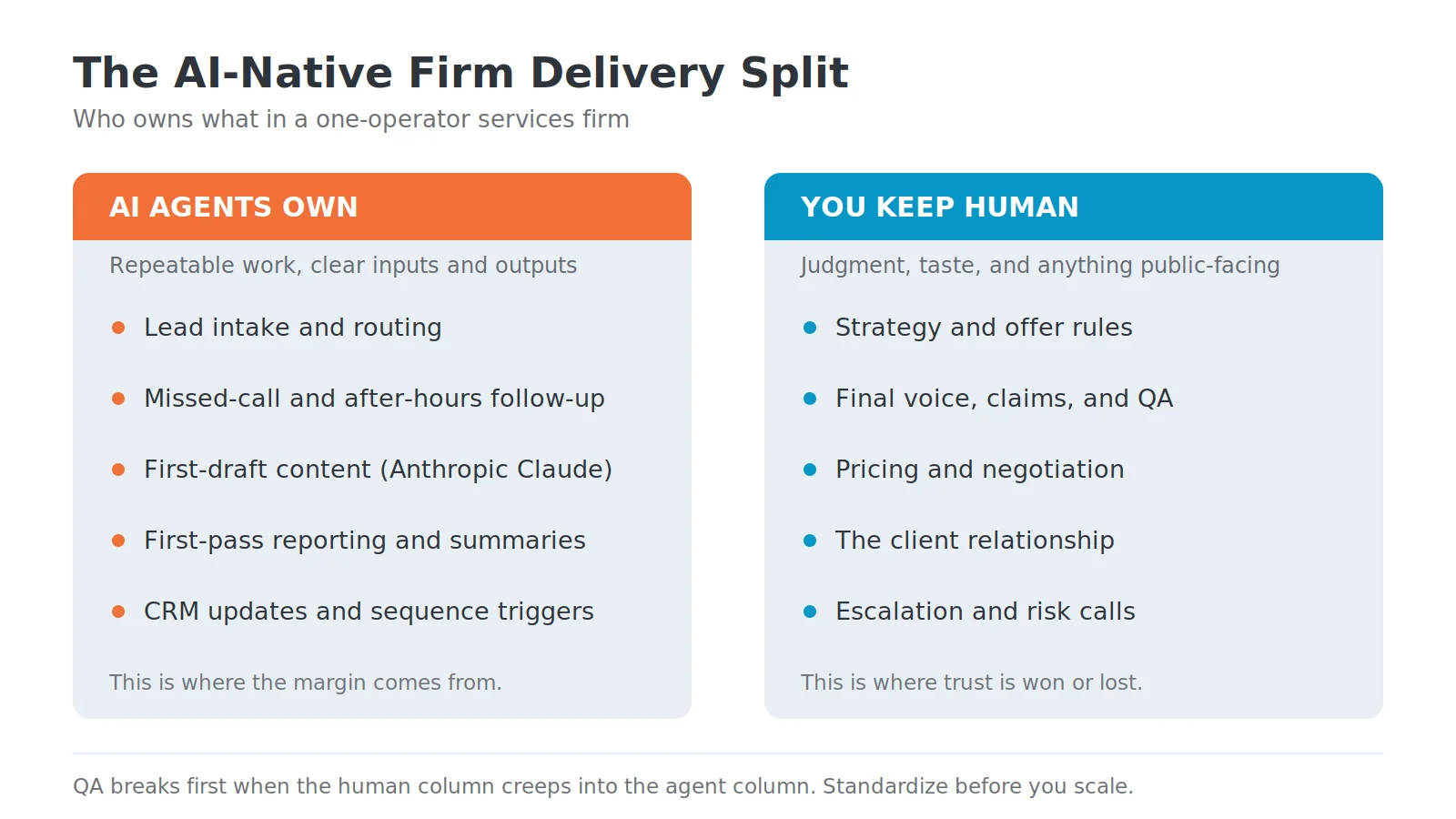
Once the offer is set, decide where agents save you time without putting client trust at risk. The line I use is simple. Agents own repeatable tasks with clear inputs and outputs. Humans own judgment, taste, and anything that could embarrass the client in public.
In practice that means agents handle lead intake and routing, missed-call and after-hours follow-up, first-draft content with tools like Anthropic Claude, and the first pass of every report. You keep the offer rules, the final voice and claims, the pricing calls, and the client conversation where money and risk are on the line. The same line holds when you add AI revenue agents to the stack. They can move the pipeline, but they should not be the last set of eyes on it.
One pattern I see over and over is teams handing an agent the client relationship itself, then wondering why retention slips. The agent can tee up the follow-up. You still send the message that keeps the account.
The Margin Math And What Breaks First
Here is the part the hype posts skip, and it is the whole ballgame. The model only works if your delivery time drops faster than your client count rises. Say you charge $3,000 a month plus a $5,000 setup fee, software runs about $300 per client, and human QA takes a few hours a week. At those numbers one operator can build a real services firm before hiring a delivery team.
The math breaks the moment you customize everything. Each exception becomes a small tax. One client wants a strange CRM. Another wants daily reports. A third wants every text rewritten in their voice. None of it is hard on its own, and together it quietly eats the margin the agents created.
So what actually breaks first? QA breaks first. Then onboarding. Then your calendar, because every “quick client call” pulls from the same time the automation was supposed to give back. The fix is boring, which is why it works. Build one onboarding flow, one dashboard, one offer promise, and one weekly rhythm, and hold every client to them.
This is where most of the advice stops short. The popular playbooks sell the setup and the tool stack, then go quiet on the cheap-retainer trap that follows, the one where thirty $500 accounts and endless one-offs bury the operator who built it. Tie the work to pipeline, not activity, and price for the QA you will actually have to do.

Build The Firm Before Everyone Notices
The operator move this week is not complicated. Pick the boring niche before it gets crowded, then sell the painful outcome before you sell the AI. Your first client does not need a huge platform. They need faster follow-up, cleaner intake, and a system that tells them which leads turned into money.
Start with ten businesses in one niche and send each a teardown, not a pitch. Show the missed lead, show the slow response, show the revenue leaking out, then offer to install the fix. The tech is the easy part. The offer is what gets you paid, and most founders get that backwards.
The next wave of agency founders will not win by sounding futuristic. They will win by making unglamorous local businesses more cash-efficient than the shop down the street. If you want help turning that model into a working revenue engine, my team can build the strategy and agent workflows with you through Single Grain’s AI marketing team. Get a free consultation, then go pick one niche and one painful problem and install the fix this week.