

Anthropic Says Claude Writes 80% of Its Code. The Real Lesson for Marketing Is Review, Not Speed



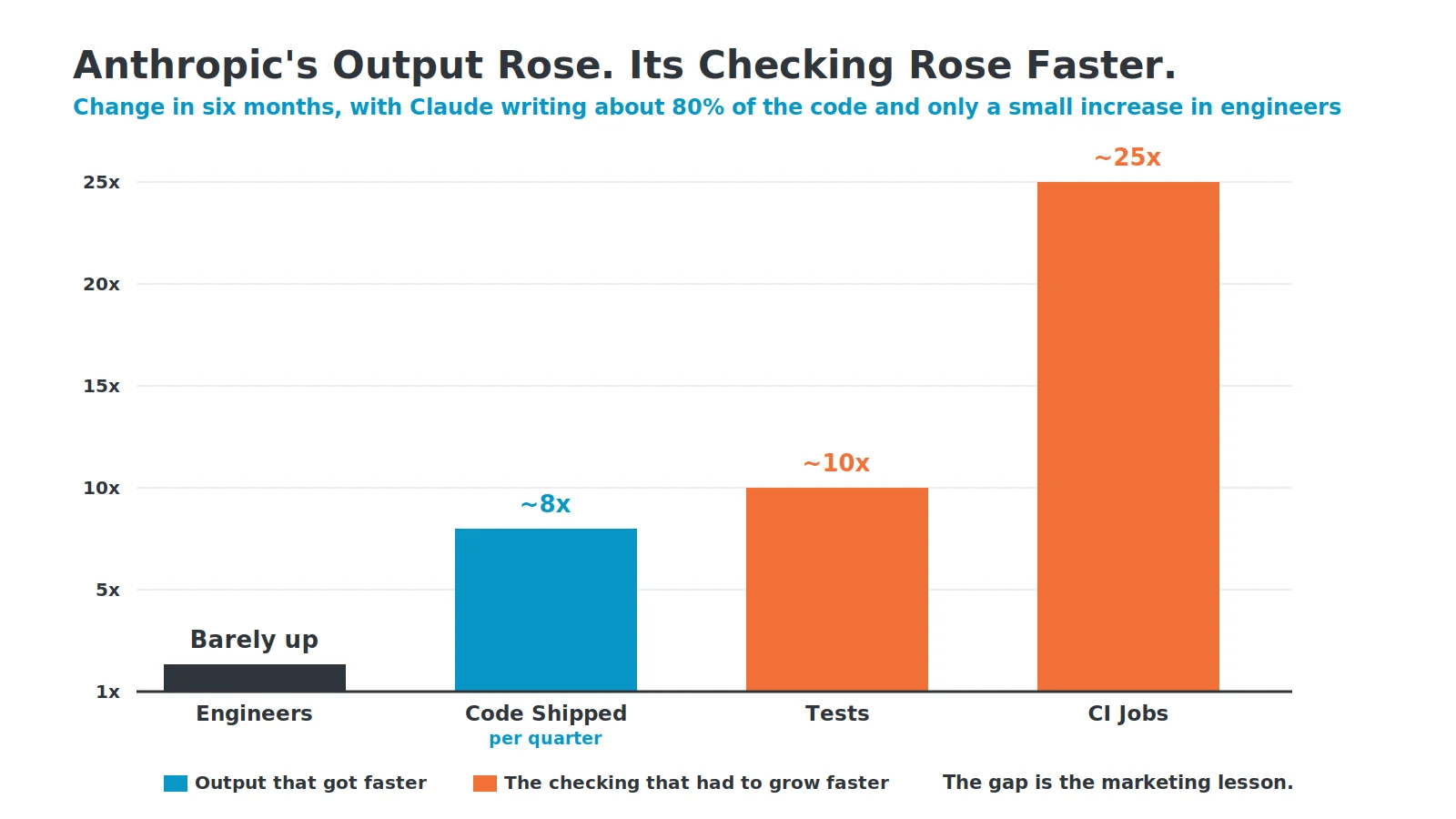
Anthropic just said Claude now writes about 80% of its own code, up from single digits roughly 15 months ago. Its engineers ship about 8x more code per quarter than they did in 2024. That reads like a speed story. It isn’t.
The side effect is the real story. To keep quality from breaking as output climbed, Anthropic grew its tests about 10x and its CI jobs about 25x in six months, on barely more engineers. When machines write the first draft of everything, production stops being the constraint. The cost and the risk move downstream, to review.
Your team is about to hit the same wall. If AI can draft ten times the blog posts, ads, and emails you used to, the bottleneck moves with the output. By the end of this you’ll know exactly what to measure and who to staff for once AI writes the first draft, and why hiring another producer is the wrong move.
TL;DR
- Anthropic didn’t just get faster. Its checking systems grew faster than its output, and that gap is the whole lesson for marketing.
- When AI drafts everything, review becomes the constraint. Put named owners and QA gates in place before you scale draft volume, not after.
- Measure the errors you catch and the work that ships clean, not raw draft count. Hire editors and reviewers before you hire more producers.
What AI Content Review Now Means
AI content review is the work of checking AI-assisted drafts for accuracy, brand fit, usefulness, and legal risk before anything ships. It pairs human judgment with a repeatable checklist, so your team isn’t relitigating what “good” means on every asset.
Production stopped being the constraint. Review did. That is the line I’d put on the wall of every content team right now. If you can generate ten drafts before lunch, the scarce resource is the person who knows which two should exist.
A bad AI workflow looks like a busy kitchen with no expo. Plates keep leaving the line, but nobody checks the order against the ticket. You get more blog drafts, more ad variants, more email copy, and then your best operator spends Friday night pulling false claims out of work that already went out.
Most marketing teams I talk to are still counting output, and output is now the easiest number to fake. The moment a draft costs almost nothing, its volume tells you nothing about whether the work is any good.

The Anthropic Signal Is a QA Story
Back to the software moment, because the numbers make the point better than I can. Anthropic disclosed that Claude now writes about 80% of its code, up from single digits roughly 15 months earlier, with engineers shipping about 8x more code per quarter than in 2024.
Most people read that as a speed win and stop. The part that matters is what happened to the checking. Tests grew about 10x and CI jobs rose about 25x in six months, with only a small increase in headcount. Output roughly 8x’d. The systems that catch mistakes had to move faster than that just to hold the line.
Marketing runs on the same physics. If AI drafts your assets, your version of tests and CI is editorial review, fact-checking, brand approval, and performance feedback. Draft volume is cheap now. The checking is where the cost quietly moves, and most teams have not funded it.
Build the Review Layer Before You Scale Drafts
Once you accept that the bottleneck moved, the org chart has to move with it. Don’t route every AI draft to the same senior person and call it a process. Build an explicit review layer with named gates, so cheap output doesn’t turn into expensive cleanup.
So who absorbs the extra checking? Right now it lands on your one senior editor, and that’s a hidden tax nobody budgeted for. A documented editorial review process for AI accuracy spreads the load and gives each stage an owner and a job. Here’s a layer that maps cleanly onto a marketing team.
| Review Gate | Owner | What It Stops |
|---|---|---|
| Brief Check | Content Lead | Wrong Angle or Weak Search Intent |
| Accuracy Check | Editor or SME | False Claims and Outdated Facts |
| Brand Check | Senior Marketer | Generic Voice and Weak Positioning |
| Risk Check | Ops or Legal | Compliance Issues and Unsafe Claims |
This doesn’t have to be slow. It has to be explicit. The failure mode is the vague “someone should review this,” which means no one did.
The stakes rise once the AI is not just drafting but acting. An agent with access to your publishing or ad budget can act on bad input if nobody is watching the gate, and that’s a security problem, not only a quality one.
What to Measure and Who to Staff
When AI writes the first draft, stop staffing and measuring for output. Staff for review by putting named editors and fact-checkers on the gates that matter, then measure the work that protects the business rather than the work that fills a calendar. Here are the four numbers worth more than draft count.
- The error rate you catch before publish, counting the false claims, broken facts, and unsupported lines your gates stop.
- Revision cycles per asset, which tell you when the brief or the prompt is the real problem.
- The share of AI output that ships unedited, which is a signal to audit quality fast when it climbs.
- Time from draft to approved asset, which shows where review actually stalls.
Now the staffing call, and it’s contrarian. Hire fewer pure producers. Hire people who can judge. That means editors who can fact-check AI content, strategists who can kill a weak angle, and operators who can turn review notes into better prompts. If one editor raises the quality of fifty AI-assisted assets a month, that hire changes the whole team’s output. A new writer just adds more drafts to a clogged lane.
Then tier the work so your reviewers don’t become the bottleneck themselves. A low-risk social variant needs a light pass. A pricing page or a category page needs a sharp one, because that’s where a mistake hits revenue.

The Operator Move for the Next 12 Months
The next edge won’t belong to the team that drafts the most. It’ll belong to the team with the cleanest path from AI draft to approved asset. Write fewer generic briefs. Name the reviewer before the draft starts. Track the errors you catch, then feed those patterns back into your prompts and templates.
Everyone is racing to draft more. The teams that win will be the ones who built the review layer first, then ran it like the QA-heavy software team it needs to be. Fast drafting is table stakes now. Judgment is where the margin goes.
If your team already runs on AI and review has become the choke point, this is the exact problem our AI content agency is built to solve: the strategy, QA, and human review layer that turns AI output into work you can actually ship.


