

Every Company Is Using AI Wrong: The Missing Layer Is Your Context, Not Your Model



Every company keeps reaching for a bigger model, and it keeps not fixing the problem. The AI writes in a voice that isn’t yours, misses the offer you actually sell, and forgets what it learned last week. The thing holding it back is everything your company has never written down.
The bottleneck was never the model. The model has no access to what your company actually knows, so it guesses, and you end up paying people to fix those guesses on the back end.
By the end of this you will know what a context layer is, why it beats chasing a bigger model, and how I would start building your company brain this week without a six-month project.
TL;DR
- Chasing a bigger model doesn’t fix output that’s off-voice, off-offer, and forgetful. The missing piece is your company’s context, not raw intelligence.
- A context layer, or company brain, is one structured store of your offers, voice, history, and decisions that every AI tool and agent reads before it generates anything.
- You can start this week: pull your worst AI outputs, turn the corrections into structured documents, and connect them to your tools. No data-warehouse project required.
Why a Bigger Model Isn’t Fixing Your AI
Most teams I talk to are on their third model and still fixing the same mistakes. They swap from one frontier model to the next, expecting the newest one to finally understand their business. It never does.
The pattern repeats. Someone pastes a prompt, the output reads generic, they add more instructions, and it gets slightly less generic. Then a newer model drops and the cycle restarts.
Two posts made the rounds this week saying the quiet part out loud. One argued that the fix is not a smarter model but the context you feed it. Another, from an engineering seat, pointed at the context pipeline feeding the model as the real constraint.
I stopped blaming the model a while ago. It was never told how any of my clients’ businesses work. No model ships pre-loaded with your pricing, your brand voice, your customer objections, or the campaign that flopped last quarter. Without that, every model guesses, and guessing is the work you’re paying people to redo.

What a Context Layer Is
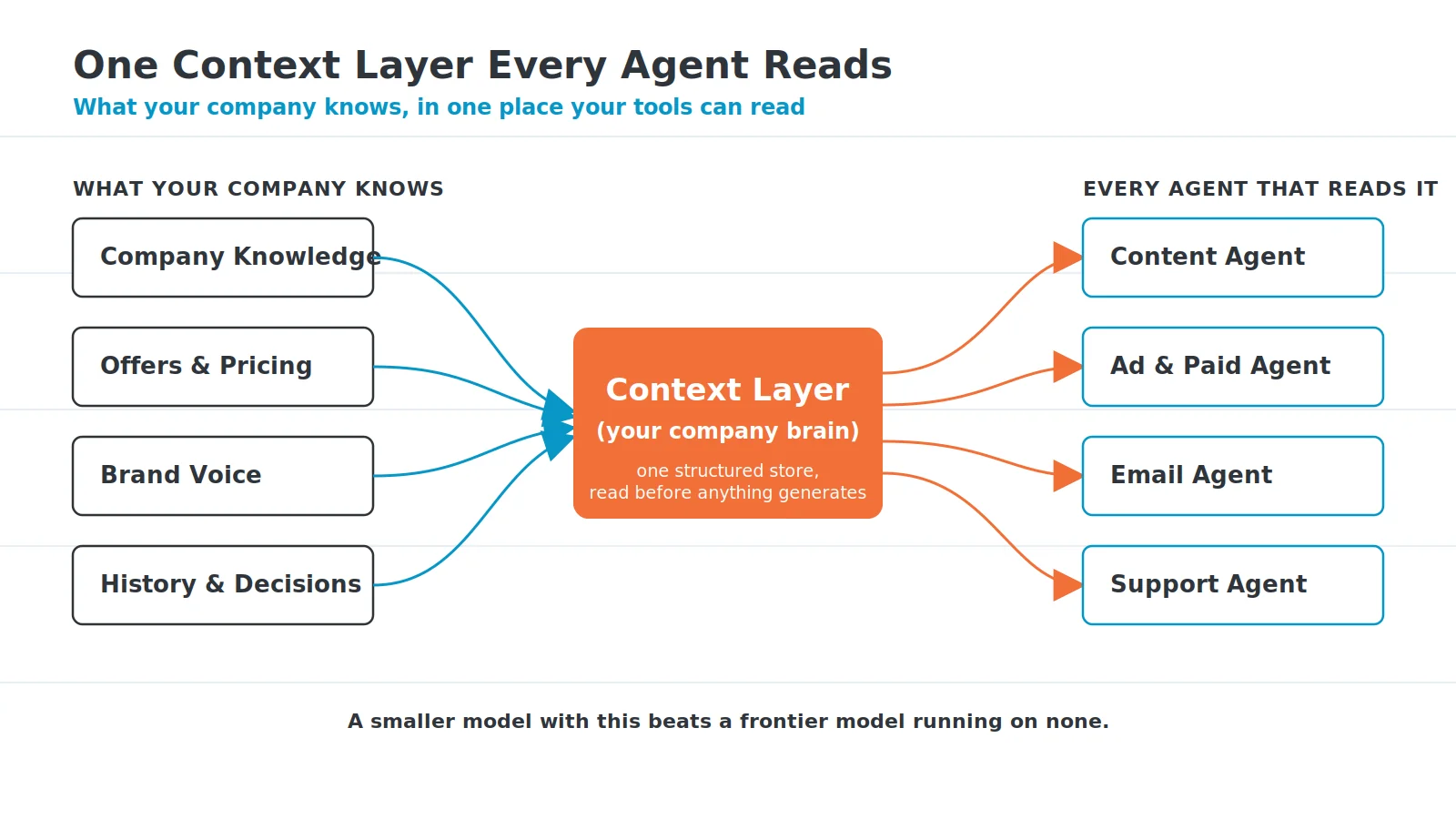
AI tools underperform at most companies because the model has no access to the company’s real knowledge, its offers, voice, history, and decisions, so it guesses. The missing context layer is a single structured store of that knowledge that every AI tool and agent can read.
Some people call it a context layer, others call it a company brain. Same thing: one place your company’s knowledge lives so every tool reads from it instead of guessing. It holds your positioning, your product specs, your tone, and your past results, and every agent pulls from that source, whether it writes emails or builds ad copy.
I would rather feed a smaller model great context than a frontier model running on none. A well-organized context layer makes a mid-tier model outperform a frontier model working blind, because the mid-tier model at least knows what it’s talking about.
The New-Hire Versus Veteran Gap
Your best employee didn’t become your best because they’re smarter than everyone else. They became your best because they absorbed years of context nobody ever wrote down. They know which clients need a gentle touch, which product promise actually converts, and why the last rebrand failed.
The gap between a new hire and a veteran is mostly tacit knowledge, not intelligence. A new hire with an MBA still asks basic questions for six months, because the real operating knowledge lives in people’s heads, not in the employee handbook.
Your AI has the same gap, except worse. It resets every session. It can’t pick up institutional memory in hallway conversations or sit in on a post-mortem.
What does the veteran have that a new hire doesn’t? A working model of how this specific company operates. A company brain gives your tools that same model, so they stop starting from zero every morning.
How to Build Your Company Brain
You don’t need a data-warehouse project or a six-figure consultant. You need to start with what’s already broken.
When I start this with a team, I begin with the last ten things the AI got wrong. Wrong tone, wrong offer, wrong audience. Each mistake points at a missing piece of context, and together they’re your build order.
Here’s how I would spend the first week:
- Days 1 to 2: collect the corrections your team already makes to AI output. Every manual fix is a context gap you can name.
- Days 3 to 4: turn those corrections into structured documents, like brand-voice rules, offer descriptions, audience profiles, and past campaign results.
- Day 5: connect those documents to your main AI tools so agents read them before they generate.
This is what building company intelligence looks like in practice. The work is organizing what your team already knows, and it moves as fast as you can write things down.
A structured store sitting in a shared drive does nothing on its own. It has to feed the tools doing the work, which means wiring it into your AI revenue agents, your content tools, your ad platforms, and your customer-facing automation. Then the context layer becomes the shared brain every agent consults.

What Changes Once It Exists
The first thing you notice is that you stop correcting. Output comes back in your voice, referencing your real offers, using the language your customers recognize.
Right now someone on your team probably spends hours a week editing AI drafts, fixing tone, swapping wrong product names, and adding context the model never had. Once the context layer exists, those edits drop from hours to minutes, though never to zero. The distance between a draft and something you can publish gets short.
Personalization changes too. Most personalization today is a first name dropped into a template. With a company brain feeding your tools, the AI knows which segment cares about which benefit, that your enterprise buyers want ROI language while your SMB prospects want speed, and that your Q3 offer isn’t your Q1 offer. A marketing consulting engagement usually surfaces that specificity over weeks of interviews. Now your tools reach it instantly.

Everyone keeps chasing the next model. The teams that win will be the ones who built the boring, structured, specific knowledge layer underneath it. Models are commoditizing fast, and the one thing that stays yours is what your company knows.
If you want help building your company’s context layer and wiring it into agents that actually drive revenue, talk to Single Grain’s AI marketing agency.


