

Prompt-Based SEO: How SEOs Can Influence AI Answers Through Prompt Patterns


Prompt-based SEO is fast becoming the difference between your content being hidden behind AI summaries and being the source those summaries actually quote. As search results fill with conversational answers, large language models are deciding in milliseconds which pages to read, how to interpret them, and whether to surface your site at all. The prompts that shape those models – and the prompt-like signals inside your pages – now influence visibility just as much as title tags and backlinks. For SEOs, understanding and shaping those patterns is no longer optional.
Instead of thinking only in terms of keywords and links, search professionals now have to think in terms of instructions and context: what AI systems are being asked to do, what they prioritize, and how your content can match that structure. This guide breaks down how to use prompt patterns both in your own AI workflows and directly on your pages so that answer engines read, summarize, and cite you more reliably. You will learn practical frameworks, reusable prompt templates, and measurement approaches that connect classic ranking factors with this new AI-driven layer of search.
TABLE OF CONTENTS:
AI answer engines have changed how people search
Search behavior is shifting from short keywords toward full questions, constraints, and follow-ups that look a lot like prompts. Users ask for opinions, compare options, and request step-by-step instructions in one fluid conversation. Answer engines then synthesize results into a single response, often keeping users on the results page instead of sending traffic to individual sites.
Because these systems are powered by large language models, they rely heavily on the textual cues they see across the web and in query logs. 51% of marketing teams already use AI to optimize content, meaning competitors are actively tuning their content to be easier for models to interpret. At the same time, 42% of marketing and sales departments now use generative AI regularly, rising to 55% in tech firms, underscoring how quickly AI-shaped search is becoming standard.
Why prompt behavior now shapes SEO performance
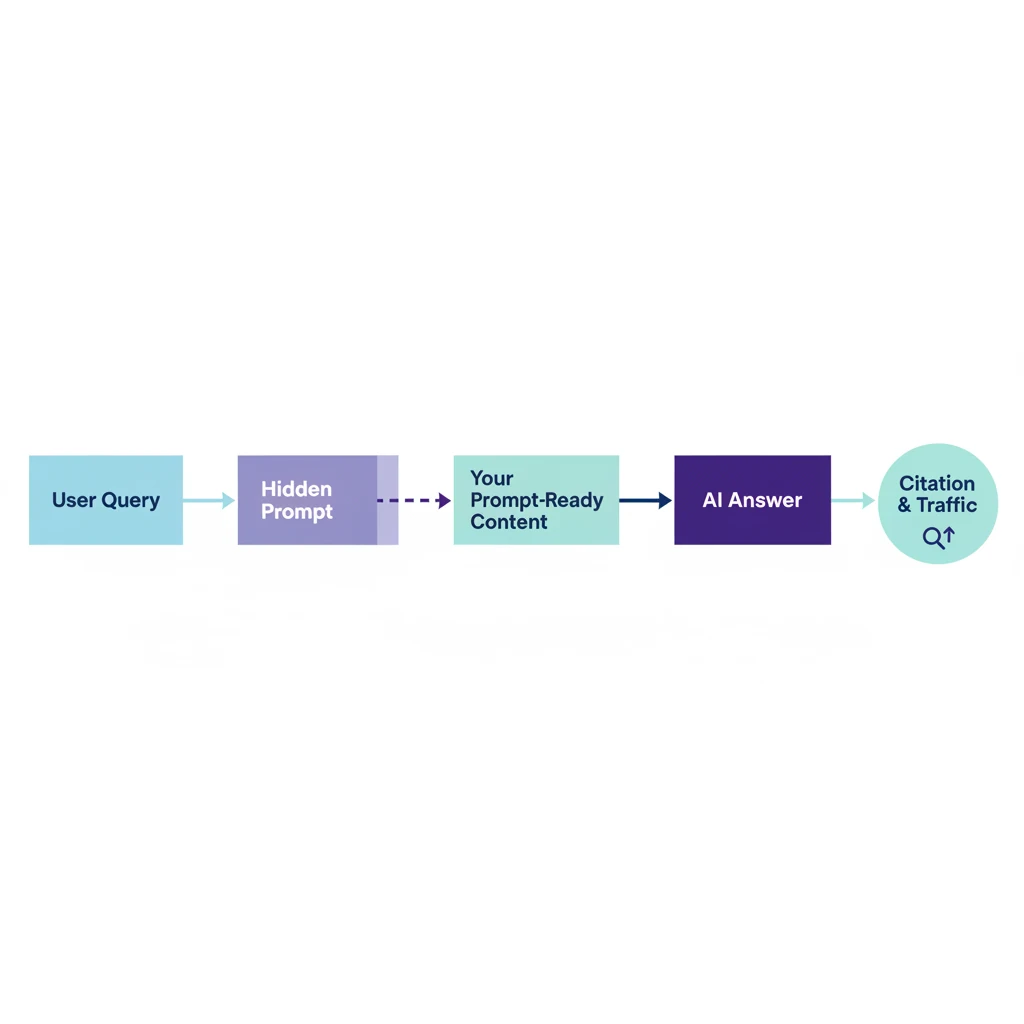
Every AI answer starts with an instruction, whether written by a user, an engineer, or a search product. That prompt tells the model which objectives to prioritize, such as diversity of sources, recency, or depth. If your pages are structured in ways that naturally map into those objectives, they are more likely to be selected as evidence, summarized accurately, and rewarded with citations.
This is where prompt-based thinking meets traditional SEO. Search professionals already shape content for featured snippets, People Also Ask boxes, and rich results by writing concise definitions, step lists, and FAQs. Prompt-based SEO extends that mindset to generative engines by modeling how prompts are likely written behind the scenes and aligning on-page cues with those hidden instructions. When you combine this with answer-engine-focused tactics like zero-click SEO strategies for AI answers and SERP citations, you give your content more ways to show up even when clicks are scarce.
Building a prompt-based SEO framework that AI systems can follow
Prompt-based SEO starts with adopting the same structured thinking that great prompt engineers use. Instead of issuing vague instructions to AI tools or publishing loosely organized articles, you design both your prompts and your pages using consistent components. This gives language models clearer signals about who you are, what you are explaining, and how your information should be used.
A practical way to do this is with a five-part pattern: role, task, constraints, context, and format. You use this pattern first when giving prompts to AI tools while researching, drafting, and optimizing content. Then you mirror the same logic in your live pages through headings, answer blocks, FAQs, and schema, so generative engines can extract information as if your page were already a well-written prompt response.
Prompt-based SEO patterns you can reuse across tools
Role tells the model who it should behave like. For SEO work, that might be “technical SEO auditor,” “B2B SaaS copywriter,” or “local search strategist.” Being explicit about the role tends to produce more consistent, domain-aware outputs, and it also reminds you which expertise you are trying to emulate instead of asking for generic advice.
Task describes the specific outcome you want, such as “cluster these queries by intent,” “draft an outline that targets AI overviews,” or “rewrite this section into a 40–60 word summary suitable for answer boxes.” Constraints set boundaries on length, tone, sources, or policies, which help keep outputs aligned with your brand guidelines and with search policies.
Context adds the background the model needs to avoid hallucinations: your product positioning, target persona, current rankings, or known limitations. Format specifies how you want the answer structured – for example, “return a table with columns for keyword, intent, and suggested H2,” or “provide a numbered list of steps I can paste into a how-to section.” This same structure can be echoed on-page through clearly labeled sections, bullet lists, and concise summaries that align with what answer engines prefer.
Smart Rent added new listicle prompts to their content strategy to improve authority and increase presence on AI search engines. This led to a 100% lift in citations on ChatGPT, Perplexity, and Gemini, and a 50% improvement in AI Overviews visibility.
Ten core prompts to jump-start your workflow
To put this framework into practice quickly, you can standardize a small library of prompts that plug directly into your SEO tools and workflows. Here are ten examples you can adapt, each using the role–task–constraints–context–format pattern:
- Keyword clustering: “You are an SEO strategist. Group the following queries into clusters by search intent. Keep cluster names short and output a table with columns: cluster, representative keyword, intent.”
- Search intent analysis: “Act as a search analyst. For each keyword below, label primary intent (informational, commercial, transactional, local, navigational) and suggest one ideal page type. Respond in CSV format.”
- AI Overview targeting: “You are an answer engine optimization specialist. Given this draft article, propose H2 and H3 headings that mirror natural-language questions users would ask and that an AI overview would likely summarize.”
- Featured snippet refinement: “Behave like a featured snippet editor. Rewrite this paragraph into a 40–55-word, neutral, third-person answer that could appear in a snippet or AI answer panel.”
- People Also Ask mining: “You are a SERP researcher. Based on these primary keywords and this audience, generate 20 follow-up questions that could appear in People Also Ask or conversational AI results.”
- On-page prompt blocks: “Act as a conversion copywriter. Create three concise answer blocks (each under 70 words) starting with phrases like ‘If you’re looking for…’ that address these user scenarios and can be marked up with FAQ schema.”
- Entity optimization: “You are an entity SEO specialist. From this article, identify key entities (organizations, people, places, concepts) and suggest how to weave them into headings and schema without keyword stuffing.”
- Technical SEO triage: “Act as a technical SEO auditor. Based on this simplified crawl export and log sample, list the top five crawl or rendering issues, with one recommended fix for each, in order of impact.”
- Analytics interpretation: “You are a digital analytics consultant. Given these metrics from organic search and AI-assisted traffic, summarize what changed over the last 90 days and suggest three hypotheses explaining the shift.”
- Localization planning: “Behave like an international SEO strategist. For this English article, propose how to adapt headings, internal links, and examples for [target language and country] while keeping core search intent and entities consistent.”
Once you standardize prompts like these, you can store them in a team library and evolve them alongside your SEO playbook. The same mindset can also guide how you structure live content for answer engines, ensuring your site works with AI systems instead of fighting them.
Influencing AI answers with on-page prompts and structure
Generative engines do not just respond to the prompts engineers write; they also treat your page structure like a kind of implicit instruction. Clear headings that resemble questions, concise summaries just below them, and logically organized FAQs all tell the model what each section is “about” and when it should be used in answers. This is where prompt-based SEO moves from off-page experimentation into concrete on-page architecture.
Think of each section of your page as a candidate answer block. If it is self-contained, specific to a single question, and written in neutral, citation-worthy language, AI systems can quote it more easily. Techniques that already work for rich results – such as featured snippet targeting, FAQ schema, and entity-rich explanations – can be extended to generative engines using principles similar to featured snippet SEO for the AI answer era.
Designing prompt-aligned content blocks for AI Overviews
Prompt-aligned content blocks begin by mirroring how users phrase questions. Instead of generic headings, you write H2s and H3s that resemble natural-language prompts such as “How do I influence AI search results with my content?” or “Which metrics show whether AI overviews are citing my site?” Under each, you add a succinct answer paragraph, followed by optional depth content.
When you design pages this way, you also create natural slots for FAQ and HowTo schema, which reinforce to both traditional crawlers and generative engines what each block represents. Layering this with focused answer-engine strategies and resources like guidance on how AI Overview optimization is changing SEO can help you prioritize which pages deserve prompt-aligned redesigns first.
Mapping search intent to prompt recipes and layouts
Different intents call for different on-page prompt patterns. Informational queries (for example, “how does crawl budget work”) lend themselves to definition-first structures with short, neutral summaries and follow-up FAQs. Transactional or commercial investigation queries work better with comparison tables, pros-and-cons lists, and buyer-oriented subheadings.
You can translate this into a simple matrix linking intent, prompt recipe, and layout. For informational topics, you might target a definition box followed by three to five common follow-up questions. For commercial ones, your H2s can mirror prompts like “Which option is best for…” or “What should I look for in…,” followed by feature breakdowns and concise recommendations.
- Informational: H2 as a plain-language question, 40–60 word answer, deeper explanation, then FAQ schema.
- Commercial: H2 comparing options, scannable pros and cons, and a closing recommendation block.
- Transactional: H2 reflecting action (“How to get…”), step-by-step list, and trust-building elements like guarantees or proof.
- Local: H2 emphasizing location (“Where to find…”), neighborhood details, and structured data for addresses and reviews.
- Navigational: H2 clarifying brand or product sections, with internal links clearly labeled for AI and users.
As you refine this, you can also consider how entity-focused strategies fit in. Approaches such as entity-based SEO for AI search help you prioritize concepts and relationships over isolated keywords, giving models richer context to decide which snippets of your content should answer a given question.
Because AI answer engines frequently summarize multiple sources, these intent-specific layouts not only improve human readability but also increase the odds that at least part of your page perfectly fits the format, tone, and length constraints implied by hidden prompts.
Operationalizing prompt-based SEO: Workflows, governance, and risk
Turning prompt-based SEO from a set of ideas into day-to-day practice requires clear workflows and guardrails. Without them, teams risk producing inconsistent prompts, duplicative AI-generated content, and pages that look templated or thin, undermining trust signals and long-term performance.
The most effective teams treat prompts as first-class operational assets. They catalog, version, and align them with key SEO activities such as content planning, on-page optimization, technical audits, and reporting. They also define review steps to ensure that AI-assisted outputs support experience, expertise, authoritativeness, and trust rather than eroding them.
Workflows for analytics, content, and technical SEO
A practical starting point is to stitch prompts directly into your existing tools. For example, you can export Search Console queries, then feed them into an analytics-focused prompt that clusters terms by intent and flags opportunities for AI answer visibility. The output becomes a prioritized roadmap for which pages need prompt-aligned rewrites or new sections.
For content creation, you can chain prompts: one to build an outline with conversational H2/H3 headings, another to draft answer blocks under each heading, and a third to suggest internal links based on your existing hub pages. Incorporating AI-powered SEO approaches into this chain allows you to cover traditional ranking factors and answer engine visibility in a single workflow.
Technical SEO workflows benefit from prompts tuned for diagnostics. After sampling crawl reports and server logs, you can ask an AI, using a structured prompt, to identify patterns that might prevent answer engines from accessing key content, such as rendering issues or blocked resources. Pairing this with topical frameworks like entity-oriented site architecture advice helps you align crawl efficiency with how generative models conceptually group your content.
- Extract relevant data from Search Console, analytics, and crawling tools.
- Apply standardized prompts to interpret that data for intent, entities, and answer opportunities.
- Translate insights into updated outlines and on-page prompt blocks.
- Run technical checks with diagnostic prompts to ensure discoverability and rendering.
- Re-test your updated pages in different AI assistants to see how answers and citations change.
Measuring prompt-based SEO impact and avoiding pitfalls
Measurement for prompt-based SEO focuses on how often and how well AI systems use your content, not just where you rank for individual keywords. You can track citation frequency in AI answers, impressions in AI overview modules, changes in featured snippet share, People Also Ask coverage, and session paths that include interactions with AI-driven surfaces.
Qualitative checks are just as important. Regularly test targeted queries in multiple AI assistants and note whether your brand is mentioned, how your information is framed, and whether any hallucinations appear. When you find inaccuracies, adjust your on-page explanations, add clarifying FAQs, and, when appropriate, strengthen signals through schema and internal links that point toward the most authoritative answers.
Risk management primarily revolves around over-automation and duplication. Overusing similar AI-generated templates can make content feel generic and may conflict with guidance on helpful, original pages. To reduce this, keep humans in the loop for subject-matter review, add first-hand examples and data where possible, and use prompts that explicitly request unique perspectives rather than generic rewrites. When you need specialized help executing at scale, looking at providers that focus on answer engine optimization – like those discussed in resources on advanced AEO implementation services – can provide benchmarks for what “good” looks like in this emerging space.
Finally, document everything. Maintain a living prompt library with descriptions of when each pattern should be used, examples of good and bad outputs, and notes on which models (such as general-purpose chatbots versus SEO-focused assistants) handle certain tasks better. This governance layer keeps your prompt-based SEO efforts consistent, auditable, and resilient as tools and algorithms evolve.
Turn prompt-based SEO into a growth engine
Prompt-based SEO gives you a practical way to influence how generative engines read, summarize, and surface your content without resorting to guesswork. By structuring both your AI prompts and your on-page content around clear roles, tasks, constraints, context, and formats, you make it easier for answer engines to select your pages as reliable evidence and for users to get precise answers that lead naturally into deeper engagement.
If your team is ready to connect traditional technical and content fundamentals with answer-engine optimization, it helps to have a partner who lives at the intersection of SEO, AI, and multi-channel growth. Single Grain’s SEVO and AEO specialists work with growth-stage SaaS, e-commerce, and enterprise brands to design prompt-aligned content architectures, experiment with AI overview optimization, and tie it all back to revenue metrics rather than vanity rankings.
To see how a structured prompt-based SEO program could increase your presence across search results, AI Overviews, and conversational assistants, get a free consultation and start building a roadmap that turns AI-shaped search into a durable competitive advantage.