

GA4 + CRM Attribution: Agency vs In-House vs WebFX-Class Vendors


TABLE OF CONTENTS:
- Quick Overview
- What must be true before anyone "owns attribution"
- Agency vs in-house vs WebFX-class vendors
- Decision tree you can run in one afternoon
- Cost and risk patterns by model
- AI-era measurement extras to demand in 2026
- A 30-day ownership pilot
- Failure modes to review every month
- Board communication patterns that reduce thrash
- Need attribution that connects to growth work?
Quick Overview
This comparison is for B2B SaaS leaders deciding who should own GA4 and CRM attribution: in-house, a specialist agency, or a WebFX-class vendor package. The job is trustworthy board reporting tied to pipeline, not a prettier dashboard. The mechanism is a decision tree on taxonomy ownership, implementation versus ongoing decision support, and whether AI-referral views must sit beside classic channels. The outcome is a clear owner model with scope boundaries you can defend in a QBR.
One documented default: Google Analytics gives most key events a 90-day lookback window. The acquisition events first_open and first_visit default to 30 days. Source: Google Analytics Help. The page does not show a publication date. I did not find a published match rate for GA4-to-CRM, or a WebFX-specific number.
- Choose in-house when taxonomy and warehouse ownership must stay internal.
- Choose a specialist agency when you need operating cadence and SaaS pipeline mapping.
- Choose a WebFX-class vendor stack for packaged implementation with clear scope edges.
- Fix event names and CRM stages before you buy another dashboard.
- Ask explicitly for AI-referral and answer-engine views if those channels matter.
A RevOps lead walked into a board prep meeting with three attribution stories that refused to agree. GA4 said paid search was the hero. The CRM said partner-sourced opportunities were carrying the quarter. The vendor dashboard said branded organic deserved the credit. Nobody was lying. Nobody owned the join. That is the buying problem this page owns.
Closest live Single Grain work explains plumbing in the revenue attribution conversation. This page owns the who-should-run-it decision across in-house, agency, and WebFX-class vendor models.
Watch the join-stack scene here: Cody on connecting ads, analytics, product, CRM, and payments.
Ownership fails when analytics is treated as a login. Connecting your analytics account only gives you the inputs. The rest is taxonomy, joins, and who narrates the board view. Eric’s broader point still applies: AI wired into real workflows, not a few prompts, is the gap between a demo dashboard and a measurement system Sales trusts. Keep the Cody join scene from the embedded talk, and when you need a second revenue-stack reference, use How to Drive Real Revenue Using GPT-6 Astra, Grok Bot, and More as the operator reminder that agents touching CRM still need labeled activity so attribution does not treat agent noise as buyer intent.
What must be true before anyone “owns attribution”
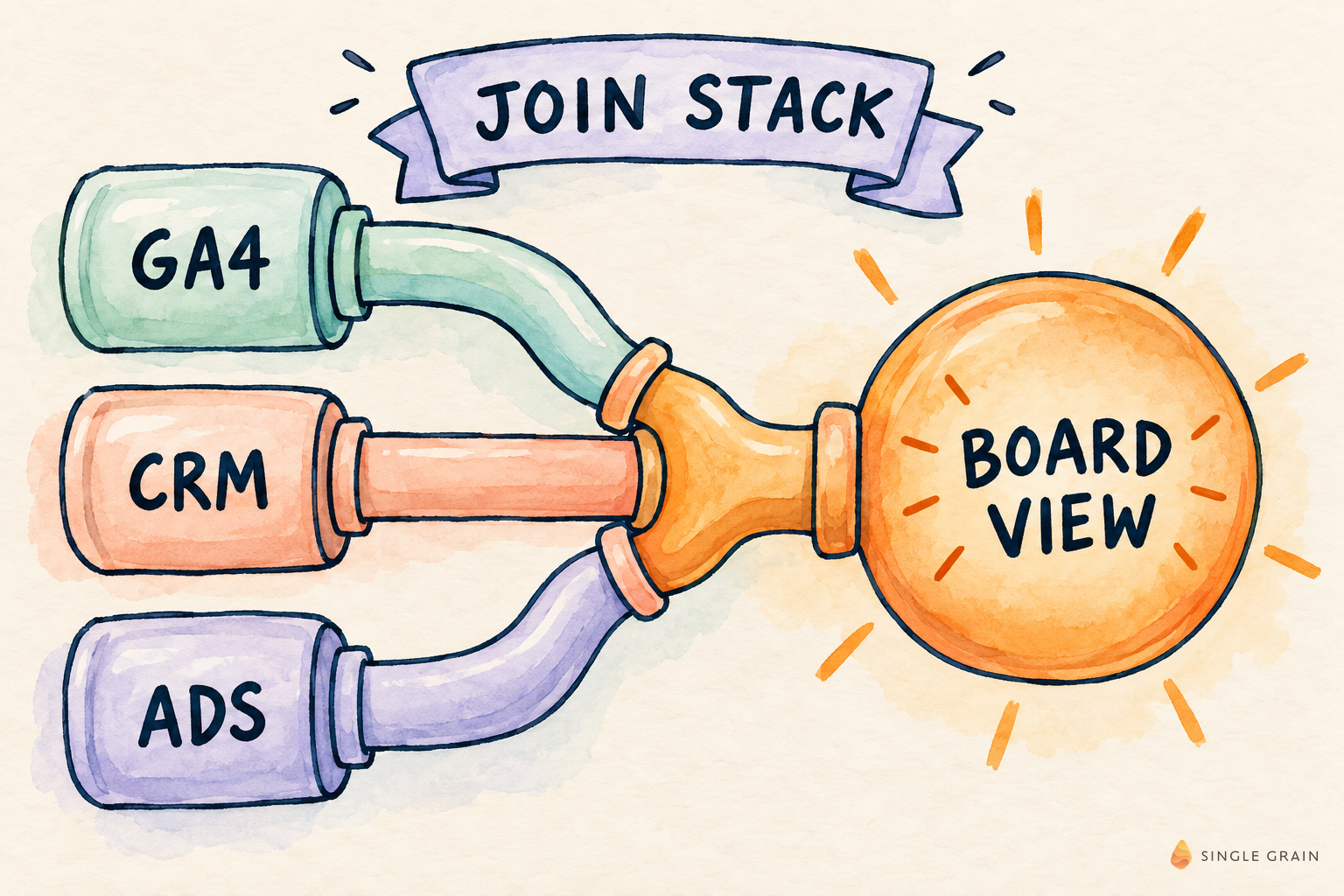
Attribution ownership is not a tool license. It is ownership of taxonomy, pipelines, and the narrative the board trusts. If event names are sloppy and CRM stages mean different things to Sales and Marketing, every model will look broken.
Cody Schneider and Eric have described the same unification idea when talking about AI-native marketing teams: connect ads spend to analytics, product events, CRM, and payment systems so you can see which search terms deserve budget because of lifetime value, not vanity clicks. That join is the stack. Ownership is who keeps the join honest every week.

Minimum taxonomy checklist
- Named events for key funnel steps with owners.
- CRM stages with written exit criteria.
- UTM and channel dictionaries that Marketing and Finance share.
- A documented rule for how AI referrals and chat answers are labeled, even if imperfect.
- A single source of truth for board views, even if exploratory views live elsewhere.
Agency vs in-house vs WebFX-class vendors
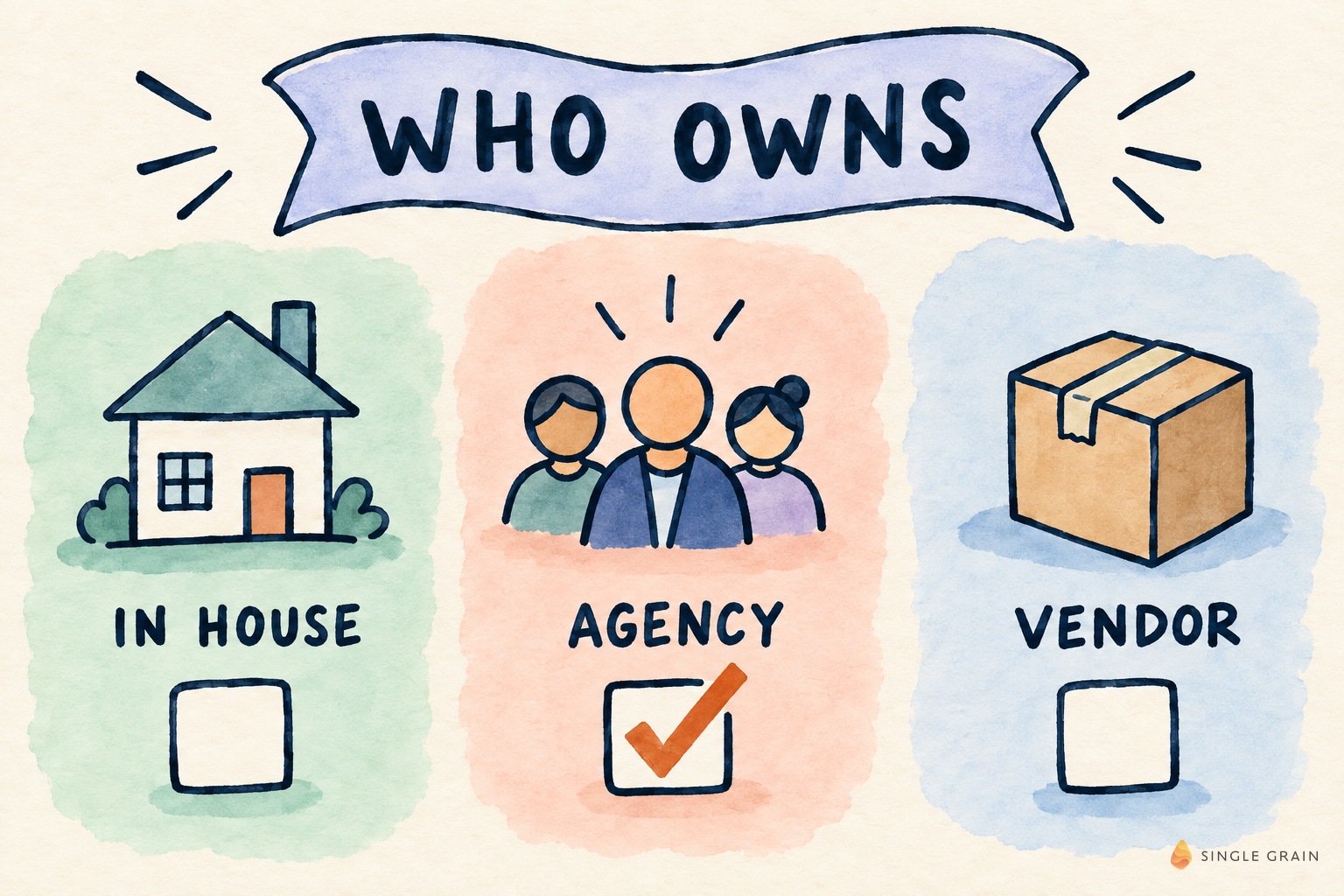
| Dimension | In-house | Specialist agency | WebFX-class vendor |
|---|---|---|---|
| Taxonomy ownership | Strong | Shared | Template-led |
| Speed to board-ready views | Variable | High if scoped | High on package |
| AI and AEO measurement add-on | DIY | Can pair with AEO | Ask explicitly |
| Best fit | Data team staffed | Growth team plus agency ops | Fixed-scope rebuild |
There is no universal winner. There is a fit. In-house wins when you already trust your warehouse and need permanent control. Agencies win when the gap is operating cadence and SaaS-specific pipeline mapping. Packaged vendors win when you want a bounded rebuild and can live with template defaults.
Decision tree you can run in one afternoon
- Do you already trust event names and CRM stages? If no, fix taxonomy first. Do not buy a new owner for a messy dictionary.
- Is the gap implementation or ongoing decision support? Implementation favors a packaged vendor or a scoped agency sprint. Ongoing decision support favors agency or strong in-house ops.
- Do you need AI-referral views alongside classic channels? If yes, ask every option how those sessions are labeled and reported. Do not assume the package includes it.
- Who presents to the board? If Marketing owns the story, choose the model that keeps Marketing fluent. If Finance owns the story, choose the model that survives audit questions.
Where Single Grain usually sits
Single Grain is a specialist agency lane: growth operating cadence, SaaS pipeline mapping, and the option to pair measurement with AI digital marketing and paid work through the paid advertising agency context. We are not pitching a warehouse replacement for teams that already have a strong in-house data function. We are pitching decision support that stays tied to revenue work.
Cost and risk patterns by model
In-house looks cheaper until headcount, on-call, and board prep time show up. Agency looks more expensive until you count the weeks your growth team stops shipping while they rebuild dashboards. Vendor packages look crisp until change requests hit the edge of scope.
- In-house risk: silent taxonomy drift when the only owner goes on vacation.
- Agency risk: shared ownership without a written RACI.
- Vendor risk: template metrics that do not match your CRM stages.
Write the RACI before the contract. Who can change event names. Who can change board definitions. Who can pause a broken pipeline. If pause requires a ticket queue with no SLA, you do not have a kill switch.
AI-era measurement extras to demand in 2026
Classic last-click views are not enough when buyers ask ChatGPT before they click your ads. Ask every model how they handle:
- AI referral traffic and assisted conversions.
- Content that earns citations but converts later through branded search.
- Agent-influenced workflows that create CRM activity without a clean UTM.
If the answer is “we will figure it out later,” later usually means never. Pair measurement rebuilds with AEO when citations are part of the growth bet. Keep AI revenue agents context nearby when the operating model includes agents that touch CRM, not only dashboards.
What not to outsource blindly
- Final definitions of closed-won and qualified opportunity.
- Legal and privacy decisions on identity joins.
- Board narrative ownership. A vendor can build the view. Your leaders still own the story.
A 30-day ownership pilot
- Week 1: freeze taxonomy and stage definitions with Sales and Marketing in the room.
- Week 2: implement or repair the join between GA4, CRM, and paid platforms for one product line.
- Week 3: publish a board-ready view and an exceptions log for mismatches.
- Week 4: decide keep, expand, or switch owner model based on mismatch rate and decision speed, not slide beauty.
During the pilot, managed agents can watch for broken events or stale UTMs if ownership is clear. Use the same standard as managed marketing agents: input, output, kill switch. Do not let an agent silently rewrite channel labels.
Failure modes to review every month
Pick five board questions and five mismatches from the month. For each miss, name whether taxonomy, pipeline, ownership, or narrative failed. Change one rule. Only one.
When two systems conflict, log the conflict. Silent resolution teaches the stack to hide disagreement. When a stakeholder wants a demo instead of a job, show the exceptions log. Demos without exceptions are how vanity attribution returns.
New teammates should shadow one full monthly cycle before they edit tracking plans. Tracking edits without cycle context recreate silent breaks. Store tracking plan versions next to CRM stage versions. Mixing versions mid-quarter creates numbers nobody can defend later.
Celebrate a shrinking mismatch rate. That usually means better ownership, not a fancier model. If the job cannot survive a vacation week, it is still a personal workflow, not an owned measurement system.
Board communication patterns that reduce thrash
Pick one board view and defend it for a full quarter unless a taxonomy bug forces a change. Switching models every month teaches the board that attribution is politics. If you must change a definition mid-quarter, publish a short change note with the old definition, the new definition, and the reason. Quiet edits destroy trust faster than ugly numbers.
Separate exploratory analyst views from the board view. Analysts should be free to chase anomalies. The board view should be boring and stable. Agencies that blur those layers create impressive workshops and confusing QBRs. Vendors that only ship the package view can starve analysts. In-house teams that only feed curiosity can starve the board. Name both layers.
When paid, organic, partner, and AI-referral channels disagree, bring the exceptions log, not a new narrative. Exceptions are the work. Narratives without exceptions are theater. Train executives to ask “what mismatched this month” the same way they ask for pipeline.
Finance partners should validate that closed-won definitions in the attribution view match the revenue system of record. Marketing-owned dashboards that redefine won deals create reconciliation fights that no creative CRO test can fix. Put Finance on the taxonomy freeze meeting even if they only stay for thirty minutes.
If you run agents that write CRM notes or route leads, label that activity so attribution does not treat agent noise as human buyer intent. Unlabeled agent activity is becoming a quiet corruption source in SaaS funnels. Fixing it early is cheaper than explaining it after a board meeting.
Finally, rehearse a vacation test. Have the primary owner offline for five business days and see whether board prep still ships. If not, you do not have an owned system yet. You have a hero dependency wearing a dashboard costume.
Keep a one-page owner map next to the board view: taxonomy owner, pipeline owner, board narrator, and pause authority. If two names appear in one cell, rewrite the cell until one name remains.
Need attribution that connects to growth work?
Single Grain helps SaaS teams pick and operate the right ownership model for GA4 and CRM attribution, then ties it back to growth decisions. If your board still gets three stories for one quarter, talk to Single Grain about a scoped ownership pilot.