Lost Deal Analysis: Score Closed-Lost Deals Worth Reopening


A lost deal analysis can uncover revenue your CRM is already sitting on. Every closed-lost deal can cost your company real sales hours, ad spend, and demos. Unfortunately, most of them never get a second look once the stage changes. A score for each one shows which of those deals deserve another shot this quarter.
My team at Single Grain built and open-sourced a script that scores every lost deal out of 100 and ranks the ones worth reopening. It’s one of my favorite builds this year, because it turns a graveyard of old opportunities into a ranked call list. It also drafts the follow-up emails and sends none of them without approval.
Which of my lost deals are actually worth chasing? Great question. Here’s how the scoring works, how to run it on your own pipeline, and where human judgment still has to make the final call.
TL;DR
- Lost deal analysis finds hidden pipeline. A score for every closed-lost deal shows which ones to reopen first, and the script checks whether your contact moved.
- Four factors drive the score. Recency is worth 35 points, deal size 30, loss reason 20, and signs of life 15, for a total of 100.
- A timing loss beats a fit loss. A deal lost because the buyer wasn’t ready yet scores higher than one lost because your offer didn’t fit.
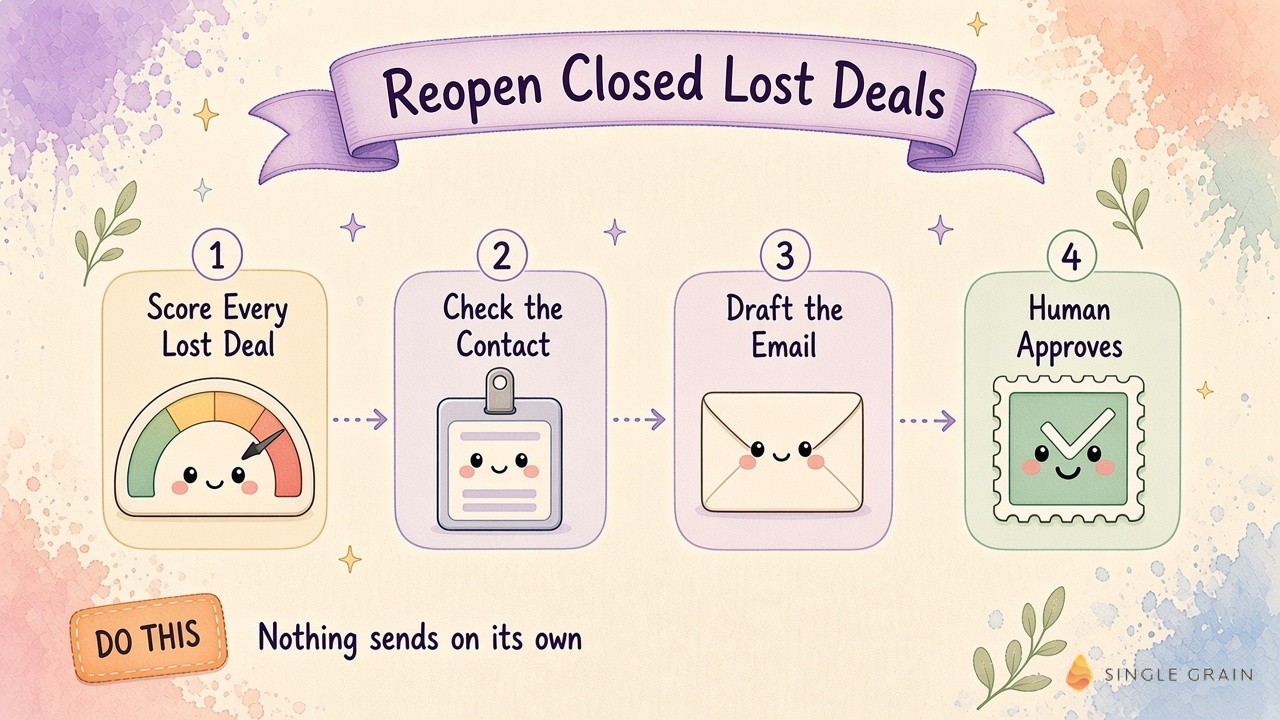
- Nothing sends on its own. Every email is a draft, and a rep approves each one before it goes out.
TABLE OF CONTENTS:
- What Is Lost Deal Analysis?
- Common Reasons Deals End Up Closed Lost
- How the Closed Lost Deal Scoring Model Works
- Why the Contact Check Matters
- How to Run the Script on Your Own Pipeline
- Where Human Judgment Still Wins
- How to Measure Whether Revived Deals Pay Off
- Turn Lost Deals Into Next Quarter's Pipeline
What Is Lost Deal Analysis?
Lost deal analysis is the process of reviewing deals your team didn’t win to learn why and to find the ones worth pursuing again. Most teams do the first half in a quarterly review and skip the second half entirely.
This gap is expensive. A deal you lost three months ago already knows your name, sat through your demo, and shared its budget. A restarted conversation is usually far cheaper than finding a brand-new prospect.
The problem is volume. A busy sales team can pile up hundreds of lost deals a year, and nobody has time to read through each one. A score gives you a ranked list, so your reps only spend time on the top of it.
Common Reasons Deals End Up Closed Lost
Before you score any deals, it helps to clean up your loss reasons. The score leans on them, and messy reasons make for a messy ranked list. Most closed lost deals fall into a handful of buckets.
- Bad timing. The buyer liked the offer but didn’t have budget, bandwidth, or urgency yet. These are your best revival candidates.
- Price. The buyer wanted the outcome but balked at the cost. A new package, a smaller starting scope, or a budget cycle change can reopen these.
- Competitor. The buyer picked someone else. Some of these come back when the competitor underdelivers, so a check-in near the end of their first contract term can pay off.
- Fit. The buyer needed a capability you don’t offer. These score lowest, and they should, unless your offer has changed since.
- No decision. The deal stalled and nobody said yes or no. These often hide timing problems, so read the notes before you file them.
Ask your reps to pick one primary reason when they close a deal, and keep the list short. A drop-down with five clear options beats a free-text field nobody fills out. Clean reasons make the twenty loss-reason points in the score far more accurate.
How the Closed Lost Deal Scoring Model Works
The script reads your closed lost deals from the past two years and gives each one a score out of 100. The weights reflect what my team has seen matter most when a deal comes back to life.
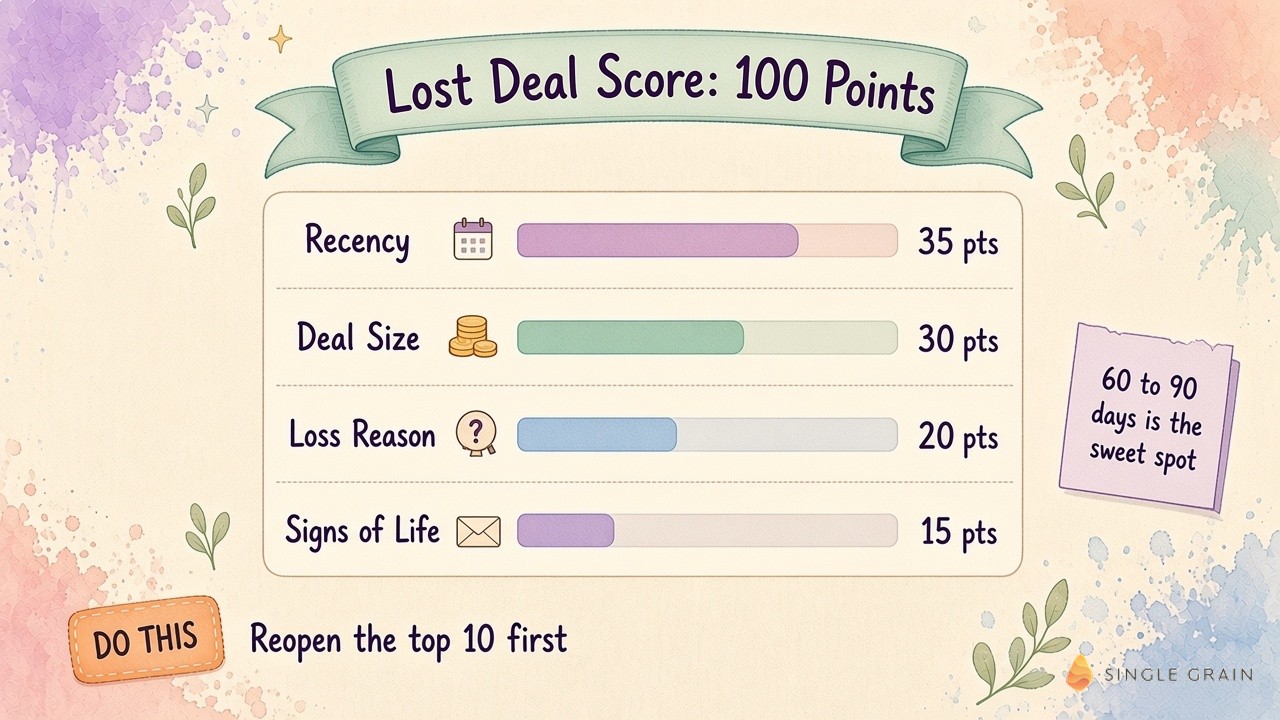
Recency (35 Points)
Recency carries the most weight. Deals lost about sixty to ninety days ago hit the sweet spot. They’re recent enough that the buyer remembers you, but enough time has passed for budgets, priorities, or leadership to shift.
Deal Size (30 Points)
Bigger deals score higher, because a single win can justify the effort of a careful follow-up. A large reopened deal can move a quarter on its own.
Loss Reason (20 Points)
Why you lost matters a lot. A deal lost on timing scores higher than a deal lost on fit. A timing problem often fixes itself, while a fit problem usually means the buyer needed a capability you don’t offer.
Signs of Life (15 Points)
Recent activity adds points. A recent email open or a visit to your site suggests the buyer still has the problem and might be looking again.
Those four factors produce the ranked list, but a score alone isn’t enough to send an email.
Why the Contact Check Matters
People change jobs constantly, and a lost deal with a departed champion can go cold fast. So before drafting an email, the script checks whether your contact still works at the company.
If they left, it looks for who replaced them. When your old contact moved to a company that fits your ideal customer profile, it drafts an email to them at the new company too. A former champion at a new company is one of the warmest leads you’ll ever get.
| Pro Tip |
|---|
| Treat a champion who changed jobs as two opportunities: the old account with a new contact, and the new account with someone who already knows your work. |
That contact check is what keeps the draft emails relevant instead of landing in a dead inbox.
How to Run the Script on Your Own Pipeline
The script is free on GitHub, and it runs on HubSpot using its CRM deals data. Drop it into Claude Code or whichever agent you use, then give it a clear instruction. Here’s the exact prompt from my post on X:
| The Prompt |
|---|
| “Read this file. Pull our lost deals from the last 2 years, score each one out of 100, and show me the top 10 with a draft email for each. Don’t send anything.” |
From there, I’d follow a simple routine:
- Run it once a month. Monthly runs keep the sixty-to-ninety-day window fresh, so new deals enter the sweet spot on a steady schedule.
- Review the top ten together. Have the deal owner and a sales manager scan the list and drop any deal with a known reason to stay closed.
- Edit every draft. Treat the emails as a starting point, and add one specific detail from the original conversation before sending.
- Log the outcome. Mark each reopened deal in your CRM so you can see which scores actually turn into meetings.
That last step is how the model gets better. After a few months, you’ll know whether your team’s best revivals come from recent losses, timing losses, or job changers.
Where Human Judgment Still Wins
A score ranks deals, but it doesn’t know the full story. It can’t see that a buyer had a bad experience with your onboarding, or that a competitor just locked them into a three-year contract. Your reps carry that context, so they always make the final call. A quick five-minute review of the top ten is usually enough to catch those exceptions before any email goes out.
That’s why the script drafts and never sends. The same approval rule runs through every agent my team builds, and I wrote about it in my piece on which AI agents get to hit send. If a bot touches a customer, a human signs off first.
It also helps to watch the other end of the funnel. The same kind of signals that revive lost deals can flag customers at risk, which is the idea behind our churn signals agent across HubSpot, Slack, and Stripe.
How to Measure Whether Revived Deals Pay Off
Track three numbers for every batch: how many drafts went out, how many got a reply, and how many turned into a booked meeting. Then follow those meetings through to closed-won revenue.
Compare that against the cost of new pipeline. Most teams already know roughly what a net-new opportunity costs in ad spend, content, and sales hours, so the math doesn’t take long. If a revived deal costs a fraction of a net-new one to close, lost deal analysis deserves a permanent slot on your sales calendar. You can also connect these results to your broader pipeline velocity work, since reopened deals often move faster than cold ones.
Turn Lost Deals Into Next Quarter’s Pipeline
Lost deal analysis turns old opportunities into a ranked call list. Score every closed-lost deal on recency, size, loss reason, and signs of life, check whether your contact moved, and let a human approve every email. Run it monthly and track the results, and your CRM stops being a graveyard.
If you’d like help building AI agents that find pipeline you already own, my team at Single Grain offers AI transformation services and lead generation programs built around real sales data. Contact Single Grain and we’ll show you what’s hiding in your closed-lost list.
Frequently Asked Questions About Lost Deal Analysis
-
What is lost deal analysis?
Lost deal analysis is reviewing deals you didn’t win to learn why you lost and to find the ones worth reopening. Scoring each deal turns that review into a ranked list.
-
When should you follow up on a closed-lost deal?
In my team’s scoring model, deals lost about sixty to ninety days ago hit the sweet spot. The buyer still remembers you, and budgets or priorities may have shifted.
-
Which closed-lost deals are most likely to come back?
Deals lost on timing, larger deals, and deals showing recent activity like email opens or site visits tend to score highest.
-
Should AI send follow-up emails to lost deals automatically?
No. The script drafts every email and sends none without approval, so a rep can add context and drop deals that should stay closed.
-
Does the lost deal scoring script work outside HubSpot?
My team built it on HubSpot. Other CRMs would need the data pull adjusted to match their fields.