Marketing Rule of 7 Is Now 28: How Many Touches Before a Sale?


Rule of 7 marketing claims a buyer needs to see your brand seven times before they act. For anything big-ticket, that number is badly out of date. In fact, data from NP Digital counts 23 interactions before a B2C purchase over $10,000. Now, I actually plan for 28, because many deals now run well past $10,000 and buying groups keep getting bigger. I find that if you only plan around seven, you’ll accidently end up cutting the channels that quietly close your largest deals.
On a Marketing School episode, my co-host Neil Patel, cofounder of NP Digital, and I traced how that number keeps climbing. We started at seven years ago, moved to 14, then 21, and today I’d plan for something closer to the rule of 28. Buyers find you in more places than ever, and most of those touches never show up in a last-click report.
In this article, I’ll explain where the marketing rule of 7 came from, what newer touchpoint data says, and how to plan and measure marketing touchpoints for buyers who need far more than seven.
TL;DR
- The rule of 7 in marketing is too low for most purchases today. NP Digital’s December 2024 study found 23 interactions before a B2C purchase over $10,000 and 16 for B2B purchases over $10,000.
- Price drives the number of touches. Purchases under $100 needed about 8 interactions for B2C and 3 for B2B, and the count rises sharply with deal size.
- Most touches are hard to attribute. YouTube, podcasts, newsletters, and AI answers often get no credit even when they start the deal.
- Plan for touches, then measure assists. Map the channels buyers see, track self-reported attribution, and judge brand channels on pipeline over time.
TABLE OF CONTENTS:
- What Is the Rule of 7 in Marketing?
- How Many Marketing Touchpoints Buyers Need Today
- Why the Rule of 7 Became the Marketing Rule of 28
- Why Most Marketing Touchpoints Never Get Credit
- How to Plan Marketing Touchpoints for Big-Ticket Buyers
- How to Measure Customer Touchpoints You Can't Fully Track
- Plan for More Touches and Win the Bigger Deals
What Is the Rule of 7 in Marketing?
The marketing rule of 7 is an old advertising rule of thumb. It says a prospect needs to hear or see your message about seven times before they take action, whether that’s a call, a signup, or a purchase. It came from a world of radio spots, print ads, and direct mail, where a brand controlled most of the touches.
Marketing touchpoints are every moment a buyer meets your brand. A podcast mention, a YouTube video, a search result, an AI answer, a review, a sales email, and a conversation with a friend all count. Customer touchpoints include the moments after the sale too, like onboarding and support.
The idea behind the rule still holds. Repetition builds trust, and trust shortens the decision. The part that broke is the number, and it broke because buyers now spread their research across far more channels.
So how many touches do buyers actually need now? The data gives a much bigger answer.
How Many Marketing Touchpoints Buyers Need Today
During the episode, Neil pulled up a December 2024 study from his agency. It looked at 800 companies, 100 per price band, and combined surveys with analytics data to estimate how often people interact with a brand before buying. I’ve charted the published numbers below.
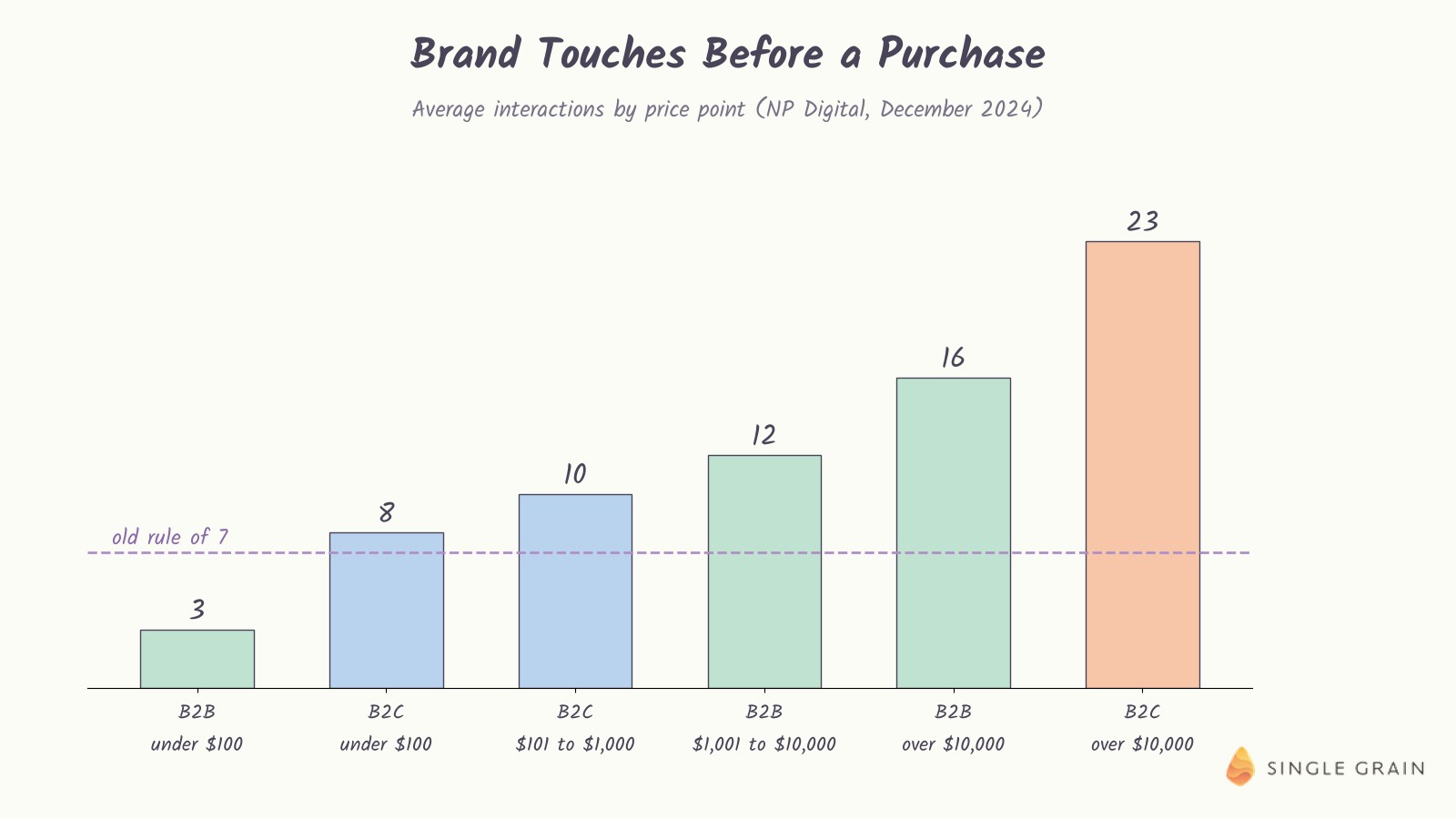
The pattern is simple to read. A cheap consumer purchase took about eight interactions, which is already above seven. A consumer purchase over $10,000 took 23, and a B2B purchase over $10,000 took 16. Neil’s quick take on air was that the rule of 7 “no longer exists,” and the chart backs him up.

Where does 28 come from, then? It’s my planning number, and I explain it below. The study tops out at 23 for its highest price band, but deal sizes for many of the companies I talk to run well past $10,000, and buying groups keep getting bigger. I’d rather plan for more touches and be pleasantly surprised.
Why the Rule of 7 Became the Marketing Rule of 28
Three shifts pushed the number up, and every one of them is still accelerating.
First, buyers research in more places. Google’s consumer insights team described this years ago as the messy middle, a complicated web of touchpoints that differs from person to person. A single deal can include a Google search, a ChatGPT answer, a few YouTube videos, a podcast episode, a review site, and a LinkedIn post. Each one is a touch, and none of them happens in a channel you fully control.
Second, bigger purchases carry more risk. The more a mistake would cost, the more proof a buyer wants, and proof takes time and repeated exposure. That’s why the price bands in the chart climb so steeply.
Third, the touches get harder to see. A story from the episode shows this well.
Story Time: When Touches Get Harder to See
Neil and I were grabbing gelato when someone walked up and recognized us. He told me he watches my AI content and told Neil he’s an OG, and he had no idea we host a podcast together. Same two people, completely different paths to knowing us.
This story points straight at the biggest problem with the rule of 28, which is attribution.
Why Most Marketing Touchpoints Never Get Credit
YouTube drives leads for my agency that nobody can attribute. People might say they came through Google or an LLM, but when my sales team talks to them, they’ve usually watched a video or heard the podcast first.
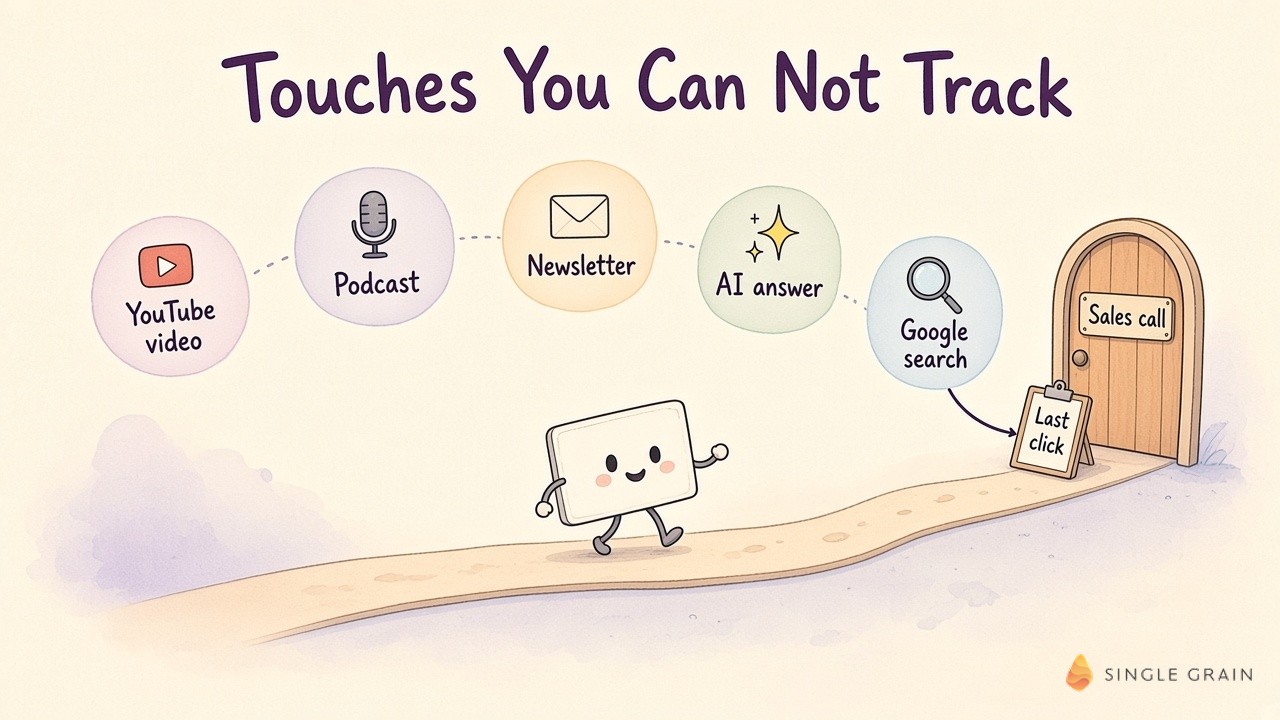
One part of this is privacy. Stricter data laws make it harder for platforms to share and track everything.
The other part of it is competition, since every big tech company now has an AI product and less reason to share data with the others. Fifteen years ago, you could open Google Analytics and see the keyword behind every conversion. Those days are gone.
If you judge channels on last click alone, you’ll keep cutting the videos, podcasts, and newsletters that create demand, and you’ll keep overfunding the search ads that capture it at the end. I wrote about this trap in why I quit multi-touch attribution, and it’s even more true with more touches in the mix.
So how do you plan a program for 28 touches without losing your mind? Here’s the approach I recommend.
How to Plan Marketing Touchpoints for Big-Ticket Buyers
You don’t need 28 separate campaigns. You need enough useful places for a buyer to meet you, and a steady rhythm in each one.
Map the Touchpoints Your Buyers Already Use
Start with your last 10 to 20 closed deals. Ask sales what each buyer mentioned on calls, and add your form fill data and CRM notes. You’ll usually find five or six channels that show up again and again, and those are the ones to double down on.
Build Content That Shows Up More Than Once
Long-form video is the best touch multiplier I’ve found. One episode can become clips, a newsletter section, a blog post, and social posts, which my team covers in repurposing long-form video into seven weekly assets. Each piece is another chance to meet the same buyer in a new place.
| Action Step |
|---|
| Pick one flagship format, like a weekly video or podcast, and commit to it for 90 days before judging results. Big-ticket buyers need time to collect their touches. |
Ninety days sounds long, yet it lines up with how slowly large deals move.
Keep Search and AI Answers in the Mix
Search still catches buyers when they’re ready, and AI answers increasingly shape the shortlist before they click anything. Treat both as touches in the same journey, and make sure your comparison and pricing content is easy to find and easy to quote.
With the plan in place, the last piece is proving it works.
How to Measure Customer Touchpoints You Can’t Fully Track
Perfect attribution isn’t coming back, so the goal is a measurement setup leadership will trust. I lean on three signals.
- Ask every new lead how they heard about you. A free-text “how did you hear about us?” field on forms and a question on the first sales call surface the video, podcast, or newsletter that click tracking misses.
- Track assisted conversions over a long window. Google’s attribution guide for Analytics explains how data-driven attribution spreads credit across touches, which gives brand channels a fairer read.
- Tie brand channels to pipeline over quarters. Compare pipeline and win rates in periods with heavier content output, and connect your analytics to the CRM with a revenue attribution join finance will sign off on.
None of these is perfect on its own. Together, they give you a picture strong enough to defend brand and video spend in a budget meeting, which is often where the rule of 28 gets decided.
| Pro-Tip |
|---|
| When a CFO asks why a podcast or video channel deserves budget, bring five recent closed deals where the buyer named it on a sales call. Real names and dollar amounts beat any attribution model. |
A handful of real stories usually carries more weight than a dashboard.
Plan for More Touches and Win the Bigger Deals
The rule of 7 made sense when brands controlled the channels. Today, buyers collect their own touches across search, AI answers, video, podcasts, and peers, and the bigger the deal, the more touches they need. Plan for the rule of 28, measure what you can, and keep funding the channels buyers actually mention.
If you’d like help building a demand generation program that shows up across every touchpoint, my team at Single Grain runs content marketing and paid advertising built around pipeline. Talk to Single Grain and we’ll map your buyers’ touchpoints together.
Frequently Asked Questions About the Rule of 7 in Marketing
-
What is the rule of 7 in marketing?
The rule of 7 is an old marketing guideline that says a prospect needs to see or hear your message about seven times before they buy. It dates back to the era of radio, print, and TV ads.
-
Is the rule of 7 still accurate?
For big purchases, no. NP Digital’s December 2024 study found 23 interactions before a B2C purchase over $10,000 and 16 for a B2B purchase over $10,000.
-
How many touchpoints does a buyer need before buying?
It depends on price. In the same study, purchases under $100 took about 8 interactions for B2C buyers and 3 for B2B buyers, and the count climbed with deal size.
-
Why do most marketing touchpoints go unattributed?
Buyers often see you on YouTube, in a podcast, in a newsletter, or in an AI answer, and none of those views show up as a tracked click. Self-reported attribution helps fill the gap.
-
How should I measure touchpoints I can't track?
Ask how buyers heard about you on every form and sales call, watch branded search over time, and judge brand channels on pipeline influenced across quarters.