

How to Expire Stale CRM Facts Before Your Marketing Agent Acts on Them


At the pre-send check in this worked example, a RevOps manager opens an outbound queue and finds an email treating a churned account as a current ideal customer. The CRM still carries its old ICP tier. The agent followed the campaign instructions, but nobody checked whether the business facts supporting the message were still valid.
At that same checkpoint, the useful artifact is a fact record with a source, a verification clock, and an expiry rule. An expired ICP tier should stop the dependent action before the email reaches the sending tool. That control belongs on the account context, regardless of which prompt or model produced the copy.
TABLE OF CONTENTS:
- Quick Overview
- Why prompt pinning is not a freshness TTL
- Worked scene: the agent that emailed a churned account as if it were still ICP
- Worked scene: TTL fields on ICP, pricing, and offer facts
- Freshness-TTL checklist (field, clock, refresh owner, block)
- Single Brain installs the system; Single Grain runs it when you need the team
Quick Overview
Prompt pinning freezes instructions. Freshness time-to-live rules expire the business facts those instructions operate on. For Single Grain’s CRM, SEO, and AEO workflows, the control belongs between context retrieval and action. Start with facts that can change eligibility or public claims, then assign each a clock, refresh owner, and blocking behavior.
- Expire individual facts, rather than treating an entire company brain as fresh.
- Use authoritative verification time, not retrieval time, to start the clock.
- Invalidate facts early when churn, pricing, or offer changes arrive.
- Keep missing, conflicting, and thin evidence visible to the decision layer.
Why prompt pinning is not a freshness TTL
Single Grain’s prompt-version-pinning guide addresses instruction stability: which prompt ran, what changed, and how to reproduce behavior. A pinned prompt can still retrieve last quarter’s ICP classification. Reproducing that decision faithfully does not make the classification current.
A freshness contract answers a separate question: may this fact support this action now? RFC 9111’s HTTP caching specification defines freshness lifetimes through mechanisms including max-age and Expires. Borrow the explicit lifetime and validation pattern. CRM facts still need business-specific invalidation rules and authoritative sources.
Reading an old value must not reset its clock. Neither should an unrelated edit to the account record. Record when the fact itself was verified, calculate its expiry from the approved policy, and check for superseding events. A churn event can invalidate an eligibility decision before its scheduled expiry.
The priority is operational. The Open Future Forum September report says 81% of 230 marketing and growth leaders are past exploring agentic AI. Attribution was the most frequently named challenge, appearing in 20 of 96 open answers. Those findings support logging the evidence behind actions, not assuming that adoption demonstrates reliability.
Worked scene: the agent that emailed a churned account as if it were still ICP
Eric’s Leveling Up discussion of a company brain starts with material companies already possess: customer calls, company content, and internal conversations. Agents pull topics from that material. The practical opportunity is to reuse customer language and questions instead of starting content research from nothing.
The freshness problem begins when that same material becomes evidence for present-tense decisions. A customer call can accurately describe a buyer’s priorities at the time and become unreliable support for today’s targeting. Eric’s recommendation changes the architecture: store company context as governed evidence with provenance and clocks, rather than an unlimited transcript dump. This is the next control after building a company brain that grounds ICP decisions.
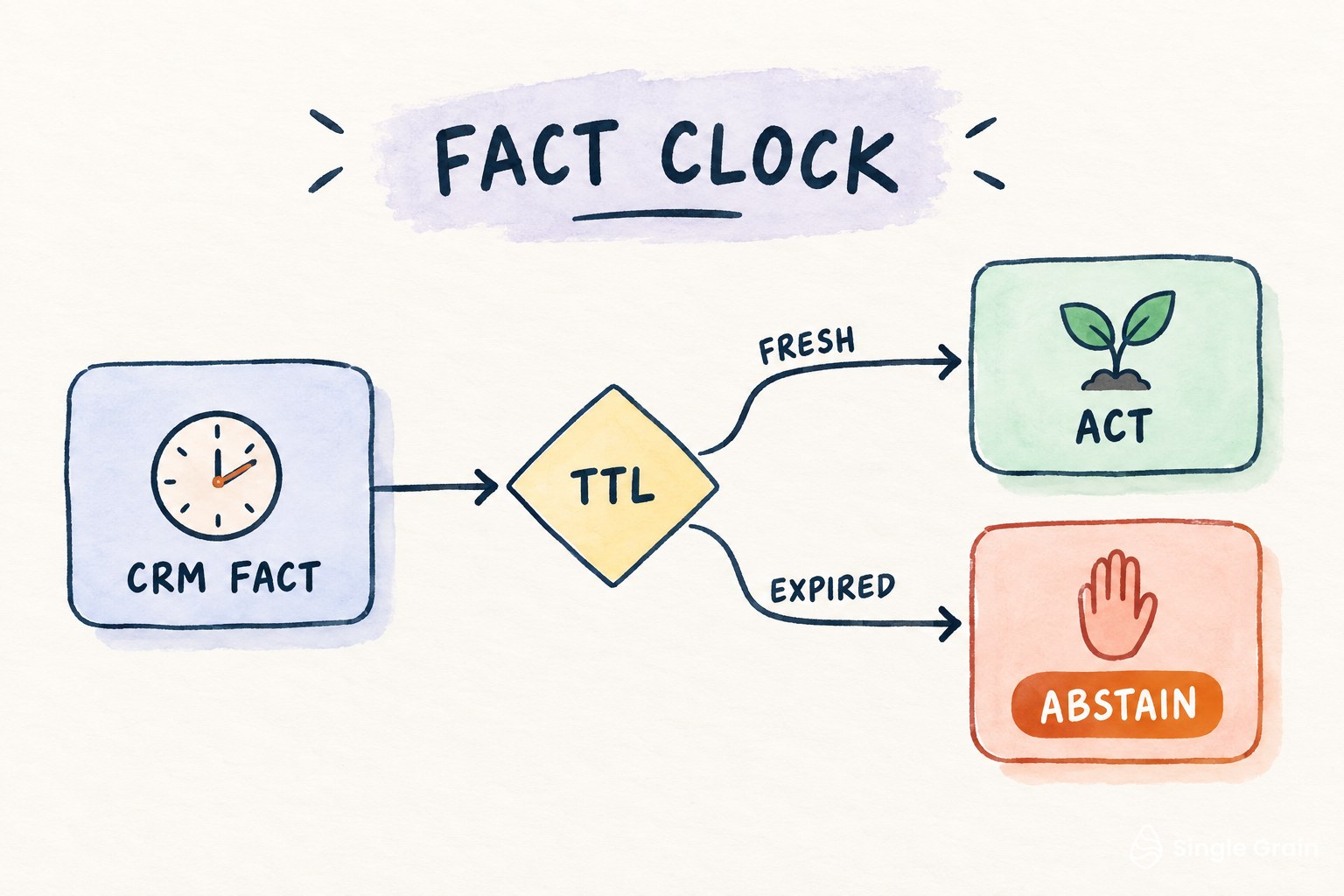
Return to the outbound example. The CRM contains a historical ICP tier and a newer churn status. ICP fit and customer status are different facts: churn does not necessarily erase fit, but it invalidates copy that assumes an active customer relationship. The eligibility check must require both current classification evidence and an appropriate lifecycle state.
Use the supplied 90-day ICP TTL as an illustrative policy, not a universal recommendation. If the tier’s verification clock has expired, the agent abstains from the dependent send and requests revalidation from RevOps. If a churn event already contradicts the message, the action blocks immediately. Success means the stale or contradictory evidence cannot authorize the send.
Worked scene: TTL fields on ICP, pricing, and offer facts
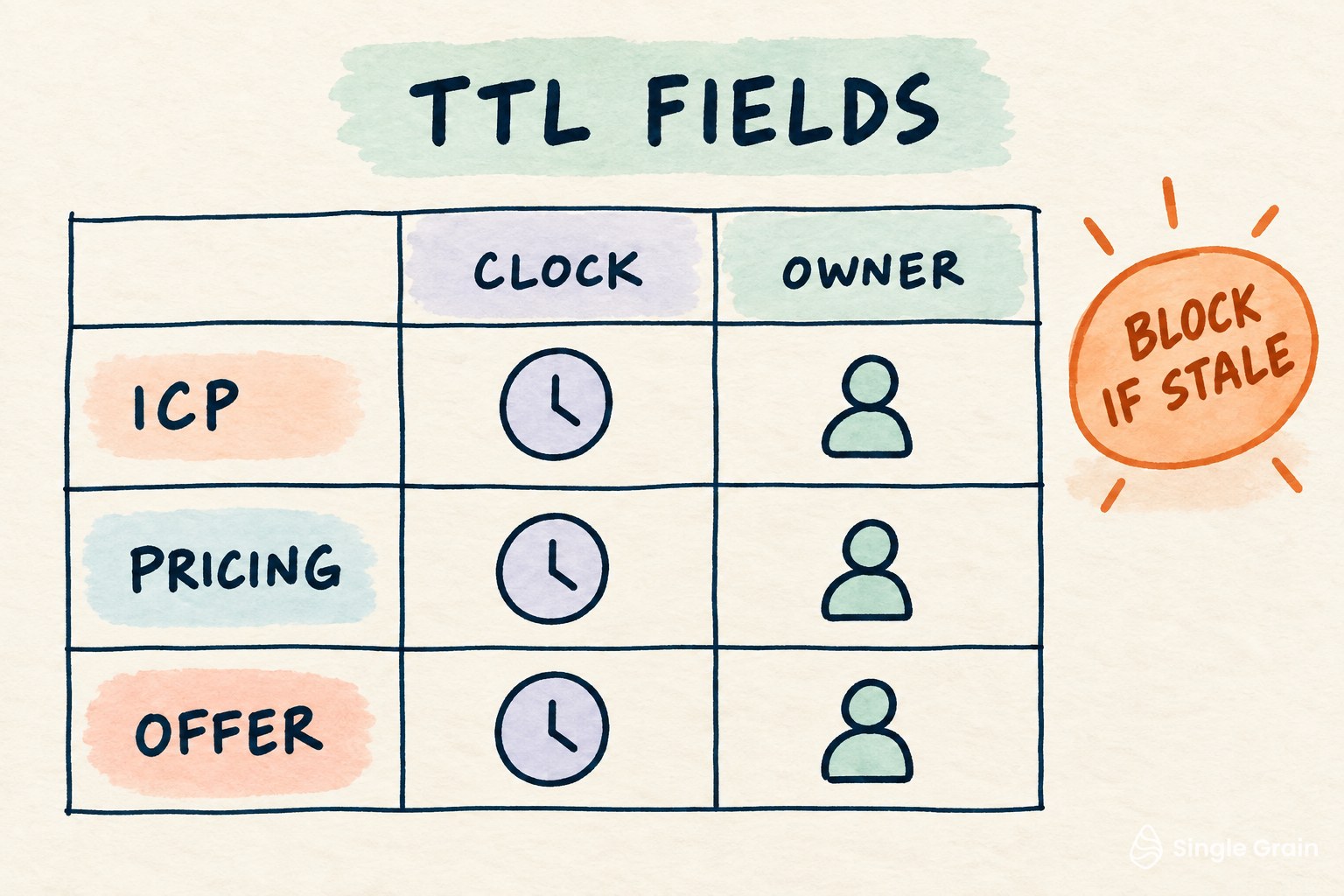
The second worked example moves the same account context into content operations. An AEO agent retrieves an ICP card, a pricing card, and an offer card to draft a product comparison. The ICP card is within its example 90-day window. The pricing card lacks a verification timestamp, while the offer card points to a withdrawn promotion.
Do not grant the retrieved bundle one shared freshness label. The ICP card can support audience framing. The pricing claim remains unavailable until the pricing owner verifies it against the authoritative record. The withdrawn offer is invalid regardless of when the agent retrieved it. Do not invent a standard pricing TTL: the owner must set a lifetime appropriate to the business’s change process.
Each card needs its value, source reference, verified-at time, expiry, refresh owner, and supersession status. For SEO and AEO work, preserve those references with the draft so an editor can trace commercial claims. Single Grain’s CRM field contracts provide the schema discipline; freshness adds the temporal permission to use each value.
Forrester reports that 83% of B2C marketing decision-makers are implementing agentic AI, describing seven categories and 52 use cases. That breadth argues for a reusable fact gate across agents. It does not establish a safe TTL or prove that a particular workflow is ready.
Freshness-TTL checklist (field, clock, refresh owner, block)
Make the freshness contract executable before expanding agent access:
- Field: identify the exact claim and the actions that depend on it.
- Clock: distinguish authoritative verification from ingestion and retrieval.
- Refresh owner: assign a role with access to the source of truth.
- Block: define behavior for expired, missing, conflicting, or superseded evidence.
- Trace: log the source, freshness state, and decision at action time.
Apply Eric’s Jev workflow discussion here: classify the case, test explicit criteria, and route uncertainty for human review. Name the actual approver in the deployment record, such as the RevOps lead for account actions or content lead for commercial claims. Keep sending and publishing behind that approval gate.
Eric’s discussion of a decision layer for existing agents also changes the rollout: label thin evidence as thin and use feedback to improve checks before claiming autonomy. In the marketing-agent eval harness, test an expired ICP tier, a missing pricing timestamp, and a superseded offer. Require the expected block for each.
The wrong purchase is a stronger model without this schema. Eric’s better-model, better-workflow discussion supports fixing the control first. A model upgrade cannot supply an absent verification record.
Single Brain installs the system; Single Grain runs it when you need the team
Single Brain is the AI implementation OS for job-specific agents, evals, and kill switches. For this job, the installation means fact contracts, source connectors, expiry checks, refresh routing, and controls that disable actions when required evidence fails.
Set kill criteria for the context store itself. Eric’s account of Supermemory dropping its Company Brain despite user enthusiasm highlights limited attention and the need to focus on core memory work. Shrink the store when freshness maintenance exceeds the team’s capacity. Do not automate claims whose authoritative source or refresh owner remains unknown.
Own the system internally if you can maintain those contracts and resolve blocked work. Hire Single Grain to install and run it when you need the operating team without staffing it yourself. Start with one consequential action and its required facts, then expand only after the freshness controls hold.