

How to Stop One-Off Chat and Put Marketing Agents on a Real Schedule


Monday morning, the content lead opens Slack to ask for the weekly SEO brief. The artifact is another chat thread: target keywords, a reminder about the audience, and a request to check last week’s content. In this proposed content-ops job, Friday’s missing run becomes Monday’s repeated setup.
At the demand-gen desk, the same scheduling gap takes a different form. A daily lead-triage agent produces a queue, but its job card names neither an on-call owner nor a stop condition. The operator has results to inspect and no clear route for an incomplete record. Both jobs need a recurring contract before they need another prompt.
TABLE OF CONTENTS:
- Quick Overview
- Why a reliability framework is not a job scheduler
- Worked scene: the Monday chat that should have been a Friday cron
- Worked scene: cadence, owner, and definition of done on one job card
- Recurring-job checklist: trigger, inputs, DoD, on-call, kill, and human approval
- Single Brain installs the system; Single Grain runs it when you need the team
Quick Overview
Turn repeat requests into scheduled job cards with explicit inputs, owners, and completion criteria. Eric Siu’s workflow tapes support building reusable controls that a team can inherit. The two scenes below are proposed operating designs, not reported Single Grain client results. Start with a bounded deliverable, then choose the scheduler and model that can execute its contract.
- Schedule an artifact, such as a brief or triage queue, rather than an open-ended assistant.
- Put cadence, timezone, input freshness, and exception routing on the card.
- Separate a successful scheduler invocation from a completed marketing job.
- Fix missing workflow controls before buying a stronger model.
Why a reliability framework is not a job scheduler
Single Grain’s five-step reliability framework addresses dependable execution. This page owns a different decision: which recurring job starts when, with whose inputs, and under whose ownership. A reliable agent can still sit idle until someone remembers to message it. A scheduler can faithfully launch a job whose source material is stale.
Eric’s point that a better model still needs a better workflow changes the purchase order. Define the job schema and run states first. Upgrade the model only when evaluated outputs show a capability gap. Missing input rules, duplicate runs, and ownerless exceptions are workflow problems.
Open Future Forum’s September report says 81% of 230 marketing and growth leaders are past exploring agentic AI. Attribution was the most-named challenge, appearing in 20 of 96 open answers. That supports keeping source references and run records with each deliverable. It does not establish that scheduling improves revenue attribution.
Forrester reports 83% of B2C marketing decision-makers implementing agentic AI, covering seven categories and 52 use cases. Broad adoption makes a bounded first job more useful than another use-case catalog. These surveys describe different populations, so their percentages should not be treated as a trend.
Worked scene: the Monday chat that should have been a Friday cron
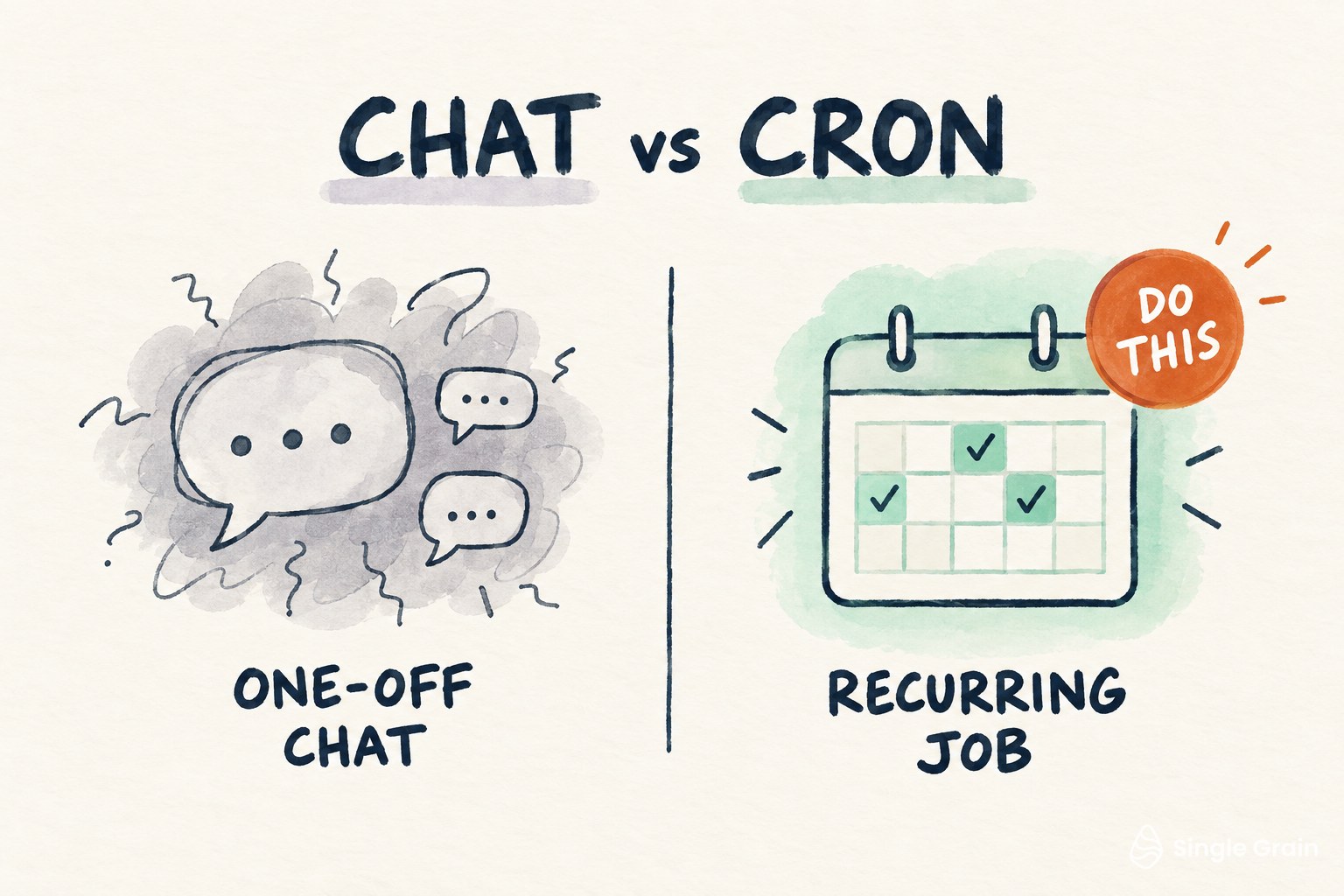
In Eric’s Leveling Up discussion of reusable workflows, the sequence is straightforward: build the workflow, then hand it to the team. The reusable workflow survives the handoff; custom work keeps requiring fresh attention. For this content job, that changes the deliverable from a saved prompt to a card the content team can operate again.
Move the Slack request to Friday at 09:00 in the content team’s declared timezone. The proposed cron expression is scheduler-dependent, but a standard five-field implementation would use “0 9 * * 5” with timezone configured separately. Record holiday behavior and daylight-saving handling instead of assuming the server clock matches the team.
The card requests one weekly SEO brief package. Inputs are the approved keyword backlog, current content inventory, and versioned ICP document. Single Grain’s company-brain approach supplies the audience context without rebuilding it in Slack. If a required source is unavailable or outside its freshness limit, return “needs input” rather than improvise.
Definition of done: every selected topic has a target query, audience problem, supporting source links, overlap check, and proposed outline. Save the package to the designated workspace and attach its run ID. The content lead owns completeness; an assigned backup handles missing inputs. Monday begins with a traceable artifact or an explicit exception.
Worked scene: cadence, owner, and definition of done on one job card
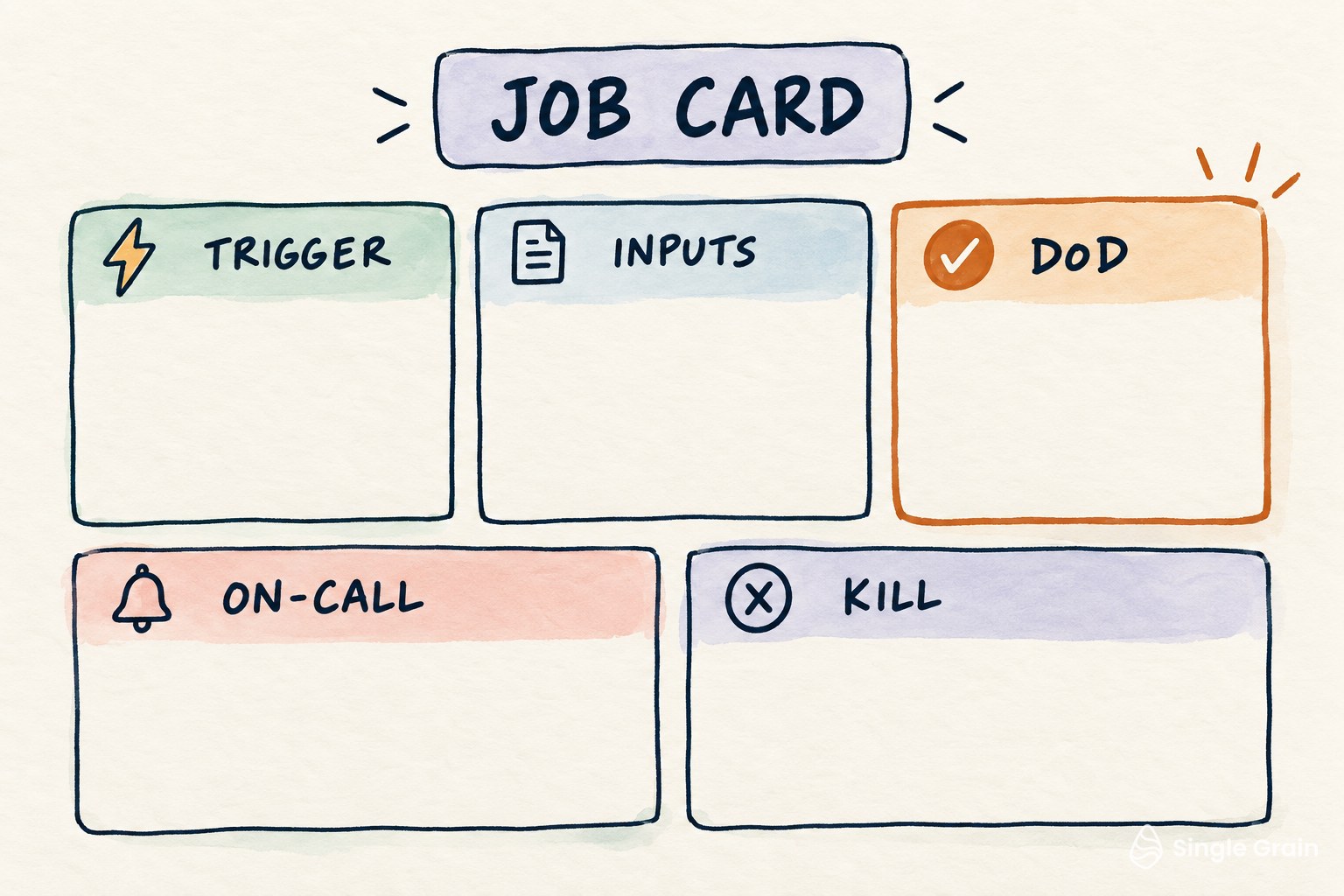
For the proposed demand-gen job, set a daily trigger and process only new or changed records since the last completed checkpoint. Name the demand-gen operations lead as owner and a backup as on-call. Use record IDs and the checkpoint to prevent a retry from duplicating the queue.
Eric describes Jev as a fast, cheap middle layer for classification, criteria, and routing between models and operations. Apply that architectural lesson before the writer model runs: the middle layer enforces the job contract, schedule, approved data fields, destination allowlist, and TTL. TTL is the permitted age of a queued action, after which the job must recheck its inputs.
The job’s DoD is a triage queue containing record IDs, classification reasons, source fields, and unresolved cases. Outreach copy is outside this contract. Kill the run if the input schema changes, required routing fields disappear, or a destination falls outside the allowlist. Keep the checkpoint unchanged when processing fails.
Plane Agents provides a product example of recurring workspace jobs with start, return, and need-input visibility. Use those capabilities as buying criteria, not proof that a tool understands your lead policy. Single Grain’s pipeline RACI guidance helps assign accountability beyond whoever configured the integration.
Recurring-job checklist: trigger, inputs, DoD, on-call, kill, and human approval
Eric’s Jev testing discussion supports explicit criteria and routing uncertain cases to human review. His discussion of people, taste, and workflow management keeps judgment with the team. Put both controls here: name an actual person as ship gate for publishing, sending, irreversible writes, and teardown. Neither scene should auto-act on uncertain classifications.
- Trigger: cadence, timezone, missed-run behavior, and overlap prevention.
- Inputs: permitted sources, schema version, freshness limits, and missing-data behavior.
- DoD: required artifact fields, destination, source references, and completion record.
- On-call: named owner, backup, notification destination, and restart authority.
- Kill: stop conditions, credential revocation path, and preserved checkpoint.
Decline automation when the task rarely repeats, the objective changes each run, or nobody can define acceptable output. Use a bounded manual workflow until those conditions change. Buying a stronger model before settling the schema only makes an undefined job more expensive.
Single Brain installs the system; Single Grain runs it when you need the team
Single Brain is the AI implementation OS for agents, eval, and kill switches. Scope the installation to the job: Friday brief generation needs source-freshness checks and completeness evals; daily lead triage needs criteria tests, checkpoint handling, and a routing stop. Keep shared controls reusable while preserving each job’s completion contract.
Use Single Grain’s hire-or-build guide to decide who operates the system. Build internally when you have a workflow owner and maintenance capacity. Hire Single Grain to install and run it when you need the operating team without staffing that function yourself.
Talk to Single Grain with one recurring request, its source systems, and its intended deliverable. Start with a job card the team can inherit.


