We Uninstalled Our AI SDR. Here Is What Broke.



AI SDRs were supposed to fill the calendar while everyone slept. Months in, teams started quietly pulling them out, because the meetings that showed up stopped matching the meetings that got booked. If you signed off on one to hit pipeline targets, you already know the sinking feeling of a dashboard that looks healthy while revenue sits still.
The pattern is consistent enough to name. An AI SDR sends more, personalizes faster, and still books the wrong buyer with the wrong offer, now at a speed that burns your domain reputation while it does it. The writing was rarely the problem. The tool failed because sending more of a broken message is not a strategy.
I will show you exactly what breaks with an AI SDR, the one number that tells you the truth, and where AI still earns a seat in outbound instead of torching it.
TABLE OF CONTENTS:
TL;DR
- An AI SDR scales whatever you feed it, so a weak offer and a loose list turn into more wrong emails, worse deliverability, and meetings that never show.
- The number that exposes a broken setup is cost per meeting that actually shows up, not emails sent, reply rate, or meetings booked.
- Keep AI on research, list prioritization, and first-draft personalization, tighten the offer and the list first, and keep a human on every send.
Why We Pulled the AI SDR
An AI SDR is software that runs the top of outbound for you. It researches prospects, writes the emails, and fires the sequence (the job a sales development rep used to do by hand). Point it at a list and it contacts every name faster than any human team could.
Once ours was running at full volume, the problem was not that it stopped working. It worked exactly as told, and that was the issue. It emailed everyone on the list with the pitch we gave it, at a pace no rep could match, and every weak assumption baked into the list and the offer got amplified the same way.
We were not the only ones. There is a public account of an operator removing an AI SDR after months of use, and another team’s post-mortem describing the same slow realization: the activity charts kept climbing while real pipeline stayed flat.
Here is the correction I give every team that asks me about it. An AI SDR is an amplifier, and it will amplify a weak offer exactly as fast as a strong one.
What Breaks First
The message and the targeting break first. An AI SDR scales whatever offer and buyer list you give it, so a weak offer or a loose list turns into more wrong emails, worse deliverability, and meetings that never show, while the human context that closes deals never makes it into the system.
Wrong Buyer, Wrong Offer, at Scale
Most teams feed their AI SDR an ICP that is too broad. “Director-level and above at mid-market SaaS” sounds specific until the agent starts emailing directors of customer support about a product built for revenue ops.
The offer problem is worse. A human rep reads the room and adjusts the pitch based on a prospect’s recent post, a funding round, or a mutual connection. An AI SDR takes the value proposition you typed into a prompt field and sprays it across hundreds of inboxes with small word variations that feel personal and say nothing new.
One issue I keep seeing is teams grading an AI SDR on emails sent, which is the number that means the least.
Deliverability and Domain Damage
Volume without precision trips spam filters. Bounce rates climb. Recipients mark you as junk. Within weeks even your human reps land in spam, because the domain reputation took the hit.
This is the part that stings. The damage outlasts the tool. You can uninstall an AI SDR in a day. Rebuilding sender reputation takes months.
The Context Gap
Real sales conversations produce signal no CRM field captures cleanly. A prospect mentions they are locked into a contract until Q3. Another loved a competitor’s demo and hated the onboarding. A rep hears these things, adjusts the timing, and tailors the next touch.
An AI SDR works with half the story, because calls, objections, and next steps rarely make it into the system in any structured way. The agent keeps emailing a prospect who already said “not now,” or worse, one who already said “yes” to someone else.

The Metric Nobody Quotes
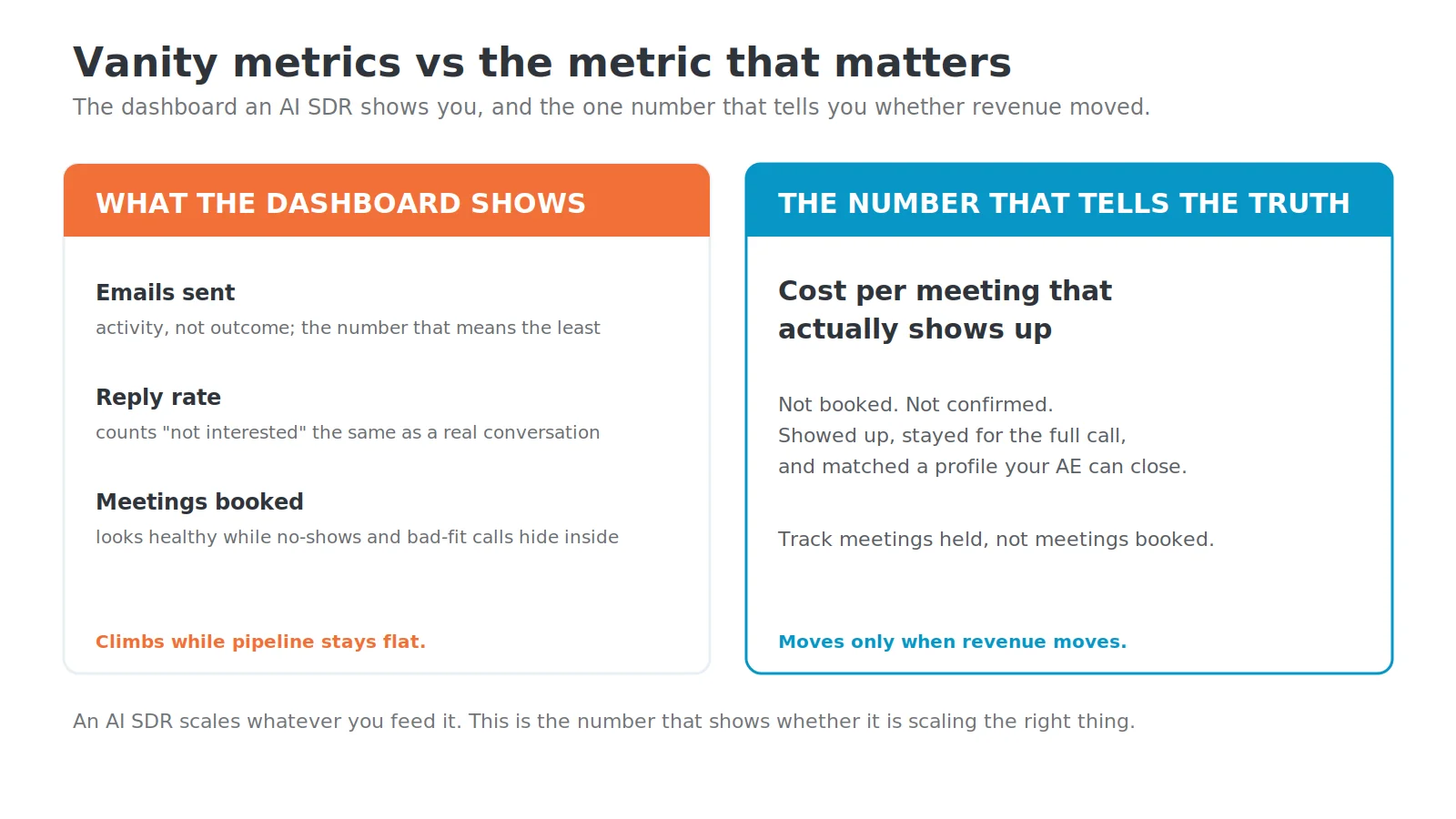
Every AI SDR vendor shows you the same dashboard. Emails sent. Reply rate. Meetings booked. None of those numbers tell you whether revenue moved.
The number that matters is cost per meeting that actually shows up. Not booked. Not confirmed. Showed up, stayed for the full call, and matched a profile your AE can close.
Run that number and most AI SDR setups look brutal. The booked-meeting count is high, but a large share are no-shows. Of the ones that do show, plenty are the wrong persona or the wrong stage, and your AE burns thirty minutes qualifying someone who was never a fit.
I would rather send fifty good emails a human approves than five thousand an agent guesses at. The math backs it every time once you track meetings held instead of meetings booked.
Where AI Actually Belongs in Outbound
None of this means AI has no place in outbound. The seat it earns is smaller and more specific than the vendors promise.
Research and List Prioritization
AI is good at scanning intent signals, recent news, and firmographic data to tell you which fifty accounts to hit this week. This is where AI sales agents save hours of research without touching an inbox. Let AI narrow the list and draft the first pass, then let a human decide whether it goes out.
Drafting Personalization for Human Review
AI can pull a prospect’s recent podcast appearance, a company blog post, or a product launch and fold it into a draft opening line. A draft like that saves a rep ten minutes an email.
The key word is draft. A human reads it, adjusts the tone, drops anything that smells like a template, and hits send. A strong outbound marketing motion uses AI as a prep cook, not the head chef.

How to Run Outbound Without Torching the Pipeline
Pulled the AI SDR already, or thinking about it? Here is how to rebuild the motion without losing speed.
Tighten the Offer and the List First
Before you send a single email, answer two questions. Is the offer specific enough that the right buyer reads it and thinks “that is my problem”? Is the list tight enough that every name on it could plausibly buy in the next ninety days?
If either answer is soft, stop. Fix those before you touch any tool.
Keep a Human on the Send
The human in the loop is the quality gate. They catch the email that names a competitor’s product wrong. They notice the prospect just posted about a hiring freeze and hold the send. These micro-decisions are where deals start.
Measure Meetings Held
Change the scoreboard. Stop reporting emails sent or replies received. Report meetings held with qualified buyers. This one shift changes every decision downstream, because it forces the team to care about who they reach, not how many.
If you want help rebuilding the motion from the offer layer up, Single Grain’s marketing consulting team works with B2B companies on exactly this problem, tightening the list, fixing the message, and building a send process that does not trade domain health for activity metrics.
Most outbound problems are message problems running on autopilot. Fix the message first, keep the send button with a person who can read a room, and let AI do the narrow work it is good at. I have yet to meet a team that regretted putting a human back on the send. If your pipeline needs a reset instead of another tool, talk to our AI marketing team about building a motion that converts.