

Agents Solved a Millennium Prize Problem. Your Content Team Still Can’t Brief One.



This month, an AI model helped push forward one of the hardest open problems in mathematics, and your marketing team still cannot get an agent to write a decent LinkedIn post. The gap between what the frontier can do and what your Monday actually looks like is the real story here.
The reason is not the model. It is the brief. Most teams hand an agent a vague prompt, get back something mediocre, and decide the tool does not work. The researchers behind that math result did the opposite. They scoped the task tightly, defined the inputs, and set clear limits on what the model could do. That scoping is the entire skill, and almost no marketing team has it.
So by the end of this you will have the six-part brief I use to turn a vague “help me with content” into work an agent can actually run.
TL;DR
- An AI model helped make real progress on a Millennium Prize-level math problem. The result went viral, and a fight over who deserves credit started almost immediately.
- Frontier breakthroughs do not reach your content calendar on their own. The bottleneck is that most marketing teams cannot brief an agent on a real task.
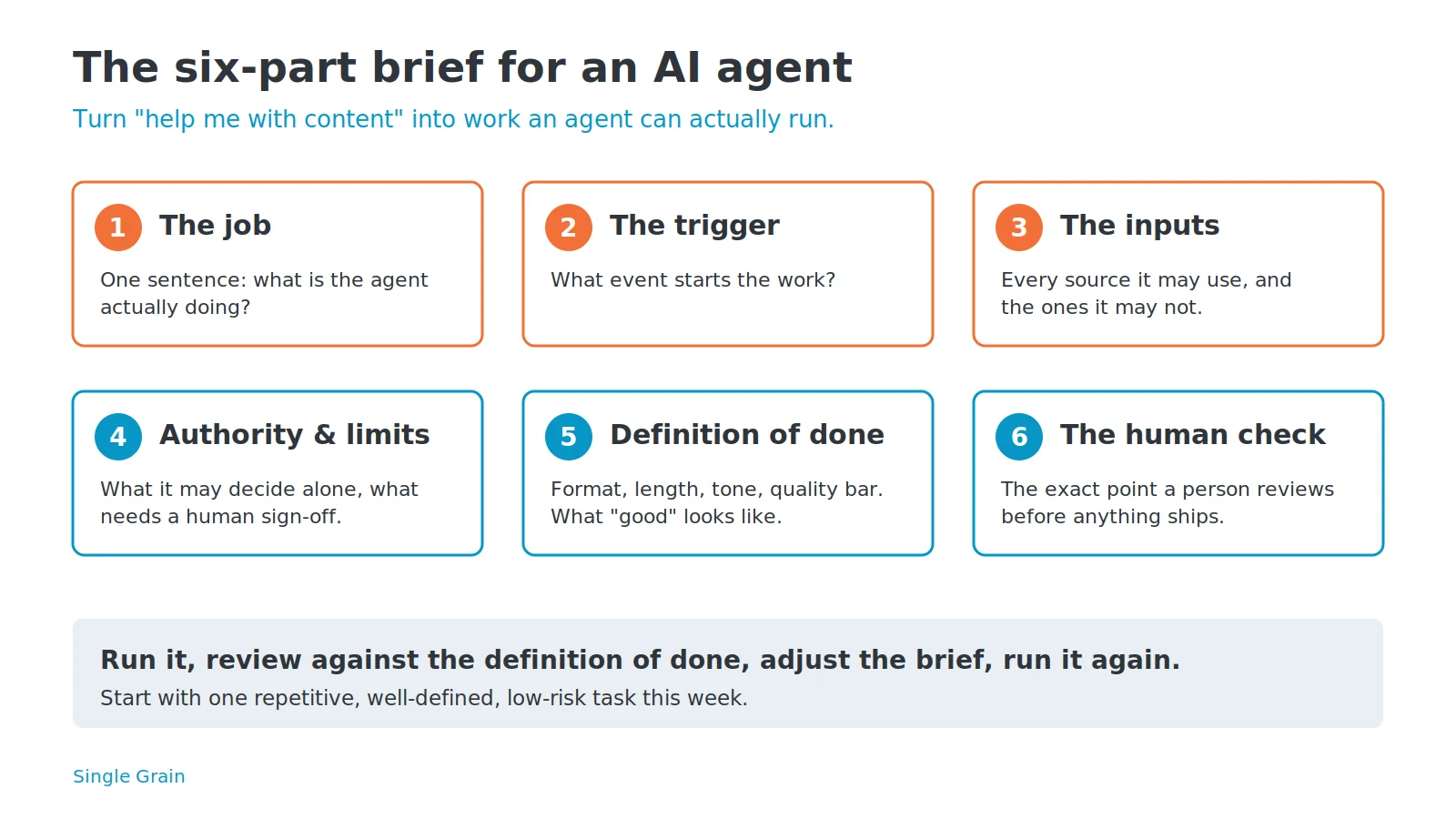
- A good agent brief has six parts: the job, the trigger, the inputs, the authority and limits, the definition of done, and the human check. Start with one task this week.
What Actually Happened, and the Credit Fight
On September 8, 2026, OpenAI announced that one of its models had contributed to significant progress on a Millennium Prize-level mathematics problem. Sam Altman amplified it within minutes, and the post spread fast.
Then the internet did what it does. A credit fight broke out almost immediately over how much the AI actually contributed versus the human mathematicians who framed the problem and guided the work. That question matters more to us than the scorekeeping does.
Here is why. The AI did not wake up one morning and decide to crack an open problem. Researchers handed it a tightly scoped task, well-defined constraints, and clear success criteria. That should sound familiar, and it usually does not, because almost no marketing team works this way.
One pattern shows up on every audit. Teams with the same tools get wildly different results, and the difference is almost never the model or the subscription tier. It is whether someone on the team can write a clear brief for an agent.
Understanding why AI skills matter more than individual prompts is the first step. A prompt is a single instruction. A brief is a system. It tells the agent what the job is, when to start, what to use, what to avoid, and when to stop and check with a human.

What a Good AI Agent Brief Contains
Think of briefing an agent the way you would onboard a sharp but literal-minded contractor who has never worked in your industry. You would not say “write me some content” and walk away. You would scope the work. An agent is not a magic box, and most teams still run it like one.
The Job and the Trigger
Start with one sentence. What is the agent doing, and what event starts the work? “When a new customer case study is approved in our CMS, draft a 200-word LinkedIn post summarizing the result.” That is a job. “Help me with social media” is not.
Inputs, Authority, and Limits
Name every source the agent can pull from. If it should only reference published case studies and never internal revenue numbers, say so. This is where teams that build AI agent security into the workflow get a real edge, because limits are what make the output trustworthy.
Then spell out what the agent can decide on its own and what needs a human sign-off. Can it publish directly? Can it choose the image? Can it tag people? Every ambiguity here turns into a mistake later.
Definition of Done and the Human Check
If you cannot describe what “good” looks like, the agent certainly cannot produce it. Define the output format, the length, the tone, and the quality bar. Then name the exact point where a human reviews the work, and build that review gate into the brief instead of bolting it on after the content is already live. That is also where agentic AI fits a real marketing operation, which is to say exactly as well as the brief that governs it.
How to Start This Week With One Real Task
Do not try to automate your whole content pipeline by Friday. Pick one task that is repetitive, well-defined, and low-risk. Repurposing a blog post into a social thread. Summarizing call transcripts into short notes. Drafting meta descriptions for a batch of product pages. Write the brief using the six parts above, run the agent, review the output against your definition of done, then adjust the brief and run it again.
You will learn more from that one loop in a week than from ten threads about a math proof. It is the same discipline behind our AI SEO services, where we scope the task, set the guardrails, then let the agent work. I built a stack of these agents live on screen and put them on real marketing and sales work, and you can watch the whole session here:

Forrester found that 42% of B2C marketing decision-makers are piloting or experimenting with agentic AI. Most of them are stuck in permanent pilot mode because they never formalized the brief. Do not be that team.

My Take
The math result is genuinely impressive and I am not dismissing it. But every time one of these breakthroughs lands, it creates a distortion field where people start believing the hard part is picking the right model or getting access to the right tool.
The hard part is the same as it has always been. Clearly define what you want, give the right inputs, and know what good looks like. That was true when you briefed a junior copywriter, and it is true now that you are briefing an agent. If your team cannot write a one-page brief for a human freelancer, they certainly cannot write one for an agent. Fix the boring thing first. The frontier will still be there when you are ready for it.
Get Help Building Your AI Marketing Workflow
Single Grain builds agent-driven marketing workflows for companies that want results, not experiments. If you are ready to move past the pilot phase and start getting real output from AI agents, talk to our AI marketing team and get a free consultation. Pick one task tomorrow morning, write the six-part brief, run it, and see what happens. That single loop will teach you more than any viral post about a math problem.