

GPT-Powered Marketing Strategies for Explosive Business Growth in 2025


While traditional agencies scramble to adapt, forward-thinking businesses are already leveraging GPT-powered strategies to capture unprecedented growth opportunities. Global spending on AI-driven marketing reached $20.4 billion in 2024 and is projected to grow to $26.99 billion in 2025, signaling a massive acceleration in adoption that’s reshaping how companies connect with customers.
What sets apart the winners from the wannabes? It’s not just about using AI tools. It’s about implementing systematic, ROI-driven strategies that compound growth over time. The companies seeing the biggest returns aren’t just experimenting with ChatGPT; they’re deploying comprehensive frameworks that integrate GPT capabilities across every stage of the customer journey.
TABLE OF CONTENTS:
- Key Takeaways
- Understanding GPT-Powered Marketing Strategies: Beyond the Hype
- The Compelling ROI Case for GPT Marketing in 2025
- Essential GPT Marketing Strategies: A Comprehensive Framework
- The AI Adoption Ladder: Your Step-by-Step Implementation Framework
- Measuring Success: Essential Metrics for GPT Marketing ROI
- Transform Your Marketing Strategy with GPT-Powered Growth
- Related Video
Key Takeaways
-
GPT is Redefining Marketing Operations: GPT-powered strategies go beyond automation—they bring contextual understanding, real-time adaptation, and generative intelligence that enable marketing systems to learn and optimize continuously.
-
The GPT Growth Flywheel: Leading companies create a self-reinforcing loop where AI-generated insights improve targeting, fuel deeper personalization, drive engagement, and produce data that makes campaigns smarter with each iteration.
-
Proven ROI Across Industries: 92% of Fortune 500 companies now use GPT or GPT-4 in marketing workflows, reporting transformative results—response times 90% faster and personalization up 300%.
-
Strategies That Drive Measurable Growth: From content marketing automation and programmatic SEO to AI-driven customer experiences, intelligent workflow automation, and predictive analytics, these strategies form a blueprint for scalable GPT implementation across every marketing function.
-
Metrics That Matter: Measure success through content velocity, response time, personalization lift, and GPT-attributed revenue—focusing on both short-term efficiency and long-term growth impact.
Understanding GPT-Powered Marketing Strategies: Beyond the Hype
GPT-powered marketing strategies represent a fundamental evolution in how businesses approach customer acquisition, engagement, and retention. Unlike traditional automation tools that follow rigid rules, GPT models understand context, generate human-like responses, and adapt to unique situations in real-time.
The most successful implementations go far beyond simple content generation. They create what we call the GPT Growth Flywheel—a self-reinforcing system where AI-generated insights improve targeting, which enhances personalization, which drives better engagement, which produces more data to fuel even smarter campaigns.
“The businesses winning with GPT aren’t just using it as a content factory. They’re building entire marketing ecosystems that learn and improve with every customer interaction.”
This approach requires thinking beyond individual tactics to consider how GPT can transform your entire marketing stack. ChatGPT’s annual revenue is projected to hit $1 billion in 2024, a 400% year-on-year increase from 2023, demonstrating the explosive demand for these capabilities across business applications.
The Compelling ROI Case for GPT Marketing in 2025
More than 92% of Fortune 500 companies have integrated ChatGPT or GPT-4 into their operations, including marketing workflows. The transformation happening at enterprise level provides a roadmap for businesses of all sizes. Companies implementing comprehensive GPT strategies report dramatic improvements across key metrics: response times slashed by 90% and personalization rates increased by 300%.
| Business Impact Area | Traditional Approach | GPT-Powered Approach | Improvement |
|---|---|---|---|
| Content Creation Speed | 5-10 pieces per week | 50-100 pieces per week | 500-1000% increase |
| Email Personalization | Basic segmentation | Individual-level customization | 40-60% higher engagement |
| Customer Service Response | 2-24 hours | Instant, contextual responses | 95% faster resolution |
| Market Research Time | 4-8 weeks | Hours to days | 90% time reduction |
Essential GPT Marketing Strategies: A Comprehensive Framework
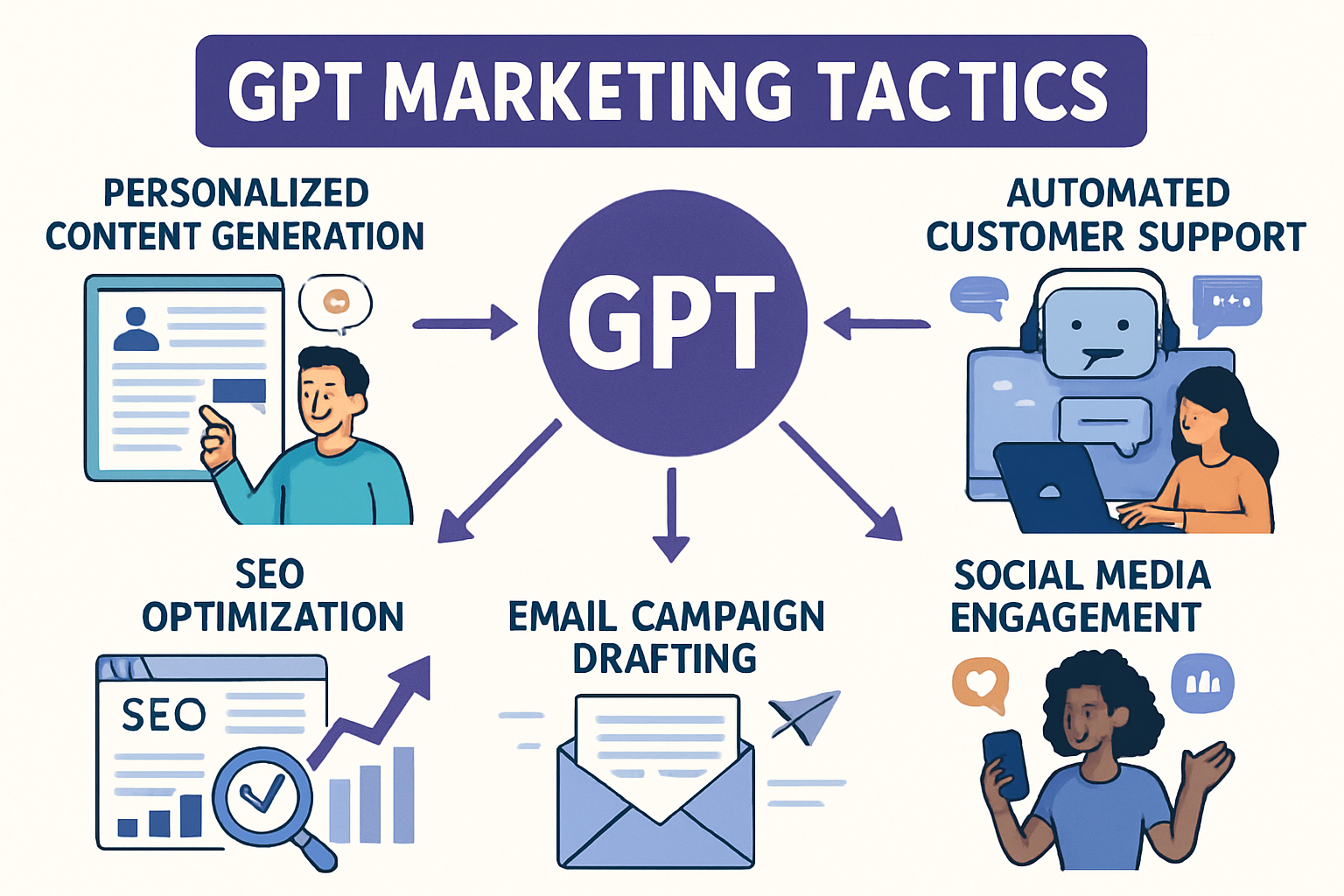
Building on our experience with growth-stage SaaS companies and enterprise clients, we’ve identified 107 specific strategies that consistently drive measurable results. These aren’t theoretical concepts. They’re battle-tested approaches that create competitive moats.
Content Marketing Automation
The foundation of any GPT marketing system starts with scalable content creation that maintains brand voice and drives organic traffic. Our Content Sprout Method leverages GPT to produce high-quality, SEO-optimized content at unprecedented scale while preserving the human creativity that converts visitors into customers.
- Programmatic SEO content generation – Automatically create thousands of location-specific or product-specific pages
- Multi-format content adaptation – Transform one piece of research into blog posts, social media content, email sequences, and video scripts
- Real-time trend integration – Monitor industry conversations and generate timely content that captures search traffic
- Competitor content gap analysis – Identify missing topics in your niche and create comprehensive coverage
- Interactive content creation – Generate quizzes, polls, and calculators that engage users and capture leads
Personalization & Customer Experience
True personalization at scale becomes possible when GPT analyzes customer behavior patterns and generates individualized experiences, enabling secure generation of context-aware subject lines, copy, and offers while protecting customer data.
The key insight here is that effective personalization requires more than just inserting a first name in an email. It demands understanding customer intent, purchase history, content consumption patterns, and behavioral triggers to deliver genuinely relevant experiences.
Automation & Efficiency
The most dramatic ROI gains come from automating high-volume, repetitive tasks that previously consumed significant human resources. This type of transformation is accessible to businesses of all sizes. The key is identifying your highest-volume customer touchpoints and systematically replacing manual processes with intelligent automation that maintains or improves quality.
Analytics & Optimization
GPT’s analytical capabilities extend far beyond content creation. The most sophisticated implementations use AI to identify patterns in customer data, predict behavior, and recommend optimization strategies that human analysts might miss. Advanced applications include predictive churn analysis, dynamic pricing optimization, and real-time campaign adjustment based on performance patterns.
Advanced Integration
The final tier of GPT marketing strategies involves sophisticated integrations that create entirely new capabilities. These include voice search optimization for AI assistants, integration with IoT devices for contextual marketing, and predictive customer journey mapping that anticipates needs before customers express them.
The AI Adoption Ladder: Your Step-by-Step Implementation Framework
Based on our work with hundreds of growth-stage companies, we’ve developed the AI Adoption Ladder—a four-stage framework that ensures successful GPT implementation without overwhelming your team or compromising quality.
Stage 1: Awareness & Foundation Building (Months 1-2)
Begin with low-risk, high-impact applications like content ideation, email subject line optimization, and social media caption generation. This stage focuses on building team confidence and establishing quality control processes.
Stage 2: Experimentation & Skill Development (Months 3-4)
Expand into more complex applications like personalized email sequences, customer service automation, and basic analytics interpretation. Develop internal expertise and refine your prompt engineering capabilities.
Stage 3: Integration & Scale (Months 5-8)
Implement systematic workflows that integrate GPT across multiple marketing functions. This includes programmatic content creation, automated lead nurturing, and cross-channel campaign optimization.
Stage 4: Optimization & Innovation (Months 9+)
Develop proprietary applications and advanced integrations that create sustainable competitive advantages. This stage focuses on custom solutions that align with your specific business model and customer needs.
Measuring Success: Essential Metrics for GPT Marketing ROI
The most critical aspect of any GPT implementation is establishing clear success metrics from day one. Unlike traditional marketing initiatives where results might take months to materialize, GPT strategies often show immediate improvements in efficiency metrics while building toward longer-term revenue impact.
Essential metrics include content production velocity, customer response time improvements, personalization engagement rates, and ultimately, revenue attribution to GPT-enhanced campaigns. The key is creating measurement frameworks that capture both immediate operational benefits and long-term strategic value.
For businesses serious about growth, the question isn’t whether to implement GPT-powered marketing strategies. It’s how quickly you can build competitive advantages before your market catches up. The companies that master these capabilities today will dominate their categories tomorrow.
Transform Your Marketing Strategy with GPT-Powered Growth
The convergence of accessible GPT technology and proven marketing frameworks creates an unprecedented opportunity for businesses ready to move beyond traditional approaches. The strategies outlined here represent just the beginning of what’s possible when you combine human creativity with AI capabilities.
Success requires more than just adopting new tools. It demands rethinking how marketing creates value for both businesses and customers. The companies winning with GPT are those that view it not as a cost-cutting measure, but as a growth multiplier that enables entirely new levels of personalization, efficiency, and customer connection.
If you’re ready to explore how GPT-powered marketing strategies can accelerate your business growth, the expertise and frameworks needed for success are within reach. The question is whether you’ll act while competitive advantages are still available, or wait until these strategies become table stakes in your industry.
Ready to implement systematic GPT marketing strategies that drive measurable results? Get a free consultation to discover which of these strategies will have the biggest impact on your specific business goals.
Related Video
For more insights and lessons about marketing, check out our Marketing School podcast on YouTube.


