

Top 4 LinkedIn Analytics Integration Services


LinkedIn analytics integration services are now central to B2B growth teams that want to see exactly how social engagement turns into qualified pipeline and closed revenue. Instead of checking disconnected dashboards, high-performing organizations are wiring LinkedIn data directly into their CRM, data warehouse, and BI tools so that every impression, click, and conversation can be tied to accounts, opportunities, and sales outcomes.
When LinkedIn data is integrated properly, marketers can see which campaigns drive deals, sales teams can prioritize accounts based on real engagement signals, and leadership can align budgets with the channels that reliably drive revenue. This article walks through how to think about LinkedIn analytics integration, what to look for in a partner, and a breakdown of four leading services that help teams operationalize LinkedIn data across their go-to-market stack.
TABLE OF CONTENTS:
- Why LinkedIn analytics integration services are a revenue lever, not just reporting
- A practical framework for evaluating LinkedIn analytics integration partners
- Top 4 LinkedIn analytics integration services for modern B2B teams
- 1. Karrot.ai: Purpose-built LinkedIn analytics integration services for ABM and revenue teams
- 2. Improvado: Flexible LinkedIn data pipelines into your warehouse
- 3. Dreamdata: LinkedIn as a key signal in full-funnel B2B attribution
- 4. Windsor.ai: Quick-start LinkedIn dashboards and connectors
- Expert support to design your LinkedIn analytics integration strategy
- Turning insight into action with LinkedIn analytics integration services
Why LinkedIn analytics integration services are a revenue lever, not just reporting
Most teams start with native LinkedIn reporting and quickly hit its limits when they try to answer revenue questions rather than content questions. Metrics like impressions and clicks are useful, but without connecting them to opportunities, pipeline stages, and customer value, it is impossible to prove where LinkedIn is truly driving growth or where spend is being wasted.
LinkedIn analytics integration services solve this gap by stitching together campaign, page, and Sales Navigator data with CRM objects such as leads, contacts, accounts, and opportunities. When these datasets live in the same model, you can finally answer questions like which accounts moved from open opportunity to closed-won after seeing specific ads, or which buyer roles engage most with thought leadership posts before booking meetings.
This integration is particularly important as content formats evolve. 41% of B2B marketers say short-form video delivers the highest ROI among video formats, which means video-heavy LinkedIn strategies require deeper analytics that surface performance by audience segment, creative theme, and account.
Once LinkedIn data is unified with ABM programs, teams can move beyond generic MQL models and start tracking engagement at the account level across ads, InMail, connection requests, and company page content. This is where capabilities such as detailed LinkedIn ABM account journey mapping, multi-touch influence tracking, and account-level scoring become possible instead of theoretical.
From vanity LinkedIn metrics to revenue-grade insights
Without integration, teams often celebrate engagement spikes that never turn into qualified conversations. With proper LinkedIn analytics integration, success is redefined around revenue outcomes such as opportunity creation, deal acceleration, average contract value, and win rate by campaign or content type.
For example, instead of reporting that a campaign drove a high click-through rate, an integrated stack can reveal that the same campaign increased opportunity-to-close rate for target accounts already in late-stage pipeline. This shift encourages smarter budget allocation and helps defend LinkedIn investments during planning cycles.
Integrated LinkedIn analytics also exposes underperforming tactics faster. If a sponsored content series generates impressive on-platform metrics but rarely shows up in opportunity influence reports, you can pause or rework it confidently, while doubling down on the messages and formats that correlate with revenue movement.
Core LinkedIn data streams you should integrate
To get this revenue-grade view, you need more than just ad performance exports. Effective LinkedIn analytics integration services typically unify four major data streams: Ads, Company Page analytics, personal profile content performance for key executives, and Sales Navigator activity from outreach and account research.
On the marketing side, ads and page data feed campaign-level measurement, while post-level performance from leadership and subject-matter experts helps attribute pipeline to executive branding and dark social. Sales Navigator signals, such as saved accounts, InMail responses, and profile views from buying committees, enrich account engagement scores and lead prioritization.
High-performing ABM programs often combine these integrated data streams with AI-based account engagement scoring models for LinkedIn ABM, similar to the approaches described in advanced AI account engagement scoring guides for LinkedIn-driven ABM. The result is a more accurate picture of intent and buying readiness than any single tool can provide.
Bringing all these signals together requires thoughtful architecture: deciding which fields to map into your CRM, which to route to a warehouse, and how to handle identity resolution between LinkedIn member data, corporate domains, and your internal account hierarchy.

A practical framework for evaluating LinkedIn analytics integration partners
Once you understand the potential, the challenge becomes choosing the right LinkedIn analytics integration partner for your situation. Some teams need a productized integration that gets them 80% of the way quickly, while others require a more customizable data pipeline that can handle complex account hierarchies, multiple CRMs, or strict compliance requirements.
Evaluating providers through a structured lens helps avoid shiny-object decisions based solely on demos. Instead of asking only what dashboards look like, focus on how data moves, how it is modeled, and how reliably it lands in the systems your teams already live in every day.
Technical capabilities your LinkedIn analytics integration service must deliver
At the foundation, confirm which LinkedIn APIs a provider supports and how they handle authentication, rate limits, and schema changes over time. Mature LinkedIn analytics integration services should support key surfaces such as Marketing and Ads reporting, company page analytics, and Sales Navigator events, then normalize them into a consistent model.
Next, look at the data movement options. Some tools offer direct connectors to major warehouses like Snowflake, BigQuery, or Redshift, while others rely on ETL into their own environment, then provide reverse ETL back into your CRM and marketing automation platform. The ideal setup depends on whether you want LinkedIn to be one of many sources in a central warehouse or managed primarily through the integration platform itself.
It is also worth assessing how closely integration services align with advanced ABM workflows. Teams running complex LinkedIn ABM programs benefit when their integration provider can support sophisticated workflows like end-to-end LinkedIn ABM account journey mapping rather than just simple campaign-level reports.
Governance, compliance, and scalability considerations
Because LinkedIn data includes professional identities and engagement histories, you need clear answers on data governance before committing. Ask how permission scopes are managed, how tokens are rotated, and how access to sensitive data is controlled through role-based access and audit logs across teams.
Scalability is another differentiator. If you manage multiple ad accounts, operate across regions, or integrate several CRMs, your provider must handle complex routing rules. Confirm how they manage historical backfills, API changes, and data freshness, and whether they expose monitoring dashboards or alerts when syncs fail.
Teams that treat LinkedIn as a primary channel rather than a secondary one often benefit from pairing integration services with broader workflow automation, similar to the types of LinkedIn pipeline automation and integration strategies used in advanced ABM programs.
Commercial model and implementation support
Pricing models vary widely across integration providers. Some charge primarily by the number of data sources and destinations, others by volume of records processed, and some by seats and feature tiers. Map these models to your projected LinkedIn investment and data usage so you are not surprised when campaigns scale up successfully.
Implementation support may be the deciding factor for many teams. Ask whether you will get a dedicated solutions engineer, what the typical implementation timeline looks like, and how ongoing change requests are handled. A provider that understands both data engineering and B2B go-to-market motions will usually help you avoid misconfigurations that lead to bad attribution or broken dashboards later.

Top 4 LinkedIn analytics integration services for modern B2B teams
With those evaluation criteria in mind, it is easier to compare concrete options. The four providers below represent different approaches to LinkedIn analytics integration: some are more opinionated, end-to-end platforms, while others emphasize flexible data pipelines that plug into your existing stack with minimal disruption.
Think of these not as interchangeable tools, but as distinct strategies for getting LinkedIn data where it needs to go. The best choice for your organization depends on how mature your data infrastructure is, how standardized your CRM processes are, and how aggressively you want to pursue multi-touch attribution and ABM use cases from day one.

| Service | Best For | Key Strength |
|---|---|---|
| Karrot.ai | ABM and revenue teams needing deep LinkedIn account analytics | Purpose-built focus on LinkedIn signals and pipeline impact |
| Improvado | Marketing teams centralizing many paid media sources | Flexible ETL into major warehouses and BI tools |
| Dreamdata | B2B SaaS companies focused on attribution and revenue analytics | Multi-touch attribution across the entire funnel |
| Windsor.ai | Teams wanting prebuilt connectors and dashboards | Fast time-to-value with templated reporting |
1. Karrot.ai: Purpose-built LinkedIn analytics integration services for ABM and revenue teams
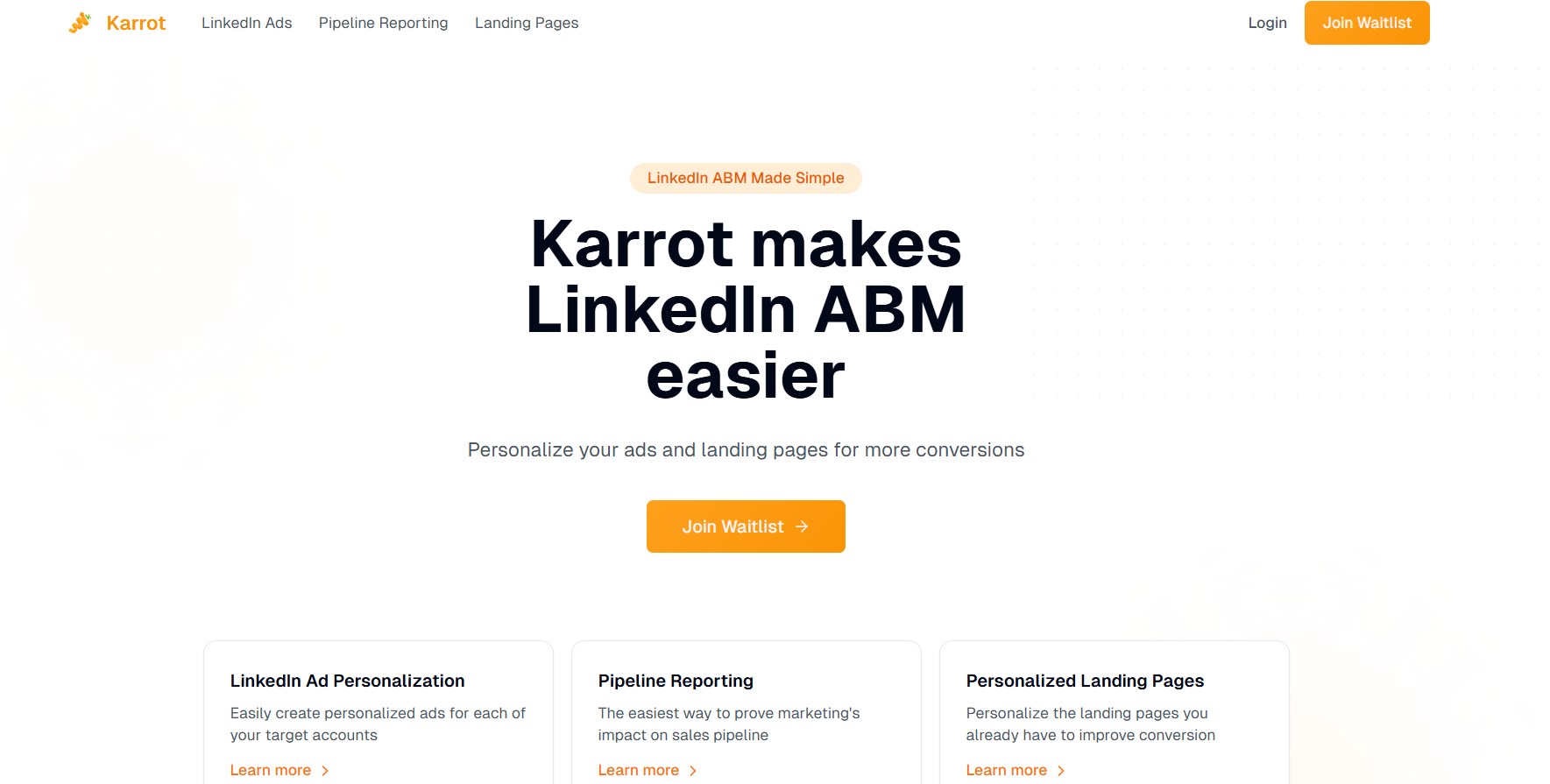
Karrot.ai focuses specifically on turning LinkedIn into a reliable revenue channel by integrating data from ads, company pages, and key stakeholder interactions into a unified account-centric view. Instead of treating LinkedIn as just another traffic source, Karrot.ai positions it as a primary signal layer for account-based marketing and outbound motions.
Because it is built on LinkedIn, Karrot.ai’s approach to LinkedIn analytics integration services typically includes fine-grained account- and buyer-role-level visibility, helping teams understand which people within a target account are engaging with which messages. This supports smarter sales plays, such as tailoring outreach based on content consumed or increasing ad frequency when engagement patterns suggest heightened interest.
Karrot.ai’s integrations are designed to push these insights directly into CRMs and revenue platforms, so sales and marketing do not need to live in yet another standalone dashboard. For many organizations, this makes Karrot.ai not just an analytics layer but an operational hub that keeps LinkedIn tightly aligned with pipeline creation, deal velocity, and renewal health.
2. Improvado: Flexible LinkedIn data pipelines into your warehouse
Improvado is a marketing data platform that offers connectors for a wide range of channels, including LinkedIn Ads and related surfaces. For teams that want LinkedIn to sit alongside other paid and organic channels in a central warehouse, Improvado’s value lies in its ability to normalize schemas and manage extraction and loading at scale.
This approach is well-suited to organizations that already have a BI strategy and simply need reliable LinkedIn data feeds to plug into existing dashboards. Rather than prescribing a specific reporting model, Improvado focuses on delivering clean, structured data so that your internal analytics team can build the exact views and attribution models they prefer.
Because it spans many channels, Improvado is often used by teams that want to compare LinkedIn performance to other social or search platforms in a consistent way. This can help with budget decisions across the entire demand engine, although it typically requires more in-house analytics resources than more opinionated LinkedIn-first platforms.
3. Dreamdata: LinkedIn as a key signal in full-funnel B2B attribution
Dreamdata positions itself as a B2B revenue-attribution and data platform, with LinkedIn among several important touchpoint sources. Its strength lies in reconstructing detailed customer journeys across channels and devices, then mapping those journeys to pipeline and revenue.
For teams that want to see how LinkedIn works together with content, email, and product usage signals, Dreamdata’s model can be especially powerful. LinkedIn touchpoints become part of multi-touch attribution, showing where in the buying journey LinkedIn tends to contribute value and which campaigns consistently appear in paths that end in closed-won deals.
Organizations using Dreamdata often standardize on its attribution logic for executive reporting, while still customizing tactical dashboards for channel owners. When set up correctly, this gives both leadership and practitioners a shared source of truth about LinkedIn’s role in driving results.
4. Windsor.ai: Quick-start LinkedIn dashboards and connectors
Windsor.ai offers a broad set of marketing connectors, including LinkedIn, with a strong emphasis on prebuilt dashboards for popular BI environments. For teams that want to move fast without building everything from scratch, Windsor.ai can provide an efficient path to integrated LinkedIn reporting.
Typical use cases include pulling LinkedIn Ads and page analytics into tools like Google Looker Studio, Power BI, or Tableau using Windsor.ai’s connectors, then adapting their templates to match your internal naming conventions and KPIs. This enables teams to start analyzing LinkedIn alongside other channels with relatively low implementation overhead.
Windsor.ai is often a good fit for marketing teams that are early in their data journey but ready to outgrow native LinkedIn reporting. As needs mature, some organizations keep Windsor.ai as their connector layer while evolving their internal data models and warehouse strategy behind the scenes.
Expert support to design your LinkedIn analytics integration strategy
Even with strong tools in place, many teams struggle with the strategic layer: deciding which metrics actually matter, aligning LinkedIn with ABM targeting, and translating integrated data into sales playbooks and creative direction. This is where experienced growth partners become valuable, especially those who understand both technical data integration and performance marketing.
Single Grain is a full-service digital marketing agency that helps growth-stage SaaS and B2B companies design LinkedIn strategies, analytics architectures, and ABM programs that tie directly to revenue. If you want guidance on selecting and implementing a LinkedIn analytics integration service like Karrot.ai and weaving it into paid campaigns, content, and sales workflows, you can get a FREE consultation to explore options.
Turning insight into action with LinkedIn analytics integration services
Choosing a LinkedIn analytics integration service is only the first step; the real value comes from how you operationalize the data across marketing, sales, and RevOps. Start by defining the specific questions you want to answer, such as which accounts are warming up on LinkedIn, which campaigns shorten deal cycles, or how executive content influences enterprise opportunities.
From there, work through an implementation sequence that keeps risk low while building confidence:
- Phase 1: Connect LinkedIn sources and validate that raw data is landing correctly in your warehouse, CRM, or integration platform.
- Phase 2: Map LinkedIn entities to your CRM account, contact, and opportunity structures, resolving identity issues and filling critical enrichment gaps.
- Phase 3: Build core dashboards and account-level reports, then socialize them with marketing and sales leaders to refine definitions and thresholds.
- Phase 4: Operationalize insights by updating playbooks, cadences, audiences, and creative strategy based on what the integrated data reveals.
As mentioned earlier, the goal is not just prettier reports; it is a tighter feedback loop where every LinkedIn impression and interaction can influence targeting, messaging, and sales actions. Done well, LinkedIn analytics integration services become part of your broader “search everywhere” and ABM strategy, informing decisions across content, paid media, and outbound.
If you want a partner to help you design this end-to-end system, from selecting tools like Karrot.ai to building attribution models and creative testing frameworks, Single Grain’s team combines analytics engineering with performance, creative, and paid social expertise. Visit Single Grain to start a free consultation and turn integrated LinkedIn analytics into a repeatable revenue engine.
Frequently Asked Questions
-
What's the typical implementation timeline for LinkedIn analytics integration platforms?
Implementation timelines vary significantly by vendor, ranging from 1-2 weeks for basic solutions like HubSpot’s native connector to 6-8 weeks for enterprise platforms like Improvado. Karrot.ai offers a middle-ground approach with 2-3 weeks of implementation, while Shield typically requires 4-6 weeks for full setup.
-
What level of data granularity should I expect from different LinkedIn analytics platforms?
Data granularity varies widely across platforms. HubSpot’s connector only provides campaign-level data, while Shield offers campaign and ad group-level insights. Karrot.ai and Improvado provide the most detailed analysis, including account, campaign, creative, and audience segment-level data for comprehensive optimization.
-
How do predictive AI capabilities differ between LinkedIn analytics vendors?
Most platforms offer limited predictive intelligence, focusing primarily on historical reporting. Karrot.ai stands out with predictive lead scoring and automated bid optimization, while Improvado offers custom data modeling capabilities. Shield and HubSpot provide only basic automated reporting or native scoring features.
-
What ROI improvements can I expect from implementing LinkedIn analytics integration?
ROI improvements vary by platform and implementation quality. Karrot.ai shows an average 34% improvement in cost-per-qualified-lead, while Shield demonstrates 15-25% efficiency gains. Improvado’s enterprise clients report 20-40% attribution accuracy improvements.
-
How do pricing models compare across LinkedIn analytics integration vendors?
Pricing structures vary significantly by vendor and target market. Karrot.ai uses usage-based pricing starting at $500/month, Shield charges flat fees of $1,200-3,000/month, HubSpot includes integration with Marketing Hub Professional+, and Improvado targets enterprises with pricing starting at $2,000+/month.
-
What security and compliance standards do these platforms meet?
Security compliance varies by vendor sophistication. Karrot.ai and Improvado both maintain SOC 2 Type II certification with GDPR compliance, while Shield offers SOC 2 Type I. HubSpot’s connector inherits HubSpot’s existing security standards, and Improvado also maintains ISO 27001 certification.
-
What recent platform updates should influence my vendor selection decision?
Key 2024-2025 updates include Karrot.ai’s advanced attribution modeling (July 2025), HubSpot’s enhanced contact matching (March 2025), and Improvado’s LinkedIn Conversions API integration (January 2025). Shield focused on API rate limit improvements in Q4 2024, showing varying levels of innovation across vendors.



