

ChatGPT for Financial Services: OpenAI Is Coming for the Verticals, Not the Tools



On September 10, 2026, OpenAI launched ChatGPT for Financial Services, a version of ChatGPT packaged for one industry instead of sold as a general tool. That is the whole story in a line. The company that powers your “AI-enabled” workflow is now selling a finished product straight into your client’s sector.
If you run marketing at an agency or an in-house team in financial services, your pitch just changed. “We use ChatGPT” stops being a differentiator the moment your client can buy ChatGPT built for their own industry. What you still own is everything the vendor cannot ship. You built the distribution. You understand the compliance. Your client controls the first-party data.
So here is what I would do this week to land on the right side of that line before a client asks the uncomfortable question.
TABLE OF CONTENTS:
TL;DR
- OpenAI is packaging ChatGPT by industry, starting with financial services. That shrinks the gap between “AI vendor” and “marketing service.”
- If your pitch is “we use AI tools,” you lose ground the day the tool vendor ships its own vertical product. The defensible work is compliance, first-party data, and distribution.
- This week, audit every deliverable your team produces, flag what the vertical product now does out of the box, and double down on what it cannot touch.
What OpenAI Shipped, and Why Financial Services Came First
The day before, on September 9, OpenAI rolled out a batch of small-business features for ChatGPT covering invoicing, scheduling, and inventory. Useful, but generic.
Then came the vertical play. ChatGPT for Financial Services bundles domain-specific prompts, workflows, and integrations tuned for banking, insurance, and wealth management. This is not a template library. It is a product that speaks the language of an industry.
Why Financial Services Gets the First Vertical
Financial services firms spend heavily on software and professional services, and they operate under strict regulation from bodies like FINRA and the SEC. That combination of big budgets, acute pain, and rules a general tool has to respect makes the sector a natural first target.
Expect healthcare and legal to follow. Financial services is the template.

What “Vertical, Not Tools” Means for Your Positioning
For two years, agencies have sold AI as a capability layer. “We use GPT to write your email sequences.” “We built a custom GPT for your FAQ chatbot.” That pitch worked while the model vendor stayed horizontal. Now the vendor is going vertical, and that changes the math.
The Pitch That Stops Working
If your agency’s edge is access to ChatGPT, you are reselling a commodity. OpenAI’s vertical product hands your client a direct path to the same capability, pre-configured for their industry. An agency whose only edge is that access was always on borrowed time.
We have watched this pattern before. Website builders ate basic web shops. Email platforms ate simple email agencies. Automated ad campaigns ate low-touch PPC management. The vendor ships a self-serve vertical product, and the shops that only provided tool access lose the account.
The Work That Still Pays
OpenAI cannot ship your client’s first-party data. It cannot file with FINRA. It cannot build the distribution that puts content in front of the right financial advisors at the right time. I would rather sell that outcome than the tool, because access to a model is not a moat and the system around it is.
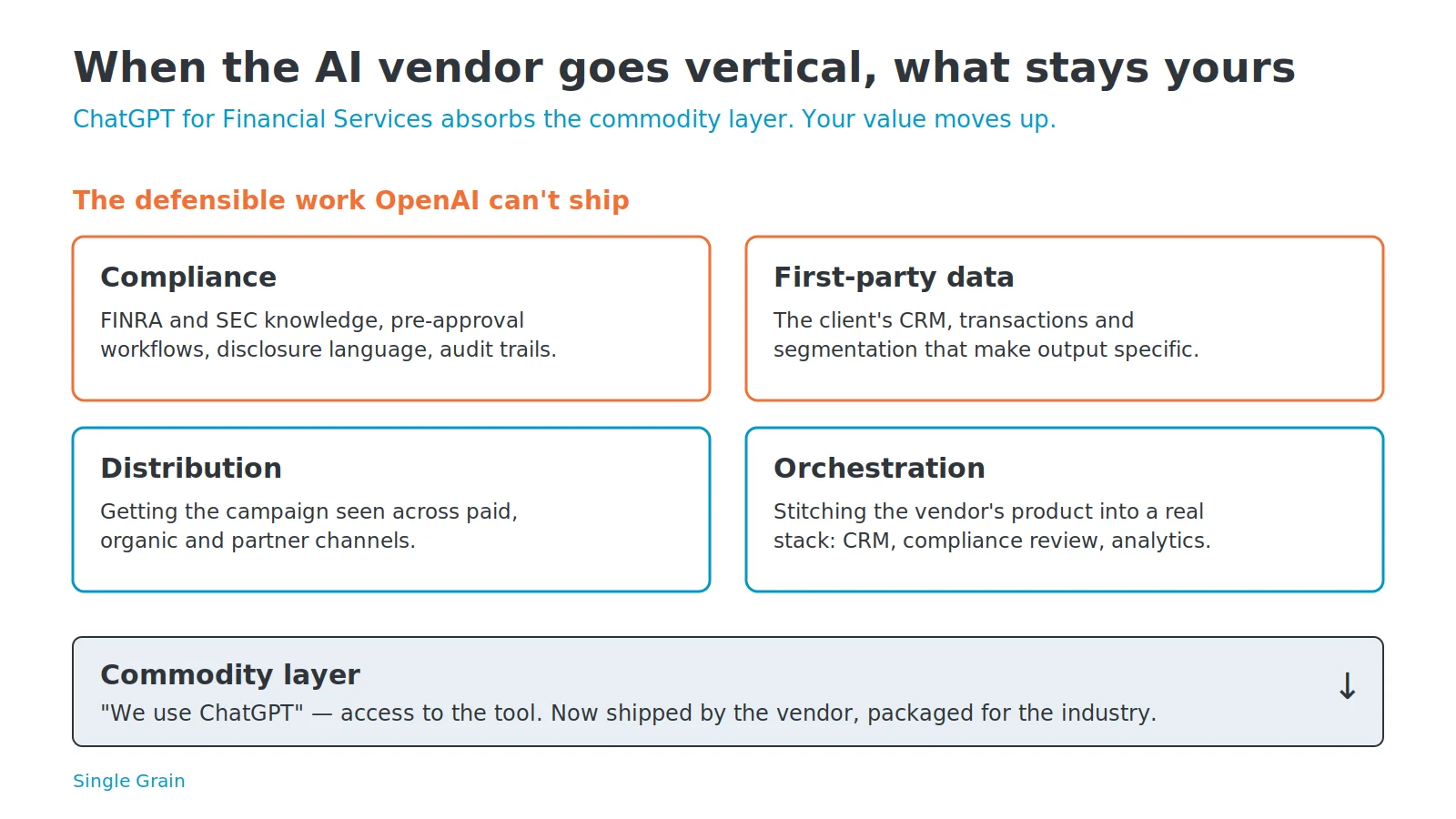
Four things hold their value when the vendor moves upstream.
- Compliance expertise. Financial services marketing needs real FINRA and SEC knowledge that a general product will not fully cover. Pre-approval workflows, disclosure language, and audit trails stay human-governed.
- First-party data. Your client’s CRM records, transaction history, and segmentation are what make AI output specific instead of generic. The agency that connects those sources to the workflow owns a layer OpenAI does not touch.
- Distribution. Getting a campaign in front of a wealth-management audience across paid, organic, and partner channels is a different problem than generating it. ChatGPT writes the ad. You get it seen.
- Orchestration. Stitching the vendor’s product into a real marketing stack, from CRM to compliance review to analytics, is hands-on integration work.
What Your Team Should Do This Week
The pressure is already in-market, so do not wait for it to arrive.
Audit Your Deliverables Against the Vertical Product
List every recurring deliverable you produce for financial services clients. Flag anything ChatGPT for Financial Services now handles on its own, from draft copy to FAQ generation to basic research summaries. Those just got commoditized, and you want to know which ones before your client does.
Reposition Around What the AI Cannot Do
Shift the pitch from “we use AI” to “we govern, distribute, and optimize what AI produces.” It is a harder pitch to make, which is exactly why it is harder to replace. This shift is already changing how selection committees evaluate partners, and procurement teams are starting to ask what you do that the tool itself does not. Have a clear answer.
Invest in the Distribution Layer
ChatGPT can generate a campaign brief for a financial-advisor audience. It cannot build the AI-informed organic visibility that puts that campaign in front of searchers, or the paid strategy that reaches high-intent prospects at the right moment. If you already run ChatGPT ads for financial services clients, the conversation shifts from “we manage the tool” to “we own the outcome the tool contributes to.”

My Take on OpenAI’s Vertical Play
The AI layer is collapsing into the product layer. The line between “AI tool” and “AI product for your industry” is disappearing, and I do not think that is bad news for agencies. It is a filter.
Agencies that were only reselling access to ChatGPT were always living on borrowed time, and this just speeds up the shakeout. The ones that survive will own what the vendor cannot copy, whether that is deep vertical knowledge, real compliance chops, proprietary data connections, or distribution that took years to build.
Sam Altman is not building an agency. He is building a platform, and platforms eat the bottom of the market while pushing everyone else upward. If your work was already above the commodity line, this is a tailwind. If it was not, this is the week to fix it. Here are seven real ways I use GPT-6 Astra to run my business:

Get Your Positioning Right Before the Market Shifts
OpenAI just told the market that financial services is a product category. Every agency and in-house team in the space has a narrow window to reposition before clients start asking hard questions. If you want help deciding what your team should own in a world where AI vendors sell straight to your vertical, Single Grain’s AI marketing team works with financial services brands on exactly this. The first move is small. Pull up your deliverable list Monday, mark what the vertical product now covers, and build your next client conversation around the three things you control that OpenAI does not.