5 Client Retention Strategies to Stop Churn Before It Starts


Client retention strategies decide whether your business growth compounds or leaks. Every client who leaves takes their budget, their referrals, and the case study you were hoping to write. As you scramble to find a replacement for that month over month revenue from the client you just lost, you’re left wondering how you could prevent this from happening in the future.
Research from Bain & Company’s Frederick Reichheld found that a 5% increase in customer retention can lift profits by 25% to 95%. Reichheld’s original Bain brief on loyal relationships explains why.
Return customers tend to buy more over time, cost less to serve, and refer others. Yet most teams still put their best people and their newest tools on acquisition, and leave retention to whoever has time.
If you want to know how to retain clients in your business, keep reading for five strategies, each with an easy way to put AI to work behind it.
TL;DR
- Retention is the cheapest growth you’ll find. Bain’s research shows small retention gains can drive outsized profit gains.
- Thank clients with no pitch attached. Perks and gestures given after the deal build loyalty that a sales pitch can’t.
- Act before clients ask. A competitor who matches your offer at the last minute is already too late.
- Let AI handle the watching. AI can flag milestones, spot churn signals, prep calls, and route requests so your team spends time on the relationship.
TABLE OF CONTENTS:
- What Is Client Retention?
- 5 Client Retention Strategies & How to Use AI to Activate Them
- 1. Say Thank You With No Sales Pitch Attached
- 2. Match Before the Client Asks
- 3. Be Direct and Prove Your Results
- 4. Show Up Prepared for Every Conversation
- 5. Make Getting Help Effortless
- How to Measure Client Retention
- How to Retain Clients as Your Business Grows
What Is Client Retention?
Client retention is your ability to keep clients working with you over time, renewing contracts, and expanding the relationship. It’s usually measured as the share of clients who stay over a period, and in subscription or retainer businesses, through net revenue retention, which also counts upgrades and downgrades. If you report to investors, the net revenue retention rules investors test are worth knowing.
Client retention differs from customer retention mostly in scale. A client relationship usually involves fewer accounts, bigger contracts, and named people on both sides. That makes every relationship more valuable, and every loss more painful.
How to Use AI to Improve Client Retention
AI changes the work in a useful way. It can watch hundreds of signals across your CRM, inbox, and billing tools, so your people spend their time on the conversations only humans can have. Each strategy below pairs a human move with an AI assist.
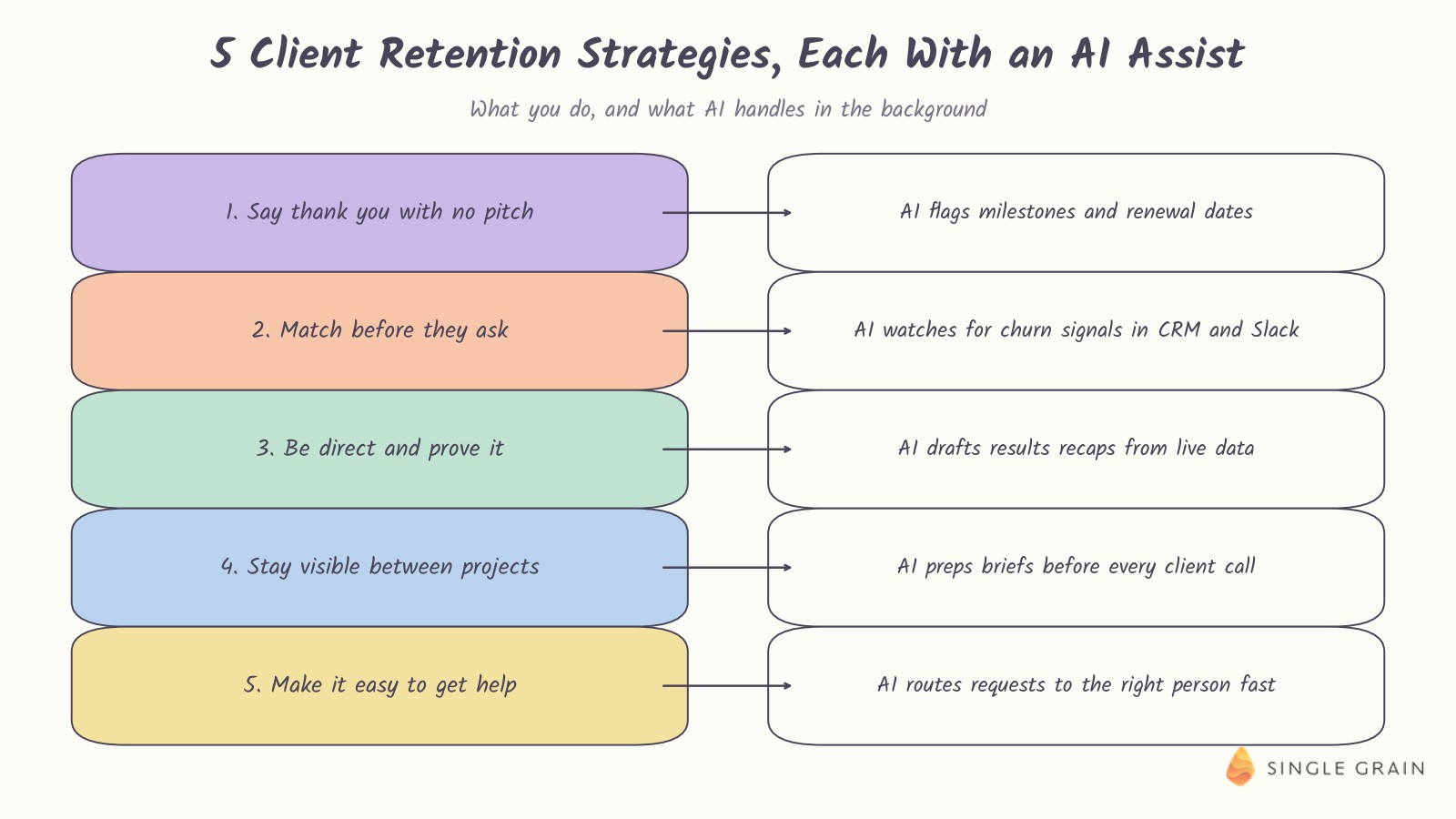
5 Client Retention Strategies & How to Use AI to Activate Them
Let’s start with the strategy most companies skip entirely.
1. Say Thank You With No Sales Pitch Attached
My Marketing School co host, Neil Patel, described what happens when his company banks with a large institution.
One bank sent his CFO, a big soccer fan, to a World Cup match and covered the hotel, with no meeting and no pitch attached. Another bank, which his team was about to sign with, sent a list of sports and concert tickets available to them after the deal was already done.
Neither bank was trying to win the business. They already had it. As Neil put it on the show, it’s a retention mechanism, because people remember who looked after them, and they think of that person first when a new need comes up.

You don’t need a stadium suite to do this well. A handwritten note at the one-year mark, a small gift tied to a client’s hobby, or a free strategy session with no upsell can all work. The key is that the gesture asks for nothing in return.
How AI Helps You Say Thank You at the Right Time
The hard part of thoughtful gestures is remembering. AI can scan your CRM and call notes for contract anniversaries, big client wins, promotions, and personal details clients mentioned in passing. A weekly digest of “moments worth marking” makes the thank-you a habit instead of an accident.
| Starter prompt for client milestones |
|---|
| Review the client notes, emails, and CRM records below. List every client with a contract anniversary, launch, promotion, or personal milestone in the next 30 days, plus any interest they’ve mentioned, such as a sport, team, or hobby. Suggest one thank-you gesture for each with no sales pitch attached. |
Keep a person in charge of the actual gesture, since the whole point is that it feels personal.
2. Match Before the Client Asks
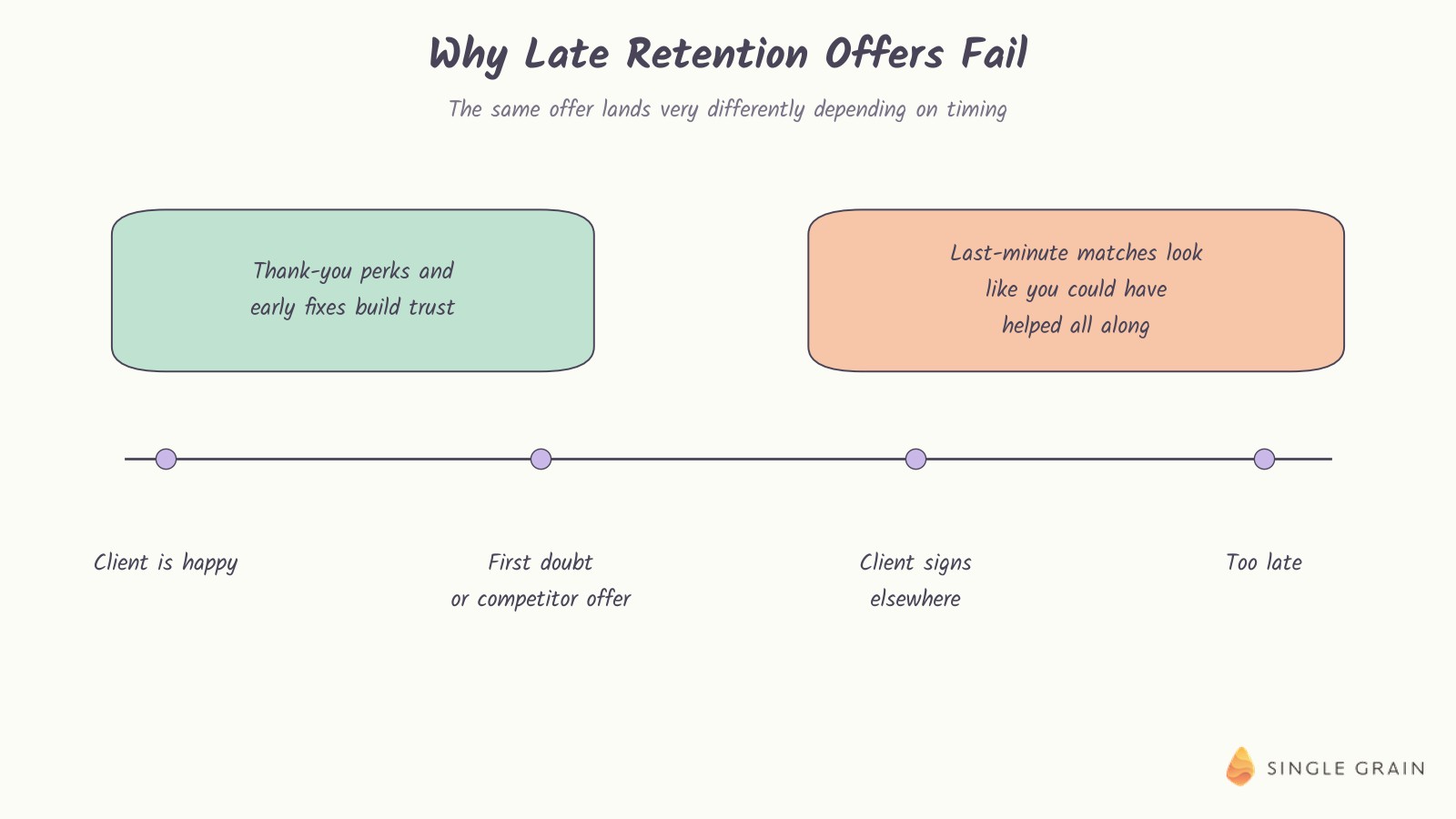
Neil’s second story is the warning. His company had told its current bank for months that it needed better terms, and the bank said it couldn’t match a competitor’s offer. At the last minute, the bank came back and asked whether it could match after all. By then, the decision was made.
His reaction was simple. Why stay with someone you had to convince to adapt, when another partner was willing to adapt from day one? A late offer reads as proof the client could have been helped all along.
How AI Spots Churn Risk Early
Churn rarely comes out of nowhere. The signs show up in smaller replies, fewer logins, slower payments, and shorter calls. My team built an agent around three churn signals hiding across HubSpot, Slack, and Stripe, and predictive models can go further, as covered in how predictive churn models cut customer loss.
When the agent flags a risk, act on it that week. Offer the better terms, fix the issue, or schedule the hard conversation before a competitor gets there.
3. Be Direct and Prove Your Results
In the same episode, Neil and I talked about sales pitches that dance around the point. People can tell when you’re selling while pretending not to, and they don’t appreciate it. Being direct, saying what you can do, and proving it builds far more trust.
The same goes for existing clients. Show them results plainly and often, including the months that didn’t go well. Clients who understand what’s working, and what you’re changing, rarely get surprised into leaving. Setting expectations early helps too, as my team covered in managing client expectations.
How AI Makes Results Reporting Easy
AI can pull live numbers from analytics, ad platforms, and your CRM, then draft a short monthly recap in plain language. Your team checks it, adds context, and sends it. A recap that takes ten minutes instead of two hours actually gets sent every month.
| Pro-Tip |
|---|
| Lead every client recap with one sentence on what changed for their business, like pipeline, revenue, or cost per lead. Put the channel metrics underneath. |
That one line keeps every update focused on the result the client is paying for.
4. Show Up Prepared for Every Conversation
Nothing erodes a client relationship faster than walking into a call unprepared. When a client has to repeat context, it signals they’re one account among many.
Preparation used to take real time, which is why it slipped on busy weeks. Now an AI assistant can read past emails, call notes, Slack threads, and open tasks, then hand your account lead a short brief before every call. My team uses this for sales, and the same approach works for client calls, as I explained in what an AI sales assistant should do before every call.
How AI Keeps the Relationship Visible Between Projects
Retention suffers in the quiet stretches between projects, when nobody has a reason to talk. AI can suggest timely check-ins based on news about the client’s company, a relevant industry change, or a result worth sharing. It’s an easy way to stay present without inventing busywork, and it pairs well with an account-based customer success approach.
5. Make Getting Help Effortless
Clients stay with partners who are easy to work with. If a simple request sits in the wrong inbox for three days, the client notices, even if the work itself is great.
AI can sort incoming requests by urgency and topic, route them to the right person, and draft a first reply for a human to send. My team covered how this works in inbox triage agents for marketing ops.
Faster answers make every client feel like a priority, and they free your senior people from inbox duty. Keep the tone human, too. A first reply that names the client’s request and gives a clear time for the full answer beats a generic receipt every time.
| What You Should Do |
|---|
| Measure how long client requests wait for a first reply this month. If the average is longer than one business day, start by routing requests with AI and keep the replies human. |
A clear target for response time gives your team something concrete to improve, and clients feel the difference quickly.
How to Measure Client Retention
You can’t improve what you don’t track. The simplest measure is your client retention rate for a period. Take the number of clients at the end, subtract the new clients you added, divide by the number you started with, and multiply by 100.
If you sell retainers or subscriptions, also track net revenue retention, which shows whether the clients who stay are growing or shrinking. Pair both numbers with the early signals from your churn agent, so you see risk before it shows up in the rate.
| Pro-Tip |
|---|
| Review retention by client segment, such as service line, contract size, or start date. A healthy overall rate can hide one segment that’s quietly leaving. |
A quarterly review of these numbers tells you which of the five strategies needs the most attention next.
How to Retain Clients as Your Business Grows
The best client retention strategies really aren’t that complicated. Say thank you with no pitch, act before clients ask, be direct about results, show up prepared, and make help easy to get. AI makes each one easier to do consistently, because it watches the signals your team would otherwise miss.
If you’d like help building retention into your marketing and client experience, my team at Single Grain offers AI transformation services that put these workflows to work. Contact Single Grain and we’ll find where your client relationships need support.
Frequently Asked Questions About Client Retention Strategies
-
What are the best client retention strategies?
Five that work well are saying thank you with no pitch attached, acting before clients ask, being direct about results, showing up prepared, and making help easy to get.
-
Why is client retention so important?
Bain & Company research summarized in Harvard Business Review found that a 5% increase in customer retention can lift profits by 25% to 95%.
-
How can AI help retain clients?
AI can flag client milestones, spot churn signals across your CRM and billing tools, draft results recaps, prep account leads before calls, and route client requests to the right person.
-
How do you know a client is about to leave?
Watch for shorter replies, fewer logins, slower payments, and shorter calls. An AI agent can monitor these signals and alert your team early.
-
What should you do when a client is at risk?
Act that week. Offer better terms, fix the issue, or schedule the hard conversation before a competitor makes a better offer.