Ultimate SEO Content Checklist: How to Leverage AI to Improve Your SEO Score


Most SEO content checklists are written for people with time to spare. But what if your SEO content checklist checked itself using AI? Ours does. My team runs every draft through Jev, the AI classifier from TypeSafe that we use as a quality gate. It scores each page out of 100 against eight specific SEO checks.
Why does this matter? A bot can’t fix what it can’t measure. Once our AI drafts started grading themselves against the checklist, we saw scores jump from 58 to 86! After the grading and automated fixes, we pass the content to our editors to make the final human SEO pass. You won’t believe how much TIME you’ll save on editing because of this!
Keep reading for the full SEO content checklist, how to score SEO content quality out of 100, and the prompt that runs every check for you.
TL;DR
- A good SEO content checklist is short and checkable. My team’s version has eight items, and each one is specific enough for a person or a bot to mark pass or fail.
- Points show what matters most. Human voice carries 20 points, title promises and linked stats get 15 each, and five other checks get ten each.
- Scores decide the next move. Under 70 gets rewritten, 70 to 89 gets fixed, and 90 and up is ready for an editor.
- A grader prompt runs the checklist for you. Paste any draft into Claude or ChatGPT, and it quotes the failing line, writes the fix, and rescores.
What Belongs on an SEO Content Checklist?
An SEO content checklist is the list of checks a page must pass before it’s published. Most checklists cover the basics, like a target keyword, a clear title, useful headings, and internal links. The best ones also check quality, meaning whether the page actually answers the search, backs up its claims, and sounds like a real expert wrote it.
Google’s guidance points the same way. Its guide to creating helpful, reliable, people-first content asks whether content shows first-hand expertise and fully satisfies the reader, and its post on Google Search and AI-generated content rewards quality however the page was produced.
A checklist turns those principles into items you can actually mark. Here’s the one my team uses on every draft.
P.S. If you’re still deciding whether to use AI for drafts at all, my team covered that in is AI content bad for SEO. Definitely take a look!
My 8-Point SEO Content Checklist
Through Jev, every draft gets scored out of 100 across eight specific SEO checks. Most of these checks were derived from my SEO content editor’s notes on human-edited content, and the rest are standard on-page SEO. I mention this because we did have a human in the loop to create many of the specific checklist rules and then fed them to Jev to grade on an ongoing basis.
We’ll break this down further below.
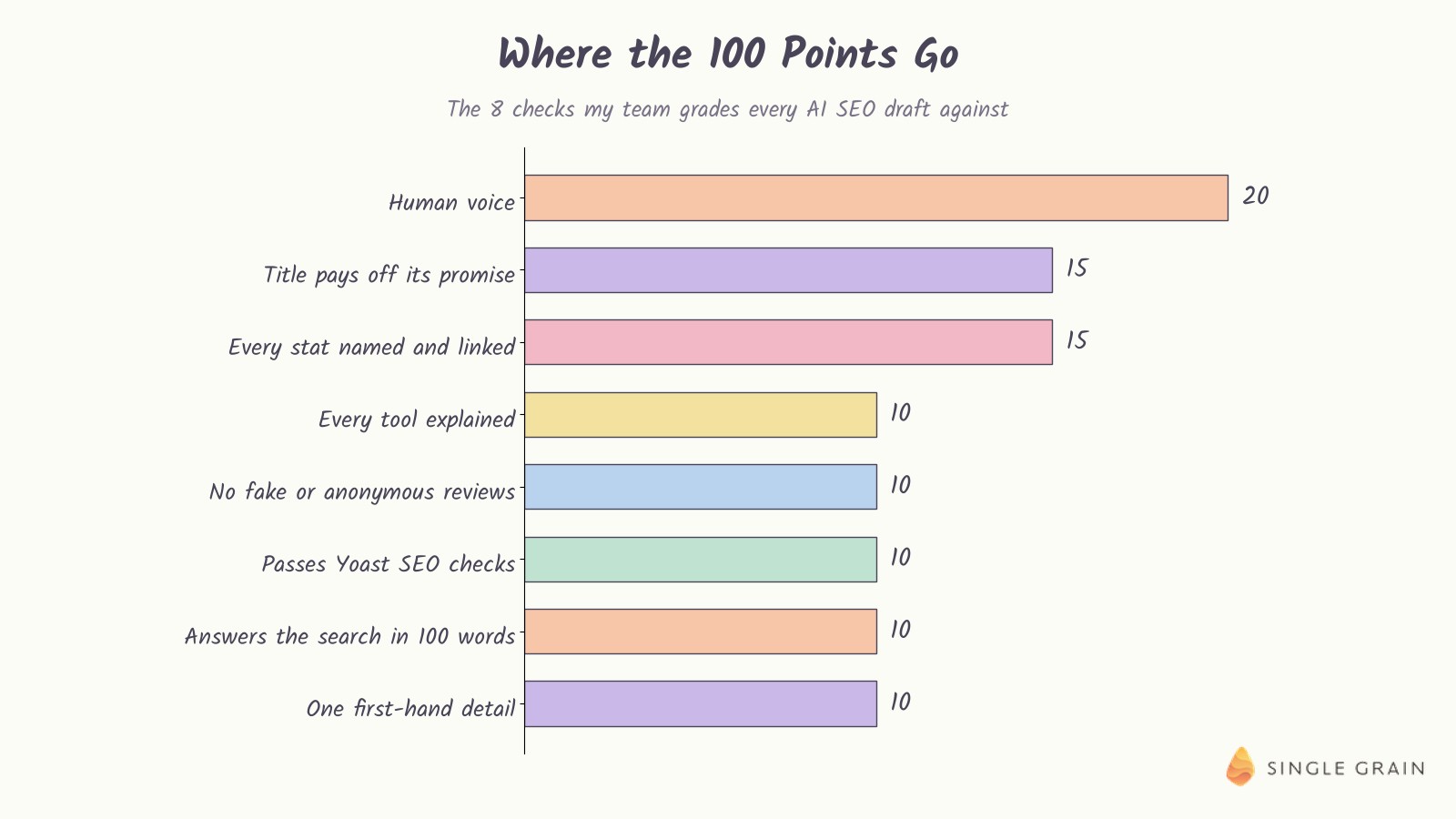
1. The Page Sounds Like a Real Expert (20 Points)
Human voice gets the biggest share because readers decide in a few lines whether to trust a page. Look for natural sentences, varied rhythm, and an actual point of view. First person is fine, and it’s often better. Human-sounding AI drafts take a skill of their own, which I cover in my humanizer skill post, so this check simply asks whether the page passes a quick read.
2. The Title Keeps Its Promise (15 Points)
A title that promises “thousands” of something has to show a real number in the body, or the title changes. The same goes for “step-by-step,” “free,” or any specific claim. Read the title, then skim the page and confirm it delivers.
3. Every Stat Links to a Named Source (15 Points)
Every number needs a named source and a link on the anchor text, ideally with a date. A bare “Source:” line at the bottom doesn’t count. My team’s guide to AI content fact-checking explains how we verify numbers before they go in.
4. The Page Answers the Search in the First 100 Words (10 Points)
Someone searching your keyword wants an answer fast. Check whether the intro tells them what they came for, or at least shows them where it is, before the first heading. Long scene-setting intros usually fail here.
5. Every Named Tool Gets a Plain Explanation (10 Points)
If the page names a tool, it needs one plain line on what the tool is and how it’s used here. Readers who haven’t heard of it shouldn’t have to open a new tab to follow along.
6. No Unverified Reviews or Case Studies (10 Points)
Anonymous testimonials, made-up quotes, and case studies without a source get removed. If a story is real, name the source and the date. Anything you can’t verify comes out.
7. One First-Hand Detail Only the Author Knows (10 Points)
Every page needs at least one detail from real experience, like a result your team saw, a mistake you made, or a step you changed. This is the part competitors can’t copy, and it’s what makes a page worth citing.
8. The On-Page SEO Basics Pass (10 Points)
The page needs a primary keyword, a title tag of about 65 characters or less, and a meta description that states the reader’s job and pain. My team also runs every draft through Yoast’s checks. These basics take minutes, and skipping them wastes everything above.
Those eight items are the whole list. Next comes turning them into a score you can track.
How to Score SEO Content Quality Out of 100
SEO content quality gets easier to manage once it’s a number. Add up the points from the eight checks, then let the score decide the next move.
| Pro-Tip |
|---|
| Score three pages you already published before you score new drafts. Compare those scores with how each page performs, and you’ll quickly see which checks matter most for your site. |
Under 70, rewrite the draft. From 70 to 85, fix what failed and rescore. At 86 and up, send it to an editor for the final human review. Always rescore after a fix, since a rewrite can introduce new problems.
The score gets more useful over time. My team’s drafts averaged 58 when we started and 86 after the bot began grading itself!
Use This Grader Prompt
Hand scoring works for a few pages. Past that, let AI do the first pass. Use this grader prompt so AI can do the work for you!
| Starter prompt for grading SEO content |
|---|
| You are a strict SEO editor. Check the page below against these rules. Mark each one PASS or FAIL, quote the line that fails it, and write the fix. Any FAIL means the page goes back. 1. Title pays the promise. If the title promises a number or scale (“thousands”), the body shows a real number, or the title changes. 2. Named tools get a what + why. Every tool in the title or body gets one plain line on what it is and how it’s used here. 3. No unverified case blocks. Remove anonymous reviews, quotes, or case studies unless there’s a real source and date. 4. Named stats are hyperlinked on the anchor with the source name and date. 5. Natural voice. Max one colon-style thesis opener per page, very few negative or back-and-forth contrast lines, and no filler slang. 6. Figure lead-ins. Every chart or image section gets one transition sentence under the header before the asset. 7. Tip piles need H3s. Group related tips under real subheads. 8. SEO basics. A primary keyword. Title tag of 65 characters or less (fail over 75). Meta description states the reader’s job and pain. 9. Timestamped embeds. If a video says it, embed it at the timestamp. Baseline: 1,500+ words, 6+ H2s, 3+ H3s, recent cited stats, no invented numbers, and a search-shaped headline. Flag these for a person instead of failing them: Title Case on H2/H3s, image captions, table of contents placement, and first person vs third person. Then grade the page from 1 to 100, list what would move the score most, and rewrite the intro. |
Paste your page at the end of the prompt and run it in Claude or ChatGPT. The grader marks each rule, quotes the exact sentence that cost points, and lists the fixes worth the most.
The checklist and the prompt overlap on purpose. The checklist gives you a score to track over time, and the prompt gives you a strict set of reasons to send a page back.
Let the Person Who Reads Every Draft Own the Checklist
My editor owns our checklist. She reads more drafts than anyone else, so her notes became the checks. Everyone else on the team suggests changes, but only one person edits the list until it holds up.
That ownership made the jump from 58 to 86 possible. A committee writes vague rules. The person who reads every draft writes specific ones, and specific rules are easy for a bot to follow. I walk through how our bot locks these rules in and grades the before and after in this video.

Once teams watch the score climb on a real draft, the checklist clicks. It also shows how much of the gain comes from a few specific fixes.
| Action Step |
|---|
| Ask your editor to list the five notes they leave most often on drafts. Turn each note into a pass or fail check, and add it to your checklist this week. |
A list built from real notes beats any generic template, because it targets the mistakes your team actually makes.
Where the Checklist Fits Before You Publish
The checklist works best as a step between drafting and human review. The bot drafts, the grader scores, the bot fixes, and only then does an editor read it. Editors spend their time on judgment calls like angle and accuracy, and less on missing links and broken title promises.
Weak drafts cost more than rankings. They drain editor time and erode trust in every future draft, which my team covered in what slop grenades cost your team. As AI writes more first drafts, review becomes the real bottleneck, and a checklist is how you scale it.
Run one more check before you hit publish. A new post can compete with an older one on the same keyword, so pair your checklist with a keyword cannibalization check.
Finally, save every failed draft along with the grader’s notes. After a month, those notes show which checks fail most often, and that list tells you exactly which instructions to tighten in your writing prompt.
Publish Pages That Pass Every Check
A short, specific SEO content checklist does more for quality than any long style guide. Score every draft on eight checks, let the grader prompt run the first pass, and let the person who reads every draft own the list. Then rescore after every fix until the page clears 90.
If you’d like help scaling content that ranks and gets cited, my team at Single Grain runs content marketing and SEO services built on checklists like this one. Contact Single Grain and we’ll grade your top pages together.
Frequently Asked Questions About the SEO Content Checklist
-
What should an SEO content checklist include?
Cover voice, a title that keeps its promise, linked stats, a fast answer to the search, plain explanations of named tools, no unverified reviews, one first-hand detail, and on-page basics like the keyword, title tag, and meta description.
-
How do you score SEO content quality?
Give each check a point value that adds up to 100. My team weights human voice at 20 points, title promise and linked stats at 15 each, and five other checks at ten each.
-
What score should a draft hit before publishing?
Under 70 gets rewritten, 70 to 89 gets fixed and rescored, and 90 and up goes to an editor for a final read.
-
Can AI check SEO content against a checklist?
Yes. Paste the draft into Claude or ChatGPT with a grader prompt, and it marks each rule pass or fail, quotes the failing line, and writes the fix.
-
Who should own the SEO content checklist?
The person who reads every draft, usually your editor. Their notes are the most specific, and specific rules are easiest for a bot to follow.