

Why Your AI Content Agent’s Rewrite Is Riskier Than the Thin Claim It Fixed


TABLE OF CONTENTS:
- Quick Overview
- Why AI content review has to be two-staged
- The review loop that keeps rewrites honest
- Operator scene: the sponsorship reply
- Where this sits in a managed content agent stack
- A practical editorial cadence
- Worked example: thin claim flagged, rewrite reviewed
- Failure modes to log every Friday
- Want two-stage review instead of confident mistakes?
Quick Overview
This is for content ops and marketing leaders who already use an AI content review step to catch thin claims. The job is two-stage trust: flag the thin claim, then review the rewrite with the same seriousness. The mechanism is a Jev flag followed by a human check on both the decision and the next agent’s output. The outcome is fewer invented promises, quieter legal risk, and drafts that stay tied to what someone actually approved.
One recent study: 74.2% of 900,000 new English pages crawled in April 2025 contained some AI-generated content. 2.5% were pure AI. 25.8% were pure human. Source: Ahrefs, May 19, 2025. The detector is not perfect. Google does not publish a penalty percentage for AI text.
- Thin-claim detection is necessary and not sufficient.
- The rewrite can invent terms, numbers, or commitments the flag never mentioned.
- Review the decision and the output as separate checks.
- Sponsorship, pricing, and SLA language need the highest scrutiny.
- Keep a refuse path: some flagged lines should die, not get rewritten.
A content ops lead opened a draft that had already “passed” an automated thin-claim check. The original sentence was weak and hedged. The rewrite was confident, specific, and wrong. It promised a sponsorship term nobody had agreed to. The flag had done its job. The next agent had created a new problem with better prose.
Eric put the warning in one short tape. Jev can flag a thin claim in my content workflow. But I would still review what the next agent writes. A sponsorship inquiry might deserve a reply, while its draft promises terms nobody agreed to. Check both the decision and the output. That is the whole thesis.
Why AI content review has to be two-staged
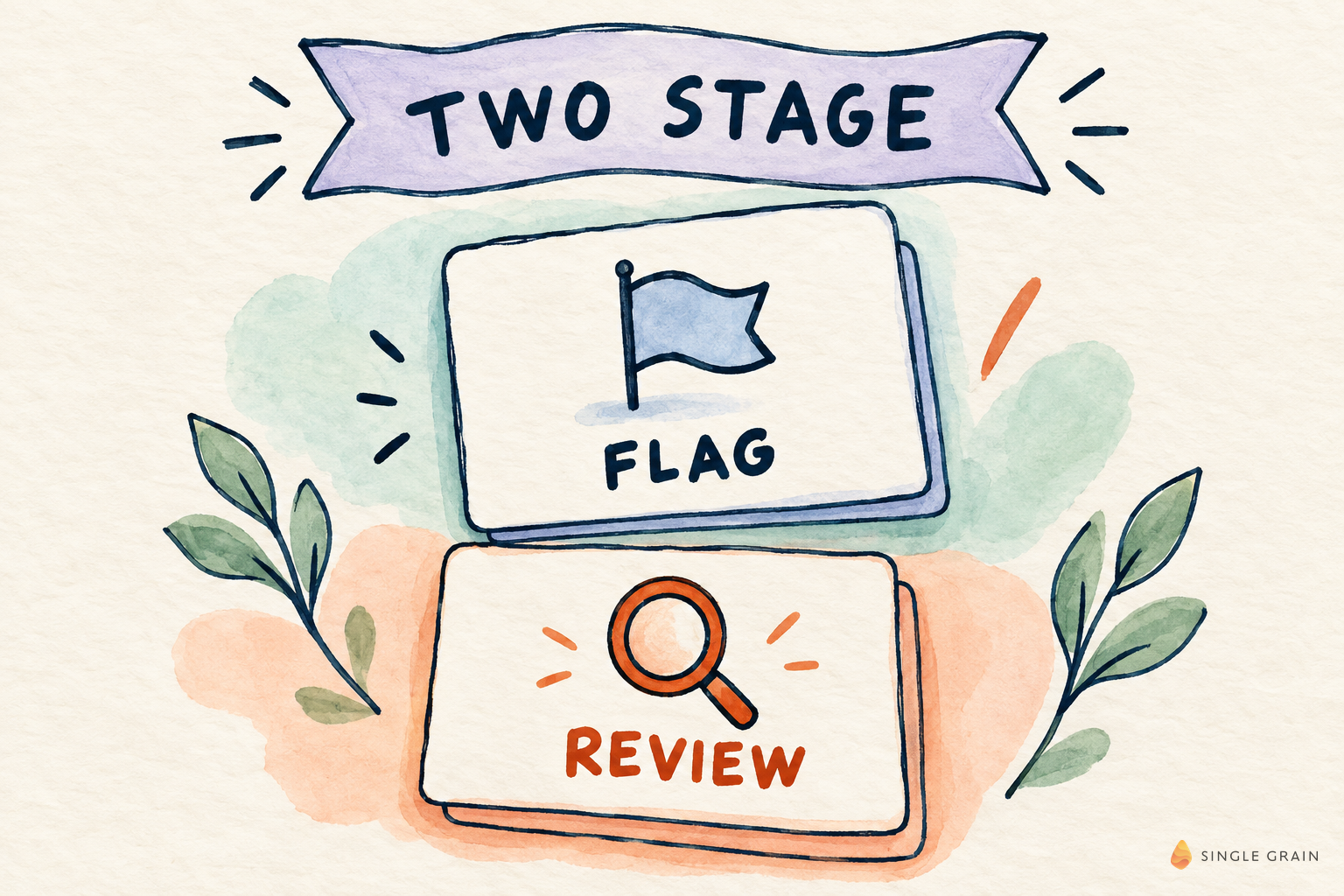
Most teams stop at detection. Detection feels like quality control because it catches empty superlatives and unsupported numbers. The silent failure is the rewrite. Models are eager to be helpful. Helpful often means filling gaps with plausible detail. Plausible detail is how a soft claim becomes a hard promise.
Two-stage review separates “should this line change” from “is the new line allowed.” Different questions. Different failure modes. Different owners if you are serious.
Failure modes the second stage catches
| Failure | What it looks like | Who must catch it |
|---|---|---|
| Invented terms | Discounts, SLAs, exclusivity nobody approved | Human commercial owner |
| Invented proof | Metrics, logos, or customer names not in source | Human evidence owner |
| Scope creep | Reply turns into a mini-proposal | Human thread owner |
| Tone laundering | Hedged truth becomes absolute certainty | Editor |
The review loop that keeps rewrites honest
- Flag. Jev marks thin, unsupported, or overreaching lines.
- Decide. A person chooses rewrite, qualify, or delete. Delete is a valid win.
- Rewrite. The next agent proposes replacement language inside the decision.
- Output check. A person compares rewrite to source of truth: brief, CRM note, sponsorship terms, or tape.
- Ship or refuse. No silent merges. Disputed lines stay blocked.
If step four is skipped because the rewrite “sounds better,” you have automated confidence, not quality control.
Decision labels worth standardizing
- rewrite: keep the intent; fix the support.
- qualify: keep the line but add the condition that makes it true.
- delete: the claim should not exist in any form.
- escalate: commercial or legal owner must weigh in before language moves.
Eric walks the content-mining side of this loop in a short on the AEO/SEO workflow: mine ideas, compare with what is already live, shortlist, then keep a human on the matches. That human pass is the same muscle as rewrite review.

Operator scene: the sponsorship reply
Eric’s sponsorship example is the cleanest teaching case. The inbound might deserve a reply. The draft might invent terms. In a Single Grain ops review of agent-assisted replies, the pattern repeated: detection caught emptiness, while rewrites introduced specificity that felt executive and was operationally false. The fix was a checklist on the output: Does every number appear in the source note? Does every promise map to an approved package? If either answer is no, the rewrite fails even if it is prettier than the original thin line.
Supporting statistics for LLM confidence is a related but different job. That page helps you strengthen answers with real support: using supporting statistics to improve LLM confidence in answers. This page is about not trusting the rewrite that follows a thin-claim flag.
Where this sits in a managed content agent stack
Give the review job an SLA and a kill switch like any other managed agent. If rewrite invent-rate rises, pause auto-rewrite and keep flags only until prompts and owners are fixed. See SLAs and kill switches. If the agent job stops earning trust, decommission it cleanly: when to decommission a marketing agent job.
A practical editorial cadence
- Run thin-claim flags on every draft before human edit.
- Human decides rewrite, qualify, delete, or escalate per flag.
- Auto-rewrite only on lines marked rewrite or qualify.
- Second human pass checks output against source of truth.
- Log invent events so the rewrite prompt gets tighter over time.
Measure invent events per thousand words, not “AI usage.” Usage without invent tracking is theater. Invent tracking turns AI content review into an ops system.
Treat the rewrite agent as a high-risk stage, not as the hero. The thin-claim flag is cheap and useful. The rewrite is expensive because it can invent terms, inflate proof, or soften a refuse into a maybe. Your content quality control job is to review the rewrite with the same seriousness you review the flag, especially on commercial language.
Worked example: thin claim flagged, rewrite reviewed
This walkthrough stays qualitative on purpose. No invented conversion rates. The lesson is the two-stage loop: flag the thin claim, then review the rewrite before it ships.
Stage one: flag
An AI content agent drafts a MOFU section that says a tactic “always works for B2B.” There is no source, no date, and no scope. The review bot flags the sentence as a thin claim and quotes the exact line. It does not auto-rewrite yet. The flag sits in a queue with the URL, the sentence, and the reason code: unsupported absolute.
Stage two: rewrite under review
A second agent pass proposes a rewrite: “In our recent ICP calls, buyers asked for proof before they booked a demo.” That sounds safer, but it invents a buyer pattern nobody logged. The human reviewer rejects the rewrite for the same reason the original was flagged: it asserts a fact the claim bank does not hold. The approved fix is narrower: drop the absolute, keep the mechanism, and point to a real tape or a live page that already supports the point.
Why the rewrite is the riskier half
Flagging is easy to automate. Rewriting is where confident mistakes enter. A thin claim is visible. A polished rewrite that invents terms, timelines, or “what buyers said” can pass a skim. That is why this post insists on two stages. Stage one finds the hole. Stage two proves the patch did not dig a deeper one.
Editorial close
Ship only when both stages clear: the thin claim is gone, and the replacement is backed by tape or an already-live supporting page. If the rewrite needs a new statistic, stop and gather evidence. Do not let the agent invent the number to finish the paragraph.
Failure modes to log every Friday
Pick five invent events and five clean deletes. Deletes are wins. Before any rewrite runs, make the agent explain the weakness first, the way Eric put it: explain why a content idea is weak before asking it to rewrite.
Keep Jev on classification so humans stay on judgment. Put Jev in the workflow to classify content ideas faster, and make sure every queue has a useful next step, including refuse, as Eric noted when he said every queue in a Jev workflow needs a useful next step.
Log invent events with before line, after line, and missing source. Measure invent events per thousand words. If invent rate rises for two weeks, pause auto-rewrite and keep flags only until prompts and source-of-truth links are fixed.
Refuse remains a first-class outcome. Escalate commercial language. Never merge a rewrite because it sounds executive. Qualify decisions need the condition written into the line, not left in a comment thread.
Owner checklist for rewrite review
- Thin-claim flag includes the exact sentence and why it is thin.
- Rewrite queue cannot publish without a second human check on commercial lines.
- Refuse path written: what stays deleted instead of rewritten.
In a Single Grain ops review, the scary moment was not the thin claim Jev flagged. It was the next agent’s polished reply that invented sponsorship terms nobody had agreed to. The first stage did its job. The second stage created a new risk. That is why Eric still reviews both the decision and the output on the thin-claim tape.
Commercial owners should see invent events weekly. Hiding them in an editorial channel recreates the risk the second stage was meant to catch. When a manager wants speed, show invent events next to publish count. Speed without invent tracking is how confident wrong lines ship.
When in doubt, hold the rewrite and keep the flag. Holding is cheaper than a confident wrong term in a customer-facing draft. Publish a one-line health note each week: flags raised, rewrites merged, invent events caught. Those three numbers tell you if the review job is alive.
Keep the invent taxonomy boring: invented term, inflated proof, softened refuse, missing source. Clever labels hide patterns. Boring labels make weekly review possible.
If editorial standups still open with a vibe check on tone, the review job is not live yet. Open the invent event log and the escalate list first.
Document who can merge a commercial rewrite after an invent flag. One named owner. Merges without names become the new publish path overnight.
Write the freeze time next to the prompt. Teams that skip freeze time recreate mid-batch drift and then blame the model for inconsistent outputs.
Before a rewrite runs, freeze the source-of-truth link next to the flagged sentence. A rewrite without a source link is how invented terms sneak into a polished paragraph.
Ask the reviewer one question on every commercial rewrite: would you send this line to a customer tomorrow? If the answer hesitates, refuse. Hesitation is data.
Keep a short invent sheet: before line, after line, missing source, and owner. Do not keep a graveyard of improved paragraphs without notes. Notes are how the next flag pass gets sharper.
Publish a weekly health line in the same channel as the job owner: flags raised, invent events caught, and open escalations. Those three numbers beat a vibes update every time.
When a rewrite softens a refuse into a maybe, treat that as invent. Softening is not polish. Softening is a new commercial promise that nobody approved.
Do not let a polished paragraph skip the invent check because the week is busy. Busy weeks are when invented terms ship. The second review exists for those weeks.
If the invent sheet stays empty for a month, your flag prompts are too soft or your reviewers are not logging. Empty sheets are a signal, not a win.
Refuse remains a first-class outcome. Not every row, bookmark, call, render, or flagged sentence deserves a clever next action. Teams that cannot refuse end up automating noise and then blaming the model for being unreliable when the real failure was missing judgment.
Owner checklist
- Input contract frozen before the run.
- Uncertain items have a named human.
- Refuse remains valid.
Week-over-week, publish a one-line health note: volume processed, uncertain share, and refused share. Those three numbers tell you if the job is alive.
Owners should be able to pause the job in one step. If pause requires an engineering ticket, you do not have a kill switch yet.
New teammates should shadow one full cycle before they edit prompts. Prompt edits without cycle context recreate silent failures.
Keep screenshots out of the source of truth. The runbook and the audit columns are the source of truth.
If a stakeholder wants a demo instead of a job, show the audit column. Demos without audits are how chatbot theater returns.
Write the refuse path in plain language. If nobody can name what gets refused, the system will accept everything under time pressure.
When two systems conflict, log the conflict. Silent resolution teaches the agent to hide disagreement.
Do not let executive demos skip the human gate. Special cases become the new default overnight.
Keep customer-identifying detail out of prompts unless the run is in an approved private sandbox.
When in doubt, hold. Holding is cheaper than a confident wrong route, flag, render, or rewrite.
Want two-stage review instead of confident mistakes?
Single Grain installs thin-claim flags with a mandatory rewrite check so agents do not invent terms after they “fix” a weak line. Talk to Single Grain about putting AI content review on both the decision and the output.


