

3 Churn Signals Hiding Across HubSpot, Slack and Stripe (and the Agent That Catches Them Before Renewal)


TABLE OF CONTENTS:
Quick Overview
This is for customer success and revenue ops leads who feel renewals slipping but cannot see why in one screen. The job is early detection when the signal is split across HubSpot, Slack, and Stripe. The mechanism is an agent ask through SingleBrain Gateway that joins deal context, account activity, and renewal timing on demand. The outcome is a short attention list before the renewal date, not a postmortem after churn.
One recent benchmark: median net revenue retention for B2B SaaS with at least $250k ARR was 82%. The upper quartile was 97%. AI-native companies were much lower, with median gross revenue retention of 40% and net revenue retention of 48%. Source: ChartMogul and Kyle Poyar, December 10, 2025. That study does not give a HubSpot, Slack, or Stripe signal threshold.
- HubSpot holds deal stage and stakeholder map.
- Slack holds the account chatter and the silence that matters.
- Stripe holds renewal timing and payment state.
- Ask the agent which accounts need attention; do not wait for a monthly deck.
- A person still owns the save motion. The agent owns the join.
Late on a Thursday, a CS lead scrolled three tabs and still could not answer a simple question: which accounts are quietly leaving. HubSpot showed a deal still marked closed-won with a healthy ARR line. Slack showed the champion had gone quiet after a support thread two weeks earlier. Stripe showed a renewal charge dated for the following month. None of the tools was wrong. The miss was the join.
Eric named the same split on X. HubSpot has the deal context, Slack has the account activity, and Stripe has the renewal timing. With SingleBrain Gateway, an AI agent can bring those pieces together when you ask which accounts need attention. That ask is the product. The value is not another dashboard. The value is a joined answer while there is still time to act.
Why HubSpot Slack joins beat another churn dashboard
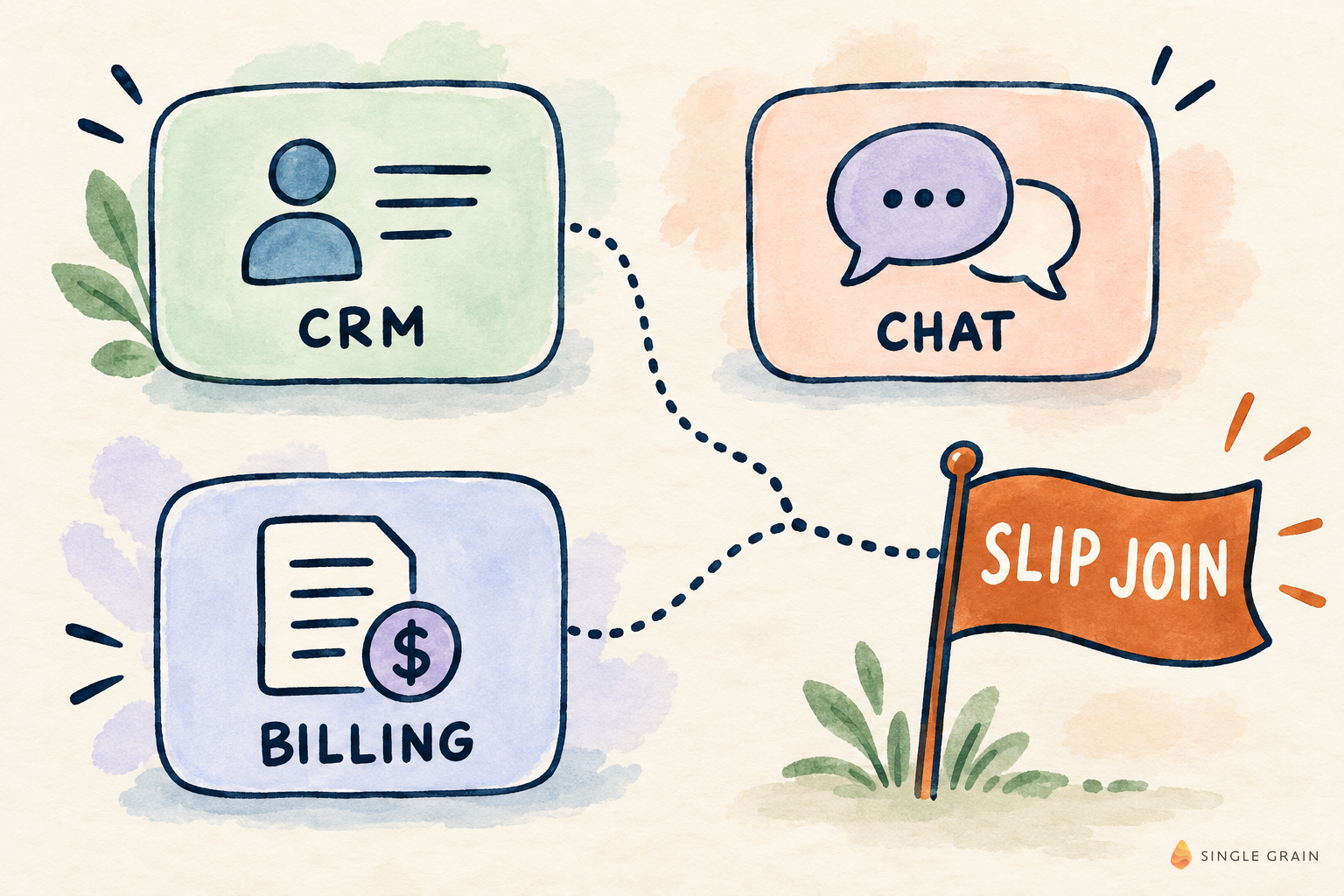
Teams already drown in dashboards. The failure mode is not missing charts. The failure mode is a human having to assemble a story from three systems under time pressure. HubSpot Slack pairings show up in search because operators feel that friction every week: CRM truth in one place, conversation truth in another. Add Stripe and the renewal clock, and you have the classic slip pattern: green CRM, quiet Slack, upcoming invoice.
A joined agent ask collapses that assembly time. You still need judgment. You do not need twenty minutes of tab hopping per account before you even decide who deserves a call.
Three signals that usually travel apart
| System | Signal | What “slip” often looks like |
|---|---|---|
| HubSpot | Deal context, stakeholders, next step | Next step stale; champion role empty; stage frozen |
| Slack | Account activity and tone | Threads go cold; only billing pings remain |
| Stripe | Renewal timing and payment state | Renewal close while usage or sentiment is soft |
The agent ask that should exist every Monday
Write the ask so a new CSM could run it without tribal knowledge.

- Scope the window. Accounts with renewals in the next 30 to 60 days.
- Pull HubSpot fields. Stage, ARR, champion, last activity date, open tickets if you store them.
- Pull Slack markers. Last meaningful thread, who spoke, whether the tone shifted to billing-only.
- Pull Stripe timing. Renewal date, failed payment flags, plan changes.
- Return an attention list. Account, why it surfaced, suggested human action, confidence of the join.
Keep the output short. If the list needs a novel to explain itself, the join criteria are too vague.
What the agent must never invent
- A churn reason that does not appear in the source systems.
- A stakeholder name that is not in HubSpot.
- A renewal date that disagrees with Stripe without flagging the conflict.
Operator scene: silence is a field
On an anonymized September account review inside the Single Grain stack, the save that mattered started with silence, not a complaint. HubSpot still looked fine. Stripe was on schedule. Slack had gone from weekly product questions to nothing. The agent surface that helped was not a prediction score. It was a joined note that said the renewal was close and the conversation graph had gone flat. A human still made the call. The agent made the silence visible in time.
That is the job delta versus a finance-facing attribution join. Revenue attribution for a GA4 and CRM sign-off is a different problem, covered here: revenue attribution GA4 CRM join finance will sign off. This page is about slip detection before renewal, not about proving channel math after the fact.
Guardrails so the attention list stays trusted
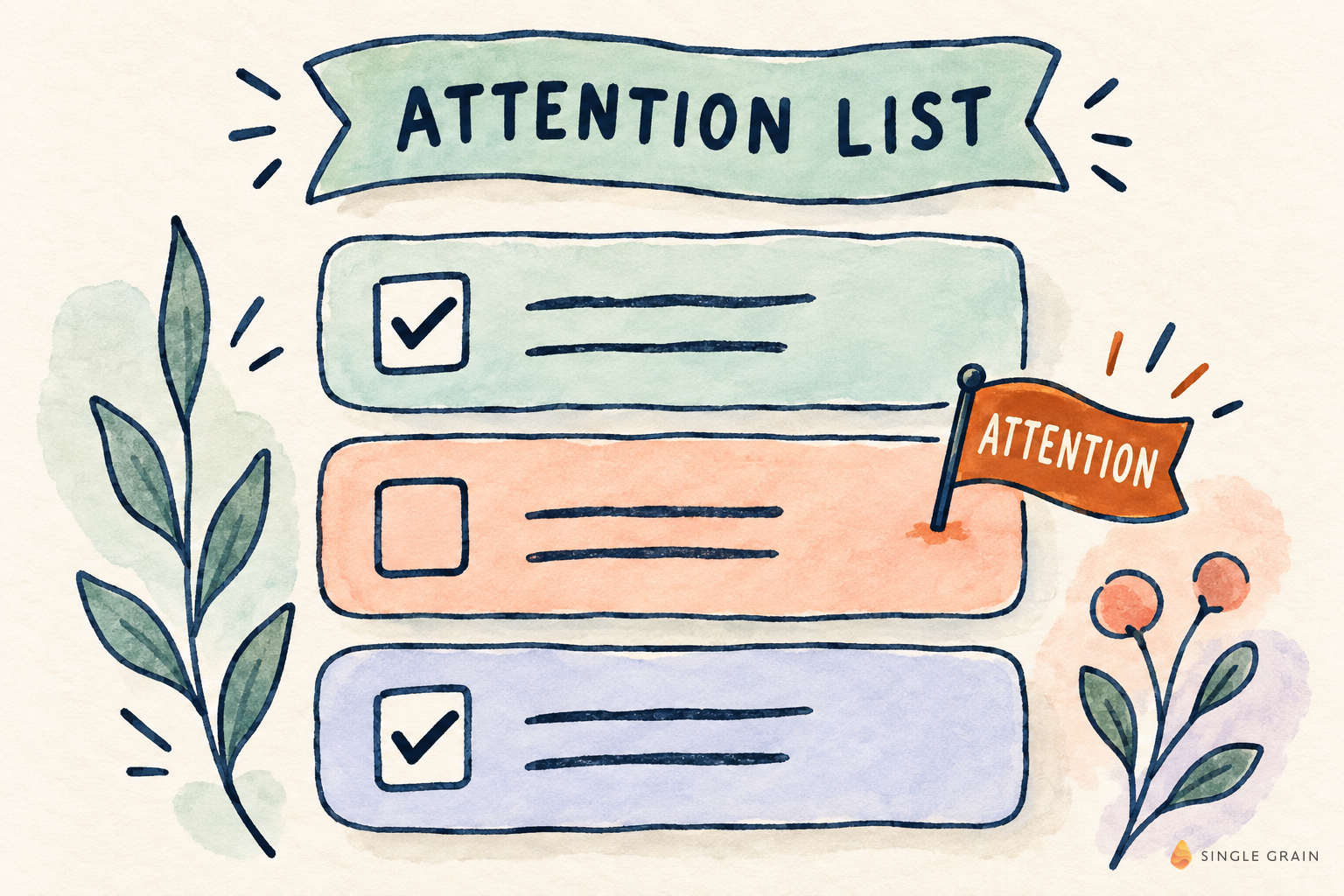
Trust dies when the list cries wolf. Start narrow. Prefer precision over recall for the first month. Log every account the agent flagged and whether a human agreed. If false positives pile up, tighten the Slack silence rule or the HubSpot stale-next-step threshold before you widen the renewal window.
Give the job an owner and a kill switch. If the join starts hallucinating stakeholders or inventing sentiment, pause the ask. The managed-agent framing in SLAs and kill switches applies even when the “marketing” job is really a retention job. For pricing the ongoing join as a service line, see pricing managed marketing agents.
Human actions the list should suggest
- Champion re-engagement call with a concrete product win to review.
- Executive sponsor check-in when HubSpot shows the champion seat empty.
- Billing + value review when Stripe renewal is close and Slack is cold.
- No action yet, watch list only, when signals conflict and confidence is low.
Weekly operating rhythm
Monday: run the attention ask for renewals inside the window. Tuesday: CSMs clear the list and log agree or disagree. Wednesday: work the agreed save motions. Friday: review false flags and update the join rules in writing. Do not let the rules live only in a prompt someone edited at midnight.
When the rhythm sticks, the team stops treating churn as a surprise that appears in a QBR. The surprise becomes an earlier, smaller conversation while Stripe still shows a future charge and Slack still has a path back to a real thread.
Failure modes to log every Friday
Pick five wins and five misses. Name whether the join rule, the Slack silence definition, or the handoff failed. Update one rule only. Keep the ask layer boring enough that a new CSM can run it, the same way Eric talks about running Jev + Grokbot as repeatable jobs.
When HubSpot and Stripe disagree, surface the conflict. The join is an ask, not a story. That matches how Eric talks about SingleBrain Gateway as the place those pieces come together on demand.
Write the Friday note as three columns only: account, joined signal (HubSpot stage plus Slack silence plus Stripe status), and human decision (save call, nurture, or leave alone). If the note cannot name which system disagreed, the join rule is still a story, not an ask. Broad rewrites of the whole stack every Friday are how institutional memory dies.
Keep the Friday note in the same place as the prompt. If the note lives in a random Slack thread, next week starts from folklore again. The point of a managed job is that a new owner can read the runbook and run the same loop without a private briefing.
Refuse remains a first-class outcome. Not every row, bookmark, call, render, or flagged sentence deserves a clever next action. Teams that cannot refuse end up automating noise and then blaming the model for being unreliable when the real failure was missing judgment.
Owner checklist
- Input contract frozen before the run.
- Uncertain items have a named human.
- Refuse remains valid.
Week-over-week, publish a one-line health note: volume processed, uncertain share, and refused share. Those three numbers tell you if the job is alive.
Owners should be able to pause the job in one step. If pause requires an engineering ticket, you do not have a kill switch yet.
New teammates should shadow one full cycle before they edit prompts. Prompt edits without cycle context recreate silent failures.
Keep screenshots out of the source of truth. The runbook and the audit columns are the source of truth.
If a stakeholder wants a demo instead of a job, show the audit column. Demos without audits are how chatbot theater returns.
Write the refuse path in plain language. If nobody can name what gets refused, the system will accept everything under time pressure.
Store prompt versions next to ICP or brief versions. Mixing versions mid-batch creates labels nobody can defend later.
Celebrate clean uncertain piles. A shrinking uncertain share usually means better inputs, not a smarter model.
When two systems conflict, log the conflict. Silent resolution teaches the agent to hide disagreement.
Schedule a monthly teardown with five wins and five misses. Change one rule. Only one.
If the job cannot survive a vacation week, it is still a personal workflow, not a managed agent job.
Measure handoff latency from agent output to human action. Slow handoffs erase the value of fast classification.
Do not let executive demos skip the human gate. Special cases become the new default overnight.
Keep customer-identifying detail out of prompts unless the run is in an approved private sandbox.
When in doubt, hold. Holding is cheaper than a confident wrong route, flag, render, or rewrite.
Week-over-week, publish a one-line health note: volume processed, uncertain share, and refused share. Those three numbers tell you if the job is alive.
Owners should be able to pause the job in one step. If pause requires an engineering ticket, you do not have a kill switch yet.
New teammates should shadow one full cycle before they edit prompts. Prompt edits without cycle context recreate silent failures.
Keep screenshots out of the source of truth. The runbook and the audit columns are the source of truth.
If a stakeholder wants a demo instead of a job, show the audit column. Demos without audits are how chatbot theater returns.
Want the join before the renewal?
Single Grain wires agent asks across HubSpot, Slack, and Stripe so your team sees slip while there is still time. Talk to Single Grain about an attention list your CSMs will actually open on Monday.