

Who Owns the Pipeline When Agents Run the Jobs


Who Owns the Pipeline When Agents Run the Jobs
A CRM agent can draft a revive message while a content agent prepares an article. Neither tells you who owns the customer relationship, the published claim, or the pipeline number. Before Single Grain scopes either job, the recommendation is simple: name one accountable human, define the agent’s permissions, and write down what stops the work.
In Eric’s discussion of marketing agent adoption, he cites 17 of 100 companies using AI agents in marketing, with those agents covering 3.5% of marketing staff. Those figures argue against selling an “AI-first organization” transformation upfront. Start with one owned workflow and measure the staff hours it actually removes, including review and correction time.
For Single Grain work spanning acquisition, content, and conversion, task completion is only part of the score. Sales must handle the reply. Editorial must defend the claim. A written RACI assigns those consequences before a faster production queue creates slower human cleanup.
When agents run jobs, ownership gets fuzzy
RACI separates four roles: Responsible does the work, Accountable owns the outcome, Consulted supplies required expertise, and Informed receives the update. A bot can be Responsible for a bounded task. It can never be Accountable for the business consequence.
“Revive pipeline” bundles record selection, exclusions, drafting, delivery, replies, and attribution. “Run content” hides a similar chain from research through measurement. Buying either as an undifferentiated capability leaves the difficult handoffs unspecified.
Eric’s one-job-per-bot recommendation changes the purchase specification: require one job, a success definition, a safety bar, and a human verifier. Refuse the super-agent pitch. Scope CRM evidence retrieval and message drafting as a bounded job, rather than authorizing a system to pursue revenue however it chooses.
Write the accountable person’s name into the operating document. Add permitted inputs, completion criteria, and an exception destination. “Blocked: missing account context” can be a correct result. A department label or shared inbox cannot resolve a disputed account.
Anthropic’s guidance on effective agents distinguishes predefined workflows from agents that dynamically direct their processes. Use predefined workflows for these jobs first: the handoffs are knowable, and improvisation does not resolve unclear ownership.
Worked scene: RACI for CRM revive outreach
In Eric’s CRM revival discussion, closed-lost and stalled opportunities become inputs for drafted outreach. The sequence starts with records already sitting in the CRM, then turns their history into potential follow-ups. The useful observation is that existing account context can ground the message. Assign retrieval and drafting first, rather than unrestricted prospecting. The discussion supplies a workflow, not proof of recovered revenue.
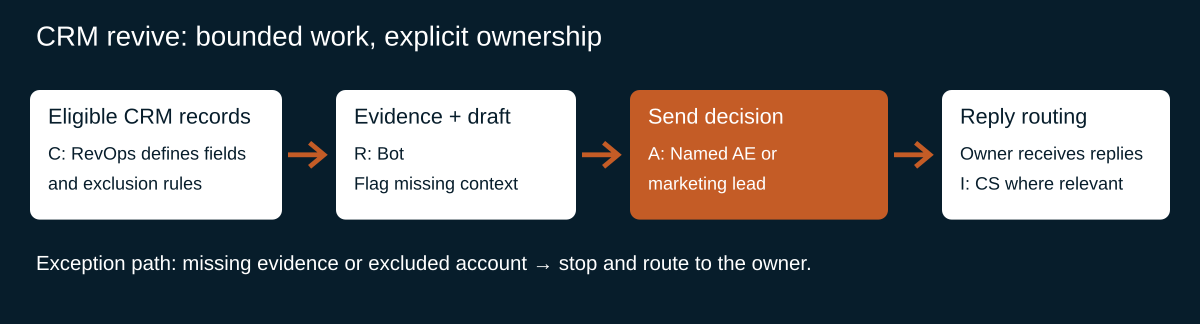
Applied to that job, the bot reads the opportunity stage, last contact, loss reason, account owner, and relevant notes. It returns proposed copy with supporting evidence. If the record says “budget frozen,” the draft can address timing. If the reason is absent, it flags missing context instead of inventing a reason to reconnect.
The bot is Responsible for retrieval and drafting. The AE is Accountable for an owned opportunity and approves its send. A marketing lead can fill that role for a separately defined marketing-owned cohort. Choose one. RevOps is Consulted on CRM fields, stage logic, and suppression rules. Customer success is Informed when existing accounts are involved.
The handoff includes the record ID, recipient, copy, evidence, and disposition. RevOps defines “stalled” before selection begins, excluding active negotiations, duplicates, and protected accounts. The Accountable human owns the kill switch and the next response when a prospect replies.
Measure eligible drafts, rejection reasons, qualified replies, reopened opportunities, and net staff hours. Preserve the original opportunity ID so a reopened deal does not become a new acquisition win. Include review time in the labor calculation; otherwise, the bot’s apparent savings may simply move work to the AE.
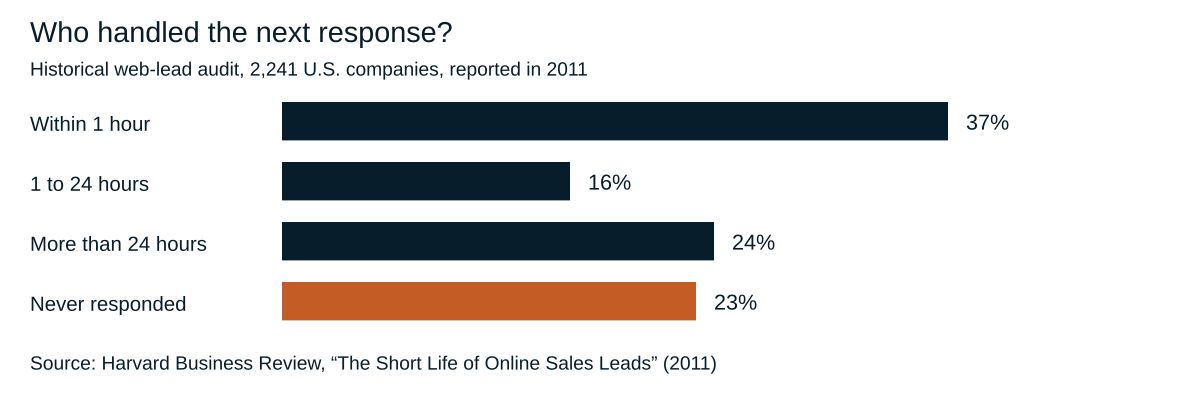
Historical research reinforces the response-owner requirement. A 2011 Harvard Business Review report described an audit of 2,241 U.S. companies: 37% responded to a web lead within an hour, while 23% never responded. This is inbound research, not a CRM revival benchmark. Use it to justify a named reply owner and response tracking, not a projected revival conversion rate.
Worked scene: RACI for draft→publish content
The second job follows the AEO scope in Eric’s discussion of agents and external actions: a bot finds answer opportunities, records measurements, and drafts content. Its packet contains the target question, existing page, retrieved sources, proposed changes, and measurement data. An unsupported assertion becomes an exception note, not an article sentence.
The SEO lead is Responsible for brief quality: intent, page choice, internal links, and whether the question warrants new content. The bot is Responsible for its research, measurement, and draft steps. The editor is Accountable and exact-approves the publication version. Legal or brand is Consulted on claims. Analytics is Informed of the URL, publication date, and measurement plan.
For Single Grain’s integrated AEO and SEO approach, keep one brief and one accountable editor per page. Separate bots producing competing “SEO” and “AEO” versions invite redundant pages and conflicting facts. The SEO lead resolves the page strategy before drafting begins.
For a job scoped through Single Grain’s AEO services, success includes source accuracy, relevant answer coverage, observable citations, and attributable visits or conversions where measurable. Retain prompts, dates, and observation conditions. A different answer on a later check warrants investigation before anyone credits the rewrite.
The completed packet joins the brief, source evidence, versioned draft, and measurement record. That gives editorial a reviewable artifact and analytics a traceable change. Counting articles alone would reward output without establishing whether the page answered the intended question.
Kill switches and what you never assign to a bot
Put the release policy in one place. Eric’s human-checkpoint recommendation assigns research, drafting, and repetition to bots, with a person checking anything outbound. His send, publish, delete, or spend boundary makes the rule executable: external work stays in draft until exact approval of the artifact and action. That includes PR pitches and citation assets, not just articles. Material changes invalidate approval.
Follow the progression in Eric’s observe, recommend, then act with approval discussion. The first deployment observes records and produces recommendations. Widen permissions only after the team can assess errors and handle exceptions. Do not start with unsupervised sending, publishing, or spending.
The Accountable human must be able to pause the queue, revoke action permissions, and assign recovery. Engineering implements the control; the business owner invokes it without waiting for a development sprint.
- Stop outreach for failed exclusions, mismatched recipients, or missing required context.
- Stop publication for unsupported claims, disputed evidence, or version mismatches.
- Never delegate accountability, spending discretion, destructive deletion decisions, or policy exceptions to a bot.
- Retain input snapshots, output versions, decisions, and action results for diagnosis.
Test the stop path before launch. A control that exists only in a slide leaves the workflow unfinished.
How to buy agents with a written RACI + CTA
Price the bounded job and its handoffs. For CRM revival, buy retrieval, evidence-backed drafting, exception routing, and logging. For content, buy brief ingestion, source handling, versioned drafts, and measurement records. Ask vendors to demonstrate incomplete inputs and rejected outputs, not just their strongest draft.
Attach the RACI to the scope of work: named owner, inputs, exclusions, permissions, completion criteria, exception destination, stop access, and reporting definitions. Calculate cost per accepted output and net staff hours saved. The adoption figures Eric cites support this limited starting point; they do not establish your business case.
Buy existing tooling when it meets the integration and control requirements. Build custom orchestration only for a demonstrated gap. Hire an operator when ownership or exception handling is the bottleneck. More software will not settle disputed CRM definitions or an unresolved editorial brief.
Single Grain’s workflow-focused approach to AI SEO tools provides the buying lens: match the tool to the handoff it must improve. Bring the revenue owner and editorial owner into scoping together when outreach and content support the same acquisition motion.
Talk to Single Grain about scoping one pipeline workflow with a written RACI, measurable completion criteria, and a named owner. Start with the job your team can define and verify. Expand after the operating evidence supports it.