

How to Embed a Forward Deployed Marketer Who Ships Agents


How to Embed a Forward Deployed Marketer Who Ships Agents
Your marketing team has a CRM full of stalled deals, a backlog of automation ideas, and nobody responsible for turning either into a working system. Embed a forward deployed marketer with depth in one channel, give them one bounded workflow, and measure whether they remove a manual loop without degrading the work.
At Single Grain, that is the useful definition of the role: a marketer who works inside your stack, understands the commercial objective, and turns judgment into a repeatable agent workflow. Their first deliverable should be something the team can run, inspect, and maintain. A strategy deck alone does not meet that standard.
Strategy decks vs someone who ships agents
Eric’s discussion of marketing agent adoption cites 17 of 100 companies using AI agents in marketing, with those agents covering 3.5% of marketing staff. Treat those as figures reported on the tape, not a current census or a forecast of headcount savings. The operating recommendation is narrower: ship one owned workflow and measure staff hours before selling an “AI-first organization” transformation.
A forward deployed marketer, or FDM, works close enough to encounter missing CRM fields, inconsistent campaign names, and disagreements about qualification. Resolving those constraints belongs in the job. Handing engineering a list of automation opportunities does not finish it.
Eric’s recommendation to go deep in one marketing skill changes the hiring profile. Choose someone with enough SEO, paid media, or lifecycle expertise to recognize weak output. They should understand adjacent channels well enough to coordinate agents, but retain a specialty that lets them judge the work.
For Single Grain, that matters across AI SEO services and answer engine optimization. Connecting an API does not establish competence in search intent, evidence, or conversion paths. Our approach to integrating AEO and SEO gives a search specialist adjacent territory to understand, rather than another discipline to claim mastery of immediately.
Scope the role around one operational workflow, documented inputs, explicit exclusions, and a quality threshold. Give the FDM a channel owner and technical counterpart. Evaluate integration and saved work, not demo volume.
Worked scene: the AI-native recruiting screen
In Eric’s AI-native hiring discussion, the screen moves through four questions: What percentage of your work is AI-assisted? Which tools do you use daily? What have you built? Which old workflows have you stopped? The sequence moves from usage to evidence. The last question reveals whether AI changed the operating process or merely added another tool.
Carry that sequence into the interview. When a candidate answers, “I use ChatGPT for copy,” ask them to open a shipped artifact. Have them trace the input, processing steps, output, and manual task that disappeared. Accept a redacted walkthrough when confidentiality prevents a live demonstration. Reject the answer as insufficient for an FDM hire if there is no shipped workflow behind it.
Stay with the artifact. Ask who used it, what happened when data was missing, how incorrect output was detected, and what maintenance it needed. A candidate who can explain the failure cases gives you more useful evidence than someone presenting a subscription list. The percentage of AI-assisted work starts the conversation; it should not become a leaderboard.
Eric’s advice to focus on the top roughly 40% already shipping with AI changes the staffing sequence. Embed demonstrated shippers first. Do not block the initial agent on an organization-wide AI curriculum. Treat that approximate figure as Eric’s talent-allocation recommendation, not a validated cutoff for dismissing employees. Train other teammates on the working system once there is something concrete to operate.
The hiring decision should favor the person who already killed a manual loop and can defend the quality of what replaced it. If that person lacks the channel judgment your workflow requires, pair them with a channel expert rather than pretending technical fluency covers both jobs.
Worked scene: first agent shipped inside your stack
Use the stalled-deal revival draft queue discussed on Eric’s tape as the first build. Assign an FDM with lifecycle or demand-generation depth. The job is to identify eligible stalled opportunities and prepare a next-touch draft using existing deal context. Closed-lost records, active negotiations, and contacts with outreach restrictions stay outside scope.
Start with read access to deal stage, last activity, owner, contact permissions, and relevant notes. The sales owner defines “stalled” before implementation. Each queued item needs an eligibility reason, supporting context, proposed message, and missing-information flag. A blank field should produce a visible exception, not an invented explanation.
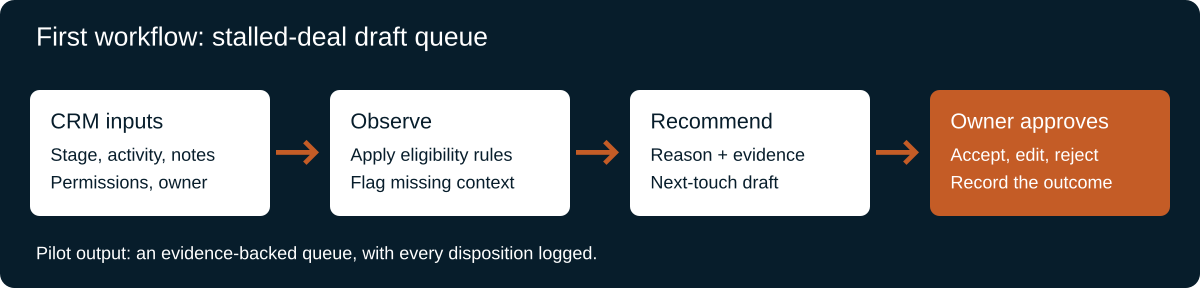
Run the workflow against a fixed set of historical records labeled by the sales owner. Compare eligibility decisions with those labels. Inspect unsupported claims, draft edit burden, and preparation time against the manual baseline. Record staff hours spent reviewing and fixing drafts alongside hours saved collecting context. Otherwise, the apparent time saving may simply move work downstream.
The numerical context keeps the promise bounded. Eric’s reported 17-of-100 adoption figure and 3.5% staff coverage favor a contained deployment. For supporting evidence, a 2011 Harvard Business Review article reported an audit of 2,241 U.S. companies: 37% responded to a web-generated test lead within an hour, while 23% never responded. Those were inbound inquiries, not stalled opportunities. The findings justify auditing follow-up gaps; they do not predict this agent’s conversion lift.
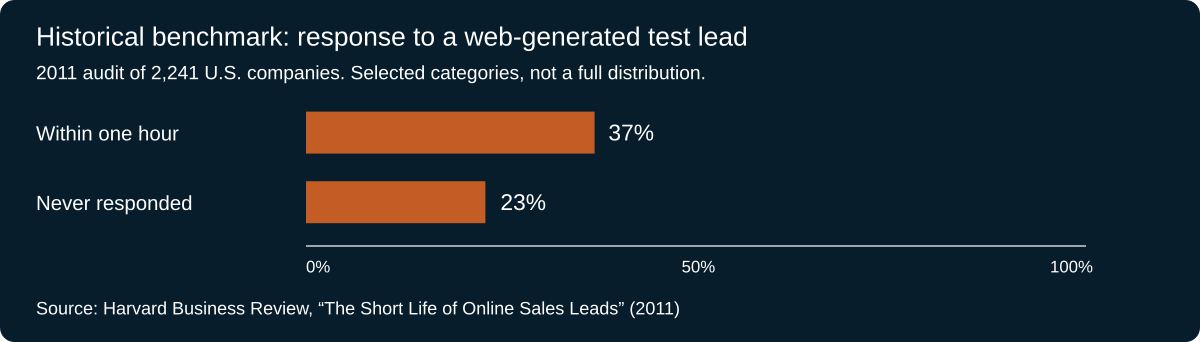
Keep those measures distinct: company adoption, staff coverage, and historical lead-response rates have different denominators. None is a Single Grain client result. For this build, success means accurate eligibility, grounded drafts, and less preparation work. Recovered conversations can become a downstream measure, but drafted messages are not recovered revenue.
Keep the architecture small. Anthropic’s guidance on building effective agents recommends starting with the simplest workable solution. Deterministic eligibility rules plus a grounded drafting step fit this job. Add autonomous planning only if evaluation exposes a limitation that simpler logic cannot resolve.
What you do not hand over (or outsource blindly)
Eric’s observation-to-recommendation-to-approved-action progression sets the permission model. First deploy in observation mode, then test recommendations, then permit action with explicit approval. Name the sales owner as the human ship gate for the revival queue, responsible for approving, editing, or rejecting outreach. Do not enable unsupervised sending, publishing, or spending in this first deployment.
Keep positioning, pricing exceptions, customer commitments, and sensitive account decisions with accountable business owners. The FDM implements the rules; the business owner defines acceptable action. Document which data the system may read, which fields it may write, and which failures stop execution.
Require a usable handoff: workflow configuration, prompt versions, evaluation records, access ownership, error logs, and shutdown instructions. Refuse a deployment whose essential credentials or logic remain trapped in a contractor’s personal account. Your team should be able to diagnose a failed run without booking the original builder.
Budget for maintenance when CRM schemas, channel rules, or offers change. Assign an operating owner before the engagement ends. Without that owner, a successful prototype becomes another abandoned automation in the backlog.
Embed vs buy managed agents + CTA
Embed when the difficult work is discovering and translating your operating rules. Fragmented data, undocumented exceptions, and frequent channel decisions reward proximity to your team. Buy the builder’s implementation judgment and require knowledge transfer as part of the engagement.
Buy managed agents when the job is already defined, integrations are supported, and a provider can demonstrate the workflow on representative inputs. Require clear data terms, service ownership, exportability, and inspectable failures. A polished demo should not outweigh those requirements.
Compare total operating cost: implementation, software, model usage, evaluation, exception handling, and maintenance. Use the same acceptance criteria for either model. Favor the option that removes the manual loop reliably, with an owner who can maintain it.
For a Single Grain engagement, bring one channel bottleneck, sample inputs, the current manual process, and the person accountable for its outcome. Start where channel expertise and implementation can work together. Contact Single Grain to assess whether an embedded marketer or a managed workflow is the better first move.


