

Google Discover Now Shows a Creator Profile Behind the Author’s Name



Google Discover started showing a creator profile behind the author’s name, not the publication. Tap a byline in the feed and you get the person, their photo, and the other pieces they have written. If you publish under a company brand or a generic staff byline, that quiet change just moved the goalposts on you. The human who wrote the piece is now part of how it gets seen and trusted, and most sites have nothing behind their bylines for Google to show.
The creator profile is Google treating the author as an entity in its own right, assembled from a consistent identity across the web rather than from your site alone. When someone taps your writer’s name, Google decides in that moment whether it has enough to put a real person forward or only a name.
By the end of this you will know what Google actually reads to identify an author, and exactly what to change on your site this week so your experts show up as credible people instead of empty bylines.
TL;DR
- Google Discover now attaches a creator profile to the author, so tapping a byline shows the person and their work across sites, not just the publication.
- Google builds that profile from signals you control: a consistent identity, clear bylines, a dedicated author page, and proof the writer exists off your own domain.
- Fix your author pages this week, add Person schema on top of real identity, and get your experts published elsewhere so engines treat them as known entities.
What Changed in Google Discover
Discover is the feed of articles and videos Google serves on phones based on what it thinks you care about, with no search query involved. What changed is small on the screen and large underneath. Discover now attaches a creator profile to the author, so tapping a name opens a short profile of the person and the work they have published across sites, instead of a link to the outlet.
Before, the feed credited the publication. Now it credits the individual. The move caught the attention of the SEO community fast, with many calling it a real shift in who Discover puts forward.
The mechanics sit in plain sight. Google’s documentation on getting content into Discover explains that the feed ranks around interest and quality signals, and the profile is the visible layer on top of that. Before Google can recommend a person’s next piece to a stranger, it has to be confident who wrote the last one.
Why Authorship Matters Again
Google retired its old authorship markup years ago, and plenty of publishers filed the topic under dead ideas. It never died. It moved into entity recognition, the same system that decides whether a name points to a known person or to nobody in particular.
The writer behind the byline is a trust signal now, and it feeds both classic search and AI answers. When a model picks which sources to quote, it weighs whether the author is a corroborated entity or a string of text with no footprint. This is where E-E-A-T stops being a slide in a deck and starts deciding who gets cited.
One thing I keep seeing is strong content published under a name with no identity behind it. No bio page, no photo, no trace of that person anywhere off the site. Google cannot build a profile out of nothing, and an answer engine will pass over that byline for one it can verify.

What Google Actually Uses for Authorship
The creator profile Google Discover shows behind an author’s name is a profile tied to the person who wrote the piece, built from a consistent author identity across the web. It lets Discover show who they are, what they cover, and why they are worth trusting, instead of naming only the publication.
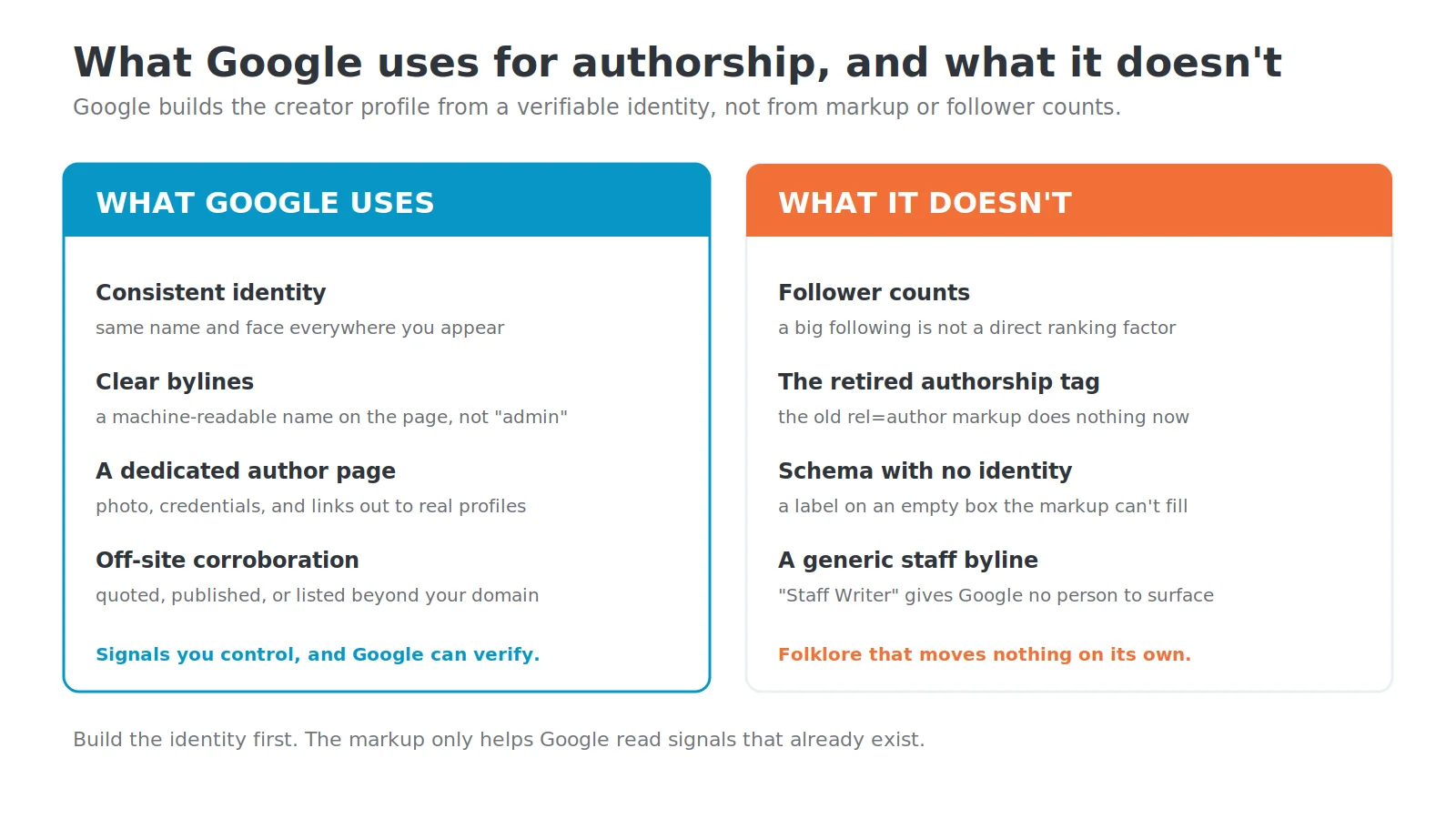
What Google reads to build it is more ordinary than the folklore suggests. It wants a consistent identity, the same name and the same face everywhere you appear, so it can connect your posts into one person rather than three half-people. Clear bylines count too, the author’s name on the page in a form a machine can parse, not buried in a footer or hidden behind “admin.” A dedicated author page is the next signal, a page with a photo, credentials, and links out to where that person lives elsewhere. Off-site corroboration closes it out, proof the writer is quoted, published, or listed somewhere beyond your own domain.
Adding Person schema and calling it done is the mistake I see most. Follower counts are not a direct ranking factor, and a large X following does not buy author trust. The retired authorship tag does nothing. Schema with no real identity underneath is a label on an empty box, because the markup helps Google read signals that exist, it cannot invent them.
What to Update This Week
Stop treating author pages as an afterthought. Here is the fix list, in the order that moves the needle.
- Give every writer a dedicated author page. A photo, two or three sentences of actual credentials, and crawlable links to their profiles elsewhere. Social icons in a sidebar do not count.
- Add Person schema to those pages. Name, the URL of the author page, sameAs links to their LinkedIn and other verified profiles, and an image. This gives Google a structured way to tie the person to the work.
- Lock one name and one photo. Pick a single version of the name and use the same headshot everywhere. One person under three name formats across six posts splits the entity into thirds, and consistency is the cheapest win here.
- State credentials Google can corroborate. If the writer is a CPA, say so. If they spent ten years at a named company, name it. This is the kind of AI trust signal that backs expertise, where “passionate content creator” backs nothing.
I would rather have three real experts with full profiles than a masthead of ghost bylines. Fewer authors with stronger signals beat a dozen anonymous contributors every time.

Turn Author Authority Into Traffic
Clean profiles are the setup. The traffic comes when those people are visible enough off your site that engines treat them as known entities.
Get your experts published elsewhere. Guest posts, podcasts, conference talks, quotes in trade press. Each mention on a new domain adds a node to the graph Google is building around that person. Point each author page at their best work too, since the profile pulls from recent output, so give it something worth surfacing. Then audit bylines every quarter, because people leave, roles change, and names get mangled in CMS migrations.
If your team does not have the hours for this, our content writing services build author-first content with real bylines and the identity signals in place from the first draft. The writing is the easy half. The infrastructure behind the name is what most teams skip.
Most publishers will skip all of it and keep wondering why a competitor with named experts keeps turning up in the feed while their brand card sits there doing nothing. I will take that trade every time, because the sites that build this now compound while everyone else waits for it to be obvious.
If you want to move before your competitors do, talk to our AI SEO team about wiring author authority into how you publish.