

AI Certifications Just Got Real. Here Is When to Put Your Marketing Team Through Anthropic’s Claude Cert.



Your team tells you they use AI. Ask them to prove it, and the room goes quiet. This question just got a formal answer. Anthropic now runs a graded certification track for Claude, with exams for associates, architects, and developers, the same way cloud vendors have certified their engineers for years.
Using AI is turning into something a person can be tested and credentialed on, and the first vendor exam for it is here. It is a paid exam, and that changes the call in front of you.
By the end of this you will know whether a vendor certification is worth your team’s time and money, which people it helps, and what builds the AI fluency a badge alone never will.
TABLE OF CONTENTS:
TL;DR
- Anthropic now runs graded, paid Claude certifications in tiers, so “we use AI” is turning into something a marketer can document.
- A cert proves someone learned the tool’s building blocks. It does not prove they can turn that into a campaign, so treat it as a floor, not a hiring gate.
- Send the one or two people who build with AI every week, pair the exam with a live project, and keep a shared library of prompts and skills so fluency compounds instead of living in one head.
What Is Anthropic’s Claude Certification?
Anthropic runs graded certifications for Claude, in tiers. Do not overcomplicate it. It is a vendor exam for people who want to prove they can work inside the tool.
The tracks split three ways:
- Associate, for baseline fluency.
- Architect, for the people designing Claude-based systems.
- Developer, for the people building with Claude in code.
Each track has a Foundations exam, and Anthropic lists an Architect Professional level above that.
What the Certification Tests
The Claude Certified Architect Foundations exam costs $125. This price matters, because this is not a badge you collect after watching a webinar.
Anthropic also runs prep courses and an on-demand library. If your team wants to wire Claude into real workflows instead of treating it like a chat box, the Building with the Claude API course is a sane place to start.

Why “Can Your Team Use AI” Became a Real Question
Once a tool touches your reporting and your content, leaders start asking for proof. “We use AI” sounds fine until you ask who on the team can build a repeatable workflow without breaking the brand voice or the numbers.
Most teams I talk to say they use AI, and they mean one person on the team does. Depending on one person is a staffing risk dressed up as progress.
A Cert Turns Vague Skill Into Evidence
Vendor credentials tend to show up once a tool becomes part of how the work gets done. Cloud went that way. Analytics went that way. AI is heading there now.
Not every marketer needs a certificate. But AI fluency is becoming something you can document in hiring and defend in a budget review. If your team’s AI knowledge lives in scattered Slack threads, map it first. A resource like AI skills for marketers helps you see what people already know and what they still need to learn.
What a Cert Proves About a Marketer, and What It Does Not
A cert proves someone learned the building blocks and passed a standardized test. I would rather pay $125 to test what my team actually knows than assume it.
A certificate is not a strategy, and plenty of certified people still cannot ship a campaign with it. A badge tells you someone can follow the map, not whether they know where your customers are trying to go.
The Badge Is a Floor, Not a Moat
The marketers who win pair the fundamentals with reps on real marketing work. They use Claude to write sharper briefs and to build workflows that spare the team from repeating low-value tasks.
Tool skills only pay off when they connect to funnel stages, which is what AI for marketing work maps out. Otherwise the cert becomes trivia with a receipt.
When It Is Worth Putting Your Team Through It
So is the Claude certification worth it for a marketing team? For most teams, yes, as a low-cost way to prove baseline fluency and to make people learn the tool, not as a hiring gate on its own. It shows someone can build with Claude, though not whether they can apply it to your funnel, and that second skill is the one that moves revenue.
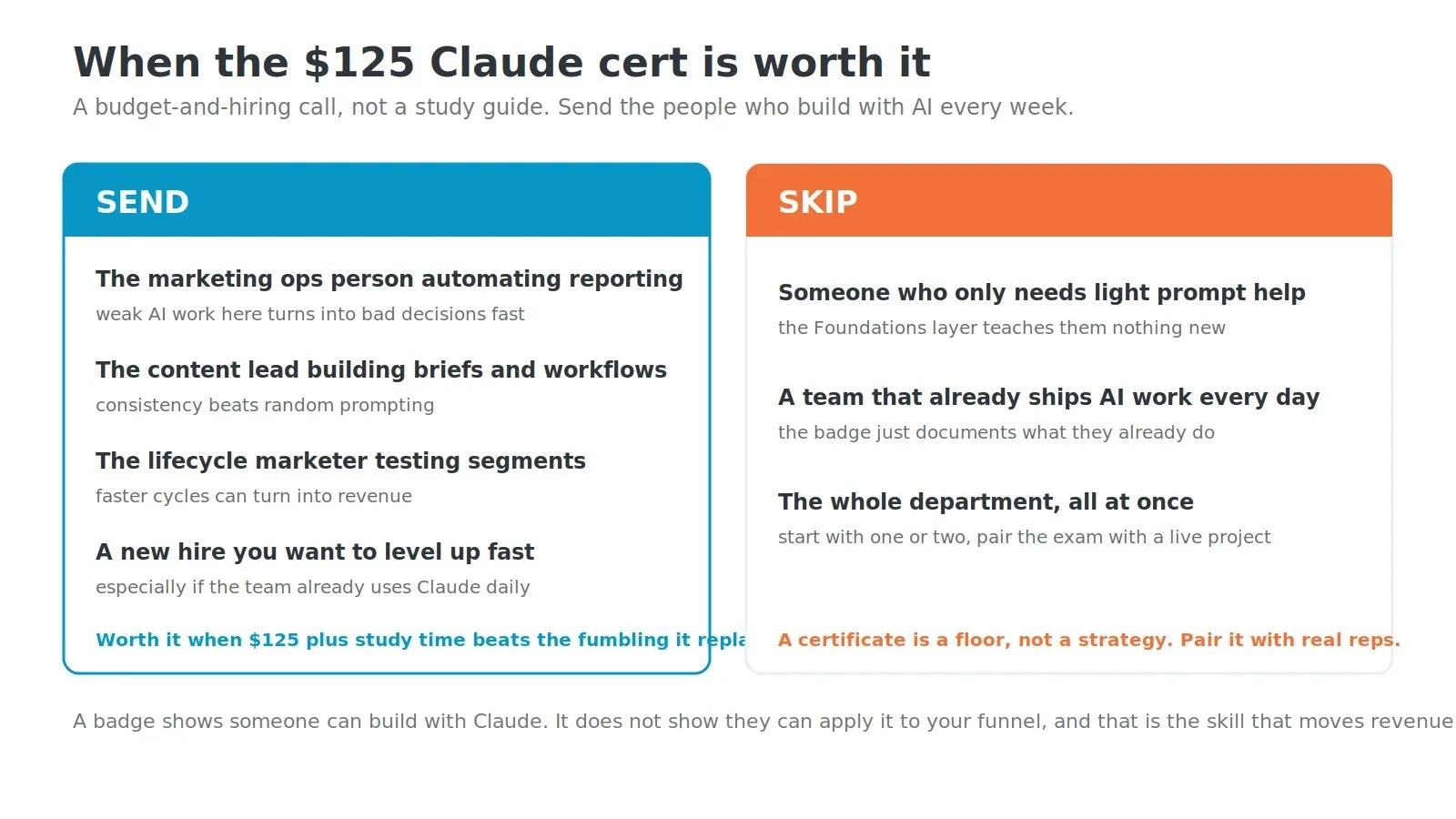
The decision rule is simple. Send the people who will build with AI every week, and send them when the $125 plus study time costs less than the fumbling it replaces.
Start with a short list:
- The marketing ops person automating reporting, where weak AI work turns into bad decisions fast.
- The content lead building briefs and editorial workflows, where consistency beats random prompting.
- The lifecycle marketer testing segments and message variants, who can turn faster cycles into revenue.
- A new hire you want to level up fast, especially if the team already uses Claude daily.
Skip it for someone who only needs light prompt help, or for a team that already ships AI work every day and would learn nothing new from the Foundations layer.
Where Tool Fluency Becomes Marketing Output
Your best operators will not stop at the exam. They will turn it into systems. When they are choosing tools for campaign work, a practical rundown of AI tools that improve marketing productivity helps them compare what belongs in the stack and what adds noise.
This is the budget call. Pay for the cert when it creates a shared floor, not to avoid the harder work of managing output.
How to Build Real AI Fluency on Your Team This Week
Pick one or two people first. Do not run the whole department through an exam because the badge exists.
Pair the study work with one live project. The project makes the learning stick, because your team has to make hard choices under real constraints.

Pair the Badge With a Revenue Project
Choose a project close to money. Reporting automation or lifecycle testing beats generic prompt training every time.
Then ask for an artifact at the end. A working prompt chain, or a documented Claude skill the team can reuse.
Build a Shared Skills Library
Your team also needs a shared library of its best prompts and skills. Otherwise fluency lives in one head, and the company pays the same learning tax every month.
This is where certification stops being decorative. Single Grain’s AI marketing agency work connects AI training to marketing systems, from workflow design through campaign execution. If you want help turning a certification into revenue work, book a free consultation with our team and bring the workflows you want to automate first.
One operator who ships useful AI work beats ten people with badges who are still waiting for someone else to build the system.