

Ultimate LLM SEO Guide: LLMO Best Practices + Examples


LLM SEO is the new front line of digital visibility, and the brands that ignore it today will wonder why their traffic plateaued (or worse, PLUMMETED) tomorrow. Whether you call it large language model SEO, LLMO, or generative engine optimization (GEO), the core idea is the same: make your content so clear and well-structured that AI-powered answer engines cite you by name.
The secret? LLMO is an evolution, not an exit strategy.
Traditional SEO is still the DNA of digital visibility. LLM SEO builds directly on top of the fundamentals. All you need are a few targeted LLMO techniques to bridge the gap between crawler and chatbot.
So, how is it done? Great question!
This all-inclusive LLM optimization guide walks you through every layer of the discipline, from foundational concepts to enterprise-grade playbooks you can hand to your team on Monday morning. You will learn exactly how AI models discover, evaluate, and surface web content, and you will leave with templates, myths debunked, and real-world examples that prove LLM SEO is not just theory.
Ready for your content to become the answer to everyone’s prompts? Excited to see your AIO, ChatGPT, Gemini, Perplexity, and other LLM citations grow? We’ve got you covered!
Let’s dive right in.
TABLE OF CONTENTS:
- What Is LLM SEO?
- Is there a Difference Between LLM SEO and LLMO?
- LLM SEO vs. Traditional SEO: A Side-by-Side Breakdown
- How LLMs Actually Read Your Content
- LLM SEO Best Practices: How to Optimize for LLMs in 8 Steps
- Step 1: Audit Your Current AI Visibility
- Step 2: Restructure Content for Citability
- Step 3: Deploy Entity-Rich Schema Markup
- Step 4: Build Topical Authority Clusters
- Step 5: Optimize for Natural-Language Queries (NLP Keywords)
- Step 6: Ensure Factual Accuracy and Freshness
- Step 7: Create LLM-Friendly Content Formats
- Step 8: Test, Measure, and Iterate
- How to Write Content: Top Tips to Become Visible to LLMs
- 5 LLM SEO Myths & The Actual Truth
- Real-World LLMO Wins: Examples That Prove It Works
- Your LLM SEO Readiness Checklist
- Start Getting Cited by LLMs Today
- Frequently Asked Questions
- Q: How should I prioritize which pages to optimize first for LLM SEO?
- Q: What should I do if AI answers mention my brand but get key details wrong?
- Q: How do I align LLM SEO with conversion rate optimization so citations turn into leads?
- Q: Are there risks to making content too “LLM-friendly” and hurting brand voice?
- Q: What’s the best way to handle duplicate or competing content on the same topic?
- Q: How can local businesses benefit from LLM SEO if they serve a specific region?
- Q: How do I report LLM SEO performance to executives who only care about pipeline?
What Is LLM SEO?
LLM SEO optimizes your content for AI to easily understand and generate helpful answers on language learning models like ChatGPT, Google Gemini, Perplexity, and Microsoft Copilot.
While traditional SEO improves your pages for search engine crawlers that rank blue links, LLM SEO optimizes for the neural networks that synthesize your information into direct responses.
Think of it this way: Classic SEO gets you a spot on a library shelf. LLM SEO gets the librarian to quote your book out loud when someone asks a question.
At this point, you are probably wondering, “How do LLMs pull data differently than search bots?” That’s a logical question, and will help you understand how AI works.
How Do LLMs Discover Content (And Why Does It Matter To YOU)?
Large language models do not search the web the way Google’s crawler does. They rely on training data, retrieval-augmented generation (RAG) pipelines, and real-time web access tools to pull information and serve it in conversational form.
Therefore, if your information isn’t written clearly and organized logically, the AI won’t be able to find the right answer to “quote” you. Because these models aim to summarize facts rather than just list websites, they prioritize content that is easy to digest and verify!
The Traffic Shift You Can’t Ignore
News flash: If your content is not structured for LLMs, you are invisible in the fastest-growing discovery channel on the internet.
Here’s why your large language model optimization strategy matters right now:
| Platform | Core Metric | Relevance to LLMO |
|---|---|---|
| ChatGPT | 2.5B prompts / day | Largest source of non-Google discovery. |
| Google AIO | 2B users / month | The primary cause of organic traffic drops. |
| Gemini | 750M monthly active users | Rapidly closing the gap with ChatGPT. |
| Perplexity | 780M queries / month | High-intent, research-heavy citations. |
| Copilot | 15M paid enterprise seats | Key for B2B and internal visibility. |
Research confirms that the vast majority of technology marketers have moved past the exploratory stage and are actively developing or using AI tools for marketing. The industry is not debating whether to adopt AI-first content strategies; rather, they are testing to see how fast they can execute it.
So, why is LLM SEO so important?
The answer is obvious: Ranking high on Google is no longer enough if your site’s architecture leaves AI models in the dark. Failing to optimize for LLMs effectively hands your market share to competitors who are visible to both human searchers and artificial intelligence.
Before we dive into everything LLM SEO, let’s talk about some important distinctions between LLM SEO, LLMO, and traditional SEO.
Is there a Difference Between LLM SEO and LLMO?
Yes and no.
While LLM SEO and LLMO have distinct technical origins, they are often used interchangeably to describe how to get your brand cited by AI models.
On one hand, LLM SEO focuses on how AI impacts search results. On the other hand, large language model optimization looks at visibility across all AI chat platforms. Because both strategies rely on the same optimization techniques, many experts treat them as two sides of the same coin.
Essentially, whether you call it LLMO or LLM SEO, the objective is to craft your content in a way that it becomes the go-to source for an AI’s response.
Both terms revolve around structuring data and building authority so that models like ChatGPT or Gemini recognize your brand as a trusted expert!
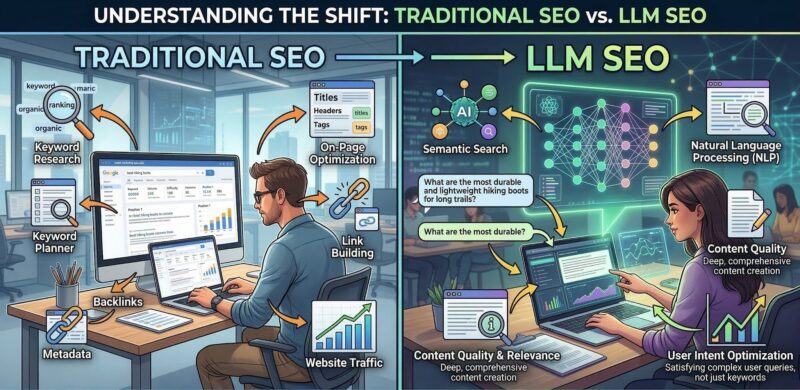
LLM SEO vs. Traditional SEO: A Side-by-Side Breakdown
One of the biggest points of confusion is whether LLM SEO replaces traditional SEO.
The short answer: absolutely not.
LLM SEO is an additional optimization layer. Let’s break it down:
| Dimension | Traditional SEO | LLM SEO / LLMO |
|---|---|---|
| Primary Target | Google, Bing index crawlers | ChatGPT, Gemini, Perplexity, Copilot, AI Overviews |
| Ranking Signal | Backlinks, keyword relevance, Core Web Vitals | Entity clarity, structured data, citability, factual accuracy |
| Content Format | Long-form articles, landing pages | Q&A hubs, decision trees, concise factual blocks |
| Success Metric | SERP position, organic clicks | Share of answer, citation rate, AI-assisted conversions |
| Keyword Strategy | Exact match, long-tail clusters | Natural-language questions, entity-rich context |
| Technical Focus | Crawlability, site speed, mobile-first | Schema.org markup, knowledge graph alignment, tokenization-friendly structure |
The overlap is real.
Strong E-E-A-T signals help both channels. Fast page speed matters to LLMs too, because models with real-time browsing capabilities favor pages that load quickly. (In fact, understanding how page speed impacts LLM content selection can give you a quiet edge most competitors overlook.)
The key difference is how content is consumed: humans scan; LLMs tokenize and embed.
With that being said, let’s dive into the ins-and-outs of how AI reads your content.
How LLMs Actually Read Your Content
Before you optimize anything, you need a mental model of how an LLM digests a web page. Here is a quick analogy that sticks.
Imagine you are studying for an exam by reading a textbook. You highlight key sentences, note definitions in the margins, and create flashcards. An LLM does something remarkably similar, just at superhuman speed:
- Tokenization: The model breaks your page into small chunks called tokens (roughly a word or sub-word each). Clean, well-punctuated writing creates cleaner tokens.
- Embedding: Each token is converted into a numerical vector that captures its meaning relative to every other word the model has seen. Entity-rich sentences (“Single Grain is a digital marketing agency founded in 2009”) create sharper embeddings than vague ones (“We are a company that does stuff online”).
- Context Window Processing: The model can only “see” a limited number of tokens at once. If your key information is buried under 2,000 words of fluff, it may fall outside the window or be weighted less.
- Retrieval (RAG): Many AI systems use retrieval-augmented generation, pulling fresh web content into the context window before generating an answer. Your content’s structured data, topical authority, and freshness determine whether it makes the cut.
This is exactly why aligning your site architecture to LLM knowledge models matters so much.
When your internal linking and entity relationships mirror how the model already organizes knowledge, you become the path of least resistance for citation.
LLM SEO Best Practices: How to Optimize for LLMs in 8 Steps
Enough theory. Here is the LLM SEO guide you came for! Use these LLM SEO best practices to take your optimization efforts to the next level.
Step 1: Audit Your Current AI Visibility
Open ChatGPT, Gemini, Perplexity, and Copilot. Ask each one five questions your ideal customer would ask that relate to your product or service. Record whether your brand appears, whether the information is accurate, and which competitors get cited instead.
Another way to check your AI share of voice (AI SOV) is to use tools like Ahref’s AI citations to evaluate wins and losses. You can also invest in tools like Ahref’s Brand Radar or ClickFlow’s AEO tracker to see how LLMs are citing you (and for which prompts!).
Here is an example of a prompt pulled from Brand Radar.
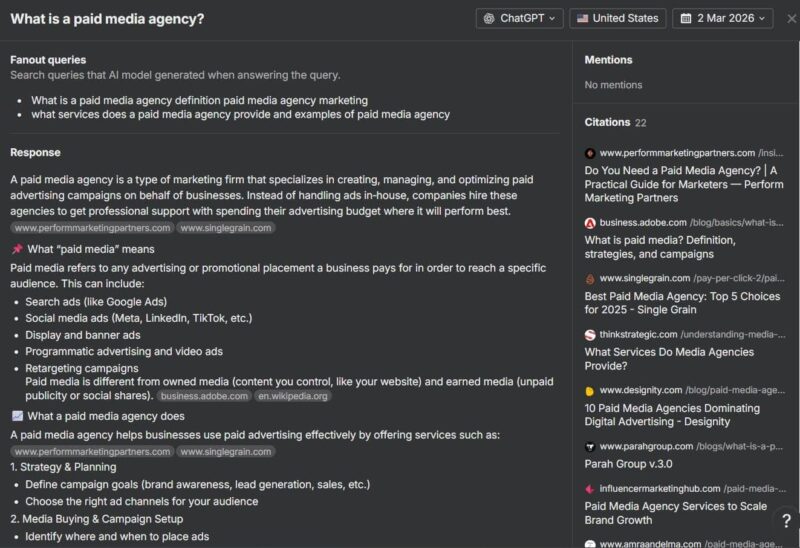
The user’s prompt is ‘What is a paid media agency’ and this is the generated response from ChatGPT. Notice the citations to the right. Our agency’s paid media agency-related blog content was picked up by ChatGPT and used as a credible source multiple times throughout the answer.
This tells us that Single Grain’s content quality and authority is high for this topic, so ChatGPT is seen as a valuable source of information.
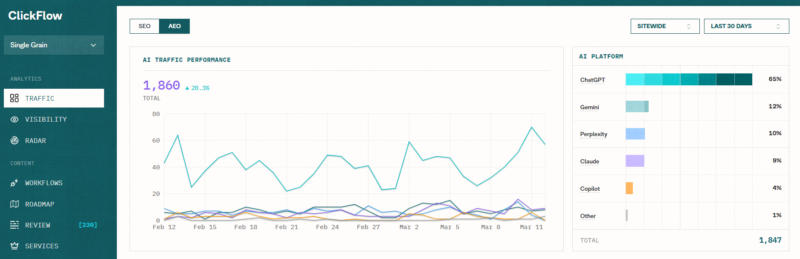
As another example, here is a 30-day overview of sitewide LLM events that took place for our agency. We are able to see our AI traffic performance spread across different AI platforms through ClickFlow.
Pro-Tip: Type your primary keywords for blogs into a Google search. Do any of your blogs or pages appear in the Google AI Overview for these target keywords? If the answer is ‘no’ or ‘some but only a few,’ then you have some work to do! You can use ClickFlow to generate quality content that is optimized for both SEO and LLMs and see your AI share of voice grow! Don’t hesitate to get started for free or book a quick demo to see how ClickFlow can take your content strategy to new heights.
Step 2: Restructure Content for Citability
Restructuring SEO content for LLMs is one of the highest-ROI activities you can do this quarter.
Add a Q&A-first structure to your blogs. Lead each section (or header) with the question a user would type into an AI chat, followed by a concise, factual two-to-three sentence answer, then expand with supporting detail.
LLMs love quotable blocks, which are self-contained passages that answer a specific question without requiring surrounding context. Think of each block as a flashcard the model can grab and cite directly!
Step 3: Deploy Entity-Rich Schema Markup
Add JSON-LD schema for FAQPage, HowTo, Product, Organization, and Article types on every relevant page. Prioritize pages that already rank well in traditional search.
Schema markup is the Rosetta Stone between your content and an LLM’s knowledge graph. When you explicitly define entities, their properties, and their relationships, you reduce the model’s guesswork.
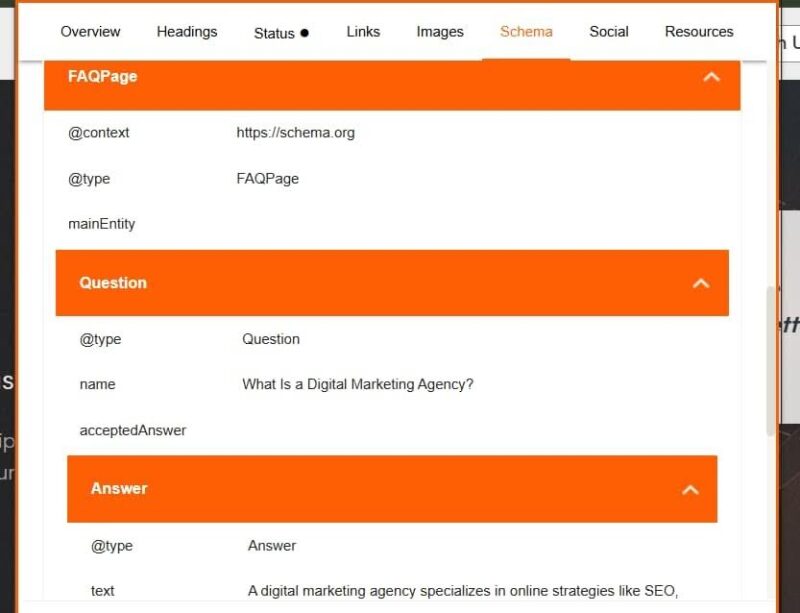
Not sure if you already have Schema? Use the SEO Pro Extension to see if you already have Schema on your pages. Here is an example:
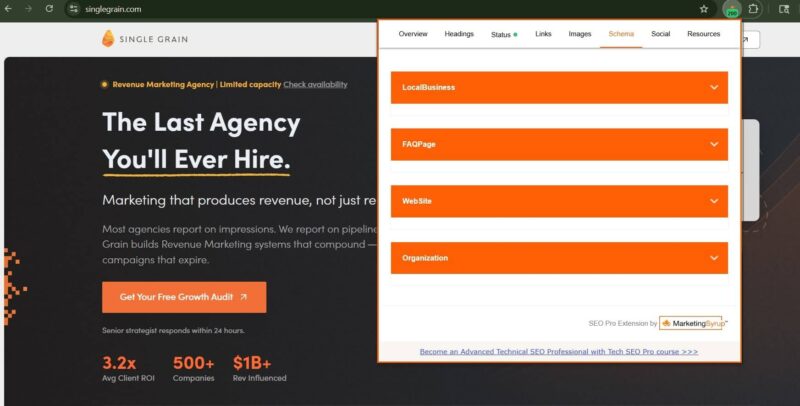
You can see FAQPage Schema is present on our Single Grain home page. This helps LLMs parse and properly index our page.
Pro-Tip: You can easily do this by using a free online Schema generator tool like Dentsu. Simply fill out the prompts, copy the code, and add it to your Schema plugin within your CMS.
Step 4: Build Topical Authority Clusters
Just like with traditional SEO, pillar pieces are also a huge win for AEO.
Create a hub-and-spoke content architecture around every core topic your brand owns. The hub page (also known as pillar pages) provides a comprehensive overview (for blogs, you can think of them as long-form guides or main feature pieces that introduce an overarching topic). The spoke pages dive deep into subtopics and link back to the hub.
LLMs assess topical authority much like a professor evaluates a student: do you cover the subject from every angle, or do you have a single shallow article?
Brands that publish 10-15 interlinked articles around a single topic consistently earn more AI citations than brands with one “ultimate guide” and nothing else.
Step 5: Optimize for Natural-Language Queries (NLP Keywords)
Write headers as conversational questions. Instead of writing one H2 header like “Best CRM Software,” you can divide the section up into several subheaders (H3s) that pertain to the main H2. For example, under this H2, you could include the H3: “Which CRM software works best for a 50-person SaaS team?” This makes it much more thorough and large language models LOVE it!
By leaning into NLP Keywords(Natural Language Processing), you use phrases and entities that mimic how humans naturally connect ideas. This helps AI search engines move beyond simple word-matching to understand the actual intent behind a query.
NLP Entity Example: How It Works
Do a simple Google search for the CEO of Single Grain.
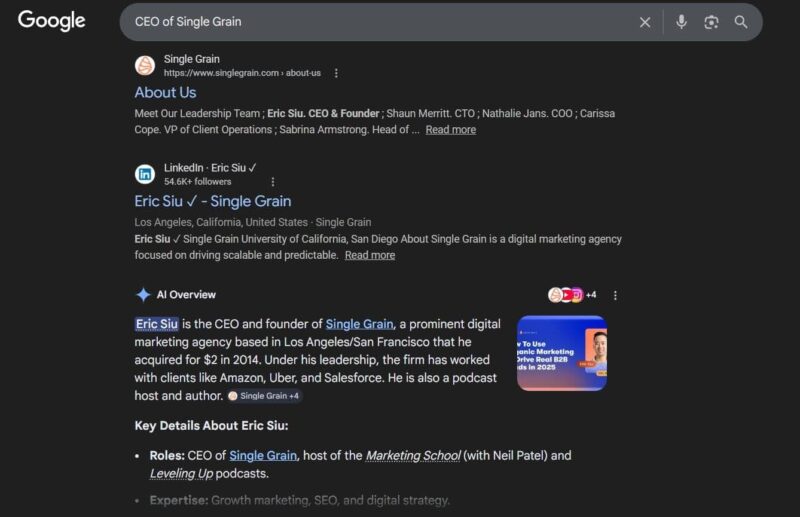
In this example, the query or keyword phrase is ‘CEO of Single Grain.’ Google and AIO bots recognize Eric Siu as the NLP entity for this keyword phrase, and appropriately pulls up the appropriate information for the search.
AI users type (and speak) in full sentences. So, if you really want to capture this AI share of voice, your content must match that natural register.
Pro-Tip: Pop into forums like Reddit, Quora threads, and X conversations for the exact phrasing real people use for your topics, then mirror it in your headings and opening sentences. These forums are a gold mine of opportunity!
P.S. You can also use forums like Reddit to expand your AI share of voice for your brand. This is a great way to bolster your AEO and SEO strategy!
Step 6: Ensure Factual Accuracy and Freshness
Audit every page for outdated statistics, broken citations, and unverified claims. Set a quarterly content refresh schedule.
LLMs are increasingly penalizing (or simply ignoring) stale content. RAG pipelines favor recently updated pages, and models with browsing capabilities check publication dates. A “last updated” timestamp is not vanity. It is an LLMO ranking signal.
Step 7: Create LLM-Friendly Content Formats
Develop at least one of each format across your site: a comparison page, a troubleshooting guide, a decision tree, and a buyer’s guide. These formats are inherently “citable” because they answer structured questions.
A practical example: optimizing product specs pages for LLM comprehension turns a static feature list into a structured, entity-rich resource that models can parse and quote with precision.
Step 8: Test, Measure, and Iterate
Want to take your LLM SEO strategy to the next level? Build a prompt-testing framework. Every two weeks, run 20 standardized prompts across major LLM platforms and score your brand’s inclusion, accuracy, and sentiment.
Track these KPIs in a dashboard alongside your traditional SEO metrics:
- Share of Answer: How often your brand appears in AI responses for target queries
- Citation Accuracy: Whether the AI accurately represents your content
- Competitor Citation Gap: How your mentions compare to top competitors
- AI-Assisted Conversions: Traffic and leads arriving via LLM referral channels
How to Write Content: Top Tips to Become Visible to LLMs
Great LLMO absolutely requires high-quality writing with strategic structure on top. It’s okay to use AI to help you generate content faster, but don’t forget to add quality control to this process!
Why Content Writing is Important for LLM SEO
Here’s the sad reality: Many businesses bought into the ‘quantity over quality’ conversation. They were promised quick results and, indeed, a lot of them saw impressions and clicks skyrocket. But after a few months, the algorithm caught up and… everything plummeted.
The lesson learned? AI is a great way to improve your content output. But you still need a human in the loop to make sure this content is quality!
After all, you want to see your content perform really well for both SEO and AEO… with no ugly drop-offs caused by AI slop.
With that being said, here are the content writing techniques that separate pages that get cited from pages that get ignored.
1. BLUF: Bottom Line Up Front
Military intelligence analysts invented BLUF (which stands for Bottom Line Up Front) because decision-makers need the conclusion before the evidence. LLMs work the same way.
So, how does it work?
Simply place your definitive answer in the first sentence of each section, then layer in supporting details! It’s that easy. This ensures the model captures your core claim even if the context window cuts off your supporting paragraphs.
We recommend using BLUF for main questions posed throughout the H2s in your content. For example, “What is [insert your primary or secondary keyword here]?” sections should be written in BLUF format.
2. The Inverted Pyramid Meets AI
The Inverted Pyramid is a classic writing structure where you lead with your most critical information rather than building up to a conclusion. Think of it as a funnel. You provide the “who, what, when, where, and why” immediately to help the reader see the value even if they stop after the first paragraph.
Journalists have used the inverted pyramid for over a century:
- Most important information first
- Details second
- Background last
Combine this with BLUF and you create content that serves skimmers, search engines, and LLMs simultaneously. Each section becomes a self-contained answer unit that does not depend on the section above it for context!
3. Entity-First Writing
Specificity is the name of the game. Specifically name the concepts or tools you are writing about!
Instead of writing “the tool helps with optimization,” write “ClickFlow provides internal linking and content optimization capabilities.” Specific entity mentions create stronger embeddings and give LLMs concrete references to cite. Vague language produces vague (or zero) citations.
4. Readability for Robots and People
Short paragraphs (two to three sentences max), clear heading hierarchy, and generous white space are not just accessibility best practices. They are LLMO signals.
Token efficiency improves when content is well-organized, and retrieval pipelines favor pages with clear semantic structure.
Pro-Tip: Want to make sure AI systems accurately represent your pages? Explore strategies around AI summary optimization and ensuring LLMs generate accurate descriptions of your pages.
5 LLM SEO Myths & The Actual Truth
LLMO is new enough that misinformation spreads faster than best practices. Here are the five myths we see repeated most often on forums and in agency pitch decks, along with the reality.
Myth 1: “LLMO Replaces Traditional SEO”
The Fear: Investing in large language model SEO means abandoning everything you built in Google organic search.
The Truth: LLMO sits on top of traditional SEO. Strong technical foundations, backlinks, and E-E-A-T signals feed both channels. Think of LLMO as the penthouse you add to the top of a building that already has solid floors. Without the foundation, the penthouse collapses.
Myth 2: “AI Will Just Scrape Your Content and Steal Your Traffic”
The Fear: LLMs will reproduce your content so users never click through, making optimization pointless.
The Truth: Platforms like Perplexity and Google AI Overviews include source citations and links. Early data shows that AI-cited brands often see higher click-through rates on cited content because the AI endorsement acts as social proof. The real risk is being left out of the answer entirely.
Myth 3: “You Need AI-Generated Content to Rank in AI”
The Fear: Only content written by AI is “compatible” with LLMs.
The Truth: LLMs do not “prefer” AI-written text. What they really want is well-structured, factually accurate, entity-rich text. A human expert who writes clearly and formats properly will outperform a sloppy AI draft every single time.
But, this does not mean AI cannot help you write content. In fact, platforms like ClickFlow are consistently generating quality content that ranks. With added help from a seasoned content writer, your content is sure to perform.
Overall, the medium does not matter. The structure and substance do.
Myth 4: “Just Add Schema Markup and You’re Done”
The Fear (or hope): Schema is a magic bullet. Implement FAQPage schema and watch the AI citations pour in.
The Truth: Schema is necessary but not sufficient. It is one signal among many. Without topical depth, strong brand authority, and fresh content behind that schema, the markup is a fancy wrapper around an empty gift box. You need the full stack: schema + content quality + entity clarity + technical performance.
Myth 5: “LLMO Only Matters for Big Brands”
The Fear: Small businesses and niche players cannot compete with enterprise-level LLMO budgets.
The Truth: LLMs prioritize topical authority over brand size. A five-person agency that owns a narrow niche with well-structured and highly-relevant content will get cited over a Fortune 500 company with a shallow, outdated blog.
Real-World LLMO Wins: Examples That Prove It Works
Theory is nice. Proof is better. Here are examples that illustrate what effective LLM SEO looks like in practice.
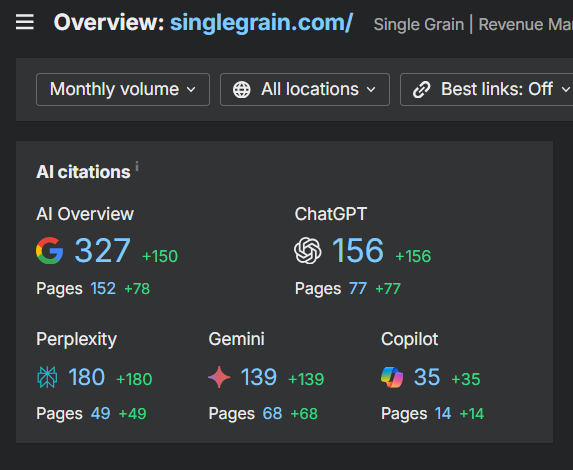
How Answer Engine Optimization Consistently Drives Measurable Pipeline for Our Clients
At Single Grain, our expertise for enterprise-level clients on AEO (answer engine optimization) and AIO (AI overview optimization) has demonstrated that restructuring existing content into Q&A hubs and deploying targeted schema markup leads to measurable increases in AI citations and referral traffic.
In fact, this exact framework helped SmartRent secure 136 new AI citations and 10 high-value SQLs in just 30 days.
Another example: LS Building Products saw a 540% surge in AI Overview mentions and added over $220,000 in organic traffic value by aligning their content with this framework.
Finally, in the healthcare space, this approach helped Bierman Autism Centers capture 365 new AI citations and grow organic clicks by 19% in a highly competitive market.
These are just to name a few!
The key takeaway was not that a single tactic won. The compounding effect of content restructuring, schema deployment, and prompt-testing together created a flywheel that traditional SEO alone could not replicate.
Your LLM SEO Readiness Checklist
Paste this into a project management tool and score your site against each item. A “yes” on 8 or more means you are ahead of most competitors. Fewer than 5 means LLMO should be your next priority.
- ☐ Content uses BLUF structure with clear answer blocks
- ☐ Entity names (brands, products, people, locations) are explicit, not vague
- ☐ Hub-and-spoke content clusters exist for primary topics
- ☐ Pages load in under 2.5 seconds (LCP)
- ☐ Prompt-testing framework running biweekly across 3+ LLM platforms
- ☐ Internal links mirror entity relationships (topic graph alignment)
- ☐ Headings match natural-language queries from forums and autocomplete
- ☐ FAQPage, HowTo, and Organization schema deployed on core pages
Start Getting Cited by LLMs Today
LLM SEO is the present reality reshaping how prospects discover, evaluate, and choose brands. If you want your business to survive, you must audit your AI visibility, restructure content for citability, deploy entity-rich schema, build topical authority, and test relentlessly. Every step compounds on the last!
Brands that thrive in the AI era are those who have the willingness to adapt content strategy to how LLMs actually read and recommend information. You now have the framework, the checklist, and the roadmap. You’ve got this!
If you want a partner who has already driven measurable results through AEO, AIO, and LLMO for enterprise clients, Single Grain’s LLM SEO services team can run your audit, build your strategy, and execute the full playbook. Get a free consultation and find out exactly where your brand stands in the AI answer economy. We can’t wait to skyrocket both your SEO and AEO wins!
Frequently Asked Questions
Q: How should I prioritize which pages to optimize first for LLM SEO?
A: Start with pages that already generate revenue or influence buying decisions, such as product pages, pricing, and high-intent comparison content. Next, prioritize pages that already rank in traditional search since they are more likely to be discovered and reused by AI systems. Use one simple rule: optimize the pages you would want an AI to quote during evaluation-stage questions.
Q: What should I do if AI answers mention my brand but get key details wrong?
A: Create a single source of truth page that clearly states your core facts (positioning, differentiators, founding details, locations, and key claims) and link to it from relevant pages. Then tighten language on pages that may be causing ambiguity by using consistent naming for products, features, and policies. Finally, add a short clarification block that addresses common misconceptions in plain language.
Q: How do I align LLM SEO with conversion rate optimization so citations turn into leads?
A: Make sure cited pages include a fast path to action, such as a clear next step, strong internal links to decision content, and a frictionless CTA above the fold. Use intent-matched offers, for example a checklist or template for informational queries, and a demo or consultation for commercial queries. Track AI-referred sessions separately so you can optimize landing experiences for that audience.
Q: Are there risks to making content too “LLM-friendly” and hurting brand voice?
A: Yes, overly standardized writing can make content feel generic and reduce trust, even if it is easy to quote. Keep the structure consistent but preserve voice through examples, point of view, and clear differentiation statements. A good compromise is to keep the first answer block neutral and precise, then use the rest of the section to express brand perspective.
Q: What’s the best way to handle duplicate or competing content on the same topic?
A: Consolidate overlapping pages into a single authoritative resource and redirect or canonicalize the rest to avoid splitting signals. Where consolidation is not possible, assign each page a distinct job to do, such as definitions vs. implementation vs. comparisons, and cross-link them with clear contextual anchors. This reduces confusion for both readers and AI systems deciding what to cite.
Q: How can local businesses benefit from LLM SEO if they serve a specific region?
A: Publish location-specific service pages with explicit coverage areas, consistent NAP details, and clear descriptions of who you serve and what you do. Add structured data for local business information and link to supporting proof points like case studies or reviews pages. This helps AI systems connect your brand to regional intent queries, not just generic informational searches.
Q: How do I report LLM SEO performance to executives who only care about pipeline?
A: Tie AI visibility metrics to downstream outcomes by showing AI-referred traffic quality, assisted conversions, and influenced opportunities in your CRM. Use a simple narrative dashboard: visibility (mentions), trust (accuracy), and impact (leads and revenue). Executives respond best when you compare AI-driven performance against existing channels like organic search and paid, using the same funnel stages.


