

CRO for SaaS in an AI Discovery Funnel


SaaS CRO AI is becoming mission-critical as more of your future customers discover software through AI chatbots and answer engines instead of traditional search results. Conversion rates that once looked healthy from search or paid campaigns can suddenly dip when a growing share of traffic comes from assistants like Perplexity, Gemini, or in-product AI marketplaces. The discovery experience now starts on your site, which means your funnel and experiments have to adapt.
This shift creates a new kind of funnel: the AI discovery funnel, where prospects form opinions, compare vendors, and even shortlist tools before they ever see your homepage. To keep growing signups, demos, and product-qualified leads, you need a conversion strategy that accounts for off-site AI interactions, fragmented journeys, and visitors who arrive mid-conversation rather than at the top of a linear funnel.
Before you spin up more tests on pricing pages or hero copy, it helps to understand how AI-driven discovery changes traffic intent and what that means for your baseline metrics and experimentation roadmap.
TABLE OF CONTENTS:
SaaS CRO AI in the age of discovery engines
Traditional CRO playbooks assume that discovery happens in a search engine results page or an ad impression, and that your site is where education truly begins. AI discovery breaks that assumption. By the time someone clicks from an AI Overview or chat response, they may already have seen your pricing, competitors, and key pros and cons summarized elsewhere.
AI search experiences also compress the funnel. Instead of multiple separate searches, a single conversational query can trigger a series of follow-up questions within the assistant. Your brand might appear at any point in that thread, which makes consistency between what the AI says and what your pages deliver a core CRO issue, not just a visibility problem.
How AI discovery changes traffic quality and behavior
AI answer engines tend to send fewer but more context-rich visitors. A single assistant session can bundle use case research, vendor comparison, and implementation questions before the user ever lands on your site. That means some AI-referred visitors behave more like mid-funnel evaluators than top-of-funnel browsers, even if it is their first time seeing your brand.
There’s a median 3.8% landing-page conversion rate for SaaS across all traffic sources, which gives you a baseline to judge whether AI-discovery cohorts are underperforming or outperforming your existing channels. You do not need AI-specific benchmarks; you need a way to compare cohorts fairly and understand the intent behind each visit.
Nearly 50% of consumers say they would prefer an AI-powered assistant over a static web experience for tasks like scheduling or troubleshooting. That preference carries into B2B behavior: users bring conversational expectations with them, so static, one-size-fits-all SaaS pages feel jarring after an interactive AI session that already “understands” their situation.
As a result, SaaS CRO AI strategies have to grapple with two realities at once: visitors who arrive with richer context and expectations, and sessions that can feel disjointed because the “first half” of the journey happened somewhere you cannot fully see. Your job is to reconnect that journey quickly with message match, segmentation, and flexible paths to conversion.
From linear funnels to AI discovery journeys
Classic funnels assume a stepwise progression: awareness → interest → evaluation → conversion. AI discovery journeys are more like branching paths. A user might start with a problem statement, get a synthesized shortlist of tools, click on one vendor’s site, hop back to the assistant to ask a pricing question, then finally book a demo with a different tool, often without repeating their query.
Zero-click outcomes also become more important. Many users will get enough information from an AI answer to narrow their choice and only later search for your brand directly or click from a review site. Even though those conversions may be attributed to branded search or direct traffic, their first touch was AI-driven. Effective SaaS CRO AI work treats AI discovery as an invisible yet highly influential channel throughout the funnel.

Mapping the SaaS AI discovery funnel
To make sense of this new reality, it helps to model a dedicated SaaS AI discovery funnel. Instead of treating AI as just another referrer, you define explicit stages that begin inside answer engines and assistants, and then connect them to on-site and in-product steps. This creates a shared language for marketing, product, and sales to design experiments and measure impact.
Think of it as a parallel funnel that sits on top of your existing lifecycle: AI Awareness and AI Answer happen off-site, while everything from Assist Click onward applies traditional CRO tactics, but must be tuned to AI-shaped expectations.
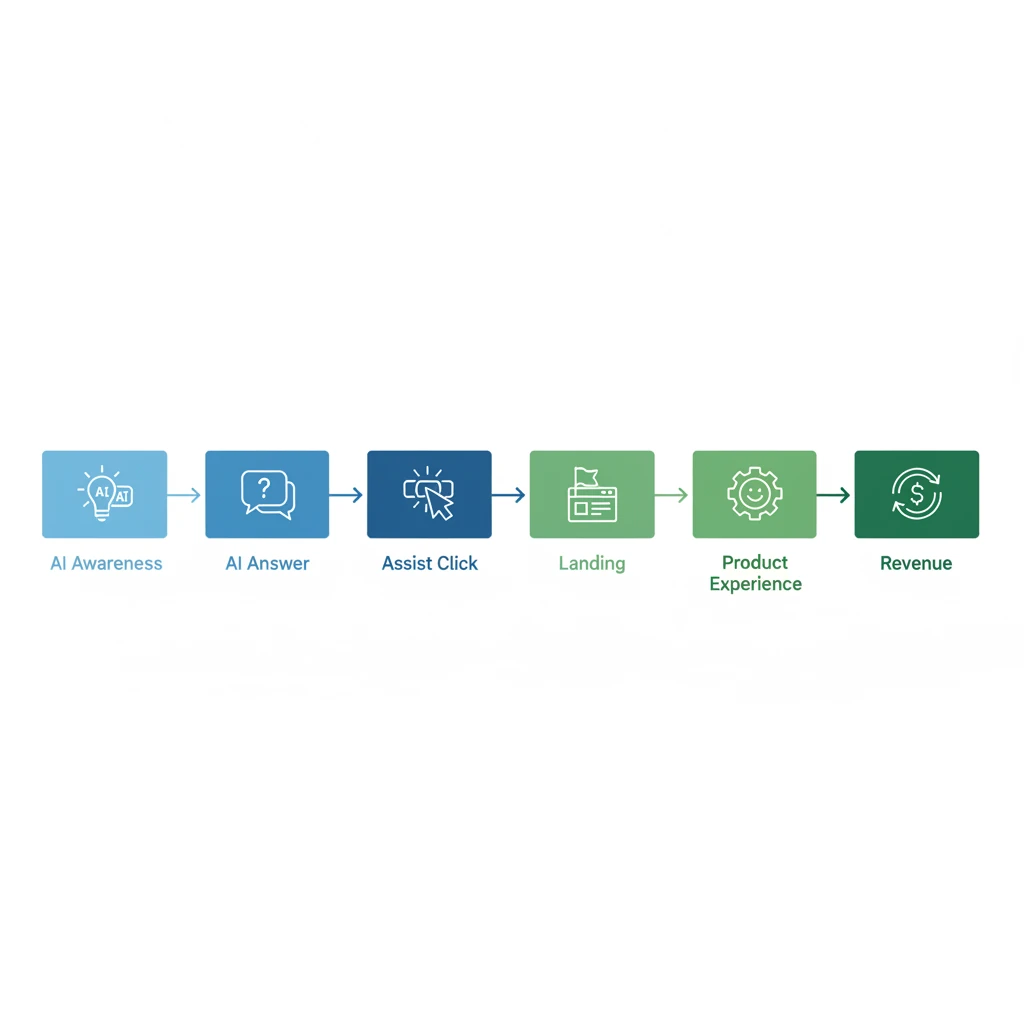
Key SaaS AI discovery stages and their CRO levers
Each stage of the SaaS AI discovery funnel has its own conversion levers. Even though you do not fully control the AI interfaces, you can influence what they say about you and how well your site continues the story once someone clicks through.
- AI Awareness: The assistant or overview identifies your category and the user’s problem. Here, your goal is to be in the consideration set via strong content, structured data, and coverage across third-party sites. Approaches for how SaaS brands can optimize for AI recommendation engines translate directly to this stage.
- AI Answer Exposure: Your brand gets mentioned, summarized, or compared. CRO levers include crafting clear value propositions in your public content, consistent messaging across docs and partner listings, and comparison pages that AI models can quote accurately.
- Assist Click: The user chooses to click your link from within an AI environment. Here you optimize headlines, meta descriptions, and the first screen of your landing page to mirror the assistant’s promise, minimizing any “wait, this is not what I asked for” friction.
- Landing Qualification: The visitor scans your page to confirm fit. Key levers are segment-specific hero messaging, fast access to pricing, social proof mapped to use case, and micro-conversions like “watch 3-minute overview” for colder visitors.
- Product Evaluation: The user explores features, documentation, and integrations. CRO focuses on clear navigation, comparison tools, calculators, and contextual CTAs that move them toward trial, freemium, or demo paths that match their buying motion.
- Trial or Demo: The prospect commits to hands-on evaluation through a free trial, sandbox, or sales-led POC. Optimization centers on frictionless signup, right-sized qualification, and onboarding that gets them to first value fast.
- Expansion and Revenue: Converted users expand usage, add seats, or upgrade plans. AI-driven in-app prompts, recommendation widgets, and contextual education nudge adoption and upsell without overwhelming the experience.
Not every user will touch every stage in order; someone might jump straight from AI Answer Exposure to Product Evaluation by reading your docs without touching marketing pages. Still, naming these stages gives you a way to map where AI is likely to influence perception and where on-site CRO can recover or amplify that influence.
Over time, you can layer AI-specific analytics on this model: tagging AI referrers, logging which AI queries your brand appears in, and tracking downstream signups and revenue from those cohorts. This is also where a broader “search everywhere” mindset and AI-informed full-funnel thinking becomes important.
Tactical playbook and implementation roadmap for SaaS CRO AI
With the funnel defined, the next step is to design experiments that respect how AI-shaped visitors think and behave. Effective SaaS CRO AI work does not mean throwing away your existing optimization program; it means layering AI-specific hypotheses, segmentation, and personalization on top.
The following subsections walk through practical tactics by stage, including examples of what is working for other SaaS brands and how to execute without overwhelming your team or tech stack.
Off-site alignment: Turning AI answers into SaaS CRO AI wins
Even though you cannot directly control AI Overviews, you can heavily influence the raw material they pull from. That starts with owning your category narrative across your site, partner directories, and review platforms so that assistants consistently describe you in ways that match your strategic positioning.
One powerful SaaS CRO AI lever is message match between AI summaries and landing pages. When SaaS marketers dynamically matched their landing-page messaging to the AI entry point, added micro-conversions for colder traffic, and combined AI-generated copy with behavior-based personalization, they lifted conversion rates on AI-feed traffic by 20–30%. That uplift did not require gimmicks; it came from carefully mirroring expectations.
Practically, this can look like creating variant hero sections keyed to specific problem phrases that you know appear in AI answers, or adding a “Coming from [assistant]? Start here” module that summarizes your unique angle in one or two sentences. If your experimentation culture and conversion rate optimization foundations are strong, you can treat “assistant source + query intent” as just another testable dimension.
Do not overlook top-of-funnel assets either. Comparison pages, “best tools for X” guides, and integration overviews often get quoted verbatim in AI responses. Ensuring they are accurate, up-to-date, and clearly structured with headings and schema helps assistants surface them and reduces the gap between what prospects read off-site and what they experience on your domain.
On-site experiments and personalization for AI-sourced visitors
Once visitors arrive, the key is to treat AI-sourced traffic as its own behavioral cohort. AI-discovery traffic can behave unpredictably across fragmented journeys. This is why SaaS marketers should segment these visitors separately, applying deep behavioral analytics, and prioritizing above-the-fold clarity.
In practice, start by tagging AI referrers (for example, known assistant domains or UTM parameters from AI-integration partners) and then build segments in your analytics and experimentation tools. Then compare core behaviors such as scroll depth, time to first interaction, and form-start rates against your search and paid cohorts. You will often see AI visitors move faster to key evaluation elements, such as pricing or integrations.
From there, prioritize a set of experiments tailored to AI cohorts, such as:
- Testing hero variants that reference the specific job-to-be-done or role implied by the AI query rather than a generic ICP statement.
- Reordering sections so pricing, integrations, and ROI proof appear earlier for AI segments that behave like mid-funnel evaluators.
- Introducing micro-conversions (short videos, calculators, ungated docs) for uncertain visitors who are still comparing vendors.
- Adjusting social proof so that logos, testimonials, or case studies match the vertical or use case most discussed in AI answers.
Coordinating these experiments across marketing pages, onboarding flows, and even in-product messaging calls for a holistic, AI-aware testing program. An approach similar to AI-driven full-funnel optimization for enterprise growth works well here: you align experiments across the entire journey rather than treating each page in isolation.
Trial, onboarding, and expansion in an AI-shaped funnel
AI discovery affects not just who lands on your site but also who signs up for trials and how prepared they are to succeed. Some AI-sourced visitors will arrive with very detailed expectations for specific features or integrations. Others may start a trial just to “test the waters” based on a quick recommendation.
For SaaS CRO AI efforts, prioritize onboarding changes that help users quickly confirm, “Yes, this is what the assistant told me I would get.” That might mean:
- Using the first screen to restate the core promise or outcome that AI answers commonly attribute to your product.
- Offering pre-built templates or guided tours mapped to the top AI-described use cases, so users see their scenario reflected immediately.
- Triggering contextual in-app messages for AI-tagged users that answer common follow-up questions you see in assistant logs or customer conversations.
This type of AI-informed personalization not only improves the user experience; it also supports strategies such as AI marketing optimization, which reduces customer acquisition costs by increasing trial efficiency, reducing wasted signups, and nudging higher-value plans earlier in the relationship.
If coordinating all these moving pieces feels daunting, partners like Single Grain, with a dedicated sales funnel agency for SaaS, can bring structured experimentation frameworks and AI discovery data together so you do not have to build everything from scratch in-house.
Analytics and metrics for AI discovery funnels
Measurement is where many SaaS CRO AI initiatives stumble. If AI discovery is grouped into “organic” or “referral” without additional context, it is nearly impossible to know which tests are really moving the needle for AI-driven cohorts. You need a lightweight but explicit metric layer for the AI discovery funnel.
Start by defining and tracking a handful of AI-specific indicators, such as:
- AI-sourced sessions: Visits identified via known assistant referrers, UTM tags, or partner integrations.
- Assist click rate: The share of AI answer impressions that result in a visit to your site, where you can estimate impressions using search tools, partner reports, or periodic manual sampling.
- AI cohort conversion rate: Trial, demo, or signup rate for AI-sourced sessions compared to your overall baseline.
- Time to qualified event: How long it takes AI visitors to reach product-qualified or sales-qualified status versus other channels.
- Downstream revenue and retention: LTV or expansion rate for AI-influenced customers, where multi-touch attribution connects AI discovery to later conversions.
Because AI surfaces and attribution signals are evolving, you will not capture every interaction perfectly. That is fine; what matters is creating consistent cohorts and metrics so you can run experiments, compare performance, and iterate with confidence.
30–180 day roadmap to SaaS CRO AI maturity
To avoid analysis paralysis, break your SaaS CRO AI program into phases. The goal is to establish tracking, run a few high-leverage experiments, and then scale what works across more touchpoints and teams. You do not need to deploy advanced personalization or conversational interfaces on day one.
A pragmatic roadmap might look like this:
- Days 0–30: Instrumentation and baseline. Tag AI referrers, define AI cohorts in analytics, and benchmark current conversion rates for AI versus non-AI traffic. Map the top AI-described use cases and queries for your brand and category.
- Days 30–90: High-impact experiments. Launch a small set of tests focused on message match (hero copy, social proof order, navigation tweaks) for AI cohorts. Add at least one micro-conversion tailored to AI visitors, such as a short explainer or template library.
- Days 90–180: Personalization and scale. Expand experiments into onboarding and in-product experiences, introduce AI-informed content or feature recommendations, and formalize a cross-functional working group across marketing, product, and sales to own the AI discovery funnel.
Throughout these phases, revisit privacy, compliance, and bias considerations whenever you collect conversational data or use AI for personalization. Make sure your data handling is transparent and that AI-driven experiences do not disadvantage specific user groups or regions.
Turning AI discovery into a conversion advantage for your SaaS
AI assistants and answer engines are not just new traffic sources; they are reshaping how buyers research, compare, and select SaaS tools. Treating this shift as a core SaaS CRO AI challenge enables you to design funnels that start within AI conversations and extend through trials, demos, and long-term revenue.
By defining an explicit AI discovery funnel, aligning off-site narratives with on-site experiences, segmenting and testing AI-sourced visitors as a distinct cohort, and building a phased roadmap for analytics and experimentation, you can transform AI discovery from a visibility risk into a durable growth engine.
If you are ready to connect AI search visibility with real pipeline and revenue, get a free consultation with Single Grain and build a SaaS CRO AI strategy that fits your product, motion, and market. Done well, AI discovery will not just feed your funnel—it will become one of your highest-converting channels.
Frequently Asked Questions
-
How should SaaS teams prioritize CRO initiatives specifically for AI-discovery traffic when resources are limited?
Start by identifying one or two high-traffic, high-intent entry points from AI (e.g., your main product page or a core comparison page) and focus experiments there first. Limit early work to fast, reversible changes, like message match and layout tweaks, so you can learn quickly before investing in heavier builds like complex personalization.
-
What organizational changes help SaaS companies manage an AI discovery funnel more effectively?
Create a small cross-functional pod (growth, product marketing, and RevOps or sales) that meets regularly to review AI-sourced data and test results. Give this group clear ownership of AI discovery metrics and decision rights for experiments spanning marketing, website, and onboarding.
-
How can SaaS brands deal with AI hallucinations or inaccurate descriptions of their product?
Monitor how assistants describe your product by running common category and comparison queries on a recurring basis and logging outcomes. When you spot inaccuracies, strengthen and clarify your public documentation, publish corrective content on trusted third-party sites, and use AI vendor feedback channels or partner programs to request updates.
-
What content operations practices support long-term success with SaaS CRO in AI-driven discovery?
Treat any page that AI is likely to quote (docs, comparison content, pricing explanations) as a living asset with scheduled reviews and an owner. Maintain a structured template for these assets (clear headings, definitions, and canonical positioning), so updates are consistent and easy for both humans and models to interpret.
-
How should sales teams adapt their process for leads that originate in AI discovery journeys?
Enable reps to ask one or two quick questions about what the prospect already learned from AI (e.g., “What did you see about us before booking this call?”) and tailor the conversation accordingly. Provide sales with brief summaries of common AI-described use cases and objections so they can reinforce or correct expectations efficiently.
-
Does AI-driven discovery change how SaaS companies should approach global or localized CRO efforts?
Yes, because many assistants blend sources across regions, localized pages and review sites become more influential in how your product is summarized in different markets. Prioritize updating local-language assets and region-specific proof points so that AI answers align with local pricing, compliance, and use cases before you run detailed CRO tests.
-
What risks should SaaS companies watch for when using AI data to personalize conversion experiences?
Be cautious about inferring sensitive attributes from AI interactions and avoid using them for targeting without clear consent. Implement guardrails such as data minimization, role-based access, and regular audits of personalization rules to ensure they are transparent, non-discriminatory, and aligned with your privacy and compliance commitments.


