

GEO for B2B SaaS vs B2C: How LLM Behavior Changes in Enterprise Queries


Your B2B GEO strategy cannot simply reuse consumer SEO playbooks anymore. As generative engines and large language models increasingly sit between buyers and your website, the way they interpret, retrieve, and summarize information diverges sharply for enterprise versus consumer queries. Marketing teams that treat those two behaviors as the same will see their visibility inside AI answers erode. Teams that adapt quickly will own the new “front page” of search-like experiences.
Generative engine optimization is particularly nuanced for B2B SaaS because enterprise prompts span long buying cycles, involve multiple stakeholders, and are subject to strict risk constraints. In contrast, consumer prompts skew toward quick recommendations and price comparisons. Understanding how LLMs behave across those contexts is the foundation for building GEO programs that capture high-intent demand, whether your product is sold to companies, consumers, or both. This article breaks down the technical behaviors that matter, compares enterprise and consumer prompts side by side, and outlines a practical blueprint you can use to operationalize GEO in your own teams.
TABLE OF CONTENTS:
How generative engines and LLMs change search visibility
Traditional SEO optimized for ranked lists of links; generative engines optimize for the best possible answer. That subtle shift means you are no longer optimizing only for “position one,” but also for whether your brand is trusted enough, clear enough, and structured enough to be cited or summarized by an AI system. To influence that behavior, you need to understand how LLMs move from a query to an answer.
From traditional SEO to GEO and entity-first content
In classic SEO, keyword matching and link authority did most of the heavy lifting. In GEO, the focus shifts to entities, such as people, products, companies, and categories, and to the relationships among them. LLMs and modern search systems represent the world as networks of entities and dense vector embeddings rather than isolated phrases.
For B2B SaaS, that means every public description of your product, pricing model, integrations, and target industries must paint a consistent, machine-readable picture. Deep educational resources that clearly explain what B2B SaaS products are and how they deliver value help LLMs connect your brand to the correct use cases, adjacent tools, and decision-makers. Ambiguity at the entity level is one of the fastest ways to lose visibility in AI answers.
Generative engines also ingest more than marketing pages. Product documentation, changelogs, API references, support articles, community threads, and even public GitHub repositories can influence how you are summarized. GEO therefore requires aligning your entire external information surface, not just your blog, with the narratives you want AI systems to repeat.
Enterprise LLM behavior: Retrieval, ranking, and risk filters
Most generative engines follow a similar pattern: interpret the query, retrieve potentially relevant documents, score them, generate an answer using the LLM, and then apply safety and quality filters. Each phase introduces levers that marketers and product teams can influence.
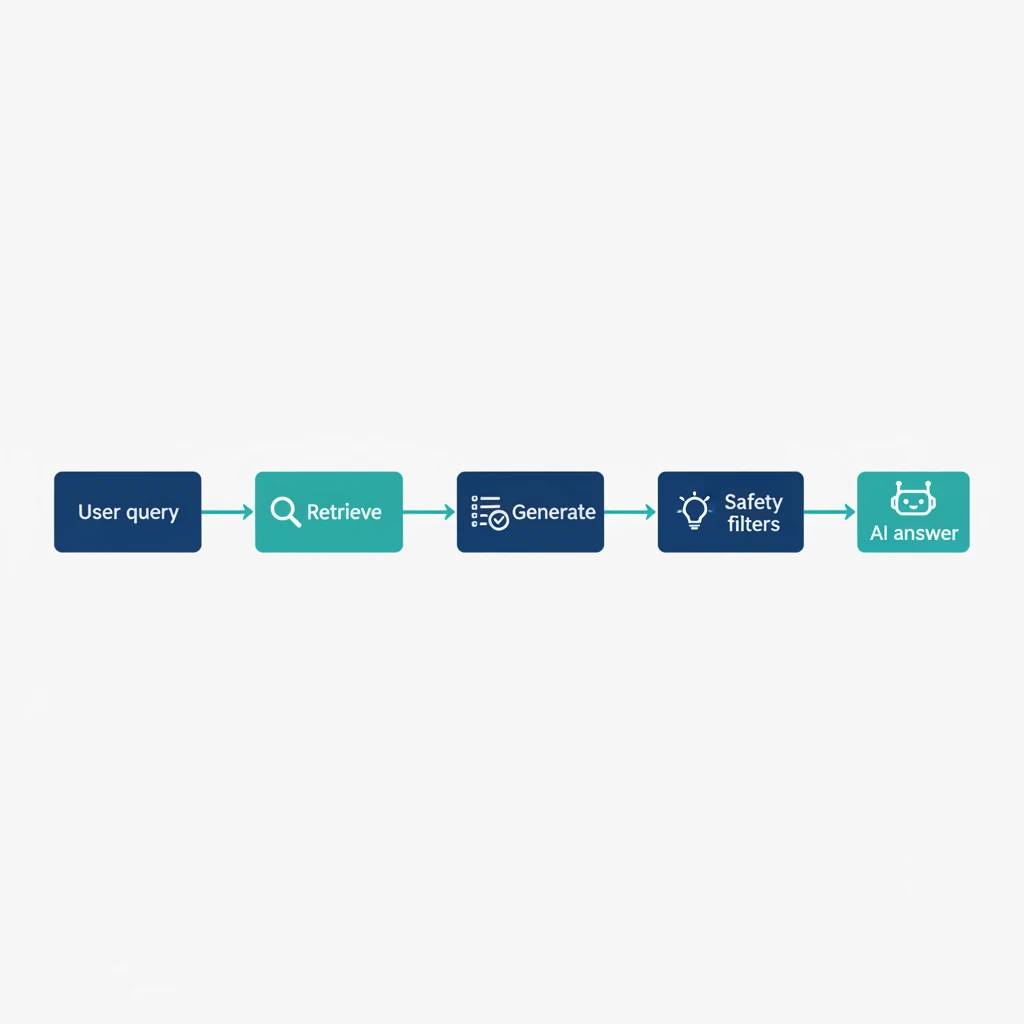
During retrieval, systems rely on an index of web pages, documentation, and sometimes proprietary corpora, using both keyword and semantic (embedding-based) search. Clear headings, descriptive anchor text, and structured data help your content become eligible for this step. In enterprise contexts that use retrieval-augmented generation (RAG), your content also needs to live in approved knowledge sources (internal wikis, CRM notes, or product knowledge bases) before it can appear in internal AI assistants.
Ranking then scores candidate passages on topical relevance, authority, freshness, and alignment with the user’s intent. Safety filters sit on top of this process to block disallowed content and to down-rank sources that look unreliable or misleading. For regulated B2B categories such as fintech, cybersecurity, or healthcare, those filters are especially aggressive, favoring precise, well-structured documentation over vague marketing claims.
Investment trends underscore how seriously enterprises are taking this shift. Enterprise IT budgets are projected to grow by an average of 5.3% year over year, giving teams more capacity to fund advanced GEO, AI search, and LLM observability tooling. Many organizations are channeling that incremental spend into search-everywhere optimization programs and into specialized GEO marketing partners that focus on qualified B2B leads.

Enterprise vs consumer LLM queries: What really differs
B2B SaaS buyers do not talk to LLMs the way consumers do, and generative engines respond accordingly. Enterprise prompts tend to be longer, more contextual, and more constrained by organizational risk, while consumer prompts emphasize convenience and personal preference. GEO strategies that blur these contexts can accidentally optimize for the wrong type of query.
Four dimensions in particular drive very different LLM behavior between enterprise and consumer scenarios: time horizon, decision complexity, risk tolerance, and preferred content formats. The table below summarizes how that plays out for GEO across B2B SaaS and B2C brands.
| Dimension | B2B SaaS GEO focus | B2C GEO focus |
|---|---|---|
| Buyer intent horizon | Long cycles, multi-year contracts, renewals, and expansions; content must support a months-long research and validation process. | Short cycles, often single purchases or subscriptions; content geared toward quick comparisons and immediate decisions. |
| Query style | Role-based, context-heavy prompts (e.g., “As a VP of Sales at a 200-person SaaS company…”). | Personal preference and lifestyle prompts (e.g., “best running shoes for flat feet”). |
| Decision complexity | Multiple stakeholders, integrations, data migration, security review, and ROI modeling. | Single decision-maker, fewer dependencies, limited need for technical depth. |
| Risk and compliance | High: LLMs prioritize sources with clear security, compliance, and implementation detail. | Moderate: LLMs can lean more on reviews, popularity, and social proof. |
| Influential content types | Implementation guides, integration docs, SLAs, case studies, ROI calculators. | Reviews, UGC, product descriptions, price and discount information. |
| Primary success metrics | Qualified pipeline, opportunity velocity, expansion revenue, reduced time-to-value. | Sales volume, average order value, repeat purchases, CLV. |
Because generative engines learn from behavior, they gradually associate enterprise-like prompts with deeper, more technical content and consumer prompts with broader, often lighter content. Your GEO program should intentionally feed each side of that pattern with the right assets and schema, rather than hoping that one type of content will serve all intents.
Prompt patterns that define enterprise buying queries
Enterprise prompts often encode role, company size, tech stack, and constraints directly into the question. This gives LLMs a rich context window to work with, if your content matches it. A single B2B buyer journey might involve queries from a CMO, a RevOps leader, a security architect, and an end user, each with different language and success criteria.
Here are typical prompt patterns that show up across the B2B SaaS funnel:
- Discovery: “As a VP of Marketing at a mid-market SaaS company, what are the leading tools to improve AI search visibility for our product-led growth motion?”
- Comparison: “Compare enterprise GEO platforms for a company with 500+ employees, SOC 2 requirements, and an existing Salesforce data stack.”
- Due diligence: “What security and compliance questions should a CISO ask before approving a generative engine optimization vendor?”
- Implementation: “Create a rollout plan for integrating a GEO-focused content workflow into our current B2B SEO and RevOps stack.”
GEO for B2B SaaS means ensuring that when buyers ask questions like these, LLMs can confidently pull from your documentation, implementation playbooks, customer stories, and integration guides. Thin listicles or generic “what is” pages alone rarely meet the specificity threshold for enterprise answers.
How consumer LLM queries change GEO priorities
Consumer prompts, by contrast, lean toward convenience and personal fit. They often ask for shortlists, recommendations, or step-by-step instructions tailored to a lifestyle scenario rather than an organizational role. This steers generative engines toward content that emphasizes reviews, visual examples, pricing, and practical tips.
Typical B2C-focused prompts might include:
- “Best family-friendly streaming services under $30/month.”
- “Create a weekly meal plan using vegetarian recipes that take under 30 minutes.”
- “Compare popular fitness apps for beginners who prefer at-home workouts.”
Brands operating in both worlds must juggle differing expectations on both price and value storytelling, a tension explored in detail in this analysis of competitive pricing strategies for B2C and B2B offerings. Your GEO roadmap should mirror that duality, ensuring consumer-facing queries surface persuasive, review-rich content while enterprise prompts uncover rigorous implementation and ROI evidence.
Once you can clearly see these prompt patterns, the next step is to design a B2B GEO strategy that gives enterprise LLMs everything they need to consistently recommend your solution over alternatives.
If you want a partner to architect that cross-channel foundation, spanning classic SEO, answer engine optimization (AEO), and AI-driven search experiences, Single Grain helps growth-stage companies build SEVO programs that tie AI visibility directly to revenue. Visit https://singlegrain.com/ to get a FREE consultation on your current search-everywhere footprint.
Designing an effective B2B GEO strategy for SaaS
An effective B2B GEO strategy for SaaS treats every LLM interaction as part of your revenue engine, not just your awareness engine. The goal is to engineer how generative systems talk about your product, from high-level category questions to nitty-gritty implementation prompts, so that they nudge the right accounts toward trials, demos, and expansions.
This requires connecting GEO directly to PLG motions, free trials, onboarding flows, and customer success content. Instead of asking “What keywords should we rank for?”, you start asking “Which prompts should reliably surface us at each buying stage, and what content do LLMs need to justify that choice?”
B2B GEO strategy fundamentals for enterprise SaaS
Four fundamentals underpin GEO for enterprise SaaS: entity clarity, role-specific narratives, full-funnel coverage, and multi-surface presence. Each one maps cleanly to observable LLM behavior.
Entity clarity ensures LLMs know exactly who you are, what you do, and where you fit. Use consistent naming for your company, products, modules, and core features across your site, documentation, and public profiles. Schema markup for software applications, FAQs, and organizations, along with detailed category pages, helps generative engines place you in the right competitive sets, similar to how robust category explanations of high-performing B2B content programs help clarify your expertise.
Role-specific narratives recognize that LLM answers often adopt the persona embedded in the prompt. If your content only speaks generically to “businesses,” LLMs have little material to use when a CISO, CFO, or Head of RevOps asks for advice. Create distinct, deeply detailed pages, playbooks, and case studies tailored to each key stakeholder, including the risks they fear and the metrics they own.
Full-funnel coverage goes beyond top-of-funnel explainers. Enterprise LLM queries routinely jump straight into evaluation and implementation: “integrate with Snowflake,” “map to our CRM schema,” “handle multi-entity billing.” If you do not expose implementation guides, migration checklists, and troubleshooting content publicly (at least in redacted form), generative engines will favor vendors that do.
Multi-surface presence acknowledges that LLMs learn from many surfaces: your marketing site, docs portal, API reference, app marketplace listings, community forum, and more. GEO planning should inventory these surfaces and ensure they carry coherent, entity-rich narratives rather than siloed, contradictory descriptions.

Operational GEO playbook: Audit, build, distribute, test
Turning these fundamentals into a working GEO program requires a repeatable workflow. Think of it as a search-everywhere operating system layered on top of your existing SEO and content processes.
- Baseline your current visibility. Systematically test prompts across ChatGPT-style tools, AI-enhanced search, and any internal enterprise assistants your buyers are likely to use. Capture where you are cited, how you are summarized, and which competitors dominate generative answers.
- Map your entity and topic graph. Identify your core entities (company, products, features, integrations, industries) and chart how they relate to one another. Use this map to prioritize which entities need better on-site definitions, schema markup, and supporting content.
- Run a content and schema gap analysis. Compare real buyer prompts to your existing assets. Where do you lack role-specific pages, implementation guides, security FAQs, or ROI calculators? Tools and frameworks for using AI to create a B2B SEO strategy that converts can accelerate this gap analysis.
- Upgrade structure and markup. Add or refine schema.org types for software, FAQs, how-tos, and product features. Standardize headings, internal links, and URL structures so retrieval systems interpret your architecture cleanly.
- Distribute to LLM-visible surfaces. Ensure your key assets are crawlable and present in external ecosystems: app marketplaces, integration directories, code repositories, and partner documentation. For internal selling, coordinate with customers on which implementation content can be mirrored in their own knowledge bases for use in enterprise assistants.
- Test, measure, and iterate. Re-run your prompt tests regularly, tracking share of voice in AI-generated lists, citation frequency, and downstream conversions from sessions that originate in AI-powered search experiences.
To move quickly, teams often blend in experimentation tools that reduce guesswork. Platforms like Clickflow.com, for example, help you test how changes to titles, meta descriptions, and on-page copy impact both traditional organic CTR and the likelihood that search and generative systems feature your pages more prominently. When combined with GEO-aware content and schema improvements, these experiments turn vague “AI visibility” goals into measurable uplifts.
Some organizations execute this playbook entirely in-house, while others work with external partners. For B2B teams, it is worth considering GEO-focused agencies that specialize in qualified B2B leads, as they already have prompt testing frameworks, measurement dashboards, and cross-channel SEVO strategies you can adapt rather than inventing from scratch.
Turning B2B GEO strategy into a competitive moat
As generative engines become the default starting point for research, your B2B GEO strategy will increasingly determine whether LLMs position you as a category leader or barely mention you at all. The brands that win will be those that treat GEO as a durable moat: engineering how AI systems perceive their products, not merely reacting to shifting SERP layouts.
Measuring GEO impact in generative engines
Measurement in GEO goes far beyond organic traffic. Teams should track which prompts consistently surface their brand, how often they are cited versus competitors, and how AI-referred sessions convert into trials, demos, and revenue. Internally, you can also monitor how frequently sales and success teams rely on AI-generated summaries and whether those summaries reflect your current positioning.
Dashboards increasingly blend traditional SEO metrics (rankings, CTR, organic sessions) with GEO-specific ones such as “AI overview presence,” “LLM shortlists that include us,” and “prompt-level win/loss rates.” Over time, these datasets help you decide where additional content, schema, or experimentation will yield the greatest incremental lift in high-value enterprise queries.
Governance, compliance, and internal education
Because GEO influences how external and internal AI systems talk about your product, it intersects with security, legal, and compliance concerns. Clear policies around which documents can be made public, how to anonymize customer examples, and what must remain inside customer-specific knowledge bases protect you from leaking sensitive information into public models.
Equally important is internal education. Marketing, product, sales, and IT leaders all need a shared understanding of how LLMs retrieve and summarize information so they can align messaging, decks, and documentation with your AI-facing content. Without that alignment, updates to positioning or pricing may propagate inconsistently across the many surfaces generative engines rely on.
Next steps for scaling your B2B GEO strategy
The most effective next step is to operationalize what you have learned in this guide: define your priority enterprise prompts, audit how LLMs currently answer them, and then work backward to the entities, content, and structures you must improve. From there, you can decide whether to build internal GEO capabilities, adopt experimentation tools like Clickflow.com, or partner with external experts.
If you want a team that already lives at the intersection of SEO, GEO, and answer engine optimization, Single Grain helps growth-stage and enterprise brands implement search-everywhere programs that connect AI visibility directly to pipeline and revenue. Start by requesting a FREE consultation at https://singlegrain.com/, and use that session to stress-test your current B2B GEO strategy, identify quick wins, and map out a roadmap for owning enterprise LLM queries in your category.
Frequently Asked Questions
-
Who inside a B2B SaaS organization should own GEO, and how should cross-functional collaboration work?
GEO is most effective when owned by a growth or product marketing leader who can bridge SEO, content, and revenue teams. They should run a working group with representatives from product, docs, sales, security, and RevOps to align on entities, messaging, and which assets must be made AI-visible.
-
How should we budget for GEO compared with traditional SEO initiatives?
Plan for GEO as a multi-line item: content and documentation upgrades, schema and technical work, prompt testing and monitoring tools, and occasional model-specific experiments. Many teams reallocate a portion of their SEO and demand gen budget rather than treating GEO as a net-new spend, then expand funding once AI-sourced revenue is clearly attributable.
-
What’s the best way to brief writers and subject-matter experts for GEO-focused content?
Give creators actual enterprise prompts, target personas, and the specific LLM misunderstandings or gaps you want to fix, instead of just keywords. Include required entities, technical depth, and approval rules (e.g., what security or pricing details can be made public) so content is both authoritative and safe to surface in AI answers.
-
How long does it typically take to see a measurable impact from a GEO program?
Most teams see early signals, such as improved citations and better summaries in AI tools, within 6–12 weeks of publishing optimized assets. Clear revenue impact usually appears over one or more sales cycles, once those improved answers begin influencing evaluations, RFP shortlists, and expansion conversations.
-
How should global or multi-region SaaS companies adapt GEO for different markets?
Create localized entity definitions, role narratives, and examples that reflect each region’s regulations, buying committees, and terminology rather than only translating English assets. Ensure country-specific sites, docs, and partner listings are structured consistently so LLMs can connect local prompts with the correct regional offerings.
-
What are the most common mistakes B2B teams make when starting with GEO?
Frequent pitfalls include treating GEO as a one-time project instead of an ongoing operating rhythm, over-focusing on top-of-funnel thought leadership while neglecting implementation and risk content, and failing to align legal and security early, leading to delays or retractions after content is already in model training data.
-
How can we keep our GEO strategy resilient as LLMs and search experiences continue to evolve?
Anchor your program on durable principles (clear entities, consistent narratives, and deep, verifiable documentation), then layer on light, continuous testing across emerging AI surfaces. By tracking how different models currently describe your product, you can adjust structures and content without rewriting your strategy every time interfaces or vendors shift.