

The Teach-First Ad Format: How to Write ChatGPT Ad Creative


Most marketers still treat ChatGPT ads like mini landing pages or search text ads, but the teach-first ad format flips that script by making education, not promotion, the first job of your sponsored response. In a conversational interface, people expect a helpful answer, not a banner masquerading as copy. If your ad sounds like an interruption, users will scroll past it mentally, even if it is perfectly targeted. When you lead with teaching, you turn that same placement into a continuation of the conversation the user already started.
This guide breaks down how to use that teaching-first structure to write ChatGPT ad creative that feels native to the experience and still drives performance. You will see how the format works inside a ChatGPT thread, the key building blocks of an effective sponsored response, concrete writing steps, and optimization ideas so you can scale this structure across campaigns without losing quality.
TABLE OF CONTENTS:
Why Teaching Before Selling Wins Inside ChatGPT
When someone opens ChatGPT, they are not “browsing”; they are already doing a task. They might be comparing software, planning a campaign, drafting an email sequence, or troubleshooting a technical issue. That task-focused mindset makes people unusually receptive to specific, actionable advice and unusually sensitive to generic sales pitches.
Traditional ad formats were built for environments where users skim headlines or scroll feeds. In those places, you often win by being the loudest or most visually arresting message in the stream. Inside a ChatGPT conversation, you win by sounding like the most useful continuation of the answer the user just received.
Inside ChatGPT, people typically want to:
- Clarify a confusing concept in plain language
- Compare a short list of options and understand tradeoffs
- Get a concise process, checklist, or template they can apply immediately
- Validate a decision they are about to make with a second opinion
If your sponsored response helps with one of those jobs before you mention your product, users experience it as help rather than a hard sell. That shift is the core strategic advantage of teaching before selling in this environment.
The broader media landscape amplifies the importance of this shift. Digital channels captured 74.4% of total global ad spend in 2025, up from 72.7% the year before, which means more brands are competing for the same eyeballs across all digital surfaces, including AI assistants.
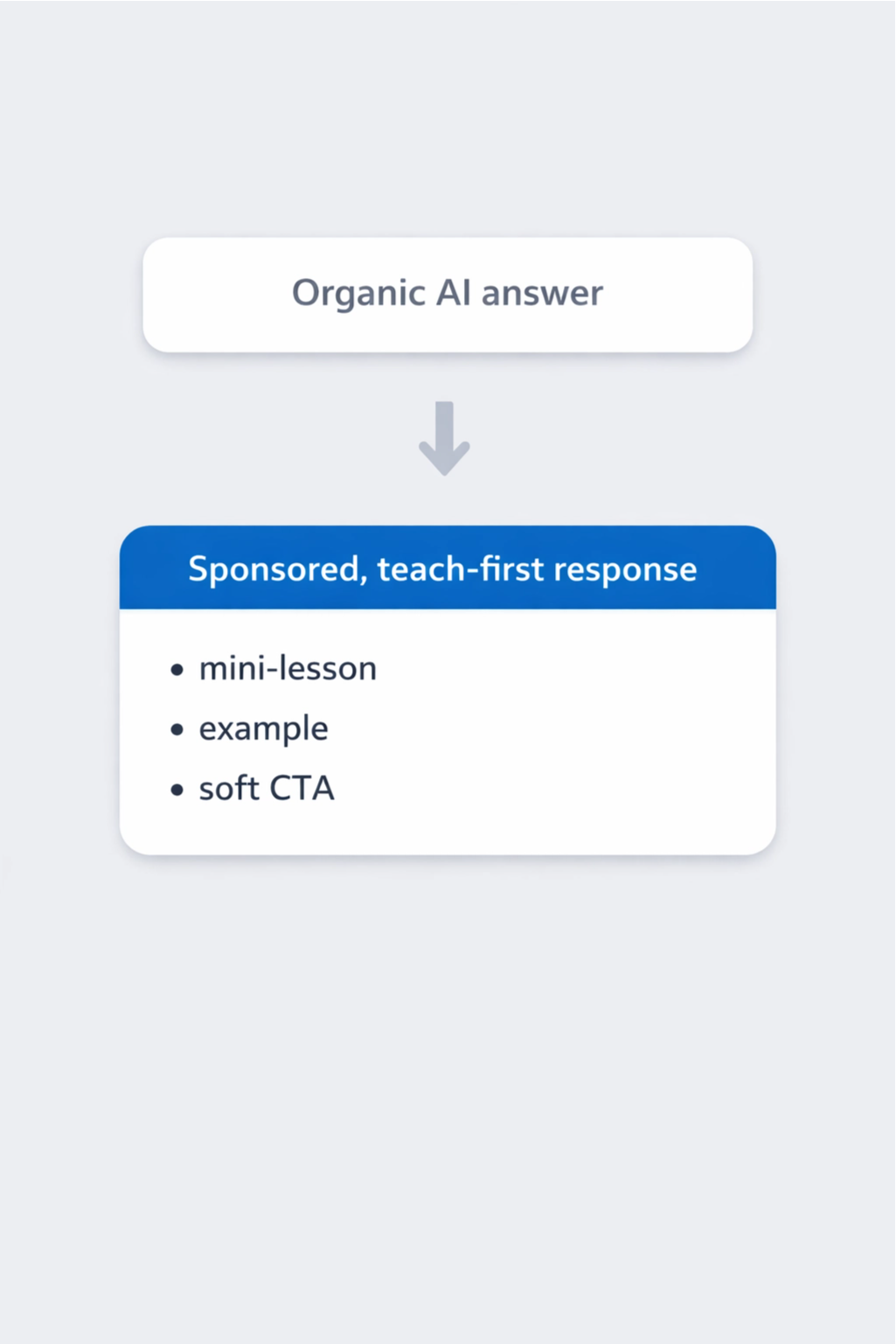
Within ChatGPT specifically, the ad unit is designed so that the organic AI answer appears first, and only then does a clearly labeled sponsored response show up afterward. According to an OpenAI blog post on its ad approach, this sequencing and labeling is a deliberate policy choice to keep the core experience trustworthy. The teach-first style of ad creative fits perfectly with that design because it lets the sponsored message behave like an optional “expert follow-up” rather than a competing answer.
How ChatGPT Conversations Rewire Ad Expectations
In search and social, users are trained to scan. In ChatGPT, they are trained to read and respond. Every interaction is part of a thread, and that thread has memory, context, and a clear problem the user is trying to solve.
That conversational context rewires expectations in three ways. First, users expect continuity: the next message should build directly on the last answer or question. Second, they expect personalization: examples and explanations should mirror their situation, industry, or skill level. Third, they expect adaptability: if they ask a follow-up question, the system should refine its guidance rather than repeat generic talking points.
Teach-first ad creative can meet those expectations much more easily than a static pitch. Opening with a mini-lesson that acknowledges the question and context, then segueing into how your solution fits, inviting a deeper comparison, or offering a next step that keeps the conversation moving rather than abruptly switching into “ad mode.”
The Teach-First Ad Format Inside ChatGPT: Structure and Rules
At a structural level, the teach-first ad format is simple: it is a short, labeled, sponsored block that follows the organic AI answer and adds more clarity, depth, or practicality to what the user just saw. Only after providing that help does it introduce a product, service, or offer as a natural extension of the advice.
You can think of it as a side-by-side contrast with the way many marketers instinctively write ads today:
| Element | Teach-first ad format | Traditional CTA-first ad |
|---|---|---|
| Opening line | Restates the user’s goal and offers a quick insight or shortcut | Mentions brand name or bold promise immediately |
| Body copy | Provides a mini-framework, checklist, or comparison tied to the query | Lists features, benefits, or offers with little situational context |
| Proof | Shows how the teaching has worked in a specific scenario | Uses broad claims like “trusted by thousands” |
| CTA | Invites the user to apply or extend what they just learned | Pushes for a click, signup, or demo with no preceding education |
| User experience | Feels like an optional “bonus tip” after the main answer | Feels like a separate, unrelated ad dropped into the conversation |
Core Principles of the Teach-First Ad Format
To make this format work consistently, it helps to codify a small set of non-negotiable rules for your creative team. These rules keep your ChatGPT ads aligned with user expectations and platform policies while still giving you room to experiment with angles and offers.
- Lead with the user’s task, not your brand. The first line should acknowledge what the user is trying to accomplish and add a helpful nuance, shortcut, or warning they have not yet encountered.
- Deliver a self-contained teaching asset. A user should walk away with value, even if they ignore your CTA, through a process, framework, or example they can immediately apply.
- Anchor everything in the current conversation. Wording, examples, and recommendations should clearly reference the query, industry, and constraints already in the thread.
- Make the CTA feel like a logical “next lesson.” Instead of pushing for a generic conversion, invite the user to deepen or operationalize what they just learned.
Step-by-Step: Writing Effective Teach-First ChatGPT Ads
With the structure and principles in place, the next challenge is turning a particular user query into a concrete ChatGPT ad creative. A consistent, repeatable writing workflow lets you scale this across dozens or hundreds of high-intent prompts without drifting back into generic ad-speak.
The following four-step process starts from the user’s words and ends with a clear, low-friction next step. You can use it whether you are hand-writing sponsored responses or generating first drafts with AI and then editing for nuance and compliance.
Step 1: Capture the User’s Exact Intent in a Single Sentence
Before you write a single line of ad copy, summarize what the user is really trying to achieve, using their own language as much as possible. Think of this as the “job-to-be-done” sentence for that specific query.
For example, if the prompt is “best CRM for a 10-person B2B SaaS sales team,” your intent sentence might be, “Help a 10-person B2B SaaS sales team choose a CRM that is simple to implement, supports outbound and inbound workflows, and fits a mid-market budget.” That sentence becomes your north star for what your sponsored response should teach.
Step 2: Deliver a Focused 3–5 Line Mini-Lesson
Your opening lines should teach something concrete that directly advances the user toward their goal. Aim for three to five short sentences or bullets that are specific enough to be useful but short enough to scan quickly.
Continuing the CRM example, a mini-lesson might look like this:
“For a 10-person B2B SaaS team, the fastest wins usually come from: 1) unifying email, calls, and LinkedIn touches in a single timeline, 2) enforcing a simple two- or three-stage pipeline, and 3) automating follow-ups for no-response leads. If your CRM nails those three, you will feel the impact in weeks, not months.”
Pattern-wise, strong mini-lessons often take one of these forms:
- A short checklist of 3–5 criteria to prioritize
- A simple framework (like “Plan → Build → Measure”) applied to the user’s situation
- A quick comparison of two or three common approaches with pros and cons
- A small template, prompt, or script that users can copy into their own workflow
Step 3: Bridge Naturally to Your Solution
Once you have given the user something useful, you have earned the right to suggest a way forward. The key is to keep the transition logically tied to the lesson you just delivered, rather than abruptly switching topics.
Effective transitions often sound like this: “If you want to skip the manual comparison…”, “If you prefer a tool that already bakes in this framework…”, or “Here’s how one platform implements all three of those steps.” The structure is always the same: reference the teaching, then present the product or service as one way to operationalize it.
Applied to our CRM example, that might look like: “If you would rather start with a CRM that already enforces a simple pipeline, unifies multichannel outreach, and automates follow-ups for you, [Product] is built specifically for lean B2B SaaS sales teams.”

Step 4: Offer a Specific, Low-Friction Next Step
ChatGPT users are rarely looking for a long signup process in the middle of a task. The strongest CTAs in this environment feel like an easy extension of the conversation, not a detour into a complex funnel.
Examples include invitations like “Generate a comparison checklist using this framework,” “See a live walkthrough of this setup for B2B SaaS,” or “Plug your numbers into an interactive version of this calculator.” Each one makes it obvious how clicking will help them implement what they just learned in the next few minutes, not weeks from now.
Once you have written a handful of these ads, you can create internal templates for different query types (evaluations, how-tos, troubleshooting, and strategic planning) so your team can plug in the intent sentence, mini-lesson, and CTA without reinventing the format each time.
If you want a partner to help you turn this workflow into a repeatable growth engine, a full-funnel performance marketing agency that combines AI strategy, performance creative, and measurement can accelerate everything from research to ad testing and reporting.
Optimizing and Scaling the Teach-First Ad Format
After you have a baseline of working ChatGPT ads built around the teach-first ad format, the next step is optimization. Instead of testing wild creative swings, you will get better returns by systematically varying specific elements of the mini-lesson and CTA while keeping the overall structure intact.
Testing Variables That Actually Matter in ChatGPT
Because the user is reading linearly, small changes in how you frame the teaching and the next step can have an outsized impact on engagement. Focus your experiments on variables that change the cognitive load, specificity, or perceived usefulness of the sponsored response.
Common test levers include:
- Teaching angle: “common mistakes to avoid” vs. “fastest path to value” vs. “checklist of must-haves.”
- Format of the lesson: short paragraph vs. numbered steps vs. a compact table
- Example selection: using a scenario that matches the user’s company size, industry, or role
- CTA framing: “see this in action,” “customize this for your stack,” or “generate a tailored version for your use case.”
Measuring Value and Choosing the Right Use Cases
While click-through rate and cost-per-click still matter, the teach-first structure shines when you also track downstream outcomes. That can include lead-to-opportunity conversion rate, product-qualified signups, or revenue per conversation initiated from ChatGPT placements.
You will generally see the strongest results from this format in scenarios where users are tackling complex or high-stakes decisions. Ideal use cases include:
- High-consideration B2B purchases, such as CRM, analytics, or security tools
- Multi-step implementation projects, like marketing automation rollouts or data migrations
- Skills-based learning, where you can provide frameworks and then offer a deeper course or tool
- Financial or strategic planning where a checklist or calculator leads naturally into your solution
For simple lookups or purely informational queries with no clear next action, you may find that a teach-first approach still builds awareness but does not justify aggressive bidding. In those cases, you can reserve the format for retargeting or for more qualified prompts that signal active evaluation or intent.
Turning the Teach-First Ad Format Into a Growth Engine
Done well, the teach-first ad format turns ChatGPT from just another line item in your media plan into a place where your brand consistently shows up as the most helpful expert in the room. Mapping user intent clearly, structuring every sponsored response as a mini-lesson, and then optimizing the angles and CTAs that drive real business metrics will build a system that compounds rather than a one-off experiment.
If you are ready to connect that system to a broader growth strategy, partnering with Single Grain’s AI-driven performance marketing team can help you integrate ChatGPT placements with search, social, and SEO so you are visible wherever your best customers go to ask questions.
Our specialists combine performance creative, paid media management, and conversion rate optimization expertise to design, launch, and refine teach-first ChatGPT ads that are tightly aligned with your funnel and attribution model. You get clear reporting on the revenue impact of this format, not just top-of-funnel engagement metrics.
To explore whether this approach fits your current roadmap, you can get a FREE consultation and map out a pilot that applies the teach first ad format to a focused set of high-intent queries, then scales what works into a durable growth engine.
Frequently Asked Questions
-
How can I adapt the teach-first ad format for B2C brands, not just B2B software or services?
For B2C, focus your mini-lesson on a small, practical tip that solves an everyday problem in your product category—think routines, hacks, or simple decision frameworks. Then position your product as the easiest way to apply that tip right away, rather than as a big lifestyle change or a long-term commitment.
-
What are common mistakes teams make when they first try teach-first ChatGPT ads?
Teams often over-explain their product rather than the user’s problem, bury the teaching under brand messaging, or write copy that reads like a generic FAQ rather than a direct reply to the query. Another frequent issue is making the CTA too heavy: forcing demos, forms, or signups instead of a quick, conversational next step.
-
How should I structure my creative team’s workflow around this format?
Give copywriters or strategists ownership of the intent sentence and mini-lesson, and let performance marketers own the offer and CTA variations. Create a shared library of best-performing “teaching angles” and transition phrases so everyone can move quickly while staying consistent with brand and compliance guidelines.
-
How do I keep teach-first ChatGPT ads compliant with industry regulations (e.g., finance, healthcare)?
Treat the mini-lesson as educational content, not individualized advice, and have the legal or compliance team review a set of reusable frameworks and disclaimers upfront. Use conservative, evidence-based language, avoid guarantees or outcome claims, and ensure your CTA clearly indicates when the user is leaving ChatGPT for a third-party site or experience.
-
Can I repurpose existing content to speed up production of teach-first ChatGPT ads?
Yes. Mine your best-performing blog posts, webinars, and sales decks for bite-sized frameworks, checklists, or comparisons, and compress them into 3–5-line lessons. The key is to rewrite them in the user’s language and adapt them tightly to specific query types rather than copy-pasting generic content blocks.
-
How should I budget for ChatGPT teach-first ads compared to other channels?
Start by carving out a small, clearly defined test budget tied to a handful of high-intent queries that already convert well in search or paid social. Once you have benchmarks for cost per qualified conversation or down-funnel metrics, you can scale spend in proportion to how those returns compare to your existing channels.
-
What’s the best way to localize teach-first ChatGPT ads for different regions or languages?
Go beyond direct translation by adapting examples, terminology, and constraints to each market’s norms, tools, and regulatory context. Work with native-language marketers or translators to rephrase the mini-lesson so it reads like natural, in-channel advice from a local expert, then localize the CTA destination and any follow-up assets accordingly.



