OpenAI Ads: Inside the New Advertising Platform


Artificial Intelligence (AI) is the transformative force in digital advertising. AI promises unprecedented efficiency, personalization, and effectiveness, from automating ad creative generation to real-time campaign optimization. Single Grain offers comprehensive resources on digital marketing trends to help businesses stay ahead. The broader impact of AI on digital marketing is significant, with experts highlighting its potential to reshape strategies.
The prospect of OpenAI Ads entering the market presents a potentially disruptive development. OpenAI, a leader in AI research and development, known for its large language models, has demonstrated the immense capabilities of generative AI. An advertising platform powered by OpenAI’s cutting-edge AI technologies raises significant questions about the future of digital marketing. What unique advantages would it offer, and what challenges might it pose to established advertising giants?
This article explores the hypothetical world of OpenAI Ads, examining its potential features, benefits, and broader implications. We will delve into AI-powered ad creation, advanced targeting, and performance measurement, while also addressing critical challenges like data privacy, ethical considerations, and market competition. Join us as we uncover the potential of OpenAI Ads in shaping the next generation of digital advertising.
TABLE OF CONTENTS:
Understanding OpenAI Ads: A New Frontier in Advertising
What Are OpenAI Ads?
At its core, OpenAI Ads envisions an advertising platform leveraging advanced AI, particularly generative AI and machine learning, to redefine the entire advertising lifecycle. Unlike traditional platforms, OpenAI Ads would use sophisticated AI models to automate and optimize processes from creative ideation to ad delivery and performance analysis. Imagine AI generating compelling ad copy, designing visuals, and producing short video advertisements tailored to specific audience segments.
This platform would integrate deep language understanding and predictive analytics, moving beyond conventional programmatic advertising. AI could analyze vast data to identify trends, predict consumer behavior, and dynamically adjust campaigns for maximum impact. The goal is a highly intelligent, adaptive, and autonomous advertising system that learns and evolves, continuously improving effectiveness without constant human intervention. This marks a significant leap from current AI applications in advertising.
The Vision Behind OpenAI’s Potential Entry Into Advertising
OpenAI’s mission is to ensure artificial general intelligence (AGI) benefits all of humanity. An advertising platform, while seemingly commercial, could align with this by democratizing effective advertising tools, empowering small businesses, and fostering innovation. An AI-driven platform could also prioritize ethical AI principles, setting new standards for transparency, fairness, and user privacy.
However, entering advertising also challenges OpenAI’s mission. Commercial imperatives, such as maximizing revenue and influencing behavior, could conflict with responsible AI development. Thus, any OpenAI advertising initiative would likely emphasize responsible AI use, user empowerment, and value creation beyond commercial gain. This would involve developing tools for relevant, less intrusive ads that improve the user experience while achieving marketing objectives. The tension between commercial viability and ethical AI development would be a central theme.
Key Features and Capabilities of the OpenAI Advertising Platform
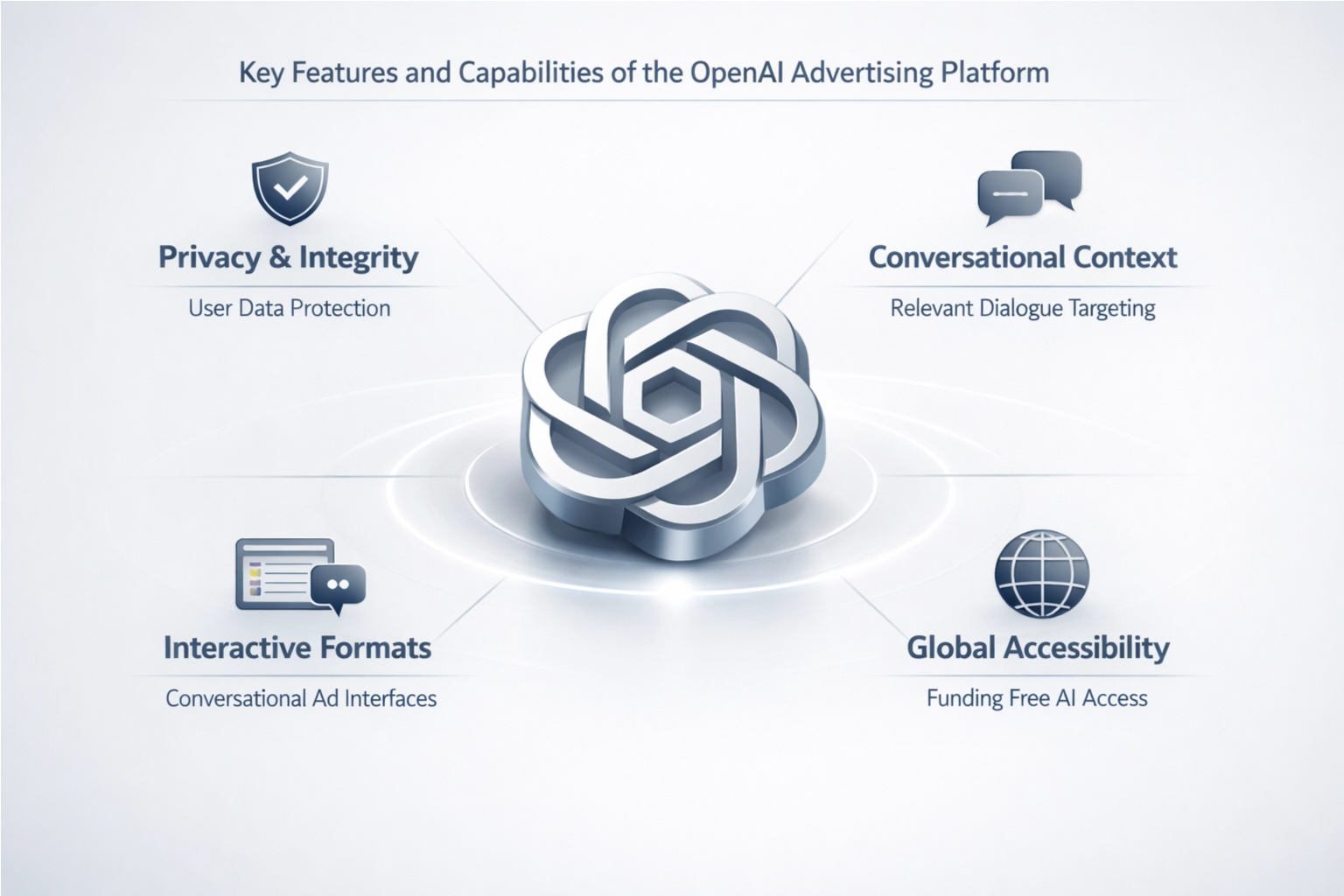
OpenAI’s foray into advertising would undoubtedly be characterized by a suite of innovative features that leverage its advanced AI research to offer capabilities far beyond what traditional platforms offer. These features would not only streamline the advertising process but also unlock new dimensions of creativity and effectiveness.
AI-Powered Ad Creation and Optimization
A compelling aspect of an OpenAI advertising platform is its ability to revolutionize ad creative generation. AI could autonomously generate diverse ad copy, visual assets, and short video clips, understanding brand identity and campaign objectives. This generative AI would craft unique, contextually relevant, and emotionally resonant content, optimizing headlines and visuals for different segments.
This AI would also integrate real-time optimization capabilities. Instead of manual A/B testing, the platform could continuously test countless ad variations, learning and adapting in milliseconds. Ads would constantly evolve to maximize performance, with AI identifying underperforming elements and automatically pivoting strategies based on live campaign data, ensuring efficient ad spend.
Advanced Audience Targeting and Personalization
OpenAI’s strength in natural language understanding and complex data patterns positions it uniquely for hyper-targeted advertising. The platform could leverage deep learning models to analyze vast datasets, including anonymized user behavior, search queries, and content consumption patterns, to create precise audience segments. This goes beyond demographic targeting, understanding subtle nuances in user intent, and predicting future needs.
This advanced targeting would enable unprecedented ad personalization, tailoring unique ad versions to individual preferences, interactions, and context, leading to higher engagement and conversion rates. However, sophisticated targeting demands robust ethical considerations and privacy safeguards to prevent intrusive personalization. Transparency in data use and strong user controls are paramount for building trust and complying with privacy regulations.
Performance Measurement and Analytics
An OpenAI advertising platform would offer AI-driven insights into campaign effectiveness beyond traditional metrics. AI could provide deeper, nuanced analysis, identifying complex correlations between ad elements, audience segments, and conversion paths. For instance, AI might discover a specific color palette performs exceptionally well with a certain demographic or that a subtle change in ad copy significantly impacts engagement.
Customizable dashboards and seamless integration with existing marketing stacks would be crucial. The platform would provide intuitive interfaces for marketers to visualize complex data, understand AI recommendations, and make informed decisions. Integration with CRM systems, analytics platforms, and other marketing tools would provide a holistic view of the customer journey and campaign performance, enabling businesses to accurately measure ROI and continuously refine their strategy based on intelligent, data-backed insights.
Benefits for Advertisers
The advent of an OpenAI advertising platform promises a paradigm shift in how advertisers approach their campaigns, offering a multitude of benefits that could redefine efficiency, performance, and innovation in the digital marketing sphere.
Enhanced Efficiency and Automation
Advertisers would experience a significant enhancement in efficiency and automation. AI-powered capabilities, from ad creative generation to real-time optimization, would drastically reduce manual effort in campaign management. Marketing teams could focus on strategic planning and creative brainstorming, rather than repetitive tasks. Automation across the ad lifecycle would allow for faster campaign deployment and iteration, enabling businesses to respond to market changes with unprecedented agility. This speed and efficiency translate into cost savings and scalable advertising efforts without proportionally increasing human resources.
Improved Campaign Performance and ROI
An OpenAI advertising platform, with its advanced AI and machine learning algorithms, is poised to deliver superior campaign performance and a strong return on investment (ROI). Leveraging deep insights into user behavior and intent results in driving higher engagement rates and optimizing for conversions more effectively.
AI’s ability to personalize ad content ensures messages resonate deeply with individual users, leading to increased click-through rates and desired actions. Continuous, real-time optimization would ensure ad spend is allocated to the most effective channels and creatives, minimizing waste and maximizing impact. This intelligent resource allocation would lead to cost-effective, optimized ad spend, providing advertisers with a clearer path to marketing objectives and higher ROI.
Innovation in Ad Formats and User Experience
The platform’s ability to generate novel ad formats and adapt to emerging digital channels would foster innovation in ad formats and user experience. Imagine AI-designed interactive ads that respond to user input, or dynamic content that seamlessly integrates across platforms, from social media to augmented reality. This constant evolution would keep advertising fresh, engaging, and less intrusive, enhancing user experience.
Advertisers would gain access to cutting-edge tools to capture attention in a crowded digital space and build stronger connections with their audiences through creative approaches. Pushing the boundaries of what’s possible in ad creative and delivery will transform OpenAI Ads into a valuable, engaging, and even entertaining part of the digital experience. This focus on enhancing the user experience, while still achieving marketing goals, could set a new standard for responsible and effective digital advertising.
Challenges and Considerations
While the potential of an OpenAI advertising platform is immense, its development and adoption would not be without significant challenges and ethical considerations. Navigating these complexities would be crucial for the platform’s long-term success and its responsible integration into the digital ecosystem.
Data Privacy and Security Concerns
The foundation of an AI-driven advertising platform is reliance on vast data for targeting and personalization, but it’s also its greatest vulnerability. Data privacy and security concerns must be addressed with utmost seriousness. Handling sensitive user data, even anonymized, requires robust security against breaches and misuse. Public wariness about data usage means any new platform faces intense scrutiny.
The platform must also ensure compliance with global privacy regulations like GDPR and CCPA. These impose strict rules on data collection, consent, and user rights; non-compliance can lead to substantial fines and reputational damage. OpenAI would need to build its platform on a privacy-by-design approach, integrating data protection into every aspect.
Ethical Implications of AI in Advertising
Beyond data privacy, advanced AI in advertising raises ethical implications. One significant concern is algorithmic bias. AI models trained on biased data can perpetuate societal biases, leading to discriminatory ad targeting. Ensuring fairness and equity requires continuous auditing and commitment to mitigating bias.
Another challenge is the transparency and explainability of AI decisions. Complex AI systems make it difficult to understand targeting or creative recommendations, hindering accountability and error rectification. OpenAI Ads would need explainable AI mechanisms that allow advertisers and regulators to understand AI-driven rationales, fostering trust and responsible deployment.
Competition and Market Adoption
Digital advertising is dominated by Google and Meta. OpenAI Ads would face significant competition and market adoption challenges. Breaking into this entrenched market requires a superior product and a compelling value proposition to convince advertisers to shift budgets. OpenAI would need to differentiate its platform by highlighting unique AI capabilities and demonstrating clear ROI advantages. Building trust and credibility is paramount and requires extensive education, robust support, and strategic partnerships. The challenge is not just technological, but also overcoming market perception and established industry practices.
OpenAI Ads vs. Traditional Advertising Platforms: A Comparison
The digital advertising ecosystem is dominated by Google and Meta. OpenAI Ads would inevitably be compared with these established platforms, highlighting its unique advantages and differentiation points.
Comparison Table: OpenAI Ads vs. Google Ads vs. Meta Ads
To understand OpenAI Ads’ potential positioning, we compare its hypothetical capabilities with Google Ads and Meta Ads, focusing on key aspects of modern digital advertising.
When to Choose OpenAI Ads: Identifying Ideal Use Cases and Advertiser Profiles
While OpenAI Ads would likely be a powerful tool for a wide range of advertisers, certain use cases and advertiser profiles would be particularly well-suited to its capabilities:
- Small and Medium-Sized Businesses (SMBs): SMBs often lack the resources and expertise to compete with larger enterprises in the advertising space. OpenAI Ads could level the playing field by providing access to sophisticated AI-powered tools for ad creation, targeting, and optimization, enabling them to achieve a higher ROI on their limited marketing budgets.
- E-Commerce and Direct-to-Consumer (DTC) Brands: For businesses focused on driving online sales, the ability to deliver hyper-personalized ads and optimize for conversions in real-time would be a game-changer. OpenAI Ads could help these brands increase their online visibility, drive more qualified traffic to their websites, and ultimately, boost their sales.
- Innovative and Tech-Savvy Brands: Companies that pride themselves on being at the forefront of technology and innovation would be natural early adopters of OpenAI Ads. These brands would be eager to experiment with the platform’s advanced features, such as generative ad creative and dynamic personalization, to create cutting-edge advertising experiences that resonate with their target audience.
Future Trends
The emergence of OpenAI Ads would likely accelerate several key trends in the advertising industry:
- Hyper-Automation: The advertising process will become increasingly automated, with AI handling everything from creative generation to campaign management and optimization.
- The Rise of Generative Creative: Generative AI will become a standard tool for creating ad content, enabling brands to produce a vast array of personalized and contextually relevant ads at scale.
- A Focus on Privacy and Ethics: As AI becomes more powerful, there will be a growing emphasis on ensuring that advertising platforms are designed and operated in an ethical and privacy-preserving manner.
Work With the OpenAI Ads Experts
The potential emergence of OpenAI Ads represents a significant inflection point in the evolution of digital advertising. Leveraging the power of generative AI and advanced machine learning will offer unprecedented levels of efficiency, personalization, and performance. From AI-powered ad creation to hyper-targeted audience segmentation, OpenAI Ads’ capabilities could redefine how businesses connect with their customers.
While the challenges of data privacy, ethical considerations, and market competition are significant, the potential benefits of an OpenAI advertising platform are too compelling to ignore. OpenAI embraces a responsible and user-centric approach. This could not only create a powerful new advertising tool but also set a new standard for the entire industry.
Ready to revolutionize your advertising strategy? Contact Single Grain today for a personalized consultation and discover how our digital marketing expertise can help you stay ahead of the curve.
Frequently Asked Questions (FAQs)
-
What are OpenAI Ads?
OpenAI Ads is a hypothetical advertising platform that would leverage OpenAI’s advanced AI and machine learning capabilities to automate and optimize every aspect of the advertising lifecycle, from ad creation to targeting and performance analysis.
-
How would OpenAI Ads differ from Google Ads and Meta Ads?
OpenAI Ads would differentiate itself through its advanced AI-powered features, such as generative ad creative, hyper-personalized targeting, and AI-driven performance insights. It would aim to provide a more automated, efficient, and effective advertising solution than existing platforms.
-
What are the potential benefits of using OpenAI Ads?
The potential benefits of OpenAI Ads include enhanced efficiency and automation, improved campaign performance and ROI, and innovation in ad formats and user experience. It could help businesses of all sizes to achieve their advertising goals more effectively.
-
What are the main challenges and concerns associated with OpenAI Ads?
The main challenges and concerns associated with OpenAI Ads include data privacy and security, the ethical implications of AI in advertising (such as algorithmic bias), and the difficulty of competing with established players like Google and Meta.
-
How does OpenAI Ads handle ad creative generation?
OpenAI Ads would leverage generative AI to create dynamic, diverse ad creatives, including copy, visuals, and video. The AI would understand brand identity and target audience to produce unique, contextually relevant, and highly engaging advertisements at scale, constantly optimizing them for performance.