

ChatGPT Ads Pricing: What to Expect in 2026


ChatGPT ads pricing is rapidly becoming one of the hardest line items for media teams to forecast, because the format is new, inventory is scarce, and benchmarks are still emerging. If you are planning 2026 budgets, you need a way to translate this uncertainty into concrete CPM assumptions, example spend tiers, and realistic performance expectations, rather than guesswork.
This guide walks through what we currently know about assistant-style inventory, how early ChatGPT ad tests are shaping expectations, and how to model different pricing scenarios in your 2026 plan. You will see example cost calculations, strategic budget ranges, and use-case guidance to help you decide when premium AI placements are justified and how to phase them in without blowing up your media mix.
TABLE OF CONTENTS:
ChatGPT Ads Pricing Overview for 2026
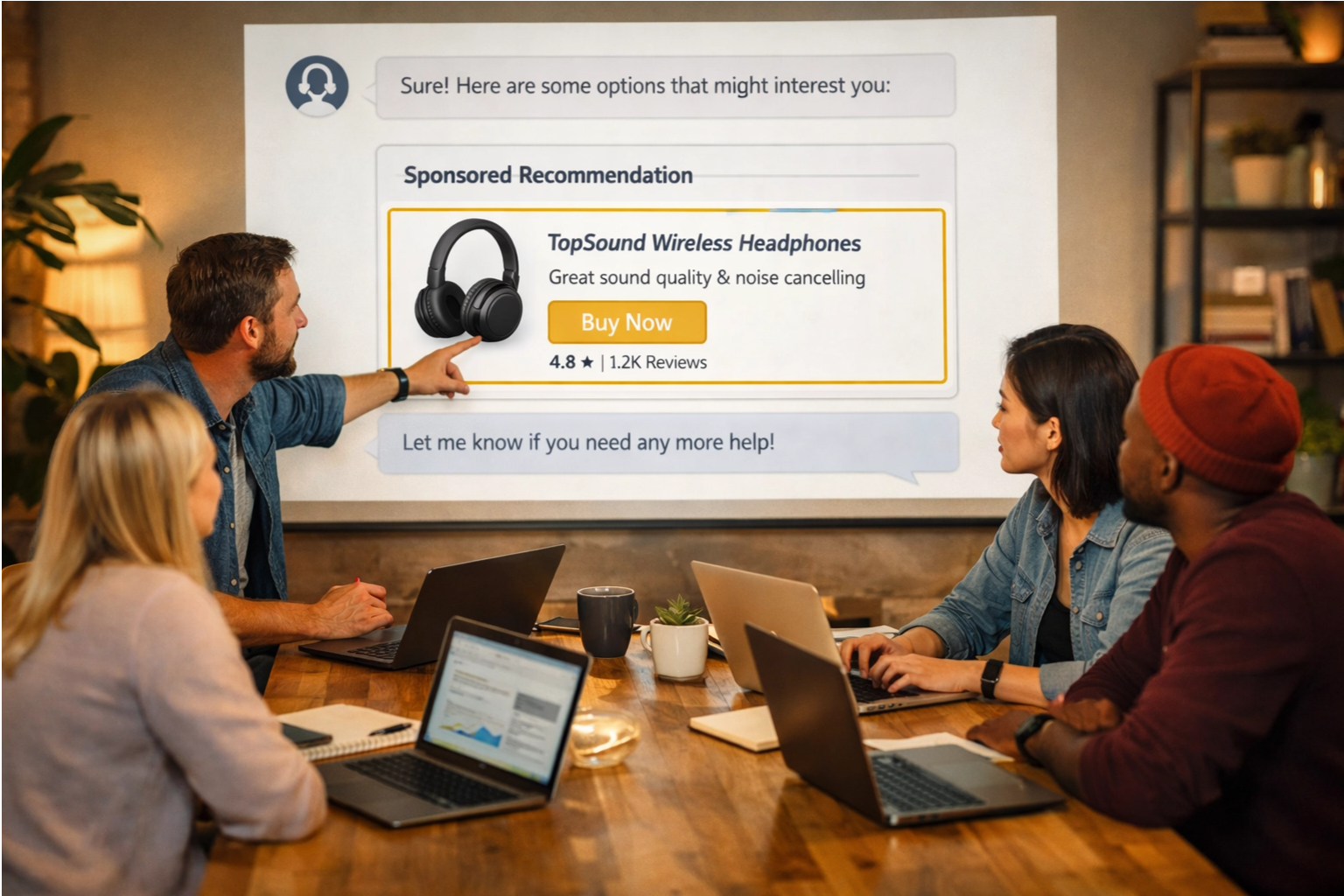
Before you lock specific numbers into a spreadsheet, it helps to ground ChatGPT ads in how they are bought and where they show up in the experience. Instead of appearing in a social feed or next to a traditional search results page, these units are injected into conversational answers, usually as clearly labeled “sponsored” suggestions below the main response.
That placement means you are not just paying for an impression; you are paying to be the recommendation inside a trusted assistant. As a result, media buyers should treat ChatGPT ad inventory more like premium search or high-impact sponsorships than like standard programmatic display.
How ChatGPT ads work and why the format commands a premium
According to the OpenAI article on its approach to advertising and expanding access, the current beta surfaces small, clearly labeled sponsored units beneath generated answers, with strict policies to preserve response integrity and brand safety. That means advertisers are effectively sponsoring recommendations inside highly contextual, intent-rich conversations.
This environment is closer to “embedded assistant search” than to traditional display, which is why early pricing is based on CPM deals rather than performance auctions. You are buying access to scarce, curated placements in front of users who are actively asking for help solving a problem, planning a purchase, or learning about a category.
What early ChatGPT ad tests reveal about pricing
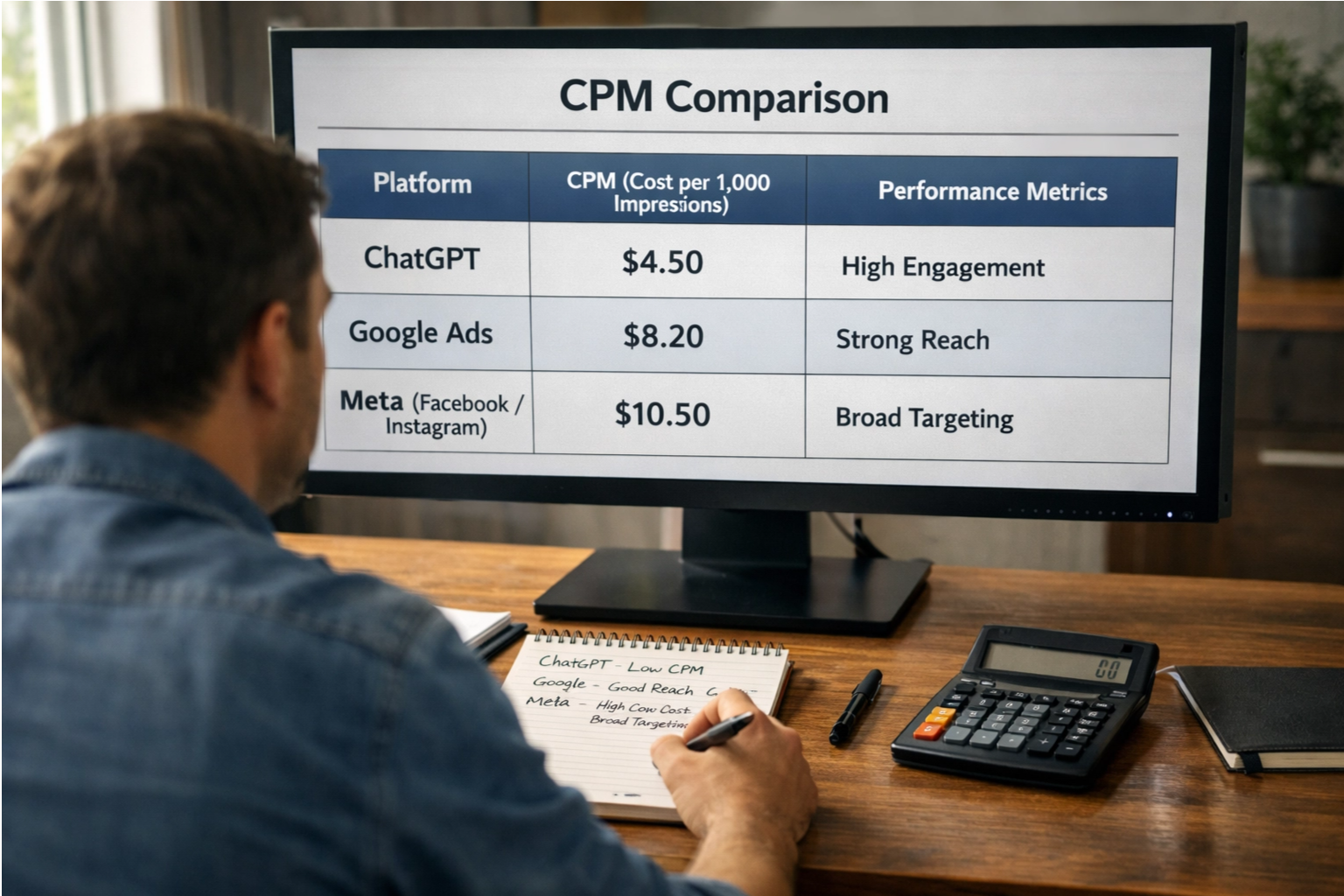
Early ChatGPT ads are being priced at roughly a $60 CPM, around three times Meta’s average rates, and with more limited data access. That single data point tells you two critical things: this channel is being positioned as premium, and volume will initially be constrained.
Digital ad spend will reach about $513 billion in 2025, a 10.7% year-over-year increase. That steady macro growth gives brands room to carve out experimental budgets for high-CPM AI inventory without gutting existing core channels.
Baseline ChatGPT ads pricing snapshot for 2026
Because OpenAI is still in closed or invite-only beta, there is no public rate card for 2026. However, most sophisticated media teams are building plans around a few working assumptions based on the early CPM signal and the premium, low-clutter environment.
Importantly, these are modeling assumptions, not guaranteed prices, but they give you a concrete way to translate ChatGPT ads pricing into impressions and budget tiers.
| Example 2026 scenario (awareness focus) | Working CPM assumption | Planned spend | Estimated impressions (spend ÷ CPM × 1,000) |
|---|---|---|---|
| Small pilot to learn | $60 CPM | $120,000 | ~2,000,000 impressions |
| Mid-sized brand test across 1–2 quarters | $60 CPM | $300,000 | ~5,000,000 impressions |
| Enterprise-scale awareness push | $60 CPM | $900,000 | ~15,000,000 impressions |
Again, these numbers are examples based on the early $60 CPM signal, but they illustrate how quickly spend climbs when CPMs are several multiples of paid social and open-web display. That is why the rest of your planning needs to be ruthless about objectives, audience fit, and measurement.
Planning Your 2026 Media Budget Around ChatGPT Advertising Costs
Given the premium nature of assistant inventory, you cannot just “add a little” ChatGPT spend on top of everything else. You need an explicit budgeting framework that starts with business outcomes, then works backward to determine whether the implied CPM, CPC, and CPA make sense.
This section walks through a simple modeling approach for chat-based inventory, how much of your overall budget to reserve, and the economics for B2B versus B2C brands under different deal sizes and margins.
How to model ChatGPT ads pricing in your 2026 budget
Start by treating ChatGPT ads as a top- or mid-funnel channel whose primary goal is to drive high-quality, engaged visits or leads, not last-click conversions. From there, you can back into implied CPC and CPA from a CPM assumption.
A simple working model looks like this, using hypothetical performance numbers purely for planning:
- Step 1: Choose a CPM assumption (for example, $60).
- Step 2: Estimate an engagement or click-through rate (for example, 1–2% of impressions engaging with your unit).
- Step 3: Estimate an on-site conversion rate (e.g., 5–10% of engaged visitors becoming leads or adding to cart).
- Step 4: Combine them to get implied CPC and CPA.
For instance, with a $60 CPM and a 1.5% click-through rate, your effective CPC would be about $4 (you pay $60 for 1,000 impressions, get 15 clicks, so $60 ÷ 15). If 8% of those visitors convert, your CPA would be $50. You can compare that to current blended CPAs in paid search, social, or programmatic to decide whether this experimental spend is defensible.
Budget allocation guidance using 2026 benchmarks
Next, you need to decide how big your experimental bucket should be and how much of it to allocate to ChatGPT ad tests. The eMarketer Worldwide Ad Spending Forecast 2026 frames this well: it encourages marketers to ring-fence roughly 15–20% of budgets for innovation channels while keeping experimental lines like API-driven assistants to under 2% of total digital spend.
Translating that into a simple rule of thumb, many brands are planning something like this for 2026:
- Total digital media budget: set as a percentage of revenue, based on your historical norms.
- Innovation bucket (15–20% of digital): reserved for emerging formats across AI search, CTV, and new social units.
- Chat-based assistants (up to ~2% of digital): where ChatGPT ads live, alongside any Gemini or Perplexity experiments.
If your total digital budget is $10 million, a 2% cap would give you up to $200,000 for ChatGPT ad experiments in 2026. You can then choose whether to run that as one concentrated pilot or spread it across several smaller tests throughout the year.
ROI framework for premium AI inventory
Because ChatGPT ads pricing sits at the high end of CPMs, you should not judge success on in-platform metrics alone. Instead, treat them as part of an AI-enabled customer acquisition strategy where media efficiency, operations, and revenue all shift together.
A 2025 Nextiva conversational AI study found that companies integrating conversational AI channels such as ChatGPT ads into their marketing mix reduced operational overhead by 10.8%, increased revenue by 41%, reallocated 8–10% of media spend into AI-powered placements, and saw blended customer acquisition costs fall 32% over six months. Those numbers highlight why it can be rational to pay premium CPMs if the channel also improves conversion rates, sales efficiency, or support costs.
To mirror that thinking in your own modeling, evaluate ChatGPT ad tests on blended CAC and LTV, not just last-click ROAS. If assistant-driven traffic converts at a higher rate, shortens sales cycles, or improves customer quality, you can justify higher front-end media costs while still hitting your payback windows.
B2B vs B2C economics of ChatGPT ads
For B2B brands, particularly SaaS and high-ticket services, the economics of premium CPMs are often easier to justify. If a single closed-won deal is worth tens of thousands of dollars in ARR, even a few incremental opportunities from assistant-driven education can cover a mid-six-figure test budget.
On the B2C side, the math hinges on lifetime value and category norms. Verticals like travel, financial services, education, and high-end retail can support higher CPAs than commoditized ecommerce with thin margins, which means they can absorb ChatGPT ad costs more comfortably as long as they treat the channel as an assistive, research-stage influence rather than a direct-response workhorse.
If you want a partner to help you integrate ChatGPT ads into a broader AI-era search strategy, a data-driven agency that combines SEVO (Search Everywhere Optimization), paid media, and CRO can design the modeling, experimentation plan, and reporting needed to keep these tests ROI-positive. Get a FREE consultation to evaluate where conversational ad inventory might fit in your 2026 growth roadmap.

Where High ChatGPT Ad Rates Make Sense: Verticals and Use Cases
Premium assistant inventory will not be right for every business. The brands most likely to win with current ChatGPT ads pricing are those with complex buying journeys, high consideration, or high lifetime value, where being the trusted recommendation inside a user’s research flow is disproportionately valuable.
Thinking in terms of verticals and use cases helps you decide whether this belongs in your near-term plan or should stay on the watchlist until pricing, tools, and self-serve options evolve.
E-commerce and retail use cases
For ecommerce, ChatGPT shines when shoppers are actively asking for advice: “What is a good starter home gym under $500?” or “How do I choose a carry-on suitcase that fits European airlines?” Assistant ads can surface your curated bundles, buying guides, or comparison pages right at that moment of consideration.
Given the high CPMs, this is not the place to promote low-margin, single-item offers. Instead, focus on higher-AOV product sets, category-entry SKUs that unlock strong LTV, or seasonal collections where one well-timed recommendation can drive a full cart, then optimize for metrics like assisted revenue and new-customer rate rather than last-click ROAS alone.
SaaS and B2B pipeline campaigns
B2B buyers increasingly use AI assistants to shortcut research, understand categories, and assemble shortlists. Queries like “best enterprise CRM for 1,000+ reps” or “alternatives to traditional SIEM for mid-market security teams” are ripe for sponsored suggestions that offer diagnostic tools, buyer’s guides, or ROI calculators.
Here, ChatGPT ad campaigns should be mapped to pipeline stages: education (guides and frameworks), problem diagnosis (assessments and benchmarks), and solution evaluation (case studies and demos). With deal values in the tens or hundreds of thousands, even a small number of incremental high-intent opportunities can justify the effective CPAs that fall out of premium CPMs.
Travel and hospitality planning moments
Travel planners are natural heavy users of conversational assistants for itinerary building, destination discovery, and logistics questions. Someone asking “what is a good 7-day itinerary for Italy in May?” or “best family-friendly resorts in Mexico with childcare” is deep in the research phase and open to suggestions.
Travel brands can use ChatGPT ads to insert curated itineraries, package deals, or planning tools into these flows. Because trip values are high and purchase decisions often involve many touchpoints, treating assistant impressions as part of upper- and mid-funnel influence, measured via view-through, assisted bookings, and brand search lift, makes the pricing more palatable.
Financial services and healthcare considerations
Highly regulated categories like banking, investing, insurance, and healthcare need to balance opportunity with compliance and brand safety. Conversational assistants are already fielding questions about retirement planning, loan options, insurance coverage, or treatments, which creates powerful, trust-sensitive contexts.
For these verticals, ChatGPT ad strategies should prioritize educational content, transparent disclosures, and conservative targeting parameters where available. Close collaboration between legal, compliance, and marketing will be essential to approve messaging, monitor outputs, and ensure that assistant experiences remain accurate and aligned with regulatory expectations.
Options for smaller and mid-market advertisers
Not every brand will be able to meet the initial spend thresholds or access requirements for direct ChatGPT ad buys in 2026. That does not mean smaller advertisers should ignore AI assistants altogether; it just changes how they participate.
Practical paths include partnering with agencies that aggregate demand, experimenting with AI-powered search and social formats that are already self-serve, and investing in content and technical optimization that make your site more likely to be cited or summarized in assistant answers. This kind of “answer engine optimization” work readies your brand for the moment when self-serve ChatGPT ad tools open up to a wider market.
A strategic growth agency that already manages spend across search, social, programmatic, and AI surfaces can help smaller and mid-market brands find realistic entry points into assistant environments while staying within budget. That might involve consortium buys, alternative AI ad formats, or answer-engine optimization work that compounds over time.
Making ChatGPT’s 2026 Ad Pricing Work for You
ChatGPT ads pricing will likely remain at the premium end of digital media in 2026, which means success depends less on hunting for “cheap” inventory and more on being disciplined about fit, modeling, and execution. With the right framework, you can treat conversational assistants as a high-impact layer on top of an already efficient media mix rather than a risky bet.
This final section pulls the pieces together into a phased rollout plan, a basic risk and measurement checklist, and a decision framework to help you decide whether to allocate budget now or keep ChatGPT ads on your strategic horizon.
Phased rollout plan for ChatGPT ads
To control risk while you learn how assistant inventory behaves for your brand, structure your approach into clear phases with decision gates, each tied to specific budget caps and hypotheses.
A simple three-phase model could look like this:
- Phase 1 – Exploration: Run a tightly scoped pilot with a clear objective (for example, incremental high-intent traffic or qualified leads) and a limited budget carved from your innovation bucket. Focus on 2–3 well-defined use cases and 1–2 hero offers.
- Phase 2 – Optimization: If Phase 1 meets minimum performance thresholds, expand creative and audience coverage while refining landing pages, offers, and follow-up sequences. Layer in incrementality tests where possible.
- Phase 3 – Scale: Only once you have stable CPAs and clear evidence of incremental impact do you expand investment within your pre-defined 2% of digital cap, continuing to compare blended CAC and LTV against your other channels.
Throughout all three phases, keep a running log of learnings about prompts, answer contexts, and creative angles that drive the most engagement. Those insights will be invaluable as new assistant surfaces and formats emerge.
Risk, contracts, and measurement in a limited-data world
Assistant environments come with unique risks and constraints: stricter content policies, evolving disclosure standards, and narrower reporting than mature ad platforms. Before committing significant 2026 spend, your legal, privacy, and analytics teams should align on a few essentials.
On the risk side, review contract terms for content ownership, data use, change management clauses, and any guarantees regarding placement quality or volume. Clarify your rights around creative approvals and pause controls if assistant outputs drift from what your brand considers acceptable.
On the measurement side, assume you will have less granular user-level data than in conventional performance channels. Plan to rely more heavily on:
- Clean UTM and tracking architecture tied to specific assistant campaigns and offers
- First-party analytics on engagement, conversion, and downstream value from assistant-driven sessions
- Incrementality tests or holdouts where feasible to isolate lift
- Higher-level modeling, such as MMM, that can incorporate ChatGPT ad spending as a distinct variable
Treating measurement design as part of the buy will give you a realistic chance to judge whether high CPMs are justified in your specific context.
Deciding if ChatGPT ads fit your 2026 strategy
Ultimately, the question is not “Are ChatGPT ads expensive?” but “Given projected performance, does ChatGPT ads pricing make sense for our margins, sales cycle, and growth goals in 2026?” For high-LTV, high-consideration categories with strong operational maturity, the answer may well be yes, especially if assistant-driven touchpoints improve conversion rates across the funnel.
For leaner, low-margin businesses, the smarter move might be to invest this year in the foundations: creative that answers real questions, sites that convert AI-era traffic efficiently, and analytics that can absorb new assistant-driven signals. Then, when pricing, tools, and access evolve, you will be ready to move quickly.
If you want an experienced team to help you pressure-test the economics, design a smart pilot, and connect ChatGPT ads to the rest of your AI-era growth stack, Single Grain blends SEVO, paid media, and CRO into integrated programs centered on measurable revenue impact. Get a FREE consultation to explore whether premium assistant inventory belongs in your 2026 plan and how to structure your first investment for learning and ROI.
Frequently Asked Questions
-
What kind of creative works best in a conversational assistant ad environment like ChatGPT?
Focus on ad units that mirror how people naturally ask questions: concise, solution-oriented copy that clearly answers a specific problem and offers a next step. Use simple value props, strong alignment with likely queries, and landing pages that maintain the same conversational tone rather than generic homepage dumps.
-
How should I structure my internal team to manage ChatGPT ad campaigns effectively?
Treat ChatGPT ads as a cross-functional effort that involves paid media, content, analytics, and product or sales stakeholders. Create a small ‘assistant task force’ responsible for query research, creative testing, and feeding insights back into broader search, SEO, and CRO programs.
-
How do ChatGPT ads fit into an overall attribution and measurement strategy?
Position assistant inventory as an upper- and mid-funnel influencer and connect it to multi-touch or data-driven attribution models instead of judging it by last-click alone. Align your analytics to track view-through impact, branded search lift, and pipeline quality from users first touched in assistant environments.
-
What are common mistakes brands make when first testing ChatGPT ads?
Many advertisers push broad, generic offers rather than tightly aligning their ads with specific questions or intents. Others fail to adapt their landing experiences and nurture flows to the consultative, research-heavy mindset of assistant users, which depresses downstream performance even when engagement is strong.
-
How can smaller brands prepare for ChatGPT ads if they don’t have the budget to buy inventory yet?
Use this period to study what your audience is asking, then build content, tools, and landing pages that directly answer those questions in plain language. Strengthen your technical SEO, schema, and on-site UX so that when assistants surface organic references or when self-serve ad tools open up, your brand is structurally ready to benefit.
-
What should I consider from a privacy and compliance perspective before advertising in ChatGPT?
Map out what user data you actually need from assistant-driven sessions and ensure your consent, retention, and processing practices align with relevant regulations in all operating regions. Work with legal and privacy teams to pre-approve data flows, tracking methods, and any custom audiences or integrations you plan to use.
-
How do ChatGPT ads differ strategically from running campaigns on other AI assistants or search partners?
Each assistant has distinct user behaviors, query styles, and integration surfaces, so you should localize creative, offers, and measurement plans to how people actually use that environment. Rather than cloning campaigns across platforms, develop a core messaging spine and then tailor prompts, hooks, and CTAs to each assistant’s strengths.



