

ChatGPT Ads Best Practices for 2026


ChatGPT ads best practices are evolving quickly as conversational AI shifts from side experiment to primary discovery channel in 2026. Performance teams that still treat ChatGPT like a traditional search engine are finding that old keyword-focused playbooks fail to capture how people actually ask questions, compare options, and make decisions inside an AI assistant.
This guide walks through how to approach ChatGPT advertising as conversation-first performance marketing, not just another PPC placement. You will learn how the emerging ad formats work, which strategic foundations matter most, how to design high-converting dialog flows, how to set up and launch campaigns step by step, and how to measure impact across your entire funnel while staying compliant and protecting brand trust.
TABLE OF CONTENTS:
- The 2026 ChatGPT Advertising Landscape
- ChatGPT Ads Best Practices for 2026: Strategic Foundations
- Designing High-Converting ChatGPT Ad Conversations
- How to Run ChatGPT Ads Step-by-Step
- Optimization and Measurement Framework for ChatGPT ads
- Vertical ChatGPT Ad Playbooks
- Compliance, Brand Safety, and Governance for ChatGPT Ads
- Budgets, Bidding, and Multi-Channel Integration for ChatGPT Ads
- Putting ChatGPT Ads Best Practices to Work in the Next 90 Days
The 2026 ChatGPT Advertising Landscape
Before you can apply any advanced tactics, you need a clear mental model of where and how ads can appear inside ChatGPT. Unlike search engines that show a page of blue links and display units, conversational assistants weave sponsored content into a flowing dialog that users experience as a single, continuous answer stream.
That means the value exchange must feel aligned with user intent from the first token. If an ad interrupts a helpful answer or steers the conversation in an obviously self-serving direction, users will either ignore it or lose trust in the assistant altogether.
Core surfaces for ChatGPT advertising
While specific implementations will continue to evolve, most ChatGPT ad inventory in 2026 can be grouped into a few logical surfaces. Understanding these helps you align objectives, creative, and measurement with what each surface is good at.
Common surfaces include sponsored answers that appear alongside or clearly labeled within an organic response, contextual cards that show an offer or product summary when a query matches commercial intent, and deeper conversational flows where a branded experience takes over a branch of the dialog for tasks like configuration, qualification, or checkout.
Each surface fits a different job. Lightweight sponsored answers are best for discovery and consideration, cards can showcase concrete offers or SKUs, and full conversational flows excel at guided selling, complex B2B qualification, or high-ticket consultative journeys.
How ChatGPT ads differ from search and social ads
Traditional search and social ads optimize for attention and clicks; ChatGPT ads optimize for relevance and dialog quality within a session. You are not just bidding on a keyword or audience, but on the right to participate in an in-progress conversation that already has context, goals, and prior turns.
As a result, your success depends less on catchy headlines and more on whether your sponsored contribution genuinely improves the answer. Technical marketers are already operationalizing AI across their programs; 85% of tech marketers are beyond the exploratory stage of AI, which signals strong organizational readiness to test sophisticated ChatGPT ad experiences.

ChatGPT Ads Best Practices for 2026: Strategic Foundations
The most important ChatGPT ads best practices in 2026 are about strategy, not settings. Your creative, bidding, and measurement frameworks will only perform if they are built on a clear view of user intent, assistant behavior, and trust dynamics inside the chat interface.
Think of this as laying the foundation for every future campaign. Once you define how your brand should appear in an AI assistant, individual sponsored answers and flows become easier to design, safer to approve, and easier to optimize.
Build an intent-first foundation for ChatGPT ads
The single highest-leverage move is to replace keyword lists with an intent taxonomy that reflects how people actually talk to ChatGPT about your category. Instead of “CRM software” as a keyword, map the full spectrum from “what is a CRM” to “best CRM for B2B SaaS” to “migrate from spreadsheet to CRM this week.”
Group these prompts into clear funnel-aligned clusters: education, solution exploration, comparison, implementation, and renewal or expansion. For each cluster, define the user’s likely goal, the minimum helpful answer the assistant should provide, and the incremental value your sponsored contribution can add without hijacking the conversation.
That taxonomy then drives how you structure campaigns, which surfaces you target, and what offers or CTAs you use at each stage. It also becomes the shared reference for product marketing, legal, and sales, so everyone judges ad concepts against the same underlying intents.
ChatGPT ads best practices checklist for your team
Once your intent map is in place, align stakeholders around a small set of non-negotiable principles for any ChatGPT ad you run. These guidelines should apply regardless of format, budget, or campaign owner.
- Require every sponsored contribution to clearly add missing context, clarity, or confidence beyond what the organic answer already provides.
- Standardize tone-of-voice rules so your ads sound like a natural extension of your owned content, not like generic PPC copy pasted into a dialog.
- Define explicit guardrails for sensitive topics, competitive claims, and regulated language so the assistant has clear boundaries for what your brand can and cannot say.
- Decide in advance when an ad should gracefully hand the user back to the neutral assistant versus pushing for a click, lead, or sale.
- Document data collection, retention, and consent practices specific to conversational ads to ensure your privacy posture aligns with evolving regulations and user expectations.
- Set minimum quality thresholds (for example, response relevance scores or user satisfaction metrics) below which a ChatGPT ad must be paused, regardless of short-term ROAS.
When these principles are captured in a playbook, your team can move fast without sacrificing consistency or safety, even as formats and policies change.
After you establish this strategic backbone, it becomes easier to choose a partner that can extend it across channels. A full-funnel, AI-driven agency such as Single Grain treats ChatGPT advertising as part of a broader SEVO (Search Everywhere Optimization) and paid media system rather than a one-off experiment. You can request a FREE consultation when you are ready to benchmark ChatGPT opportunities against your existing acquisition mix.
Designing High-Converting ChatGPT Ad Conversations
Once your foundations are clear, the next layer of ChatGPT ad effectiveness comes from conversation design. You are not just writing lines of ad copy; you are orchestrating a structured but flexible exchange that respects how people think through problems and decisions in real time.
Conversation design for ads must balance three goals at once: help the user accomplish their task faster, surface your differentiated value credibly, and create a natural path into your owned properties or sales process when appropriate.
Conversation frameworks that convert
A practical way to structure sponsored flows is to use a simple, repeatable framework. One example is “Problem → Probe → Guide → Decide.” First, confirm the user’s problem in their own words to signal understanding. Next, ask one or two targeted questions to fill gaps that matter for your solution, such as budget range or team size.
Then, guide them through a concise recommendation that ties your offer to those answers without overwhelming them with options. Finally, present a decision moment with two or three paths: continue learning inside the chat, click through to a tailored landing page, or schedule a follow-up if the purchase requires human support.
This structure keeps sponsored interactions focused and finite, which is crucial for avoiding “infinite sales pitch” fatigue while still giving motivated users a clear next step.
Writing ChatGPT ad prompts and scripts
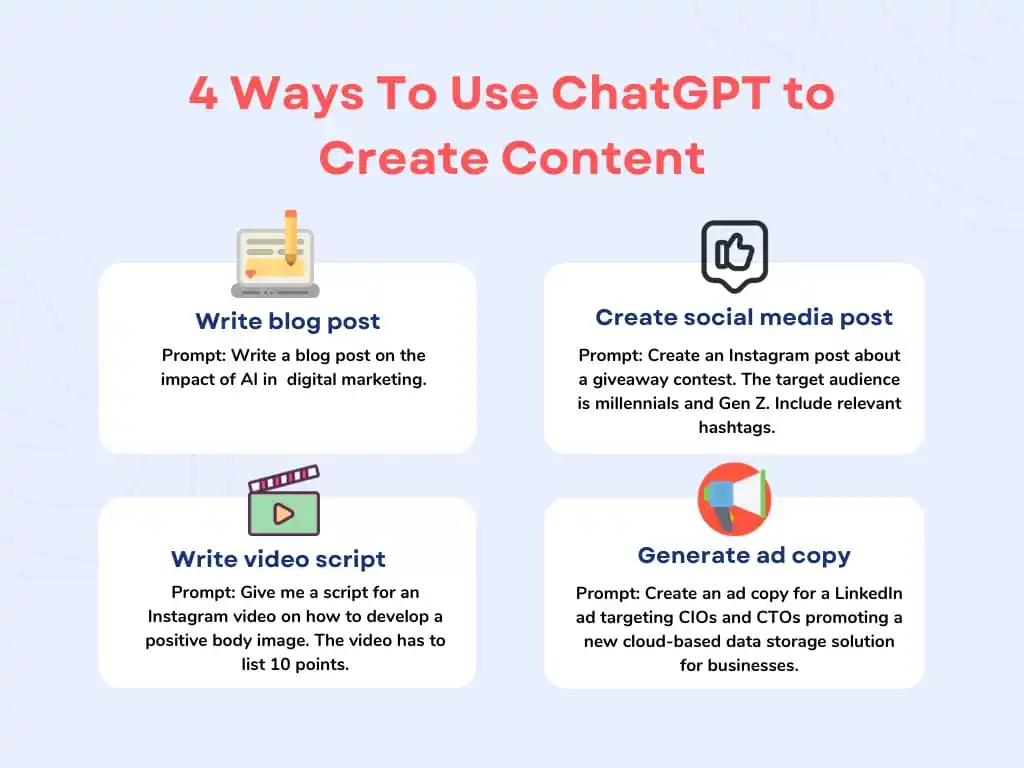
Because the assistant generates language dynamically, your job is to design robust prompts and guardrails rather than hard-coded scripts. Start each sponsored flow with a system-level instruction that defines your brand role, the user types you can help, and any must-include or must-avoid content rules.
Then, provide example turns that illustrate best-in-class responses for your highest-value intents. Include samples that show how to gracefully decline irrelevant queries, how to acknowledge limitations, and how to transition to a human channel when the assistant is not the right tool to complete a task.
Finally, decide which elements should be dynamically populated, such as product names, pricing tiers, or regional availability, so your engineering or marketing-ops team can connect the flow to accurate, up-to-date data rather than hard-coded text that quickly becomes stale.
How to Run ChatGPT Ads Step-by-Step
With strategy and creative patterns in place, you can move into execution. While specific interfaces will vary, most ChatGPT ad platforms will require a similar set of steps to go from idea to live campaign.
Phase 1: Pre-launch research and access
First, confirm access and eligibility for whatever ChatGPT ad beta or program you plan to use. That typically includes verifying your business, agreeing to advertising and data policies, and configuring billing with clear cost controls.
In parallel, finalize your intent taxonomy and choose a narrow set of high-impact intents for your initial tests. Focus on queries with clear commercial or high-value informational intent where your brand can demonstrably improve the answer, such as complex product comparisons or implementation “how-to” questions.
Phase 2: Campaign creation and launch checklist
Once your scope is tight, move into build-out. Treat this like a formal launch process, not an ad hoc experiment, so you do not miss learning opportunities or create governance risk.
- Define objectives and success metrics. Choose one primary goal per campaign, such as qualified leads, self-serve trials, or assisted revenue, and define what counts as success for ChatGPT-originated sessions.
- Select surfaces and placements. Decide whether to start with sponsored answers, deeper conversational flows, or a mix, based on your chosen intents and funnel stages.
- Configure targeting and exclusions. Use available controls for geography, language, category, and negative intents to avoid showing up in irrelevant or risky conversations.
- Upload creative and conversation definitions. Provide your system prompts, example dialogs, brand voice rules, and any assets (logos, product images, or structured data feeds) that the assistant can reference.
- Wire up tracking and analytics. Tag downstream pages, forms, and events so you can trace ChatGPT-assisted sessions through to pipeline, revenue, or retention, not just clicks or leads.
- Run qualitative and quantitative QA. Test sponsored experiences across a representative set of prompts, user profiles, and devices, logging any hallucinations, policy violations, or confusing flows for revision.
- Set conservative bids and caps for launch. Start with modest budgets and throttled pacing so you can watch behavior and adjust quickly without taking on outsized risk.
Document each of these steps in an internal runbook so future ChatGPT campaigns can reuse the same structure and avoid repeating early mistakes.
Optimization and Measurement Framework for ChatGPT ads
Early pilots should focus less on squeezing out maximum short-term ROAS and more on understanding how ChatGPT ads influence your funnel. That requires a disciplined experimentation plan and a measurement model that treats the assistant as both an acquisition channel and an assistive touchpoint. Because large language models already handle complex pattern recognition, you also want to lean into automation where it improves performance and frees your team to focus on your strategy.
Experimentation roadmap for the first 90 days
Design your first three months as a series of structured tests rather than a single “set-and-forget” campaign. In the first 30 days, explore message and offer variations tied to the same core intents to identify which value propositions resonate in conversational form.
In days 30 to 60, shift toward experimenting with different conversation depths, such as one-turn sponsored answers versus three-turn guided flows, and track how each pattern influences downstream behavior. In the final 30 days, test automation features, like dynamic response optimization or smart bidding, against your best-performing manual setups to assess incremental gains.
KPIs and attribution for ChatGPT ads
Traditional metrics like CPC and CPM are still useful, but they are not enough for conversational ads. You also need to track engagement quality signals, such as the completion rate for sponsored flows, the number of helpful turns before a user exits, and the ratio of branded to neutral answers within a session.
For revenue impact, build multi-touch attribution that can treat ChatGPT as an assist channel when it influences discovery or education but is not the last click. Where possible, run controlled experiments, such as geo-based or user-level holdouts, to estimate incremental conversions and LTV driven by sessions that include your ChatGPT ads versus those that do not.
Vertical ChatGPT Ad Playbooks
ChatGPT’s conversational nature makes it especially powerful in categories where buyers have complex questions or need help comparing nuanced options. While every business will need custom flows, you can accelerate progress by starting from vertical-specific patterns.
The following mini playbooks outline where ChatGPT ads can add the most value in B2B SaaS, e-commerce, and local or service-driven businesses.
ChatGPT ads for B2B SaaS
B2B SaaS buyers often use ChatGPT to untangle acronyms, shortlist tools, or understand implementation trade-offs. High-value intents include prompts like “CRM for a 20-person B2B sales team,” “alternatives to [competitor],” or “how to migrate from spreadsheets to a marketing automation platform.”
For these, a sponsored answer might validate key evaluation criteria, then offer a concise comparison that highlights where your product is the best fit. A deeper conversational flow can be qualified by company size, tech stack, and use case, then route users to a tailored demo, sandbox, or playbook that matches their stage.
ChatGPT ads for e-commerce brands
In e-commerce, people lean on ChatGPT for discovery, fit guidance, and reassurance about quality or logistics. Useful intents include “best running shoes for flat feet,” “eco-friendly gifts under $100,” or “furniture that fits a 300-square-foot studio apartment.”
Sponsored content can offer curated product bundles with clear reasons why each choice aligns with the user’s constraints, along with transparent information on shipping, returns, and sustainability. Conversational flows can ask one or two clarifying questions about preferences and constraints, then surface a small, confidence-inspiring shortlist rather than overwhelming catalogs.
ChatGPT ads for local and service businesses
Local and professional services benefit from ChatGPT’s ability to translate complex options into plain language. Intents might include “tax advisor for freelancers in Austin,” “emergency plumber near me tonight,” or “physical therapist for post-surgery rehab.”
Effective ads here focus on immediate clarity and trust: clear service descriptions, transparent availability windows, and easy ways to reach a human via call, chat, or booking. Where regulations allow, conversational flows can pre-qualify by urgency, location, and issue type, then either confirm that your practice is a fit or proactively recommend neutral next steps when it is not.
Compliance, Brand Safety, and Governance for ChatGPT Ads
Because ChatGPT answers feel authoritative to many users, the bar for accuracy and transparency in sponsored content is high. Mistakes here risk not only regulatory trouble but also erosion of trust in both your brand and the assistant itself.
To manage that risk, blend platform-level safeguards with internal governance that defines how your brand will use conversational ads responsibly.
Policy guardrails for AI-powered ads
OpenAI’s own guidelines for sponsored answers prioritize user trust and clarity. The OpenAI Policy & Safety Blog describes a framework built on clear ad labels, separation between sponsored content and organic answers, and strict data-privacy safeguards so brands can be machine-readable without compromising user protections.
You should mirror those pillars in your own policies. Require unambiguous indicators that a response is sponsored, instruct the assistant to keep core informational answers independent from commercial messaging, and ensure any captured data is handled under the same standards you apply to your other first-party channels.
Operational governance and review workflows
Operationally, create a cross-functional review process for any new ChatGPT ad experience. Involve legal or compliance for regulated claims, product for accuracy on features and limitations, and customer success or sales for alignment with real-world objections and use cases.
Establish escalation paths for when the assistant is unsure, including when to defer to neutral information, when to offer to connect to a human, and when to exit the sponsored experience entirely. Log and periodically audit conversation transcripts (with appropriate anonymization) to catch hallucinations or drift before they scale.
Budgets, Bidding, and Multi-Channel Integration for ChatGPT Ads
Because ChatGPT is still a relatively new ad surface, budgets in 2026 should be deliberate and hypothesis-driven. At the same time, discovery behavior is clearly shifting toward AI-enhanced search and assistants, which justifies meaningful tests rather than token experiments.
Budgeting and bidding decisions also work best when you see ChatGPT ads as part of your broader SEVO and paid media mix, rather than as an isolated channel competing for scraps.
Budget and bid strategy for 2026 ChatGPT ad pilots
Use proportional test budgets tied to the strategic importance of your target intents. For many growth-stage brands, dedicating a small but focused share of overall performance spend to ChatGPT pilots, enough to reach statistically useful volume over a quarter, is more informative than spreading tiny amounts across many uncoordinated experiments.
Brands that have already reallocated meaningful spend toward AI search and conversational interfaces are seeing the upside; early adopters shifting at least 15% of their budget into AI search surfaces reported up to 1.4x higher assisted-conversion rates than traditional PPC baselines.
On bidding, start with conservative targets based on blended CAC or CPA benchmarks from adjacent channels, then adjust as you observe real-world conversion and assisted-impact data from ChatGPT-driven sessions.
Integrating ChatGPT ads into your funnel
From a funnel perspective, design ChatGPT ads to play specific roles rather than trying to do everything at once. Discovery-oriented sponsored answers can drive awareness and shortlist inclusion, while deeper flows focus on qualification, solution design, or onboarding.
Connect these roles to downstream channels: retarget visitors who arrive via ChatGPT with tailored search and social campaigns, drop qualified leads into nurture sequences that reference the questions they asked the assistant, and give sales teams context on which conversational paths a prospect followed before booking time.
A revenue-obsessed partner such as Single Grain can help orchestrate this full-funnel view by connecting ChatGPT touchpoints to your analytics, CRM, and SEVO strategy so you see exactly how conversational ads contribute to pipeline and LTV rather than just top-of-funnel engagement.
As your program matures, fold ChatGPT metrics into your broader Growth Stacking and experimentation roadmap so each new test builds on the last across channels instead of competing for attention in a silo.

Putting ChatGPT Ads Best Practices to Work in the Next 90 Days
ChatGPT ads best practices in 2026 come down to one idea: respect the conversation. When you ground campaigns in a clear intent taxonomy, design flows that genuinely help users, and measure performance across the full funnel, ChatGPT becomes a high-leverage surface for discovery, education, and conversion.
Over the next 90 days, you can move from theory to execution by codifying your strategic principles, launching a tightly scoped pilot around a few high-value intents, and running a disciplined series of experiments that test messaging, flow depth, and automation. Along the way, bake in compliance and governance so your program scales safely rather than requiring painful rework later.
If you want a partner that already blends AI innovation, SEVO, paid media, CRO, and analytics into revenue-focused programs, the team at Single Grain can help you stand up and scale ChatGPT advertising as part of a bigger growth system. Get a FREE consultation to map your first 90-day ChatGPT ad sprint, define the metrics that matter, and build conversational experiences that compound into long-term competitive advantage.
Frequently Asked Questions
-
How much budget should I allocate to ChatGPT ads compared to my existing paid channels?
Treat ChatGPT ads as a focused test line item rather than a tiny experiment or a full replacement for existing channels. A practical starting point is to carve out a small single-digit percentage of your overall performance budget for at least one full quarter, then scale up only after you see a reliable impact on qualified pipeline and revenue.
-
What kind of team and skills do I need to run ChatGPT ad programs effectively?
You’ll get the best results by pairing a performance marketer with someone who understands conversation design or UX writing, plus light support from analytics and legal or compliance. Many teams start by upskilling existing PPC strategists and copywriters on conversational frameworks rather than hiring a dedicated AI specialist on day one.
-
What kind of team and skills do I need to run ChatGPT ad programs effectively?
You’ll get the best results by pairing a performance marketer with someone who understands conversation design or UX writing, plus light support from analytics and legal or compliance. Many teams start by upskilling existing PPC strategists and copywriters on conversational frameworks rather than hiring a dedicated AI specialist on day one.
-
How can smaller brands or startups compete with larger advertisers on ChatGPT?
Smaller brands can win by being more specific and helpful for narrow, high-intent use cases instead of trying to cover every possible query. Focus on a few tightly defined problems where your offer is clearly the best fit, and design sponsored answers that feel like expert, niche guidance rather than broad, generic recommendations.
-
How should I handle first-party data and CRM integration with ChatGPT ads?
Use ChatGPT as a front door that enriches leads with context, like needs, timelines, or objections, then pass that metadata into your CRM or CDP with explicit consent. Keep the integration lightweight at first (e.g., tagging leads by conversational path or topic), and only expand to deeper personalization once your privacy, security, and consent flows are fully documented and tested.
-
What are the early warning signs that my ChatGPT ads may be hurting brand trust?
Watch for user behaviors like abrupt exits after sponsored turns, complaints about pushiness or confusion, or support tickets referencing misleading assistant answers. If you see these patterns, pause affected flows, review transcripts, and tighten your rules around when to sell, when to educate, and when to hand control back to the neutral assistant.
-
How do I adapt ChatGPT ad experiences for different countries and languages?
Start by localizing not just the language but also examples, regulations, and offers to each market’s norms and buying process. Maintain a shared global intent structure while allowing regional teams to define local guardrails, value propositions, and escalation paths so the conversation feels native rather than translated.
-
What should I include in a brief if I’m hiring an agency to manage ChatGPT ads?
Your brief should spell out your ideal customers, priority intents or use cases, brand voice rules, compliance constraints, and success metrics beyond clicks, such as qualified meetings or self-serve activations. Ask the agency to propose specific conversational flows, testing plans, and reporting cadences so you can see exactly how they’ll connect ChatGPT activity to revenue outcomes.



