

AI-Powered PPC for Travel: Predicting Seasonality with LLM Models


Travel PPC AI is quickly becoming essential as traveler demand swings with seasonality, shifting booking windows, and unpredictable events across destinations. Traditional bid rules and spreadsheet forecasts struggle to keep up with these dynamics because they react to performance after the fact instead of anticipating demand before it arrives. That gap is especially costly in travel, where inventory is perishable, prices change rapidly, and peaks and troughs can make or break annual revenue.
LLM models and broader AI tools give travel marketers a way to forecast demand more intelligently, understand seasonality at a granular level, and translate those insights into smarter PPC decisions. In this guide, we will walk through how to build a travel demand forecasting pipeline, how to use LLMs to analyze seasonality and booking curves, and how to plug those predictions directly into your paid search and social campaigns.
TABLE OF CONTENTS:
How AI and LLMs Are Transforming Travel Search and PPC
Travelers no longer rely only on blue links and price comparison grids when planning a trip. They ask conversational questions in AI assistants, browse social video for inspiration, and use metasearch and OTAs to refine options before ever searching brand terms. This means intent signals are scattered across more surfaces, and the queries themselves are longer, more contextual, and more unpredictable.
From keyword lists to AI-assisted trip planning
A typical journey might start with an LLM-powered assistant suggesting destinations for “a warm beach trip in March from Chicago with two kids,” then move to metasearch to compare hotel options and finally to Google or Bing to search specific properties or neighborhoods. Many of these questions never appear as classic exact-match keywords, yet they still determine which destinations and brands make the traveler’s shortlist.
This shift pushes travel advertisers to think beyond rigid keyword lists and capture intent patterns at the theme and persona level. LLMs can help interpret natural-language queries, cluster them into meaningful groups (family beach getaways, business city stays, last-minute weekend breaks), and then map those clusters to PPC campaigns, audiences, and creative that feel relevant at every stage.

What this shift means for your PPC structure
As intent fragments across channels, your PPC account structure needs to connect search term data, audience segments, and creative themes more flexibly. Instead of over-fitting campaigns to a few high-volume keywords, you can let platforms’ automation handle bidding while AI tools analyze search query reports and feed seasonality-aware negatives, ad variants, and audiences back into the system.
Many revenue teams already use AI search forecasting for modern SEO and revenue teams to anticipate organic demand; the same predictive mindset should extend into PPC. When you pair that with predictive SEO with AI to anticipate trends, your paid and organic visibility can be orchestrated around the same demand curves instead of competing blindly for attention.
Building a Travel Demand Forecasting Engine for PPC
To move from reactive to forecast-driven advertising, you need a demand engine that understands how many people are likely to search, click, and book for each destination, route, or property at different times of year. For travel, this means going beyond generic media mix models and capturing the nuances of occupancy, fare classes, and booking windows.
The data foundation for AI-powered travel demand forecasting
Start by defining a unified schema for all the signals that influence your PPC decisions. Typical inputs include historical campaign data (impressions, clicks, cost, conversions, revenue), search metrics (impression share, query volume, device splits), website behavior (sessions, search filters used, abandonment points), and commercial outcomes like bookings, ADR, and occupancy or load factor. You should also incorporate first-party data from PMS or CRS systems, loyalty programs, and CRM so that forecasts align with actual inventory and revenue, not just last-click conversions.
External factors matter as well: school calendars, public holidays, major events, weather patterns, and macroeconomic indicators can all shift demand curves. Organize these inputs by destination, origin market, product type, and week (or day) so models can learn how specific segments behave over time rather than treating “travel” as a single undifferentiated category.
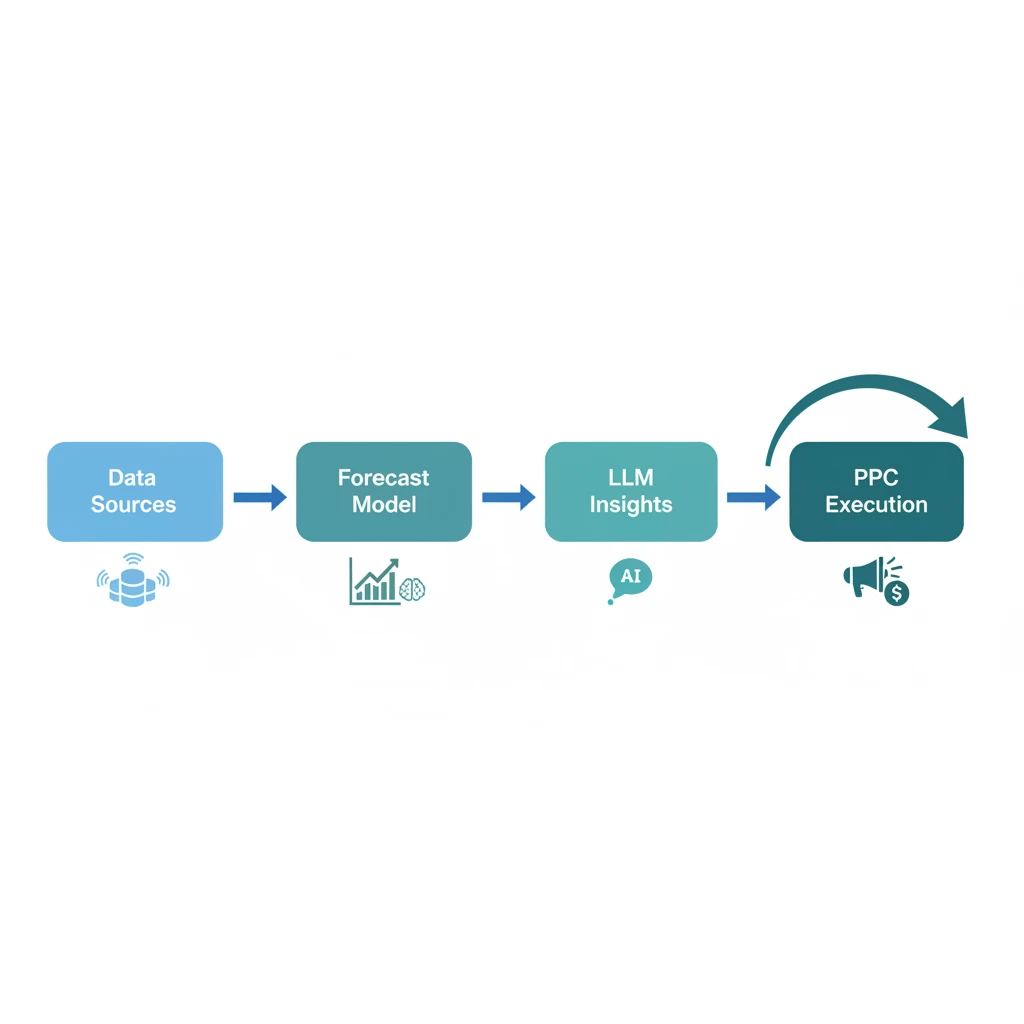
From data to forecasts: a practical workflow
Once your data is structured, you can layer in forecasting methods and then hand-select tasks to LLMs. A straightforward workflow keeps the statistical forecasting separate from the generative reasoning, so you can validate each step.
- Aggregate historical data by destination, origin market, product type, and time bucket (week or day) to create clean time series for each segment.
- Apply baseline forecasting models that capture trend and seasonality, such as simple moving averages or more advanced time-series approaches, to project demand for impressions, clicks, and bookings.
- Overlay business scenarios like price changes, new routes or properties, and expected events to create optimistic, base, and conservative scenarios.
- Export forecasts into a grid that links each segment and time bucket to recommended budgets, target CPC or CPA, and revenue expectations so media buyers can plan.
Teams looking to operationalize this approach quickly often adapt techniques from smarter PPC forecasting for seasonal demand, then extend them with travel-specific metrics like occupancy or seat load. From there, you can connect the engine to automation layers described in resources on using AI for paid ads to boost marketing ROI so that forecasts directly influence bids, budgets, and creative testing.
Seasonality Strategies With Travel PPC AI
Seasonality in travel is not just about “high” and “low” periods; it is about how demand ramps up, peaks, and tails off differently across markets, traveler types, and products. Travel PPC AI allows you to detect these patterns automatically and tune campaigns for both short booking windows and long lead times, instead of relying on generic monthly budget shifts.
Vertical-specific seasonality patterns to model
Different travel sectors behave very differently across the year, so your forecasting and bidding strategies must reflect those nuances. A city hotel near a convention center experiences spikes around conferences, while a beach resort depends heavily on school holidays and predictable weather. Airlines juggle demand by route and fare class, and tour operators may rely on a handful of long-haul seasons with very long booking windows.
| Travel vertical | Key peak periods | Shoulder and low seasons | Critical PPC-aligned KPIs |
|---|---|---|---|
| City business hotels | Weekdays during conferences and trade shows | Weekends and holiday weeks | Occupancy, ADR, same-week bookings |
| Resort and beach properties | School holidays and predictable warm-weather months | Spring and autumn shoulder periods | Length of stay, advance purchase, package uptake |
| Airlines and routes | Holidays, major events, seasonal migration periods | Off-peak travel windows and midweek flights | Load factor, cabin mix, route-level revenue |
| Tours and activities | Destination peak tourism seasons | Weekdays, off-peak weather months | Seats per departure, add-on sales, cancellation rate |
Once you have a matrix like this, you can align account structures and budget pacing to each vertical’s booking curve. For example, a ski resort might push prospecting on Meta and upper-funnel search months before peak snow, then shift to last-minute PPC for equipment rentals and shorter stays as weather and conditions become clearer.
LLM prompts for travel PPC AI seasonality analysis
LLMs are especially helpful at translating dense time-series exports into plain-language insights your team can act on. Rather than manually scanning pivot tables, you can upload a CSV file and ask the model to identify where seasonality is strengthening, weakening, or shifting by market, then validate its findings against your own expertise.
For a seasonality-focused export, you might include columns such as:
- Date (by week or day)
- Origin market and destination
- Product type (hotel, flight, package, tour)
- Channel (Google Search, Performance Max, Meta, OTA metasearch)
- Impressions, clicks, cost, conversions, and revenue
- ADR or average booking value
- Occupancy or load factor, where applicable
- Audience segment (family, business, luxury, last-minute, planner)
A prompt for this file could ask an LLM to “identify destinations where peak demand has shifted by more than a few weeks compared with prior years, describe booking-window changes by persona, and suggest bid and budget adjustments for the next quarter.” You can extend the same dataset to generate creative ideas and test plans, especially when combined with frameworks from AI creative scoring that predict campaign ROI before launch, so that seasonal messages are validated before you scale spend.
At this stage, if you want specialized support designing prompts, schemas, and validation checks for your forecasts, Single Grain’s team can step in to help architect the full travel PPC AI workflow from raw data through to campaign execution and reporting.
Execution, Measurement, and a Roadmap for Forecast-Driven Travel PPC AI
Forecasts and LLM analyses only create value if they reliably change how your campaigns run. The final piece is operational: connecting predictions to platform levers, deciding which tasks to automate, and defining how you will measure success and governance quality over time.
Key LLM workflows for day-to-day PPC execution
Once your demand and seasonality insights are in place, LLMs can make them usable for campaign managers who live within Google Ads, Meta Ads, and other platforms. Think of the model as a co-pilot that turns raw data into ready-to-implement assets and recommendations.
- Keyword expansion and clustering: Feed in historical search terms and destination details so the model suggests new, seasonally relevant queries and groups them into themes that align with your campaigns or asset groups.
- Negative keyword mining: Provide search query reports and ask the LLM to flag irrelevant or low-intent terms for exclusion, especially around ambiguous city names or generic “cheap travel” searches that never convert for your brand.
- Seasonal ad copy and assets: Use destination attributes, review snippets, and forecasted demand windows to generate responsive search ad variations and Meta primary text tailored to different languages, personas, and booking windows.
- Landing page messaging suggestions: Supply current page copy and booking data so the model can recommend headline and body test ideas that match seasonal intent (early-bird deals, last-minute flexibility, family-focused packages).
- Persona and audience mapping: Summarize behavioral differences between segments and let the LLM propose audience combinations or creative angles for families, business travelers, or luxury guests.
To scale this responsibly, many advertisers blend these workflows with the broader strategies used in AI-powered paid ads optimization, so that creative, bidding, and audience strategies draw from the same forecast and seasonality backbone.
Measurement, governance, and an AI maturity roadmap
Because AI systems can influence large budgets quickly, you need clarity on what “good” looks like and how responsibilities are shared between humans and machines. For travel PPC AI, useful metrics include forecast accuracy for demand and bookings, the share of spend managed by automated rules or agents, net profit per booking, and the pace at which your team can launch and learn from experiments.
A simple maturity roadmap can help you prioritize next steps:
- Phase 1 – Assisted insights and content: Analysts export PPC and booking data into LLMs for pattern detection and copy generation, but humans still make all bid and budget decisions manually.
- Phase 2 – Forecast-informed automation: Demand forecasts drive structured budget and bid adjustments via scripts or rules, while LLMs continuously propose new seasonal tests that performance marketers review and deploy.
- Phase 3 – RAG-powered AI agents: Retrieval-augmented generation connects live inventory, pricing, and external signals like events or disruptions to agents that suggest—or in tightly governed cases apply—changes to campaigns, with human approval workflows and robust logging.
Throughout each phase, data governance is critical. That includes minimizing personally identifiable information sent to external models, aligning regional consent flows with privacy regulations, and enforcing human review on all ad copy to avoid misleading claims or biased recommendations. Similar principles underpin AI product recommendation optimization for revenue, and they apply just as strongly when the “product” is a room night, seat, or tour departure.
As your program matures, you can expand your use of travel PPC AI to coordinate search, social, metasearch, and even email or app messaging around the same forecasted demand spikes and lulls. This creates a coherent, forecast-driven marketing system instead of a patchwork of disconnected, channel-specific tactics.
At Single Grain, we combine AI-powered forecasting, LLM-driven insights, and performance-focused PPC management to help brands turn travel seasonality from a risk into an advantage. Our team can work with your analysts and revenue managers to design the correct data schema, build demand forecasts, and deploy LLM workflows that generate high-quality keywords, creative, and landing page ideas tailored to each destination and season.
If you are ready to make travel PPC AI a core part of your growth strategy, rather than an experiment on the side, we can help you move quickly and safely. Visit Single Grain to get a FREE consultation and start building a forecast-driven advertising engine that keeps your bids, budgets, and messages aligned with real traveler demand.
Frequently Asked Questions
-
What internal skills and roles do we need before adopting AI-powered PPC for travel?
You’ll get the most value when performance marketers, revenue managers, and data analysts collaborate closely. Aim for at least one person who understands basic statistics and data pipelines, plus PPC specialists who can translate AI insights into concrete campaign changes and tests.
-
How can smaller travel brands with limited budgets practically start using travel PPC AI?
Begin by using built-in platform automation (Smart Bidding, Advantage+, etc.) and layer on lightweight LLM workflows for keyword ideas, ad copy variants, and simple seasonality reviews from exported reports. As you see ROI, invest gradually in more structured forecasting and data integration rather than trying to build a complex system from day one.
-
How do we choose the right tools and platforms to support AI-driven travel PPC?
Look for tools that can easily connect to your ad platforms, booking systems, and analytics stack, with clear APIs and export options. Prioritize platforms that support time-series forecasting, flexible reporting by segment, and safe integration with LLMs for analysis and content generation.
-
What data quality issues most often derail AI-based seasonality forecasting in travel?
Common pitfalls include inconsistent tracking across channels, missing attribution for cross-device or OTA-influenced bookings, and unclean historical data around promotions or outages. Before modeling, audit your data for gaps, annotate anomalies, and standardize naming conventions so the AI isn’t learning from noise.
-
How should direct travel brands use AI PPC when they also rely heavily on OTAs and metasearch?
Use AI forecasting to understand when direct bookings tend to be strongest and allocate more PPC budget to those periods and markets. During times when OTAs dominate, focus AI-optimized campaigns on higher-margin segments, loyalty acquisition, and brand differentiation rather than trying to outbid everyone on generic terms.
-
What privacy and compliance considerations should we keep in mind when using LLMs with PPC and booking data?
Avoid sending any personally identifiable information or raw customer records to external models; work with aggregated or anonymized datasets instead. Ensure your use of AI aligns with regional regulations (such as GDPR) and your own consent policies, and document how each vendor processes and retains data.
-
How can we tell whether AI-driven changes to our travel PPC are truly improving performance?
Set up controlled experiments in which AI-informed strategies are tested against your current approach, with clear success metrics such as incremental revenue, ROAS, or profit per booking. Review results over multiple seasonal cycles to confirm improvements hold up across different demand environments, not just short-term spikes.



