

7 ChatGPT Ad Copywriting Frameworks That Work


In the rapidly evolving landscape of digital marketing, crafting compelling ad copy is more crucial than ever. With the advent of advanced AI tools like ChatGPT, marketers now have powerful allies to streamline their creative processes and enhance the effectiveness of their campaigns. This article explores seven proven ChatGPT ad copywriting frameworks that can help you generate high-converting ad copy, save time, and elevate your marketing efforts.
TABLE OF CONTENTS:
- 1. AIDA (Attention, Interest, Desire, Action)
- 2. PAS (Problem, Agitate, Solution)
- 3. BAB (Before, After, Bridge)
- 4. FAB (Features, Advantages, Benefits)
- 5. The 4 Cs (Clear, Concise, Credible, Compelling)
- 6. The Star-Story-Solution Framework
- 7. The Problem-Promise-Proof-Push Framework
- Conclusion
- Frequently Asked Questions About 7 ChatGPT Ad Copywriting Frameworks That Work
- Ready to Transform Your Ad Copy?
1. AIDA (Attention, Interest, Desire, Action)
The AIDA framework is a classic in marketing and sales, guiding the customer through a psychological journey from initial awareness to conversion. When applied with ChatGPT, this framework becomes a potent tool for generating ad copy that resonates deeply with your target audience.
How it Works with ChatGPT:
- Attention: Prompt ChatGPT to create a captivating headline or opening statement that immediately grabs the reader’s attention. Focus on a pain point or a compelling benefit.
- Interest: Follow up with content that builds interest by highlighting unique features, benefits, or solutions your product offers. Use engaging language and storytelling elements.
- Desire: Generate copy that evokes desire by emphasizing the value proposition and how the product can improve the customer’s life. Use strong emotional appeals and vivid descriptions.
- Action: Conclude with a clear, concise call to action that tells the reader exactly what to do next, such as “Shop Now,” “Learn More,” or “Sign Up Today.”
Example Prompt: “Generate an ad copy for a new productivity app using the AIDA framework. The app helps users manage tasks and deadlines efficiently. Focus on busy professionals.”
2. PAS (Problem, Agitate, Solution)
The PAS framework is highly effective for problem-aware audiences. It identifies a problem, agitates the pain associated with it, and then presents your product or service as the ultimate solution. This framework is particularly powerful for driving urgency and demonstrating immediate value.
How it Works with ChatGPT:
- Problem: Ask ChatGPT to articulate a common problem your target audience faces. Make it relatable and specific.
- Agitate: Instruct ChatGPT to elaborate on the negative consequences of this problem, intensifying the reader’s pain points. Use evocative language to make the problem feel more urgent.
- Solution: Position your product or service as the definitive answer to the agitated problem. Highlight its key features and benefits that directly address the pain points.
Example Prompt: “Write an ad copy using the PAS framework for a cybersecurity software that protects small businesses from ransomware. The problem is data breaches and financial loss.”
3. BAB (Before, After, Bridge)
The BAB framework paints a vivid picture of the customer’s current undesirable situation (“Before”), contrasts it with an ideal future state (“After”) achieved with your product, and then provides the “Bridge” – your product or service – that connects the two. This framework is excellent for demonstrating transformation.
How it Works with ChatGPT:
- Before: Describe the current negative situation or challenge the customer is experiencing. ChatGPT can help you craft a realistic and empathetic portrayal.
- After: Generate a description of the positive outcome or desired state the customer will achieve after using your product. Focus on benefits and emotional satisfaction.
- Bridge: Explain how your product or service acts as the bridge, enabling the transition from the “Before” to the “After” state. Detail the mechanisms or features that make this transformation possible.
Example Prompt: “Create an ad copy using the BAB framework for an online fitness program. Before: feeling sluggish and out of shape. After: energetic and confident. Bridge: our personalized workout plans and nutrition guidance.”
4. FAB (Features, Advantages, Benefits)
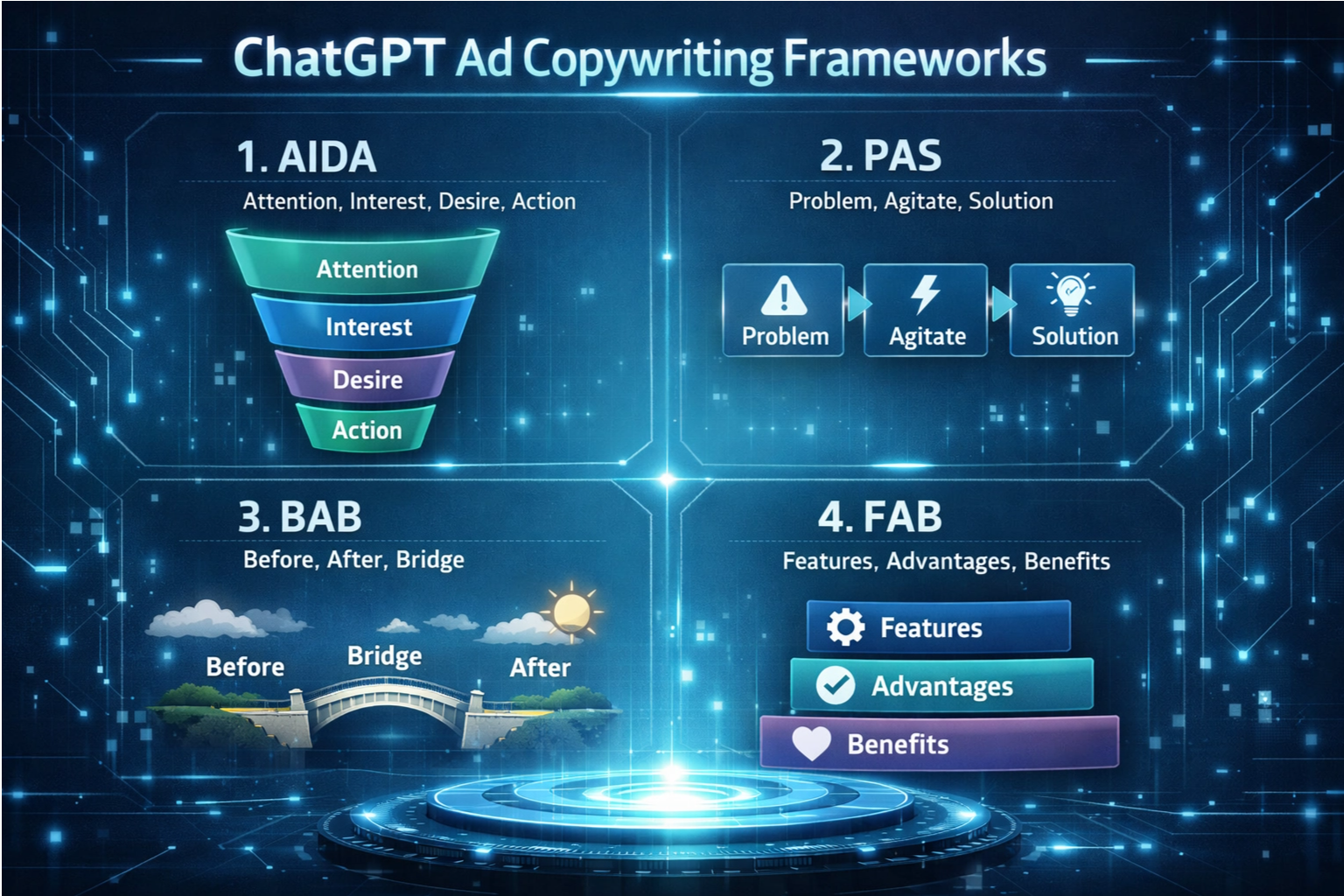
The FAB framework moves beyond simply listing product features to explaining what those features do (advantages) and, most importantly, how they benefit the customer. This approach helps customers understand the true value of your offering.
How it Works with ChatGPT:
- Features: List the key features of your product or service. ChatGPT can help you articulate these clearly.
- Advantages: For each feature, prompt ChatGPT to explain what it does or how it works. This clarifies the function of the feature.
- Benefits: Crucially, instruct ChatGPT to translate each advantage into a direct benefit for the customer. Focus on the positive impact on their life or business.
Example Prompt: “Develop an ad copy using the FAB framework for a new smartphone. Feature: long-lasting battery. Advantage: powers your device for over 24 hours. Benefit: stay connected all day without worrying about recharging.”
5. The 4 Cs (Clear, Concise, Credible, Compelling)
The 4 Cs framework is a guiding principle for effective communication, ensuring your ad copy is easy to understand, to the point, trustworthy, and persuasive. While not a step-by-step process like AIDA, it’s a lens through which to evaluate and refine your ChatGPT-generated copy.
How it Works with ChatGPT:
- Clear: Prompt ChatGPT to use simple, unambiguous language. Avoid jargon and complex sentence structures.
- Concise: Instruct ChatGPT to get straight to the point, eliminating unnecessary words or phrases. Every word should serve a purpose.
- Credible: Ask ChatGPT to include elements that build trust, such as statistics, testimonials, or guarantees. Ensure claims are verifiable.
- Compelling: Guide ChatGPT to use persuasive language, strong verbs, and emotional triggers to motivate action. Focus on the unique selling proposition.
Example Prompt: “Refine this ad copy for a financial advisory service using the 4 Cs framework. Ensure it is clear, concise, credible (mentioning certified advisors), and compelling (highlighting financial freedom).” [Internal Link: https://www.example.com/financial-freedom]
6. The Star-Story-Solution Framework
This framework leverages the power of storytelling to engage your audience emotionally. It introduces a “Star” (the customer or a relatable character), tells their “Story” (their journey with a problem), and then presents your “Solution” as the resolution to their struggles. This creates a powerful connection and makes your product memorable.
How it Works with ChatGPT:
- Star: Prompt ChatGPT to create a relatable persona or describe your ideal customer. This “star” should embody the pain points your product addresses.
- Story: Instruct ChatGPT to weave a narrative around the star’s struggle with a problem that your product solves. Focus on the emotional journey and challenges faced.
- Solution: Introduce your product or service as the hero of the story, providing the solution that transforms the star’s situation. Emphasize the positive outcome and benefits.
Example Prompt: “Generate an ad copy using the Star-Story-Solution framework for a meal delivery service. Star: a busy parent. Story: struggling to cook healthy meals. Solution: convenient, nutritious meal kits.”
7. The Problem-Promise-Proof-Push Framework
This framework is designed to build trust and overcome skepticism by not only identifying a problem and promising a solution but also providing concrete proof and a clear call to action. It’s particularly effective for products or services that require a higher level of trust.
How it Works with ChatGPT:
- Problem: Clearly define the problem your target audience faces. ChatGPT can help you articulate this with precision.
- Promise: Generate a compelling promise of how your product or service will solve this problem. Be specific about the desired outcome.
- Proof: Instruct ChatGPT to include evidence that supports your promise, such as testimonials, case studies, statistics, or guarantees. This builds credibility.
- Push: Conclude with a strong, direct call to action that encourages immediate engagement. This is where you “push” the customer towards conversion.
Example Prompt: “Write an ad copy using the Problem-Promise-Proof-Push framework for a digital marketing agency. Problem: low online visibility. Promise: increased organic traffic and leads. Proof: client success stories and testimonials. Push: schedule a free consultation.” [Internal Link: https://www.example.com/case-studies]
Conclusion
Leveraging these seven ChatGPT ad copywriting frameworks can significantly enhance your marketing efforts. By providing structured prompts and understanding the core principles of each framework, you can guide ChatGPT to produce highly effective, engaging, and conversion-focused ad copy. Experiment with different frameworks and iterations to discover what resonates best with your specific audience and campaign goals. The future of ad copywriting is here, and it’s powered by intelligent collaboration between human creativity and AI efficiency.
Frequently Asked Questions About 7 ChatGPT Ad Copywriting Frameworks That Work
Q: What is the AIDA framework in ad copywriting?
A: The AIDA framework stands for Attention, Interest, Desire, and Action. It’s a classic marketing model that describes the stages a customer goes through when interacting with an advertisement, from initial awareness to making a purchase. When used with ChatGPT, it helps structure ad copy to guide the reader through these stages effectively.
Q: How can ChatGPT help with the PAS framework?
A: ChatGPT can assist with the PAS (Problem, Agitate, Solution) framework by helping you articulate the problem your audience faces, elaborate on the pain points associated with it, and then present your product or service as the ideal solution. This allows for targeted and empathetic ad copy generation.
Q: Are these frameworks only for ChatGPT, or can they be used generally?
A: These frameworks (AIDA, PAS, BAB, FAB, 4 Cs, Star-Story-Solution, Problem-Promise-Proof-Push) are fundamental principles of effective copywriting and marketing. While this article focuses on their application with ChatGPT, they are universally applicable to any form of ad copywriting, whether human-generated or AI-assisted. ChatGPT simply makes the process of applying them more efficient and scalable.
Q: Where can I find more resources on ad copywriting?
A: For more in-depth resources on ad copywriting, consider exploring reputable marketing blogs, online courses, and industry publications. Websites like MarketingProfs and Copyblogger offer valuable insights and tips for improving your copywriting skills.
Ready to Transform Your Ad Copy?
Discover how ClickFlow can revolutionize your ad campaigns with AI-powered insights and optimization tools. Click Here to Learn More!



