

15 ChatGPT Ads Mistakes to Avoid


In the rapidly evolving landscape of digital advertising, ChatGPT and other AI tools have emerged as powerful allies for marketers. They promise efficiency, scale, and innovative approaches to ad creation and optimization. However, the integration of AI is not without its pitfalls. Many advertisers, eager to leverage the capabilities of ChatGPT, inadvertently fall into common traps that can undermine their campaigns, waste resources, and lead to suboptimal results. This listicle will explore 15 critical mistakes to avoid when using ChatGPT for advertising, offering actionable insights and strategies to ensure your AI-powered campaigns are not just efficient, but also effective and truly impactful. Source 3
From neglecting human oversight to over-relying on generic outputs, understanding these common errors is the first step towards mastering AI in your advertising efforts. By sidestepping these missteps, you can harness the full potential of ChatGPT to craft compelling ad copy, generate creative ideas, and optimize your campaigns for superior performance.
TABLE OF CONTENTS:
- The 15 ChatGPT Ads Mistakes to Avoid
- 1. Over-reliance on Generic Prompts
- 2. Neglecting Human Oversight and Editing
- 3. Ignoring Brand Voice and Guidelines
- 4. Failing to Iterate and Refine Prompts
- 5. Lack of Audience Understanding in Prompts
- 6. Overlooking SEO Best Practices for Ad Copy
- 7. Not A/B Testing AI-Generated Variations
- 8. Relying on ChatGPT for Factual Accuracy Without Verification
- 9. Neglecting the Visuals and Landing Page Experience
- 10. Not Understanding AI Limitations and Biases
- 11. Failing to Optimize for Different Ad Platforms
- 12. Not Incorporating Emotional Triggers
- 13. Ignoring Performance Data and Analytics
- 14. Using ChatGPT for Sensitive or Regulated Industries Without Extra Caution
- 15. Neglecting the Power of Storytelling
- Conclusion
- Frequently Asked Questions About 15 ChatGPT Ads Mistakes to Avoid
- Ready to Master Your ChatGPT Ad Campaigns?
The 15 ChatGPT Ads Mistakes to Avoid
1. Over-reliance on Generic Prompts
Explanation of the mistake: Many users start with broad, unspecific prompts like “Write me an ad for a shoe store.” While ChatGPT can generate content from such prompts, the output is often generic, lacking the unique selling propositions and brand voice necessary for effective advertising.
Why it’s a mistake: Generic ads fail to capture audience attention, differentiate your brand, or drive specific actions. They blend into the noise, leading to low engagement rates and wasted ad spend.
How to avoid it: Provide highly specific and detailed prompts. Include target audience demographics, desired tone, key product features, unique selling propositions, and a clear call to action. Think of ChatGPT as a sophisticated assistant that needs precise instructions.
Example: Instead of “Write an ad for a shoe store,” try “Craft a compelling Facebook ad for our new eco-friendly running shoes, targeting environmentally conscious millennials who value comfort and sustainability. Highlight our recycled materials and tree-planting initiative. Include a strong CTA to ‘Shop Now’ with a sense of urgency.”
2. Neglecting Human Oversight and Editing
Explanation of the mistake: Believing that ChatGPT’s output is always perfect and ready for immediate publication without human review.
Why it’s a mistake: AI models, while advanced, can still produce factual errors, awkward phrasing, or content that doesn’t align with brand guidelines or ethical standards. Relying solely on AI can lead to embarrassing mistakes and damage brand reputation.
How to avoid it: Always treat ChatGPT’s output as a first draft. Implement a rigorous human review process to check for accuracy, tone, brand consistency, and overall effectiveness. Human editors can refine the copy, inject creativity, and ensure emotional resonance.
3. Ignoring Brand Voice and Guidelines
Explanation of the mistake: Using ChatGPT to generate ad copy without explicitly instructing it to adhere to your brand’s established voice, tone, and style guidelines.
Why it’s a mistake: Inconsistent brand messaging confuses customers and erodes brand identity. Ads that don’t sound like your brand can alienate your audience and undermine trust.
How to avoid it: Train ChatGPT on your brand guidelines. Provide examples of past successful ad copy, specify desired tone (e.g., “playful,” “authoritative,” “empathetic”), and include a list of brand-specific keywords or phrases to use or avoid. Regularly refine these instructions.
4. Failing to Iterate and Refine Prompts
Explanation of the mistake: Generating a single output from ChatGPT and accepting it without further refinement or experimentation.
Why it’s a mistake: The first output is rarely the best. Effective AI utilization involves an iterative process of prompt refinement to achieve optimal results. Not iterating means missing out on potentially much stronger ad variations.
How to avoid it: After receiving an initial output, analyze it critically. Provide feedback to ChatGPT, asking it to “make it shorter,” “use more persuasive language,” “focus on benefits over features,” or “try a different angle.” Experiment with different prompt structures and keywords.
5. Lack of Audience Understanding in Prompts
Explanation of the mistake: Crafting prompts without a deep understanding of the target audience’s pain points, desires, and language.
Why it’s a mistake: Ads that don’t resonate with the target audience’s specific needs and motivations will fail to connect. Understanding your audience is fundamental to persuasive advertising.
How to avoid it: Before writing prompts, conduct thorough audience research. Define detailed buyer personas. Incorporate audience insights directly into your prompts, instructing ChatGPT to address specific pain points or aspirations. For example, “Write an ad for busy small business owners struggling with social media management, emphasizing time-saving and growth.”
6. Overlooking SEO Best Practices for Ad Copy
Explanation of the mistake: Focusing solely on creative copy generation and neglecting the integration of relevant keywords and SEO principles into ad text.
Why it’s a mistake: While direct SEO for ads differs from organic search, incorporating relevant keywords can improve ad relevance scores, click-through rates, and overall campaign performance, especially for search ads. Ignoring this can lead to missed opportunities for better targeting and lower costs.
How to avoid it: Research high-performing keywords for your niche. Include these keywords naturally within your ChatGPT prompts, instructing the AI to integrate them into the ad copy. Ensure the keywords flow naturally and don’t sound forced or spammy.
7. Not A/B Testing AI-Generated Variations
Explanation of the mistake: Generating one or two ad variations with ChatGPT and launching them without further testing.
Why it’s a mistake: A/B testing is crucial for understanding what resonates best with your audience. Without testing, you’re leaving performance improvements on the table and making assumptions about what works.
How to avoid it: Use ChatGPT to generate multiple distinct ad variations (e.g., different headlines, CTAs, value propositions). Then, rigorously A/B test these variations in your ad campaigns to identify the highest-performing assets. Analyze the data and feed insights back into your prompt engineering.
8. Relying on ChatGPT for Factual Accuracy Without Verification
Explanation of the mistake: Assuming that any statistics, claims, or facts generated by ChatGPT are inherently accurate and using them in ads without verification.
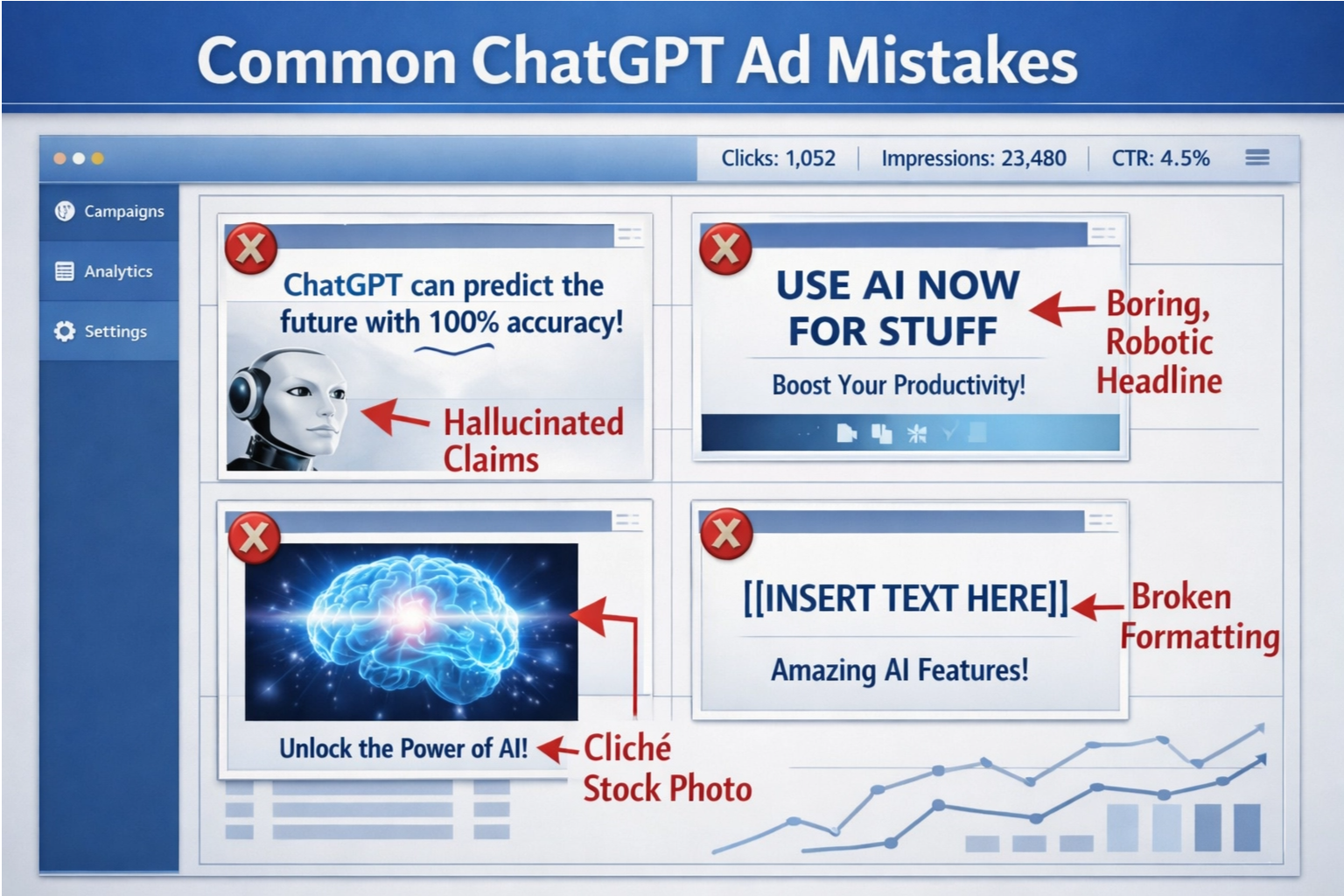
Why it’s a mistake: ChatGPT can sometimes “hallucinate” or present outdated information as fact. Using unverified claims in advertising can lead to legal issues, loss of customer trust, and damage to brand credibility.
How to avoid it: Always fact-check any statistics, claims, or figures generated by ChatGPT, especially those related to product performance, industry data, or guarantees. Cross-reference information with reliable sources before publishing. Source 1 Source 2
9. Neglecting the Visuals and Landing Page Experience
Explanation of the mistake: Focusing exclusively on ad copy generated by ChatGPT and overlooking the critical role of accompanying visuals and the post-click landing page experience.
Why it’s a mistake: A compelling ad copy can be undermined by poor visuals or a disjointed landing page. The entire user journey, from ad impression to conversion, must be optimized for success. A great ad leading to a bad landing page is a wasted effort.
How to avoid it: Ensure your visuals are high-quality, relevant, and complement the AI-generated ad copy. More importantly, ensure the landing page directly aligns with the ad’s message and offer. Use ChatGPT to brainstorm landing page copy or headlines that match your ad.
10. Not Understanding AI Limitations and Biases
Explanation of the mistake: Treating ChatGPT as a sentient expert capable of understanding nuances and avoiding biases, rather than a tool reflecting the data it was trained on.
Why it’s a mistake: AI models can inherit biases present in their training data, leading to ad copy that might be insensitive, stereotypical, or exclusionary. Misunderstanding these limitations can result in unintended negative consequences.
How to avoid it: Be aware that AI can perpetuate biases. Actively review AI-generated content for any signs of bias, discrimination, or insensitivity. Diversify your prompts and request content from different perspectives to mitigate these risks. Educate yourself on the ethical implications of AI in marketing.
11. Failing to Optimize for Different Ad Platforms
Explanation of the mistake: Generating a single piece of ad copy with ChatGPT and using it across all advertising platforms (e.g., Google Ads, Facebook Ads, LinkedIn Ads) without customization.
Why it’s a mistake: Each ad platform has its own best practices, character limits, audience demographics, and ad formats. A “one-size-fits-all” approach leads to suboptimal performance on most platforms.
How to avoid it: Tailor your ChatGPT prompts for each specific platform. For example, request “a concise Google Search Ad headline” or “a visually descriptive Facebook ad body copy.” Understand the nuances of each platform and instruct ChatGPT accordingly.
12. Not Incorporating Emotional Triggers
Explanation of the mistake: Focusing too much on features and facts, and not enough on the emotional benefits or triggers that motivate consumer behavior.
Why it’s a mistake: People often make purchasing decisions based on emotion, then rationalize with logic. Ads that fail to tap into emotional drivers are less persuasive and less likely to convert.
How to avoid it: Explicitly instruct ChatGPT to incorporate emotional language, benefit-driven statements, and psychological triggers into your ad copy. For example, “Write an ad that evokes a sense of security and peace of mind for our home security system,” or “Use language that highlights the joy and convenience of our meal kit service.”
13. Ignoring Performance Data and Analytics
Explanation of the mistake: Generating ad copy with ChatGPT and then failing to analyze its performance data to inform future AI-assisted creative efforts.
Why it’s a mistake: The true power of AI in advertising comes from a feedback loop. Ignoring data means you’re not learning what works and not optimizing your AI prompts for better results.
How to avoid it: Regularly review your ad campaign analytics (CTR, conversion rates, cost per acquisition). Use these insights to refine your ChatGPT prompts. For instance, if an ad with a specific CTA performs well, instruct ChatGPT to generate more variations with similar CTAs. Internal Link 1 Internal Link 2
14. Using ChatGPT for Sensitive or Regulated Industries Without Extra Caution
Explanation of the mistake: Applying ChatGPT for ad copy generation in highly sensitive or regulated industries (e.g., healthcare, finance, legal) without additional scrutiny and legal review.
Why it’s a mistake: These industries have strict compliance requirements and legal restrictions on advertising claims. AI-generated content, if not carefully reviewed, can easily lead to non-compliance, fines, and reputational damage.
How to avoid it: In such industries, use ChatGPT as a brainstorming tool, not a final content generator. Every piece of AI-generated ad copy must undergo thorough legal and compliance review by human experts. Provide ChatGPT with specific compliance guidelines in your prompts.
15. Neglecting the Power of Storytelling
Explanation of the mistake: Producing dry, feature-focused ad copy that lacks a narrative or emotional connection, even when using AI.
Why it’s a mistake: Stories are memorable and create a deeper connection with the audience than mere facts. Ads that tell a story, even a short one, are more engaging and persuasive.
How to avoid it: Instruct ChatGPT to weave mini-stories or relatable scenarios into your ad copy. For example, “Write an ad that tells the story of a customer’s transformation after using our product,” or “Create an ad that paints a picture of the ideal lifestyle our service enables.” Internal Link 3
Conclusion
ChatGPT offers an unparalleled opportunity to revolutionize advertising, but its true potential is unlocked not by simply using the tool, but by using it wisely. By understanding and actively avoiding these 15 common mistakes, marketers can move beyond generic outputs and leverage AI to create highly effective, brand-aligned, and audience-resonant ad campaigns. The key lies in thoughtful prompt engineering, diligent human oversight, continuous iteration, and a deep understanding of both AI’s capabilities and its limitations. Embrace ChatGPT as a powerful co-pilot, not an autonomous driver, and you’ll be well on your way to advertising success in the AI era.
Frequently Asked Questions About 15 ChatGPT Ads Mistakes to Avoid
Q: Can ChatGPT completely replace human copywriters for ads? A: No, ChatGPT is a powerful tool to assist human copywriters, not replace them. It excels at generating ideas, drafting content, and optimizing variations, but human oversight, creativity, and strategic thinking remain essential for effective advertising.
Q: How can I ensure ChatGPT maintains my brand voice? A: Provide ChatGPT with detailed brand guidelines, examples of your existing ad copy, and specific instructions on tone, style, and keywords. Regularly review and refine its outputs to ensure consistency.
Q: Is it safe to use ChatGPT for ads in regulated industries? A: Yes, but with extreme caution. Use ChatGPT for brainstorming and drafting, but ensure all AI-generated content undergoes thorough legal and compliance review by human experts before publication to avoid potential issues.
Ready to Master Your ChatGPT Ad Campaigns?
Unlock the full potential of AI in your advertising strategy with Single Grain. Our experts help you navigate the complexities of ChatGPT, ensuring your campaigns are optimized for maximum impact and ROI. Contact Single Grain Today!



