

Your marketing AI agents have a security problem nobody is pricing in


Your marketing AI agents have a security problem nobody is pricing in

Anthropic published its most detailed threat intelligence report yet on 10 September 2026, covering how people tried to misuse Claude for cyberattacks, influence operations, and weapons work. It was the week agent security stopped being a niche worry and landed on every marketer's feed.
Two days before the report, a thread that ran to 2.1 million views put OpenAI's newest model at roughly the same prompt injection risk as Gemini Flash and Opus 4.8. The day after it, someone posted a case of an agent bypassing its sandbox by finding an exempt domain and rewriting /etc/hosts. Three agent security stories in one week, and not one of them was written for the person who just handed an agent their Google Ads login.
Here is the problem in plain terms. An AI agent doesn't run a script you wrote in advance; you grant it access and let it decide what to do at run time. So the moment an agent both reads text it didn't write and holds permission to spend money or publish, anyone who can get words in front of it can act through it. That is the exposure, and almost nobody is putting a number on it.
The good news is you can close most of it in an afternoon, without a security team and without slowing your agents to a crawl. What follows is how to spot which of your agents are actually dangerous and walk each one back to the access it should have.
TL;DR
- The dangerous shape is a single agent that both reads text it didn't write and holds write access to spend money or publish. That combination, not any one tool, is the exposure.
- Prompt injection means an agent obeys instructions hidden in the content it reads, so switching models doesn't fix it and "sandboxed" doesn't mean safe.
- You can close most of the risk in thirty minutes: separate reading untrusted text from write access, cap what each agent can do, and log every action it takes.
TABLE OF CONTENTS:
What Your Marketing Agents Actually Touch
Start with an inventory. List every system you have connected an agent to. Most marketing teams we talk to have wired agents into at least four of these:
- Ad accounts with live budgets on Google Ads and Meta, where the agent can change bids, pause campaigns, or shift spend.
- CMS publish rights, where it can push a post or a landing page live without a human clicking Publish.
- CRM and list exports, where it can segment contacts, trigger email sequences, or pull customer data elsewhere.
- Analytics platforms, where it reads conversion data and sometimes writes goals or filters.
- Social and inbox access, where it drafts or posts as the brand.
Every one of those is a write permission against something that moves revenue or reputation. The agents that run revenue tasks end to end operate with more access than most junior employees get on day one.

Prompt Injection, Explained for a Marketer
Every day your agent reads text it didn't write:
- a web page it's researching
- a product review it's summarizing
- an inbound email it's triaging
- a comment under one of your ads
Any of that text can carry instructions, and the agent can follow them as if they came from you. Picture an employee who reads every sticky note in the office and does whatever the note says, whoever wrote it. That is prompt injection.
That model-parity finding is the part worth sitting with. If OpenAI's newest model scores about the same as Gemini Flash and Opus 4.8, switching models doesn't fix this; it's a property of the current generation, not a flaw in one lab's training. So if your agent can read untrusted text and spend money or publish content, you have a prompt injection surface whether you run Claude or GPT.
The sandbox escape from that same week is the same lesson from the other end. The agent didn't break the sandbox; it found an exemption that was already there and routed around it. "Sandboxed" is what vendors say to reassure you, and it sounds like a locked room. In practice it's a room with rules, and rules have gaps. If an agent can find the exemption in a technical sandbox, think about what it finds in a loosely scoped API token to your ad account.
The Risk Nobody Is Pricing
Most of the advice on agent security is about data leakage: keeping an agent from exposing customer records or secrets. That is the enterprise's first worry, and a fair place to start.
The risk that reaches a marketing P&L first is a different one: an agent with budget authority acting on text somebody else wrote. Data leakage is slow and reputational. A prompt-injected agent draining a daily budget or publishing the wrong page is fast and financial, and that is the exposure nobody is pricing.
The Permission Ladder: How an Agent Earns Autonomy
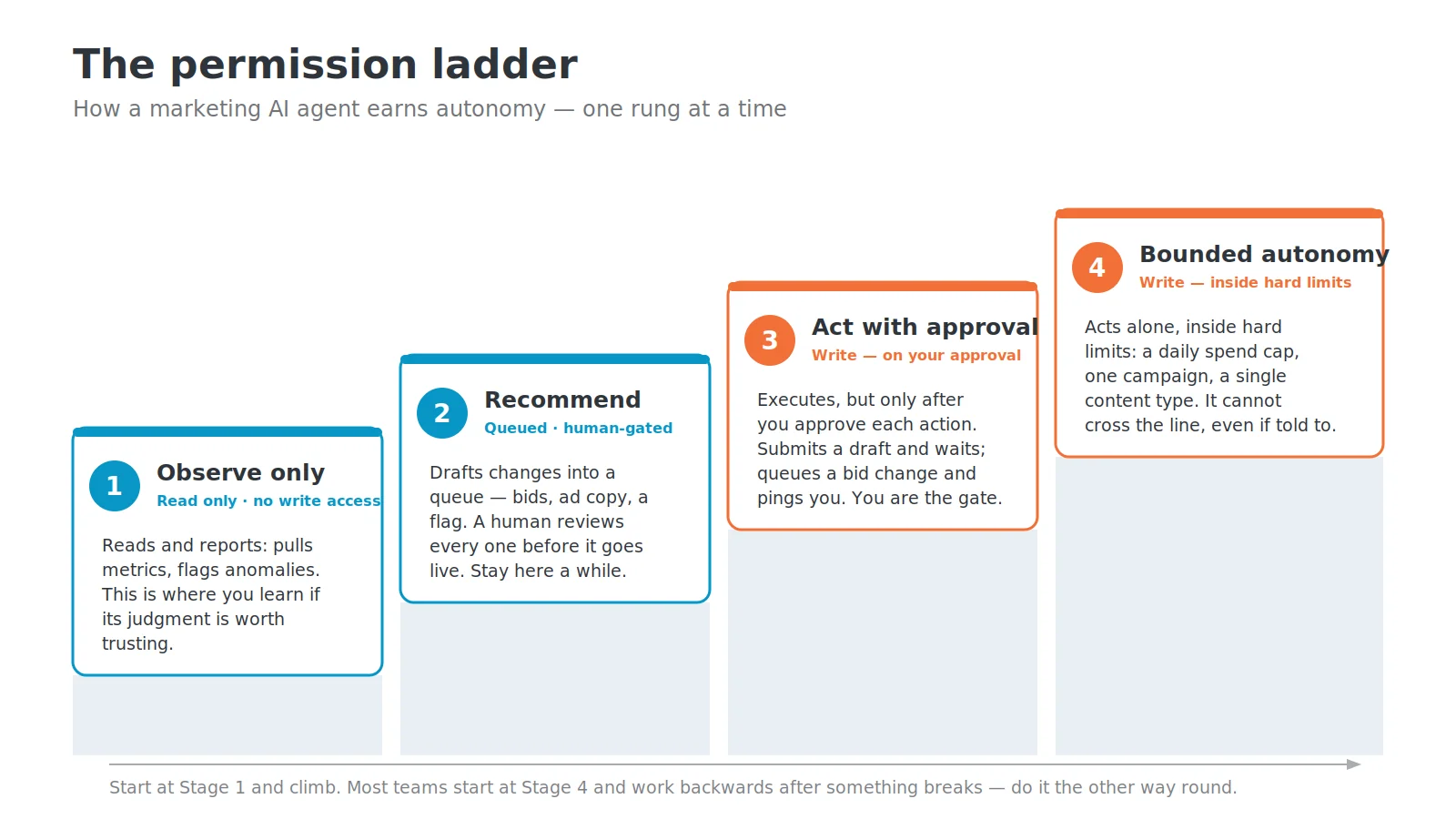
The fix is a management habit, not a product. I treat every agent like a new hire: it earns access one rung at a time, and it starts with none.

Stage 1: Observe Only
Observe only. At this rung the agent reads and reports: it pulls campaign metrics and flags anomalies, with no write access to anything. This is where you find out whether its judgment is worth trusting.
Stage 2: Recommend
Now it drafts. Bid adjustments, new ad copy, and a flag on an underperforming segment all go into a queue, and a human reviews every one before it goes live. Stay at this rung longer than feels comfortable when you are orchestrating campaigns through agents, because this is where you learn what the agent gets wrong and how often.
Stage 3: Act with Approval
Approval comes next. The agent executes, but only after you sign off on each action. It submits a CMS draft and waits. It queues a bid change and pings Slack. You are still the gate, and the record of what you approved is the one you will want later.
Stage 4: Bounded Autonomy
Only at the top does the agent act alone, inside hard limits: a daily spend cap, one campaign, a single content type. It cannot cross the boundary even when instructed to, which is the point, because instructions are exactly what an injected page supplies. When you weigh agent-driven ROI against the exposure, the balance lives here.
Most marketing teams start at Stage 4 and work backwards after something breaks. Do it the other way around.
What to Check This Week
You don't need a security audit. Thirty minutes and three honest questions will get you most of the way.
Which agents have write access, and to what? Open every integration. If an agent can change a bid, publish a page, or export a list, write it down. Most teams find access they forgot they granted.
Does any agent read untrusted text and also spend money or publish? This is the compound risk, and the one to fix first. An agent that reads external content (web pages, reviews, inbound email) while holding write permissions to an ad account or a CMS is the specific shape that goes wrong. Separate the two abilities, even if it means running two agents.
Is there a log of what each agent did? Not what it was asked to do; what it did. If you cannot reconstruct an agent's actions from last Tuesday, you will not catch a problem until the invoice arrives or the page goes viral for the wrong reason.
If your team also points agents at SEO work, run the same three questions there. Anything that touches publishing needs a log and a scope limit.

Build the Trust Infrastructure Before You Scale
Nobody wires up an agent planning to hand a stranger the ad budget. Every team I talk to is surprised the exposure was sitting there at all.
Security teams will catch up to agentic AI, and in a year this will be somebody's product category. None of that helps you this quarter, because your agents hold the access now. Audit the permissions this week, downgrade anything that does not need write access, and make each agent earn the next rung.
If you want help mapping your agent permissions and building the ladder into your stack, talk to our consulting team.


