

How to Build AI Chatbots for LinkedIn ABM Lead Qualification


Picture this: Your LinkedIn ABM campaign just generated 500 new leads, but your sales team can only qualify 50 per week. By the time they reach lead #200, the first 100 have gone cold. Sound familiar? This scenario plays out daily in B2B companies worldwide, where manual lead qualification creates a bottleneck that kills pipeline velocity.
The solution isn’t hiring more SDRs; it’s deploying AI chatbots specifically designed for LinkedIn ABM lead qualification. 80% of marketers say account-based marketing outperforms other marketing initiatives in terms of ROI, making it a high-value strategy worth automating with intelligent conversational AI.
But here’s the challenge: Most companies treat chatbots as generic customer service tools rather than precision instruments for B2B lead qualification. The difference between a basic chatbot and an AI-powered LinkedIn ABM qualification system is like comparing a sledgehammer to a surgical scalpel. Both are tools, but only one delivers the precision your revenue demands.
Key Takeaways
- Leverage LinkedIn’s professional data for pre-qualification by mapping your ideal customer profile to LinkedIn signals like job titles, company size, and recent activity before initiating conversations, creating a more intelligent qualification process than generic chatbots
- Design conversation flows that respect professional context with different paths for C-suite executives versus individual contributors, ensuring each interaction feels like a valuable business conversation rather than an automated interrogation
- Implement dynamic lead scoring algorithms that adjust scores based on conversation quality and engagement depth, not just checkbox responses. Prospects asking detailed technical questions score higher than those seeking basic pricing information
- Build seamless CRM integration for immediate handoffs that automatically create detailed contact records, lead scores, and recommended next actions within minutes of qualification, maximizing conversion rates through speed
- Focus on revenue-impact metrics over vanity metrics by tracking qualification-to-opportunity conversion rates, pipeline velocity improvements, and multi-touch attribution that connects chatbot interactions to closed deals
TABLE OF CONTENTS:
Why LinkedIn ABM + AI Chatbots = ROI Gold Mine
Over 53% of B2B marketers use LinkedIn for lead generation, making it the logical platform for deploying AI chatbots that engage, score, and qualify leads in real-time. This data signals a massive opportunity: optimizing LinkedIn touchpoints with AI chatbots can materially affect both pipeline size and deal value. When you combine LinkedIn’s professional context with AI’s ability to process complex qualification criteria, you create a lead qualification machine that works 24/7 without coffee breaks or vacation days.
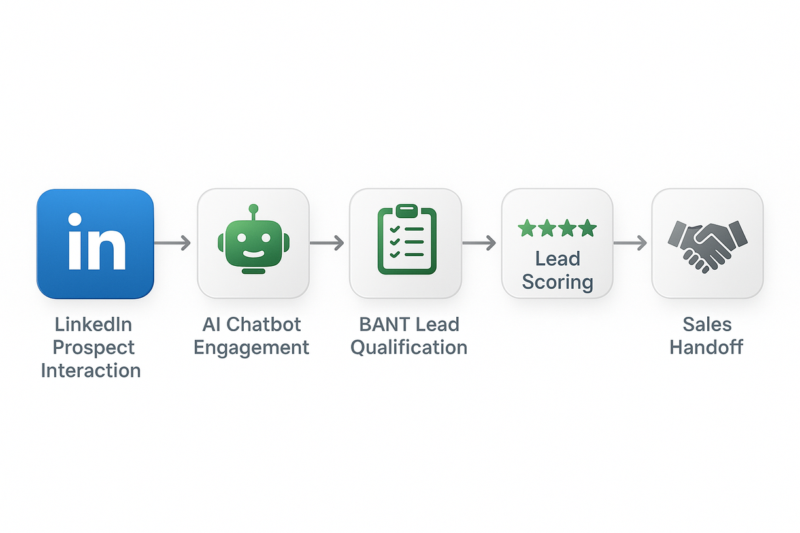
The magic happens when you layer intelligent conversation flows on top of LinkedIn’s rich professional data. Your chatbot isn’t just asking “What’s your budget?”—it’s analyzing job titles, company size, recent activity, and engagement patterns to deliver hyper-personalized qualification experiences that feel human, not robotic.
The 8-Step Blueprint for Building AI Chatbots for LinkedIn ABM Lead Qualification
Building effective AI chatbots for LinkedIn ABM lead qualification requires a systematic approach that strikes a balance between automation and personalization. Here’s the proven framework that top B2B companies use to transform their lead qualification processes:
Step 1: Define Your Qualification Criteria Within LinkedIn Context
Start by mapping your ideal customer profile (ICP) to LinkedIn’s available data points. Traditional BANT (Budget, Authority, Need, Timeline) frameworks need LinkedIn-specific enhancement. Your AI chatbot should leverage LinkedIn profile data, job titles, company size, industry, recent posts, and connection networks to pre-qualify prospects before the first question. Create scoring matrices that weight different LinkedIn signals. Your chatbot’s intelligence comes from understanding these nuances before initiating a conversation.
Step 2: Design Conversation Flows for Professional Context
LinkedIn conversations require different etiquette than those found in website chat widgets. Your AI chatbot needs conversation flows that respect professional boundaries while efficiently gathering qualification data. Design branching logic that adapts based on initial responses. C-suite executives get different conversation paths than individual contributors.
Step 3: Integrate LinkedIn Sales Navigator Data
Your chatbot’s effectiveness multiplies when connected to LinkedIn Sales Navigator’s advanced search and account insights. This integration provides real-time access to prospect activity, mutual connections, and recent company updates, which inform conversation personalization.
Build API connections that pull fresh data before each interaction. When your chatbot mentions a prospect’s recent promotion or company funding round, the conversation immediately feels more relevant and less automated.
Step 4: Implement Dynamic Lead Scoring Algorithms
Static lead scoring kills conversion rates. Your AI chatbot needs dynamic algorithms that adjust scores based on conversation context, not just checkbox responses. A prospect who asks detailed technical questions about integration capabilities scores higher than someone seeking basic pricing information.
| Qualification Factor | Traditional Weight | LinkedIn ABM Weight | AI Enhancement |
|---|---|---|---|
| Job Title Authority | 25% | 35% | +15% for recent promotions |
| Company Size/Revenue | 30% | 25% | +10% for growth indicators |
| Engagement Quality | 15% | 25% | +20% for specific pain points |
| Timeline Urgency | 30% | 15% | +25% for active evaluation |
Step 5: Build CRM Integration for Seamless Handoffs
The moment your chatbot qualifies a high-value lead, your CRM should automatically receive a complete conversation summary, lead score, and recommended next actions. This isn’t just data transfer, it’s intelligence amplification for your sales team.
Configure automated workflows that create detailed contact records, schedule follow-up tasks, and alert the appropriate sales representative within minutes. The faster the handoff, the higher your conversion rates.
Step 6: Train Your AI on Successful Qualification Conversations
Your chatbot learns from your best SDRs’ qualification techniques. Feed successful conversation transcripts into your AI training data, focusing on how top performers uncover pain points, handle objections, and identify buying signals.
Machine learning models improve when they understand not just what questions to ask, but how to interpret answers in a business context. A response of “We’re evaluating options” means different things from different company types and decision-maker levels.
Step 7: Implement Compliance and Privacy Safeguards
LinkedIn automation requires careful attention to platform policies and data privacy regulations. Your chatbot must operate within LinkedIn’s automation guidelines while maintaining GDPR and CCPA compliance for data collection and storage. Build explicit consent mechanisms into your conversation flows and provide clear transparency on data usage. Professional prospects expect professional data handling practices.
Step 8: Establish Continuous Optimization Feedback Loops
Your AI chatbot’s performance improves through systematic analysis of conversation data, qualification accuracy, and downstream conversion rates. Create weekly review cycles that examine qualification-to-opportunity ratios and identify conversation patterns that predict deal closure.
AI marketing automation succeeds when human insight guides machine learning improvements. Your sales team’s feedback on lead quality serves as training data for improved future qualification.
Real-World Examples and Results from LinkedIn ABM Chatbots
The proof lives in the performance data. An enterprise software company used Karrot.ai to attract 1,000 new leads on LinkedIn. This tactic resulted in a 187% increase in target account engagement.
Technical Implementation: From Setup to Scale
The technical architecture for LinkedIn ABM chatbots requires careful consideration of API limitations, data flow optimization, and scalability requirements. Your implementation should anticipate growth. What works for 100 qualified leads per month must scale to 1,000 without performance degradation.
Start with webhook configurations that trigger chatbot interactions based on specific LinkedIn activities, such as profile views, InMail opens, content engagement, or connection requests. These behavioral triggers create natural conversation entry points that feel organic rather than intrusive.
Database design becomes critical at scale. Your chatbot needs rapid access to conversation history, lead scores, and account context. Implement caching strategies that pre-load relevant data before initiating conversations, ensuring response times remain under two seconds regardless of data complexity.
Measuring Success: KPIs That Matter for LinkedIn ABM Chatbots
Traditional chatbot metrics, such as conversation volume, response rates, and session duration, miss the revenue impact that matters for LinkedIn ABM lead qualification. Your KPI dashboard should focus on qualification accuracy, pipeline velocity, and deal influence metrics that connect chatbot performance to business outcomes.
Track qualification-to-opportunity conversion rates by lead source, chatbot conversation path, and initial lead score. This data reveals which qualification approaches generate the highest-quality sales pipeline. Monitor time-to-qualification improvements. Your AI chatbot should dramatically reduce the days between initial contact and sales-ready status.
Revenue attribution becomes crucial for ROI demonstration. Implement multi-touch attribution that traces closed deals back to initial chatbot interactions, measuring both direct influence and assist value throughout extended B2B sales cycles.
Future-Proofing Your LinkedIn ABM Chatbot Strategy
The LinkedIn platform continues evolving, with enhanced API capabilities and richer data access for compliant automation solutions. Your chatbot architecture should anticipate these improvements while maintaining current functionality.
Emerging AI capabilities, improvements in natural language understanding, advances in sentiment analysis, and support for multimodal interaction will enhance qualification accuracy and conversation naturalness. Build modular systems that integrate new AI capabilities without requiring complete rebuilds.
Consider the competition as more companies deploy LinkedIn ABM chatbots. Differentiation will come from conversation quality, personalization, and integration sophistication rather than basic automation capabilities.
Ready to Transform Your LinkedIn ABM Lead Qualification?
Building AI chatbots for LinkedIn ABM lead qualification represents a strategic opportunity to accelerate pipeline velocity while reducing operational costs. The companies implementing these systems in 2025 will establish competitive advantages that compound over time.
Your next step depends on current technical capabilities and timeline requirements. Companies new to LinkedIn ABM should establish foundational campaign management practices before adding AI chatbot complexity. Organizations with mature ABM programs can implement chatbot qualification immediately for rapid impact.
The investment in AI-powered LinkedIn ABM lead qualification yields dividends through enhanced sales team productivity, increased qualification accuracy, and accelerated deal closure rates. Your prospects expect professional, intelligent interactions. Generic chatbots won’t meet that standard.
Whether you build internal capabilities or partner with specialized providers, the key is starting with clear qualification criteria, robust data integration, and systematic performance measurement. The technology exists today to transform your LinkedIn ABM lead qualification process. The question is whether you’ll implement it before your competitors do.
Ready to see how AI-powered ABM personalization can accelerate your pipeline? Get your free ABM audit to discover optimization opportunities specific to your LinkedIn campaigns and lead qualification processes.
Tired of watching qualified leads go cold while your team drowns in manual qualification?
Frequently Asked Questions
-
How do AI chatbots for LinkedIn ABM differ from regular customer service chatbots?
LinkedIn ABM chatbots are precision instruments designed specifically for B2B lead qualification, leveraging LinkedIn’s professional data like job titles, company size, and engagement patterns. Unlike generic customer service bots, they create personalized qualification experiences that respect professional context and adapt conversation flows based on prospect authority levels and business signals.
-
What specific LinkedIn data should be integrated into chatbot qualification processes?
Your chatbot should integrate job titles, company size, industry, recent posts, connection networks, and LinkedIn Sales Navigator insights like prospect activity and mutual connections. This data enables pre-qualification before conversations begin and allows real-time personalization, such as referencing recent promotions or company funding rounds during interactions.
-
How do dynamic lead scoring algorithms improve qualification accuracy?
Dynamic algorithms adjust scores based on conversation context and engagement quality, not just checkbox responses. For example, prospects asking detailed technical questions about integration capabilities score higher than those seeking basic pricing, while recent promotions or growth indicators can boost scores by 10-25% depending on the qualification factor.
-
What are the essential technical requirements for implementing LinkedIn ABM chatbots?
You need webhook configurations for behavioral triggers, API connections to LinkedIn Sales Navigator, robust CRM integration for seamless handoffs, and scalable database architecture with caching strategies. The system must maintain sub-two-second response times and handle growth from hundreds to thousands of qualified leads monthly without performance issues.
-
Which KPIs should companies track to measure chatbot ROI beyond basic metrics?
Focus on qualification-to-opportunity conversion rates, pipeline velocity improvements, and multi-touch revenue attribution that connects chatbot interactions to closed deals. Track time-to-qualification reductions and monitor how different conversation paths and lead scores correlate with downstream sales success rather than vanity metrics like conversation volume.
-
How can companies ensure compliance with LinkedIn's automation policies?
Operate within LinkedIn’s automation guidelines by building explicit consent mechanisms into conversation flows and maintaining GDPR/CCPA compliance for data collection. Implement clear data usage transparency and ensure all interactions respect platform policies while providing professional-grade data handling that B2B prospects expect.
-
What kind of results can companies expect from implementing these AI chatbot systems?
Real-world implementations show a 187% increase in target account engagements after using LinkedIn ABM tools such as Karrot.ai


