

GEO for Realtors: Ranking in AI Models for Local Market Queries


Realtor GEO optimization is quickly becoming the difference between being the first local expert AI tools recommend and never being mentioned at all. As buyers and sellers move from typing keywords into search boxes to asking full questions in conversational assistants, the way “rankings” are earned has fundamentally shifted.
Instead of fighting only for blue links, real estate agents now need to position themselves as the most quotable, trustworthy source when someone asks an AI, “Where should I buy a condo in my price range near good schools?” This guide breaks down how generative engines interpret local real estate questions, how that connects to traditional local SEO, and how to build a practical, 90-day plan to earn visibility, trust, and leads from AI-driven discovery.
TABLE OF CONTENTS:
How AI search reshapes local visibility for realtors
Traditional SEO was about ranking web pages for typed queries, but generative engines build direct answers by synthesizing multiple sources. They still crawl, index, and evaluate websites, yet their goal is to assemble a coherent response and then selectively surface citations to a few high-confidence sources.
Local intent is central to that behavior. 46% of all Google searches have local intent, which means nearly half of queries are candidates for AI-generated local overviews. If your content does not clearly explain your market, your specialty, and your answers to buyer and seller questions, AI assistants have no reason to feature you.
The competitive pressure is intensifying as well. 90% of U.S. small businesses plan to increase technology adoption in the coming years, and about two-thirds say they will be using AI. For realtors, that means more local competitors producing AI-aligned content and fewer opportunities to coast on a basic website and profile.
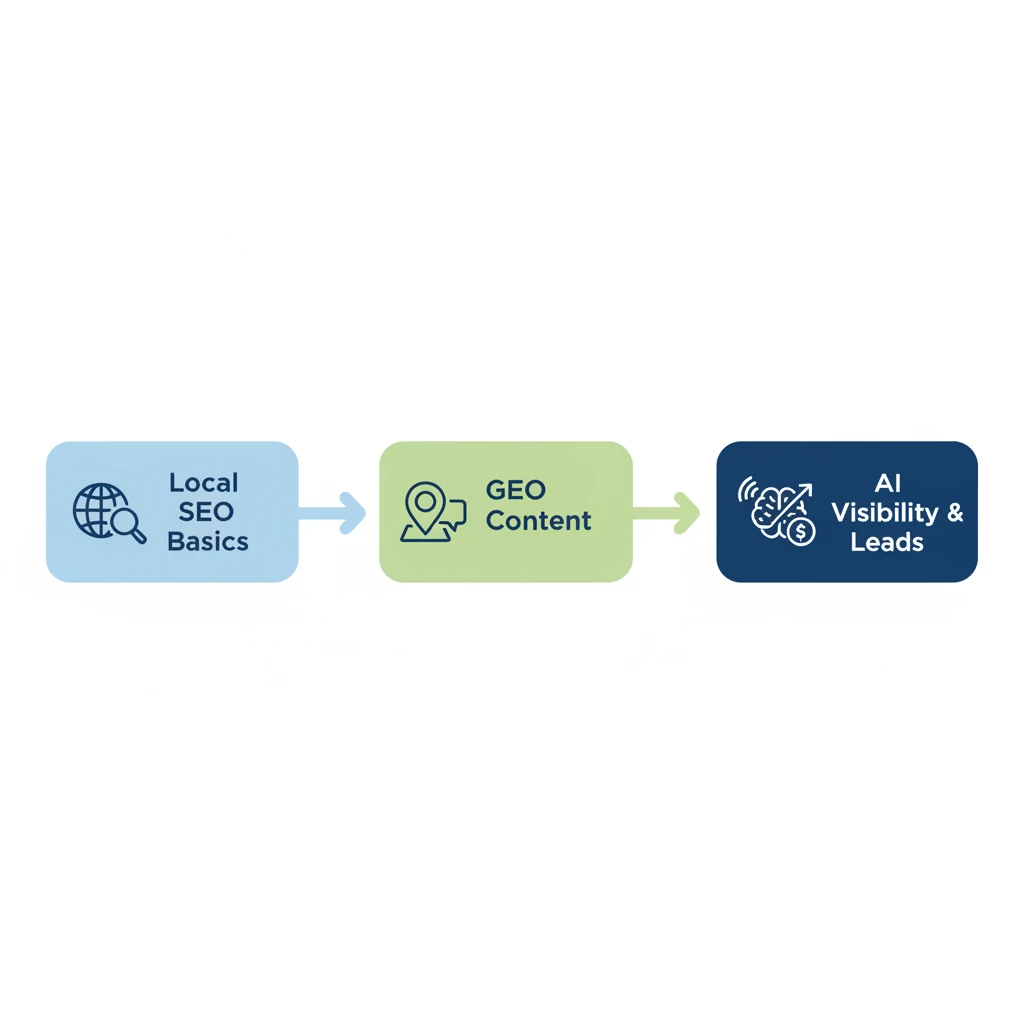
For local businesses in general, including real estate teams, frameworks that explain why local businesses need GEO optimization now treat generative engines as an additional “channel” alongside classic local SEO. The opportunity is to build a single, coherent presence that works for both: accurate local signals for search engines and structured, conversational content that is easy for AI models to quote.
How AI answer engines treat local real estate queries
When someone asks, “Is now a good time to buy in [neighborhood]?” an AI assistant looks for content that combines three things: topical relevance to the local market, clear explanations in natural language, and evidence that the source is a trustworthy real estate expert in that area.
That is why generative engines favor pages that answer specific, question-shaped queries with short, well-structured sections. REALTORS® who publish conversational, hyper-local Q&A pages and layer in LocalBusiness and FAQ schema are more frequently cited in AI answers like “What do I need to buy a home in [city]?” Clear structure and markup make it easier for language models to extract, understand, and attribute your insights.
Generative systems also reward pages formatted into “atomic” paragraphs: short, standalone units that neatly answer one sub-question. This fine-grained structure, combined with sub-two-second mobile load times and rich schema, increases inclusion in Bing Copilot answers. Realtors can mirror the same pattern on neighborhood pages, market explainers, and FAQs to become preferred sources for local housing questions.

Realtor GEO optimization strategies for AI-driven local discovery
Once you understand how answer engines assemble local responses, the next step is to align your site, profiles, and content with the specific questions buyers and sellers actually ask. Realtor GEO optimization is not about stuffing keywords into pages; it is about making sure every important local question has a clear, structured, AI-friendly answer that can be cited.
Designing content around real local market questions
Instead of starting with generic keywords like “homes for sale in [city],” begin with the real questions clients bring to consultations and open houses. These often fall into a handful of predictable intent buckets that map naturally to content types AI systems can reuse.
Common buyer and seller question themes include:
- Neighborhood fit (“Best neighborhoods in [city] for young families with a budget of $X”)
- Lifestyle and amenities (“Walkable areas near [employer or landmark] with good restaurants and parks”)
- Schools and safety (“Areas in [city] with top-rated schools and low crime”)
- Market timing and pricing (“Is it a good time to sell a townhouse in [neighborhood]?”)
- Investment and rentals (“Expected rental yields in [zip code] for 2-bedroom condos”)
Each intent bucket should correspond to a specific content format. Neighborhood fit questions align with neighborhood guides and comparison pages. School and safety concerns fit into concise, regularly updated local data explainers. Market timing questions belong in monthly or quarterly market update posts. Investment questions call for ROI breakdowns and example deal analyses.
As you build this library, design every piece so that a language model can easily lift a paragraph or two as a direct answer. That means using plain language, adding headings that mirror natural questions, and including simple context like price ranges, commute times, and property types rather than abstract commentary.
Realtor GEO optimization checklist for your website
Structuring your site for GEO starts with clear information architecture. A practical pattern for many agents is: city hubs, neighborhood pages, property-type or use-case pages (first-time buyers, investors), then FAQ and resource hubs. That hierarchy helps both crawlers and AI systems understand the breadth and depth of your local expertise.
The on-page realtor GEO optimization checklist for each important page can include:
- A headline that naturally reflects a core question, such as “Is [Neighborhood] right for you?”
- An opening paragraph that answers the main question directly before diving into detail.
- Short sections with H2/H3 headings that echo sub-questions buyers ask (“What does a typical home cost in [Neighborhood]?”).
- One focused idea per paragraph so language models can quote without editing.
- FAQ markup around the most common micro-questions (“How long does it take to commute from [Neighborhood] to downtown?”).
Schema markup is a technical but critical GEO lever. For realtors, that typically means LocalBusiness or RealEstateAgent schema on your main contact and “about” pages, FAQ and HowTo schema on guides and process explainers, and Offer or Product-style schema for listings where your MLS or brokerage rules allow. A detailed GEO vs SEO comparison shows how this structured data layer gives answer engines explicit signals about who you are, what you do, and which questions you are qualified to answer.
Visual assets should not be left out of GEO planning. Listing photos, community images, and videos benefit from descriptive file names tied to neighborhoods and property types, alt text that tells an AI what the image shows in location-aware language, and, where appropriate, captions that add micro-answers like “Tree-lined residential street in [Neighborhood] with single-family homes built in the 1990s.”
Local authority signals AI systems rely on
Answer engines do not rely on on-page content alone; they also look for proof that you are genuinely embedded in your market. That includes a fully built-out Google Business Profile with accurate categories, service areas, and hours, consistent name, address, phone citations across major directories, and a steady cadence of high-quality reviews that mention specific neighborhoods and transaction types.
Review strategy is particularly important for GEO. Encourage clients to reference the area and service you provided (“helped us buy our first condo in [Neighborhood]”), then surface those testimonials on your site using Review schema. That structure allows generative systems to understand not just that you have reviews, but what you are known for and where.
Local E-E-A-T (experience, expertise, authoritativeness, and trustworthiness) also plays a role. Detailed bios that mention how long you have worked in the area, references to local associations, and content that cites public data sources all help position you as a reliable authority. Resources that unpack how GEO optimization improves your customer acquisition highlight how these trust signals convert into better-qualified inbound leads from both search and AI assistants.

A 30/60/90-day GEO + local SEO action plan for agents
Translating concepts into a practical workflow is where most agents get stuck. Instead of trying to overhaul everything at once, use a phased 90-day plan that lays foundations, ships content, and then measures and scales what works.
First 30 days: Get your GEO foundations in place
Start with an honest audit of your current local digital presence. Review your Google Business Profile, main website pages, and top-ranking content to see whether they clearly express the markets you serve, the questions you answer, and the proof that you are an expert in those areas.
In this first month, you can focus on four foundational steps:
- Clean up local basics: ensure NAP consistency, appropriate GBP categories, and a current service area list.
- Create or refine a single flagship neighborhood page using the Q&A structure described earlier.
- Implement LocalBusiness or RealEstateAgent schema on your homepage and primary contact page.
- Collect three to five fresh, detailed reviews that reference specific neighborhoods or transaction types.
To understand what effective execution looks like in practice, it is helpful to review real GEO optimization case studies in other local verticals. While the industries differ, the common thread is a clear, structured local presence plus Q&A-style content that answer engines can easily surface.
Days 31–60: Publish AI-friendly local content
Once your foundations are in place, the next 30 days should prioritize shipping content that maps tightly to local questions and is formatted for answer extraction. Aim for one substantial piece per week, rotating through different intent types so you gradually cover the full buyer and seller journey.
During this phase, AI writing tools can dramatically speed up research and drafting without replacing your expertise. You might use assistants like ChatGPT or Gemini to brainstorm questions, outline pages, or turn your video transcripts into draft articles, then edit for accuracy, nuance, and compliance with fair housing and MLS rules.
Practical prompt patterns for realtor GEO optimization include:
- “List 20 specific questions a first-time homebuyer might ask about living in [Neighborhood, City]. Categorize them by topic.”
- “Using this market data, draft a 600-word neighborhood guide for [Neighborhood, City] with sections that directly answer each of these questions: [paste questions].”
- “Turn this video transcript of my buyer consultation about [Neighborhood] into a Q&A-style article with short paragraphs and clear headings, preserving my tone but removing filler.”
- “Suggest structured FAQ questions and concise answers for my page about selling a home in [City] that AI assistants could easily quote.”
Throughout these weeks, keep refining internal linking between city hubs, neighborhood guides, and FAQs so that crawlers and AI systems see a coherent content network. As you build, a resource such as an in-depth GEO vs SEO comparison can remind you how traditional ranking factors and AI citation patterns support each other rather than compete.
Days 61–90: Measure, iterate, and scale GEO
The final 30 days are about feedback loops. Begin by documenting a small set of representative prompts you care about, such as “best neighborhoods in [city] for families with a budget of $X,” “is it a good time to sell in [neighborhood],” and “top realtors in [city] for first-time buyers.” Run those prompts in Google (checking AI Overviews when they appear), Bing Copilot, and a few leading assistants like ChatGPT or Perplexity.
Record whether your brand is mentioned, whether any of your pages are cited or linked, and what competing content is being referenced. Over time, this manual panel of prompts becomes a lightweight “GEO dashboard” that complements Google Search Console, website analytics, and call or form-tracking data.
On the business side, 75% of small and medium-sized businesses are at least experimenting with AI, and 91% of those using it say it boosts their revenue. For realtors, GEO is the marketing counterpart to that operational AI adoption: it ensures that when potential clients use AI in their own lives, they still discover you rather than only national portals or generic content farms.
Financially, it is helpful to understand how these efforts compare with other lead sources. An analysis of GEO optimization costs vs ROI typically shows that, while there is an upfront investment of time and content creation, the marginal cost of additional AI-sourced leads falls over time, especially compared with paying per lead from portals.
| Channel | Cost Profile | Lead Quality | Time to Results | Primary Role |
|---|---|---|---|---|
| Traditional local SEO | Content and optimization work; ongoing but stable | Varies; good when search intent is specific | Medium-term (months) | Baseline visibility and evergreen traffic |
| Realtor GEO optimization | Similar to SEO plus structured content and schema work | Often very high, because questions are intent-rich | Medium-term as AI systems discover content | Owning AI-generated recommendations and answers |
| PPC (search and social) | Direct spend per click or lead; scales with budget | Mixed; depends on targeting and landing pages | Short-term (days to weeks) | Campaign-driven spikes in inquiries |
| Portals (Zillow, etc.) | Subscription or per-lead fees | Often lower intent; buyers may not be loyal | Short-term, but highly competitive | Supplemental deal flow, not owned audience |
To decide how aggressively to scale, it helps to look at the bigger picture of AI search. AI-mediated discovery could influence up to $750 billion in revenue by 2028, and early adopters already see higher conversion rates from these pathways. For realtors, this argues for treating GEO as a core marketing capability rather than a side experiment.
Tools that support experimentation can further accelerate learning. A platform like the Clickflow content optimization platform lets you test variations of titles, meta descriptions, and key on-page elements, then measure which versions drive more organic and, indirectly, AI-sourced traffic and leads. Coupled with UTM tracking, CRM data, and simple dashboards, this kind of system turns GEO work from guesswork into an evidence-based growth engine.
Bringing realtor GEO optimization into your weekly workflow
Once your 90-day sprint is complete, the goal is to integrate GEO into a sustainable rhythm rather than treating it as a one-time project. The most effective agents allocate 30–60 minutes a day or a couple of focused blocks per week to maintaining and expanding their AI-ready local presence.
As you refine this routine, remember that AI systems respond to clear structure, genuine expertise, and fresh, specific local insight. The more consistently you translate your day-to-day market experience into concise, question-shaped content, the more likely generative engines are to treat you as the default local expert.
If you want a partner to turn this into a comprehensive “search everywhere” strategy that spans Google, social search, and AI assistants, Single Grain offers SEVO and GEO programs tailored to growth-focused real estate teams. You can tap into specialists who handle technical SEO, schema, content strategy, and experimentation so that your brand shows up wherever buyers and sellers ask questions and turn that AI-powered visibility into measurable deals.
Frequently Asked Questions
-
How can realtors balance GEO optimization with fair housing and advertising regulations?
Start by building content around objective factors—commute times, property types, pricing bands, and public data rather than protected characteristics. Have a broker or legal advisor review your neighborhood and school content, and document clear internal guidelines so any AI-assisted drafts are checked for compliance before publishing.
-
What GEO tactics work best for realtors who primarily get business through referrals?
Use GEO content to ‘codify’ the expertise your sphere already trusts: turn common referral questions into short, location-specific explainers you can send to prospects. This makes you easier to recommend, gives referrers useful resources to share, and helps AI systems see a consistent pattern of specialization in your core areas.
-
How should realtors approach GEO optimization in multilingual or culturally diverse markets?
Create separate, fully localized pages for the main languages you serve, with examples and FAQs tailored to each audience’s real concerns. Align your profiles, reviews, and schema with those languages as well, so AI models can confidently match users’ language preferences with your local expertise.
-
What are some common GEO optimization mistakes realtors make when they first get started?
Many agents overextend into too many neighborhoods at once, publish thin pages that repeat generic copy, or rely exclusively on AI tools without adding their own market insight. A more effective approach is to go deep on a small number of areas, focus on specific questions buyers and sellers actually ask you, and update content as conditions change.
-
How can solo agents implement GEO optimization without a large budget or marketing team?
Prioritize a narrow geographic focus and a handful of key client personas, then batch content creation by turning existing materials (emails, texts, videos, and listing descriptions) into structured Q&A sections. Use low-cost tools for schema, basic analytics, and review collection, and commit to a consistent but realistic publishing cadence.
-
How often should GEO-optimized neighborhood and market pages be updated to stay useful for AI models?
Refresh core pages whenever there’s a meaningful market shift, such as notable price changes, new infrastructure, or zoning updates, and schedule at least a light review every quarter. Even small additions, such as a new FAQ, revised examples, or updated data points, signal to AI systems that your insights are current and reliable.
-
Can social media activity influence how AI models perceive a realtor’s local authority?
Yes, consistent local posting that links back to your site (market breakdowns, neighborhood walk-throughs, or Q&A clips) can generate mentions, engagement, and secondary citations that reinforce your area expertise. Embedding or repurposing your best social content on your GEO pages helps tie those authority signals together in a way AI can recognize.



