

AEO and ChatGPT Ads: Complementary Strategies for AI Visibility


AEO and ChatGPT ads are quickly becoming the twin pillars of visibility in AI-driven search, yet most teams still treat them as disconnected experiments. As users shift from typing short keywords into traditional search boxes to asking full questions in conversational interfaces, brands that only optimize for classic search results risk vanishing from the places where decisions now start.
This guide unpacks how answer engine optimization and paid placements in conversational AI can work together rather than compete for budget. You will learn how AEO differs from SEO and GEO, how emerging ChatGPT ad formats fit into your media mix, and how to build a single framework for planning, implementing, and measuring both organic and paid visibility in AI answer engines.
TABLE OF CONTENTS:
From SEO to AEO and ChatGPT Ads: Understanding the New Landscape
Search is no longer limited to ten blue links on a results page. People now expect a direct, conversational answer compiled from many sources, whether they are using a web search engine with AI overviews, a standalone assistant, or a chatbot embedded in their workflow.
Where answer engines fit beside traditional search

Traditional SEO focuses on ranking URLs in search engine results pages for specific keywords so users click through to your site. Answer engines, by contrast, generate responses using large language models that synthesize multiple documents and may only show a handful of citations or brand mentions.
Answer Engine Optimization (AEO) aims to make your content the most trustworthy and useful candidate when these models compose responses. Generative Engine Optimization (GEO) broadens that mission to all generative surfaces, from AI Overviews in search results to assistants like ChatGPT, Gemini, Perplexity, and Copilot.
ChatGPT ads introduce a paid layer into this ecosystem by inserting sponsored messages or recommendations into conversational flows or AI search-style experiences. ChatGPT already reaches about 810 million people every day, so gaining both organic citations and paid presence inside that environment can materially affect brand visibility.
Some teams group all of this work under a “Search Everywhere Optimization” mindset, where the objective is not just to rank in one engine but to be discoverable wherever users ask questions and receive AI-generated summaries.
Comparing SEO, AEO, GEO, and ChatGPT ads at a glance
Each channel in the AI search ecosystem plays a distinct role. Seeing them side by side clarifies why they should be orchestrated rather than managed in isolation.
| Channel / Tactic | Primary Objective | Surface / Placement | Control Levers | Typical Time to Impact | Core KPIs |
|---|---|---|---|---|---|
| Traditional SEO | Rank individual URLs for search queries | Classic search engine results pages | Technical SEO, content quality, links | Medium to long term | Organic traffic, rankings, conversions |
| AEO / GEO | Earn citations and inclusion in AI-generated answers | AI overviews, answer panels, assistants | Entity clarity, structured data, answer formatting | Medium term | AI citation share, assistant-driven sessions |
| Search Ads (SEM/PPC) | Capture high-intent clicks on specific queries | Sponsored units in search results | Keywords, bids, audiences, creative | Short term | CPC, CTR, conversions, ROAS |
| Social Ads | Drive awareness and demand among defined audiences | Feeds, stories, video, and discovery surfaces | Targeting, creative, placements | Short to medium term | Impressions, engagement, assisted conversions |
| ChatGPT Ads | Influence choices inside conversational journeys | Sponsored answers or suggestions in ChatGPT experiences | Context, audiences, bids, conversational creative | Short term once inventory is available | Cost per engagement, downstream revenue |
Taken together, these levers let you engineer both unpaid and paid visibility across the full question-to-decision journey. The rest of this guide focuses on how to use AEO to secure organic presence in answer engines, then layer ChatGPT ads on top to expand and control that footprint.
Building an AEO Foundation for Answer Engines
Before investing in ChatGPT ads, it is vital to become a high-quality source for AI models. That means structuring your site and content so that answer engines can easily understand who you are, what you offer, and which questions you reliably address.
10-step AEO blueprint for ChatGPT and other answer engines
A practical AEO workflow keeps you focused on the limited set of actions that move the needle for AI citations without getting lost in edge cases or speculative tactics.
- Prioritize high-intent, conversational questions. Start by listing questions real buyers ask in sales calls, support tickets, and community spaces, then group them into themes that map to your revenue-driving products or services.
- Map entities and relationships. Clarify how your brand, products, features, industries, and problems relate by using consistent naming, dedicated explainer pages, and internal links that reflect those relationships.
- Upgrade or create cornerstone resources. For each theme, maintain a comprehensive guide or hub page that tackles the main question in depth, supported by tightly focused subpages that explore related queries.
- Strengthen E-E-A-T signals. Add clear author bylines, detailed bios, and real-world credentials to content; ensure company information pages convey track record, team, and trust markers.
- Implement rich structured data. Use schema types such as Article, FAQPage, HowTo, Product, and Organization so machines can programmatically interpret what each page covers and how it fits into your brand.
- Format content for answer extraction. Introduce sections with natural-language questions, follow with concise 2–3 sentence summaries, then expand into details, examples, and visuals.
- Refresh content on a predictable workflow.
- Open access for approved AI crawlers. Unless there is a clear privacy reason to block them, allow GPTBot, Google-Extended, and other reputable AI crawlers in robots.txt so models can legally and technically train on your public content.
- Instrument visibility tracking. Set up a consistent prompt set you can run in major answer engines to see whether and how your brand is cited, and log this data over time.
- Iterate based on observed answers. When you notice answer engines drawing from weaker sources, analyze how those pages are structured, and selectively adopt patterns that make sense for your own site.
Running this blueprint across your most valuable topics gives you a repeatable process for improving AI visibility without waiting for ad products to mature or algorithms to stabilize.
Technical building blocks that help LLMs trust you
Once your editorial workflow supports AEO, you need a consistent technical foundation so that answer engines view your site as stable and machine-friendly. Implementing structured data at scale is a central part of this, particularly FAQPage markup for question-heavy resources and Product or Service markup for commercial pages.
Equally important is a clean site architecture. Consolidate overlapping content, fix broken links, and ensure each key topic has a single canonical URL rather than being spread across multiple near-duplicate posts, which can dilute signals in both traditional search and AI models.
Performance and accessibility also influence how often your content is surfaced. Fast-loading, mobile-optimized pages with clear headings and legible text are easier for crawlers to process and less likely to be deprioritized by systems seeking reliable, user-friendly references.
Adapting AEO across ChatGPT, Gemini, Perplexity, and Copilot
Although most answer engines rely on related families of language models, their behavior and presentation differ enough that you should test and fine-tune separately. Some interfaces lean heavily on recent web content in their answers, while others emphasize stable reference material or a mix of both.
A practical approach is to build a core AEO foundation that serves all engines, then maintain an engine-specific testing set. Periodically run the same prompts in ChatGPT, Gemini, Perplexity, and Copilot, record whether you are cited, note how the answers are framed, and adjust your content structure where one engine consistently misinterprets your positioning.
Activating AEO and ChatGPT Ads Across the Funnel
With a solid AEO foundation, you can treat ChatGPT ads as an incremental layer that gives you more control over where and how you appear in conversational journeys. The goal is to leverage organic visibility to reduce acquisition costs, then use paid placements to fill gaps, accelerate testing, and shape demand.
How AEO and ChatGPT ads reinforce each other at every stage
In early discovery, potential buyers ask broad questions like “What’s the best way to automate customer onboarding?” or “Which project management tools work for remote teams?” AEO helps your educational resources be cited in these exploratory answers, while ChatGPT ads can introduce your brand when you are not yet organically referenced.
As prospects move into comparison mode, they ask questions that implicitly or explicitly reference vendors, pricing, or feature sets. Sponsored messages can present structured comparison points or offer tools such as ROI calculators, while your organic citations provide neutral, third-party-style explanations that build trust.
Near decision, users often ask process-oriented or implementation questions, such as how to migrate from a competitor or integrate a product into a stack. At this stage, conversational ads can surface offers, such as demos or limited-time incentives, that align with the specific scenario the user is discussing.
Experts highlighted in a 2026 Search Engine Land predictions feature recommended securing strong organic presence in AI Overviews before ad auctions fully mature, and early adopters who did this saw higher share of voice and meaningfully lower cost-per-click once paid inventory opened.
Designing conversational journeys for SaaS, e-commerce, and services
Different business models experience answer engines in distinct ways, so pairing AEO and ChatGPT ads requires tailored conversational paths for each.
B2B SaaS. Prospects often start with problem-framing (“How do I reduce churn in a subscription app?”), progress to category exploration, and then compare platforms. Organic citations from in-depth guides and implementation playbooks support the early and middle phases, while ads can highlight free trials, interactive demos, or security documentation when queries reveal buying intent.
E-commerce. Shoppers lean on AI assistants for product discovery (“What should I buy for a new runner?”), comparison, and post-purchase questions. AEO ensures buying guides, sizing charts, and care instructions are eligible for inclusion in generated responses, while targeted ads can showcase specific products, bundles, or seasonal offers that match the described use case.
Professional services. Decision-makers frequently ask about frameworks, tactics, and ROI rather than specific vendors. Publishing detailed case narratives, pricing philosophy pages, and strategy breakdowns helps answer engines present your approach, and conversational ads can extend an invitation to consultations or assessments when the assistant detects high purchase intent.
Measurement and attribution for AI-driven visibility
Measuring success in answer engines requires new leading indicators alongside your familiar performance metrics. Rather than focusing only on sessions and conversions, you need ways to quantify how often and how prominently you appear in AI-generated responses.
- AI citation share. Percentage of tested prompts in each engine where your brand or content is referenced.
- Assistant-driven traffic. Sessions and engaged sessions that arrive via links or recommendations from AI assistants.
- Cost per engaged interaction. For ChatGPT ads, the cost is divided by meaningful interactions such as site visits, tool launches, or lead submissions.
- Pipeline and revenue influence. Opportunities and closed-won deals where AI assistants or ChatGPT-driven campaigns appear in the touchpoint history.
- Brand search lift. Changes in branded search volume correlated with AEO improvements and AI-focused campaigns.
To collect this data, combine structured prompt testing, analytics tagging for assistant referrers, and multi-touch attribution models that treat AI answers and ChatGPT ads as distinct, trackable touchpoints in your reporting.
Managing brand safety and AI hallucinations
Because language models can generate inaccurate or outdated statements, you need clear guardrails for how your brand is represented in AI answers and adjacent ad placements. Start by publishing canonical, up-to-date pages for sensitive topics such as pricing, compliance, and product limitations so models have reliable references.
Establish a monitoring program for branded and near-branded prompts in major answer engines, documenting any serious misrepresentations and following each platform’s process for requesting corrections where available. For ads, define categories or query themes that your brand should avoid, and create internal guidelines for acceptable messaging, disclaimers, and claims inside conversational creatives.
30-day AEO and ChatGPT ads rollout plan
To make this actionable, translate your strategy into a focused month-long rollout that lays the foundations for AEO and prepares you for ChatGPT ad testing.
- Week 1 – Baseline and prioritization. Inventory your top revenue-driving products or services, extract real buyer questions from sales and support conversations, and run a structured prompt set in ChatGPT and other answer engines to benchmark your current citation footprint.
- Week 2 – Quick AEO wins. Upgrade 3–5 high-impact pages with clearer entities, author bylines, FAQ sections, and structured data; ensure robots.txt is configured to allow reputable AI crawlers where appropriate.
- Week 3 – Measurement and ad strategy design. Configure analytics to capture assistant referrals, formalize your recurring prompt test set, and outline initial ChatGPT ad concepts that map to specific conversational moments and funnel stages.
- Week 4 – Launch a tightly scoped pilot. Activate a small, well-defined ChatGPT ad test focused on one product or segment, monitor cost per engaged interaction and downstream impact, and capture learnings to refine both your AEO roadmap and paid strategy.
If you want an experienced partner to orchestrate this kind of combined AEO and ChatGPT ads system, Single Grain’s AI search and paid media specialists can analyze your current visibility and design a roadmap tied directly to revenue goals rather than vanity metrics.
Turning AEO and ChatGPT Ads Into a Sustainable Advantage
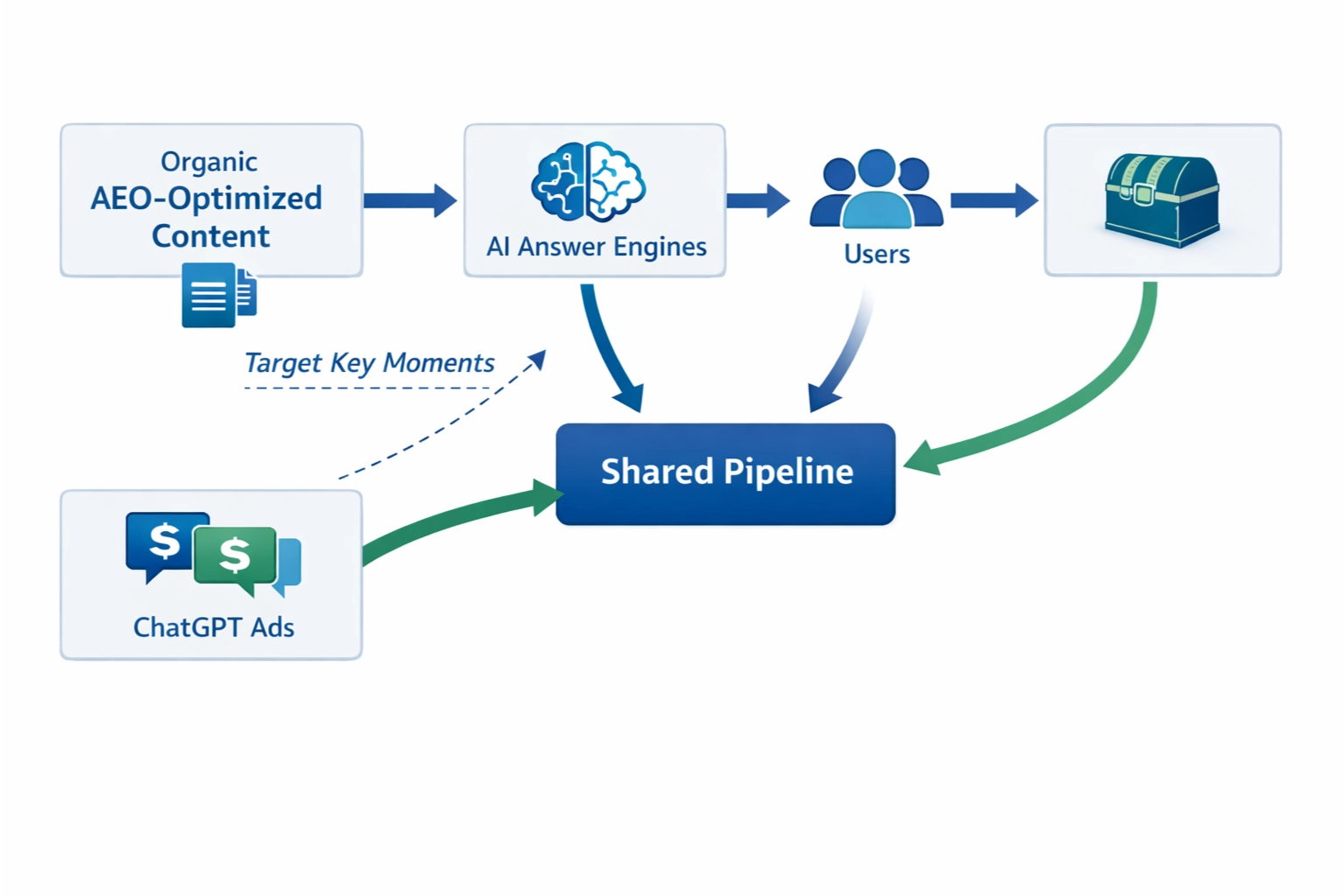
As answer engines mature, treating AEO and ChatGPT ads as an integrated system rather than as disconnected tactics becomes a durable competitive advantage. Brands that invest early in being reliable sources for AI-generated answers, then strategically layer paid placements inside those same environments, will occupy more of the conversational real estate where decisions are shaped.
The frameworks in this guide give your team a concrete path: clarify your entity map, build answer-friendly resources, instrument AI visibility, and experiment with tightly scoped ChatGPT ad pilots that fill the gaps left by organic citations. Over time, this compound approach can reduce acquisition costs, improve lead quality, and make your brand the default name surfaced when prospects describe the problems you solve.
If you are ready to accelerate this journey, Single Grain can bring together AEO, GEO, traditional SEO, and paid ChatGPT campaigns into a single, accountable growth program. Get a FREE consultation to see how a unified AI visibility strategy could translate into measurable pipeline and revenue for your organization.
Frequently Asked Questions
-
How should I budget between AEO initiatives and ChatGPT ads?
Treat AEO as a foundational investment and ChatGPT ads as an acceleration layer. Many teams allocate a higher percentage of budget to AEO upfront to build durable visibility, then gradually increase paid spend in ChatGPT once they see which topics and journeys are already working organically.
-
Who inside my organization should own AEO and ChatGPT ad strategies?
AEO typically sits at the intersection of SEO, content, and product marketing, while ChatGPT ads align closely with paid media and demand gen. In practice, you’ll see the best results when a single cross-functional owner (often a growth or digital lead) coordinates shared goals, reporting, and test plans across all of these stakeholders.
-
How can we adapt AEO and ChatGPT ads for different countries and languages?
Localize not only language but also examples, regulations, and product nuances so answer engines recognize you as contextually relevant in each market. For ChatGPT ads, build separate campaigns with region-specific messaging, offers, and compliance checks, rather than relying on simple translation.
-
What legal and compliance considerations should we keep in mind for ChatGPT ads?
Work with legal and compliance teams to pre-approve claim language, required disclaimers, and data capture flows before launching conversational creatives. Also, ensure your privacy policy clearly covers interactions from AI assistants and that your ad copy does not imply guarantees or outcomes you can’t substantiate.
-
How do we keep our content and messaging consistent across AEO and ChatGPT ads?
Create a central messaging framework that defines your key value propositions, proof points, and tone, then reference it in both content briefs and ad copy guidelines. Regular quarterly reviews ensure that your answer-oriented content and conversational ads reflect the same positioning, pricing, and product reality.
-
Which tools can streamline day-to-day management of AEO and ChatGPT ad programs?
Use your existing SEO platform for crawl health, entity mapping, and structured data checks, then layer on prompt-testing spreadsheets or custom dashboards to track AI mentions over time. For ChatGPT ads, rely on your media-buying or marketing automation stack for audience management, creative testing, and performance reporting so results roll up into your existing analytics.
-
How can subject matter experts (SMEs) contribute without slowing down AEO and ad production?
Involve SMEs in structured, time-boxed interviews to extract detailed insights, then have content and paid teams translate those into answer-friendly resources and conversational ad angles. Capture reusable SME quotes, frameworks, and FAQs in an internal knowledge base so you don’t need to re-engage them for every new asset or campaign.