

How Universities Can Influence LLM Responses to “Best Programs For…”


LLM university rankings are quietly reshaping how prospective students discover “best programs for…” across law, AI, business, and more. When someone asks an AI assistant for the top schools in a field, the answer appears as a confident list, often without any explanation of data sources. Those snapshots can influence shortlists, applications, and even scholarship decisions long before anyone reaches an official university website. Yet most institutions have little visibility into how these rankings are formed or how they might be improved.
The phrase “best LLM programs” is especially confusing because it can refer to both Master of Laws degrees and universities leading in large language model research. Behind that ambiguity sits a deeper shift: generative AI is becoming a primary gateway to program discovery. This guide unpacks how AI-generated “best programs for…” answers are constructed, how they differ from traditional rankings, and what practical steps universities can take to influence them ethically and effectively.
TABLE OF CONTENTS:
- LLM university rankings: Two meanings, one strategic opportunity
- How large language models construct “best programs for…” answers
- Strategic playbook for influencing LLM “best programs” lists
- Governance, ethics, and KPIs for AI-driven university rankings
- Safeguarding your story in the era of LLM university rankings
LLM university rankings: Two meanings, one strategic opportunity
When people type or speak “best LLM programs” into an AI assistant, they often mean one of two things. Some are looking for the strongest Master of Laws programs in a particular jurisdiction or specialty. Others are asking about universities that excel in large language model research, AI safety, or applied machine learning. Because models interpret queries statistically, they frequently blend these intents together.
For universities, this ambiguity creates both risk and opportunity. If your law school and computer science department are not clearly differentiated online, a model may conflate them, omit one entirely, or misinterpret which is most relevant for a given query. Institutions that clarify their entities and strengths across both meanings of LLM can capture more of this blended demand.
Two overlapping user journeys behind “best LLM programs”
A prospective law student might start with a web search for “best LLM in international law,” skim a few human-curated rankings, then ask an AI assistant for clarification about scholarships or regional options. By the time they reach an individual university site, their expectations and shortlist have already been shaped by those AI summaries.
An aspiring AI researcher follows a similar but distinct path. They may ask a model directly for “top universities for large language models research,” receive a synthesized ranking, and only then dive into faculty pages, labs, and publications. In both cases, AI-generated lists serve as a reputational filter, determining which institutions are even considered.
Why conversational answers now shape program discovery
Conversational interfaces compress research steps that used to span many pages and sessions. Instead of comparing multiple ranking tables, notes, and student reviews, applicants often accept a single composite answer as a starting point. That answer can downplay regional strengths, emerging programs, or niche specializations that do not yet have strong digital signals.
Because the mechanics behind these AI-generated rankings are opaque, universities can feel powerless to respond. In practice, however, the same elements that support strong organic visibility (clear entities, authoritative content, and consistent external citations) also influence how models assemble their “best programs” outputs. The difference is that optimization now has to consider both classic search engines and AI-powered answer engines at once.

How large language models construct “best programs for…” answers
Large language models do not maintain a traditional database of ranked universities. Instead, they generate answers by combining what they learned during training with any external information they can access at query time. That means LLM university rankings emerge from patterns in text rather than from a transparent scoring rubric.
During training, models ingest vast amounts of public web content, including news articles, academic pages, Wikipedia entries, and human-curated rankings. When asked for the “best” programs, they infer which institutions are associated with excellence in a given field based on how often, and in what context, those institutions appear. If a university’s strengths are poorly documented or inconsistently described online, the model may not surface them even when human experts would.
The hidden pipeline from web content to AI-generated rankings
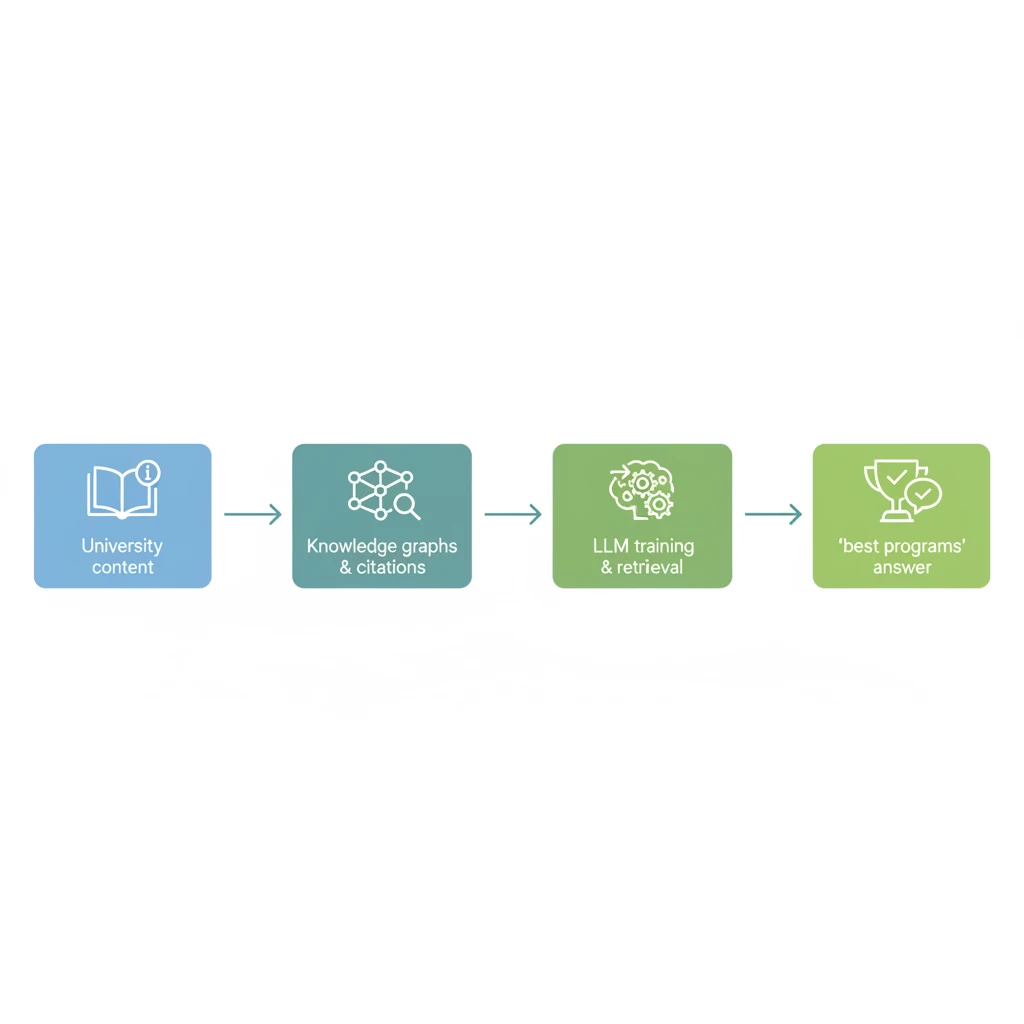
Between your program pages and an AI-generated ranking answer sit several layers of interpretation. Search engines and knowledge graphs first parse your content, extract entities such as institution names and departments, and connect them to topics like “LLM in Tax Law” or “large language models research.” Ranking organizations and media further amplify certain institutions through lists, profiles, and comparative articles.
By the time a user asks a model for the “best programs,” the LLM is drawing from this multi-layered ecosystem of entities, citations, and prior rankings. If your institution is underrepresented in those intermediate layers, you are less likely to appear in the final answer—even if your actual program quality is high.
Data sources LLMs lean on for university reputation
Models give disproportionate weight to sources that are dense with comparative information about universities. Prominent global rankings, major news outlets, and widely referenced encyclopedic resources often form the backbone of their understanding. That is one reason why appearing in respected ranking tables and being covered in mainstream or specialist media can have an outsized impact on AI-generated visibility.
Ranking publishers are also adapting. Times Higher Education recently validated more than 270,000 documents from 2,152 institutions using LLM-assisted workflows, and has begun advising universities on how to present evidence so both human analysts and AI systems interpret it correctly. When your submissions and public materials are structured in ways these hybrid human–AI systems can parse, your strengths are more likely to be reflected in downstream AI outputs.
The field is still remarkably under-measured. There are currently zero quantified statistics for 2024–2025 on how many universities are actively trying to influence LLM-generated “best programs for…” rankings. For institutions willing to experiment responsibly, this lack of benchmarking means there is a significant first-mover advantage.
At the same time, models inherit the web’s structure. If your site’s architecture does not clearly express relationships between faculties, degrees, and research areas, knowledge graphs have less to work with. Approaches such as building an AI topic graph that aligns site architecture with LLM knowledge models, as explored in this analysis of AI-aligned site structures, can help ensure your content slots neatly into the entity graphs that models rely on.
| System | Owner of methodology | Primary data sources | Update frequency | Transparency | Strengths | Limitations |
|---|---|---|---|---|---|---|
| Traditional rankings (e.g., QS, THE, US News) | Ranking organizations | Institutional submissions, bibliometrics, surveys | Annual or periodic | Methodology published, but complex | Stable, comparable year to year | Slow to reflect emerging fields or niches |
| Review aggregators | Platforms (e.g., student review sites) | User reviews, ratings | Continuous | Scattered and inconsistent | Rich qualitative insight | Subject to selection bias |
| AI/LLM-generated rankings | Model developers (opaque) | Training data, web content, retrieved snippets | Model and index update cycles | Limited visibility into weighting | Fast, conversational, customizable by prompt | Potentially biased, hard to audit or replicate |
Strategic playbook for influencing LLM “best programs” lists
Because LLM university rankings are emergent rather than explicitly computed, influence comes from shaping the input models that they rely on. That requires a coordinated strategy across content, technical SEO, external signals, and measurement. The goal is not to “game” models, but to ensure they have accurate, machine-readable evidence of your strengths.
The most effective way to begin is with a systematic audit of how different AI systems currently describe your institution and programs. From there, you can prioritize the gaps that matter most for specific queries such as “best LLM in environmental law” or “top universities for large language models research.”
Auditing your current LLM university rankings presence
An audit starts with standardized prompts tested across several major models (for example, ChatGPT, Gemini, Claude, Perplexity) and regions. By keeping the wording consistent, you can see where answers converge or diverge, and where your institution appears, is omitted, or is mischaracterized.
Useful prompt patterns include:
- “List the top 10 universities worldwide for [subject] and briefly explain why each is well regarded.”
- “What are the best LLM (Master of Laws) programs in [country/region] for [specialty]?”
- “Which universities are known for leading research on large language models and generative AI?”
- “If I want a career in [career goal], which university programs should I consider?”
Recording these answers over time effectively becomes a longitudinal dataset on your AI visibility. Techniques like LLM query mining—systematically analyzing the kinds of questions users ask AI tools about programs and universities—can further reveal new intent clusters you may not be addressing in your content.
Rebuilding program pages and site structure for LLM clarity
Once you understand how models currently see you, the next step is to make your key pages unambiguous and semantically rich. That means clear, descriptive headings; concise explanations of what makes each program distinctive; and structured metadata that reinforces degree type, subject area, and level. Consistency across related pages (for example, program overview, faculty list, and admissions page) helps models form a stable picture of the entity.
Some universities are already standardizing this. Purdue University’s Digital Media Services has published campus-wide SEO guidance that emphasizes semantic headings, descriptive metadata, and user-first structures to keep program pages discoverable and authoritative as AI-driven search grows. Aligning with similar best practices makes your content easier for both search engines and LLMs to parse.
At a structural level, mapping how your faculties, research centers, and degrees relate to one another helps external knowledge graphs connect the dots. Extending the AI topic graph approach mentioned earlier beyond blog content to your full academic catalog can greatly improve how your institution is represented in AI reasoning about “best programs.”

Authority, citations, and high-signal data for LLMs
Because LLMs learn reputation indirectly, third-party validation is critical. Profiles in respected media outlets, inclusion in traditional rankings, notable alumni stories, and structured research outputs all increase the likelihood that your institution is mentioned in high-signal contexts. These mentions then become part of the model’s training data and retrieval ecosystem.
Emerging LLM evaluation benchmarks increasingly look for high-quality, well-documented datasets and research outputs. Universities that publish AI-relevant datasets, open-access papers, and clear summaries of their contributions make themselves attractive inputs for future models that will power ranking-like answers in AI assistants.
Internally, consider how your own systems surface institutional knowledge. If you are deploying chatbots or assistants on your site, retrieval-augmented generation (RAG) quality matters. Applying LLM retrieval optimization practices to those systems not only improves the on-site experience but also encourages teams to think in terms of structured, machine-consumable content that external models can understand.
Analytics and experimentation for ongoing LLM visibility
Unlike traditional rankings, AI-generated answers may shift with model updates, new training data, or even changes to your own content. Monitoring those shifts requires deliberate instrumentation. Specialized LLM tracking software for brand visibility can help you measure how often your institution appears in specific AI answers, how it is described, and how competitors are positioned.
At the same time, classic SEO experimentation remains valuable. An SEO experimentation platform such as Clickflow.com can help your team test title tags, meta descriptions, and on-page elements on critical program pages to improve organic click-through rates. Over time, those refinements can influence both how search engines rank your pages and how they are ingested into the broader web corpus that trains and informs LLMs.
Bringing these threads together into a unified “AI rankings” roadmap can be challenging. If your institution needs a partner to connect technical SEO, AI-focused content strategy, and answer engine optimization into a coherent plan, Search Everywhere Optimization services from a specialized agency can provide the cross-channel perspective and experimentation muscle required.
Governance, ethics, and KPIs for AI-driven university rankings
Influencing LLM-generated rankings touches on institutional reputation, academic integrity, and student trust. That makes governance and ethics as important as technical execution. Universities need clear principles for drawing the line between accurate amplification of strengths and manipulative behavior that could undermine credibility.
Good governance also ensures that responsibility for AI visibility is shared appropriately across marketing, communications, IT, and academic leadership, rather than falling haphazardly to whichever team first experiments with prompt testing or AI-focused content.
Ethical boundaries: Influence versus manipulation
Most universities are comfortable correcting factual errors in media coverage; similar standards should apply to AI outputs. It is reasonable to work to ensure that models accurately reflect your accreditation status, program offerings, and major strengths. It is not acceptable to publish misleading claims, obscure necessary trade-offs, or overstate rankings in ways that would confuse prospective students.
Because LLMs often over-represent English-language and heavily digitized institutions, there is also a responsibility to consider global fairness. Strengthening your own digital footprint should go hand-in-hand with supporting broader efforts toward multilingual, geographically diverse training data so that AI-generated rankings do not systematically disadvantage certain regions or institution types.
Designing LLM visibility KPIs for your institution
Measuring progress requires metrics that reflect how often and how positively you appear in AI-generated “best programs” answers. Useful KPIs include share of voice in top lists for priority queries, consistency of inclusion across different models, and assessments of how accurately your programs are described. Tracking these over time lets you see whether content, PR, or structural changes are having the intended impact.
At the ecosystem level, however, measurement frameworks are still immature. There are currently zero dedicated benchmark suites explicitly tracking “LLM ranking manipulation by universities.” In the absence of standardized benchmarks, institutions must build their own ethical KPIs and monitoring processes, often combining AI answer tracking, web analytics, and admissions data.
Here, the same platforms you use to monitor AI visibility can integrate with broader analytics. Combining LLM answer tracking, insights from tools like Clickflow.com on content performance, and traditional web metrics enables a more complete view of how changes to your digital footprint affect applicant behavior and brand perception.
Safeguarding your story in the era of LLM university rankings
LLM university rankings will only grow more influential as prospective students treat AI assistants as trusted guides for deciding where to study law, computer science, and countless other fields. Institutions that ignore this shift risk being sidelined by opaque, composite lists that do not fully reflect their strengths. Those that engage thoughtfully can help models tell a more accurate, nuanced story about their programs.
The path forward combines careful auditing of current AI outputs, disciplined improvements to program pages and site architecture, and deliberate cultivation of external signals that LLMs treat as evidence of quality. Governance and ethics frameworks ensure that these efforts support transparency and student trust rather than undermining them. Over time, this becomes a continuous process of monitoring, learning, and refinement rather than a one-off project.
If your university wants to turn this emerging challenge into a strategic advantage, partnering with experts in AI-era search and answer engine optimization can accelerate progress. A team focused on Search Everywhere Optimization can help you map the connections between classic SEO, AI Overviews, LLM-generated rankings, and admissions outcomes, then prioritize the levers that matter most for your specific goals.
Alongside that strategic support, tools like Clickflow.com give your web and content teams a practical way to experiment with on-page changes, improve organic performance on critical program pages, and feed cleaner, more compelling signals into the ecosystem LLMs learn from. Taken together, these capabilities help safeguard your institution’s story and ensure that when someone asks an AI for the “best programs for…” your strengths have every chance to appear.
Frequently Asked Questions
-
How should universities respond when AI tools present outdated or incorrect information about their programs?
Start by documenting the specific prompts and outputs where the errors occur, then update your own web content, structured data, and official profiles so the correct information is clearly and consistently published. Where possible, use feedback channels offered by major AI and search platforms to flag inaccuracies, referencing authoritative pages on your site as the source of truth.
-
What role can faculty and researchers play in improving a university’s visibility in LLM-generated rankings?
Faculty can increase institutional visibility by maintaining up-to-date profiles, publishing in reputable venues, and clearly affiliating their work with the university in bios and author lines. Encouraging consistent naming for labs, centers, and chairs also helps LLMs reliably associate expertise and breakthroughs with your institution.
-
How can smaller or less globally known universities compete in LLM-generated “best programs” lists?
Smaller institutions can focus on clearly defined niches, showcasing measurable outcomes, partnerships, and specialized strengths that may be underrepresented among large universities. By publishing high-quality, well-structured content around those niches and earning citations from respected regional or sector-specific sources, they can signal distinct expertise to LLMs.
-
Are there legal or compliance issues universities should consider when trying to influence AI-generated rankings?
Universities must ensure that any claims about rankings, outcomes, or accreditation are accurate, up-to-date, and properly sourced to avoid misleading advertising or regulatory scrutiny. Coordination with legal and compliance teams is important when updating public materials, especially in jurisdictions with strict rules on educational marketing and data protection.
-
How can universities align messaging for traditional rankings, SEO, and LLMs without confusing prospective students?
Develop a single messaging framework that defines your core differentiators, then adapt its depth and format for each channel while keeping terminology and proof points consistent. Internal review processes can ensure that references to rankings, outcomes, and strengths match across brochures, web pages, press releases, and AI-focused content.
-
What internal data can universities safely leverage to improve how AI systems recommend their programs?
Aggregated, anonymized data on graduate outcomes, employer partnerships, and student satisfaction can be turned into public-facing reports and case studies that LLMs can ingest. Sensitive or personally identifiable data should never be shared with external AI tools; instead, translate insights into de-identified, high-level narratives and statistics on your own site.
-
How might LLM university rankings change over the next few years, and how can institutions stay prepared?
As models become more multimodal and personalized, rankings are likely to shift from static lists to context-aware recommendations that factor in budget, geography, and career goals. Universities can stay prepared by treating AI visibility as an ongoing discipline: regularly monitoring outputs, updating content, and adapting to new AI interfaces rather than relying on one-off projects.