

How Fintech Companies Can Rank in AI-Driven Financial Advice Queries


Fintech GEO optimization is rapidly becoming the missing link between your content and the AI-driven financial advice now appearing at the top of search results and inside conversational assistants. Instead of clicking through ten blue links, consumers increasingly get a synthesized answer to questions like “best cash-back card for freelancers in California” or “low-fee robo-advisor for UK beginners” directly from AI systems trained on web content.
For fintech companies, this shift is both an opportunity and a risk: win these AI answers, and you capture high-intent demand; lose them, and you become invisible in crucial decision moments. This guide walks through how fintech teams can structure content, data, and workflows so AI systems confidently surface their guidance, while staying aligned with stringent financial and privacy regulations across regions.
TABLE OF CONTENTS:
- Why AI-Driven Financial Advice Queries Demand a New Playbook
- Fintech GEO Optimization Fundamentals for AI-First Search
- Compliance-First GEO: Ranking in AI Results Without Regulatory Risk
- Content Architectures That Win AI-Driven Financial Advice Queries
- Measurement, Tools, and a 90-Day Fintech GEO Roadmap
- Turning Fintech GEO Optimization Into a Competitive Moat
Why AI-Driven Financial Advice Queries Demand a New Playbook
Traditional SEO was built around ranking on result pages where users skim multiple listings before deciding where to click. AI-driven financial advice queries compress that decision path, because the answer engine produces a single, synthesized recommendation, often with only a few source citations. That means many fewer brands get visibility for each query.
Generative engines combine classic search signals with entity understanding, topical authority, and geographic context to decide which sources are trustworthy. In regulated finance, those decisions must reflect not just expertise, but also whether the source is relevant to the user’s country, state, or licensing regime. GEO-focused strategies directly influence these signals.
Global fintech investments reached $95.6 billion across 4,639 deals in 2024, underscoring how competitive the space has become. With so many funded players chasing similar audiences, winning visibility in AI overviews and assistant responses becomes a structural advantage, not a nice-to-have.
From SEO to GEO in Regulated Finance
Generative Engine Optimization (GEO) extends beyond keyword rankings to shaping how AI systems understand and reuse your content. It focuses on your presence in AI overviews, answer boxes, and chat-based assistants, where models paraphrase, compare, and contextualize your information. For fintech, the “answer” itself is often interpreted as advice, which triggers an entirely different risk profile.
As mentioned earlier, success is less about winning a single position on a results page and more about being the safest, clearest, and most contextually relevant source an AI model can cite. That requires precise descriptions of products, eligibility, risks, and geography so models can align your content with specific financial situations. It also requires consistent signals across your site that you are authorized to speak to those scenarios.
Fintech marketers who approach GEO as an add-on to classic SEO campaigns usually miss these nuances. A more effective approach treats GEO as the connective tissue between content, compliance, and regional targeting, ensuring every page can be safely reused in an AI-generated explanation of a financial strategy or product choice.
Fintech GEO Optimization Fundamentals for AI-First Search
Ranking in AI-driven financial advice queries starts with giving models the raw materials they need to construct precise, risk-aware answers. That means structuring your site so that products, advice topics, and locations are described in a machine-readable way, not just in marketing copy. This is where disciplined fintech GEO optimization begins.
Location-based tactics are central. The global market for location-based advertising is growing rapidly, reflecting a broader industry shift toward geo-specific digital strategies. Applying that same level of geographic precision to your organic and AI-search content ensures that advice surfaces only where it is valid and relevant.
For many teams, the same thinking that drives paid geo-campaigns can inform organic GEO playbooks. Campaign structures, region definitions, and audience research already exist; the challenge is to translate those insights into content architectures, schemas, and internal links that AI systems can interpret and trust.
Core Building Blocks of Fintech GEO Optimization
Four foundational elements underpin effective fintech GEO optimization for AI search: entities, topics, structure, and signals. Entities describe who you are and what you offer (your brand, product lines, licenses, and key people) consistently across the site so AI systems can resolve you in their knowledge graphs.
Topics map to the specific financial questions your audience asks, such as “tax-efficient investing for German residents” or “invoice financing options for Canadian SMEs.” Each high-value topic needs an authoritative, comprehensive page that provides clear definitions, step-by-step explanations, eligibility criteria, and risks, written in a language that is understandable to both humans and machines.
Structure then exposes this information via clear headings, tables, and FAQ sections, while enriched schema (for example, FinancialService, Product, FAQPage, and Organization) makes your intent explicit. Finally, signals like author bios, citations to regulations, and consistent cross-linking tell generative engines that your content is accurate, current, and well-sourced.
Aligning GEO With Local and Regulatory Boundaries
In finance, “local” is rarely just about proximity; it is about which rules apply. A savings product might be available nationally, while a mortgage offer is limited to certain states, and an investment advisory service is licensed in a specific country. GEO strategies must encode these realities unambiguously.
Practical implementations create separate, clearly labeled sections or pages for each jurisdiction, with explicit statements about where the offer applies and who it is suitable for. Internally, your content strategy can mirror the kind of structured planning outlined in resources on how GEO optimization improves customer acquisition, mapping journey stages and locations to specific content assets.
This alignment helps AI systems avoid suggesting your UK-only product to a US-based user or recommending a lending solution to someone in a province where you do not operate. It also reduces the risk of being cited in misaligned or misleading AI-generated advice, which becomes increasingly important as regulators scrutinize digital marketing in finance.

Compliance-First GEO: Ranking in AI Results Without Regulatory Risk
Financial services marketing is governed by overlapping regimes such as the SEC and FINRA in the US, the FCA in the UK, and GDPR-style privacy laws globally. When AI systems start quoting your site in what users perceive as advice, regulators may see that as an extension of your marketing communications. GEO work cannot be separated from this compliance backdrop.
Instead of treating compliance as a final review step, leading fintechs design GEO programs where every content brief, template, and schema pattern is reviewed through a regulatory lens. This reduces rework, accelerates publishing, and builds a defensible audit trail showing that AI-optimized content was created and approved in a compliant manner.
Mapping Content to Jurisdictions, Licenses, and Disclaimers
A practical first move is to create a master “jurisdiction matrix” that maps each product or advice area to the regions where it can be offered and the licenses that underpin it. Every major content type (guides, calculators, comparison pages, and FAQs) should reference this matrix so writers and editors know which boundaries to maintain.
In addition, standardized disclaimer blocks can be associated with specific content archetypes and regions, ensuring that AI-accessible pages always carry appropriate risk warnings and eligibility notes. A 2025 Slaughter and May insight on marketing compliance emphasizes the value of full-funnel compliance reviews and meticulous tagging, which dovetails directly with GEO’s emphasis on structured, clearly labeled content.
When AI models crawl and learn from these pages, they encounter consistent jurisdictional language and disclosures, making your brand a safer candidate for inclusion in synthesized advice. Over time, this consistency becomes part of your reputation within the models themselves.
Operational Workflows for Compliance-Aware GEO Content
Compliance-aware GEO requires disciplined workflows, not just good intentions. Role-based permissions, structured review queues, and automated archiving are essential so teams can show exactly who approved which content, when, and for which regions. These controls become even more critical as content volume grows.
Examples from regulated social media operations illustrate this well. The Hootsuite blog on social media compliance describes geo-aware governance frameworks that match content and disclosures to jurisdictional rules, resulting in robust audit trails and reduced enforcement risk. The same concepts apply to long-form SEO, GEO-optimized pages, and AI-focused FAQs.
Fintechs who embed these workflows into their content operations can scale GEO confidently, knowing each new landing page or article is traceable and defendable. This also makes it easier to respond if regulators or partners question how a specific AI-generated explanation used your brand’s content.
Privacy, Data, and Tracking in a GEO World
While GEO often focuses on content, it intersects closely with how you collect and use data for geo-targeting and personalization. Emerging rules under frameworks like the EU’s DSA/DMA and US state privacy laws constrain how location and behavioral data can be combined, especially for profiling and automated decision-making.
A Basis Technologies article on digital advertising regulation highlights the importance of privacy-by-design approaches that blend first-party intent data with compliant GEO signals. For fintech GEO work, that mindset means designing experiences where users understand how their data shapes localized content and where consent management is fully aligned with your organic and AI-optimized experiences.
Treating privacy constraints as design parameters allows marketing teams to co-create GEO strategies that retain regional relevance without drifting into risky data practices. This keeps your AI-search visibility sustainable as privacy enforcement tightens.
For fintech teams that want specialized partners to support both strategy and execution, resources such as the overview of leading GEO-focused SEO companies for AI Overviews can help benchmark capabilities and understand what a mature GEO engagement should include.

Content Architectures That Win AI-Driven Financial Advice Queries
Once governance foundations are in place, the next step is designing content formats that AI systems favor for financial advice queries. These formats must answer questions clearly, show how recommendations change by scenario and region, and make it trivial for models to attribute specific claims to specific parts of a page.
Rather than relying on generic blog posts, high-performing fintech sites use modular page designs, with each module serving a clear purpose: define, compare, qualify, warn, and next-step. This modularity helps generative engines extract only the relevant pieces when constructing an answer for a particular user.
Query Clusters by Fintech Segment
Different fintech sub-verticals face different AI-search opportunities. Consumer neobanks often see queries about fees, overdraft protections, and local ATM networks, while wealthtech platforms attract questions about portfolio construction, tax efficiency, and automated rebalancing. Insurtech firms see coverage and exclusions questions, and B2B payments platforms see integration and cross-border settlement queries.
A practical approach is to develop “query clusters” for each segment you serve:
- Consumer banking: account types, local deposit insurance, branch/ATM availability, overdraft policies, and regional fee differences.
- Wealth and robo-advisors: risk profiles, rebalancing rules, fund selection, tax rules by country, and minimum investment amounts.
- Lending and BNPL: eligibility, APR calculation, late-payment consequences, and jurisdiction-specific consumer protections.
- Insurtech: coverage triggers, exclusions, regional regulations, and claim processes.
- B2B payments and SaaS: integration options, settlement currencies, local regulatory reporting, and data security certifications.
Each cluster becomes a blueprint for dedicated answer-first pages and FAQ sections that cover the full set of related questions a user — or an AI assistant — might ask.
Designing Answer-First Pages for AI Assistants
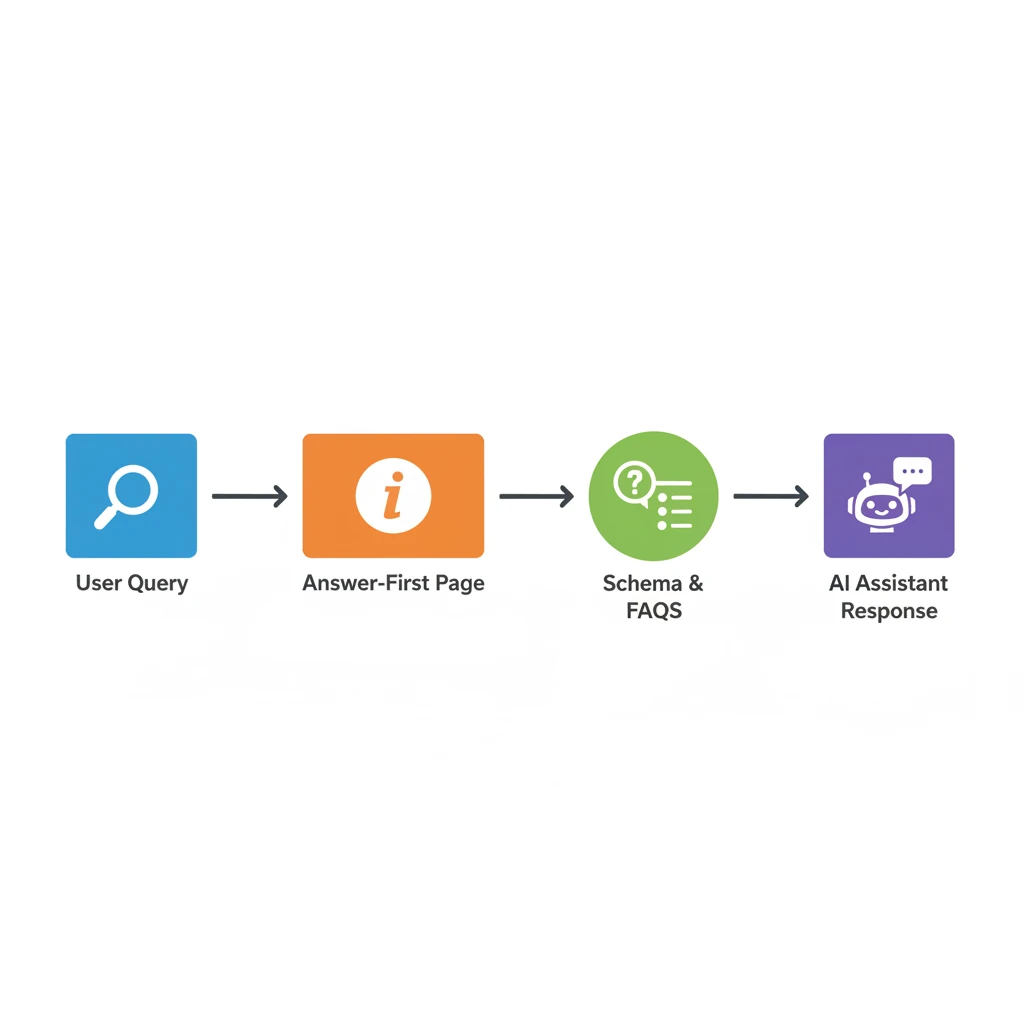
Answer-first pages prioritize clarity over storytelling. Each should open with a concise, plain-language summary that directly addresses the primary query, followed by structured sections detailing how the answer varies by customer type, risk tolerance, and region. Tables work especially well for side-by-side comparisons of product features or regulatory constraints.
Below the main explanation, short, focused FAQ entries can address adjacent questions in a question-and-answer format that LLMs parse easily. When combined with a consistent schema and clear internal links, these pages become highly attractive training material for generative systems seeking authoritative, well-structured financial explanations.
Because these pages often become the de facto “source of truth” about your brand in AI-search contexts, it is essential to ensure they present an accurate and balanced story. Guidance on using GEO for brand reputation and managing what AI says can be adapted to the specific reputational stakes of financial advice.
Schema, FAQs, and Internal Links for GEO
Technical enhancements amplify the effectiveness of answer-first content. Structured data lets you define the type of page (for example, FAQPage or Article), the financial products discussed, and the geographic areas served, all programmatically in a way AI systems understand. This reduces ambiguity and strengthens your eligibility for AI overview citations.
Smart internal linking then connects GEO-optimized hubs to related resources, such as product disclosures, calculators, and support documentation. Over time, this creates a dense, topic- and region-specific graph that both traditional search engines and generative assistants can navigate, increasing the chance that your content is selected when they assemble a comprehensive, multi-part answer.
Measurement, Tools, and a 90-Day Fintech GEO Roadmap
GEO initiatives must prove their value in the same way as other growth programs, especially in capital-efficient fintech environments. While AI-search visibility is harder to measure than classic rankings, you can still build a robust measurement framework that shows how fintech GEO optimization influences discovery, engagement, and revenue.
Because many AI experiences are “zero-click,” attribution will never be perfect, but directional metrics, combined with rigorous experimentation, can still guide investment decisions. The key is to define GEO-specific KPIs and align them with your broader acquisition and retention goals.
KPIs for GEO and AI-Search Visibility
Useful measurement categories fall into visibility, engagement, and outcomes. Visibility metrics include tracking how often your brand appears as a cited source in AI Overviews, answer boxes, and assistant responses for target queries and regions, using a structured sampling process over time.
Engagement metrics include organic traffic, time on page, and on-site search interactions for GEO-optimized content clusters, segmented by geography and product line. Outcome metrics then connect this activity to lead submissions, applications started, funded accounts, or assets under management, depending on your model.
To justify GEO investment internally, you can also draw on analyses of GEO optimization costs versus ROI, using their frameworks to model scenarios where improved AI-search presence translates into incremental conversions in key markets.
30/60/90-Day Fintech GEO Optimization Plan
A structured roadmap keeps GEO from becoming an open-ended experiment. In the first 30 days, focus on audits: catalog existing content by topic and region, document licenses and eligibility rules, and identify your top 20–30 high-intent financial advice queries by segment and geography. At the same time, map your current compliance workflow and pain points.
Days 31–60 are for foundations and pilots. During this phase, you can create or refactor a small set of answer-first pages and FAQ clusters for one or two key query clusters, apply schema and internal linking patterns, and run them through your newly tuned compliance workflow. Initial measurements should focus on organic engagement and any early AI Overviews citations.
Days 61–90 are about scaling and iteration. Here, you expand the content architecture to additional segments and locations, refine templates based on performance data, and begin more systematic testing of titles, meta descriptions, and on-page structures. SEO experimentation platforms such as Clickflow.com can be especially useful at this stage to run controlled tests on GEO-targeted pages and quantify their impact.
Fintech teams that prefer to augment internal capabilities rather than build everything from scratch can explore specialized partners highlighted in resources covering innovative answer engine content optimization companies, selecting support that aligns with their vertical and regulatory footprint.

As your program matures, the objective is to integrate GEO into routine planning and retrospectives, just as you would with paid media or lifecycle marketing. Over time, you should see clearer relationships between improvements in AI-search visibility and down-funnel metrics such as application completions or booked advisory calls in each target region.
When internal resources are constrained or when you need a benchmark for best-in-class execution, overviews of agencies that use GEO to improve customer acquisition and of top GEO-focused SEO companies can help define expectations for outcomes, workflows, and reporting.
Turning Fintech GEO Optimization Into a Competitive Moat
AI-driven financial advice will only grow more prevalent, and the brands that models habitually trust today will be hard to dislodge tomorrow. A thoughtful fintech GEO optimization strategy, grounded in precise entities, jurisdiction-aware content, robust compliance workflows, and clear measurement, turns that reality into a durable advantage rather than a threat.
Instead of chasing rankings keyword by keyword, you position your company as a consistently reliable explainer of complex financial decisions for specific audiences in specific regions. That positioning not only improves your visibility in AI assistants and overviews but also builds confidence among regulators, partners, and customers who increasingly encounter your brand through synthesized answers instead of direct clicks.
If you want a partner that can connect GEO, AI-search, and conversion-focused growth into a single, revenue-driven strategy, Single Grain specializes in SEVO and GEO for fintech, SaaS, and other regulated industries. Get a free consultation to design a roadmap that aligns AI-era visibility with your compliance obligations and growth targets, and turn generative search into a scalable acquisition channel rather than a black box.
Frequently Asked Questions
-
How should fintech marketing and compliance teams be organized to support GEO at scale?
Create a joint pod or working group where marketing, compliance, product, and data teams meet on a set cadence with shared GEO KPIs. Give compliance a seat at the planning table, not just final review, and document clear SLAs, approval pathways, and escalation rules so content doesn’t stall as you expand into new regions.
-
What’s the best way for fintechs to handle localization versus simple translation for GEO content?
Treat localization as adapting advice to local norms, regulations, and financial behaviors, not just converting words into another language. Use in-country specialists or localized agencies to adjust examples, thresholds, terminology, and risk framing so answers feel native and reduce the chance of AI misinterpreting your intent in that market.
-
How can early-stage fintechs prioritize GEO work when resources are limited?
Start by focusing on one or two core markets and a small set of high-intent questions directly tied to revenue, rather than trying to cover every geography. Use lightweight templates, shared design systems, and a single schema pattern so each new GEO page is incremental, not a from-scratch build.
-
What budget considerations should fintech leaders keep in mind when planning a GEO program?
Account for three main cost buckets: foundational work (audits, information architecture, and schema design), ongoing content production, and monitoring/analytics. Many teamsphase investment by launching a pilot cluster, proving impact on acquisition metrics, then using those results to secure a larger cross-functional budget.
-
How often should GEO-optimized fintech content be updated to remain attractive to AI systems?
Refresh cadence should follow the rate of regulatory, product, or pricing change in each region, with at least a light review scheduled quarterly. Maintain a change log and version control so you can show when key figures, eligibility rules, or disclosures were last updated if regulators or partners ask.
-
What can fintechs do if AI assistants surface outdated or incorrect information about their products?
First, correct and clarify the source content on your own properties, then strengthen signals such as dates, ownership, and canonical URLs so models can more easily pick up the latest version. Where possible, use feedback channels offered by major platforms and coordinate PR, support, and legal responses to reinforce the updated narrative.
-
How should fintechs integrate GEO optimization into their broader content and demand-generation strategy?
Position GEO pages as the authoritative hubs that other campaigns point to, so paid, email, and partner traffic all amplify the same structured assets. Align campaign themes and lead magnets with your highest-value GEO query clusters, turning AI-discoverable content into the backbone of your full-funnel programs rather than a standalone SEO project.