

Can You Take Your Prompts, Logs, and Evals With You When You Leave a Managed-Agent Vendor?


At a pre-renewal procurement rehearsal, the marketing operations lead asks for the eval fixtures behind the managed agent’s weekly report. The vendor account manager supplies a dashboard export. It contains scores, but no test inputs, expected outcomes, or grading rules. The team has a performance summary it cannot reproduce.
Across the same meeting table, procurement opens the statement of work. It promises access to reporting, but says nothing about exporting prompt versions or raw execution logs. This illustrative renewal scene exposes the purchasing question: can another team run and evaluate the marketing job after the vendor relationship ends?
TABLE OF CONTENTS:
- Quick Overview
- Why specialist-model fit is not an exit plan
- Worked scene: the renewal meeting where nobody can export the eval set
- Worked scene: portability artifacts buyers should demand in the SOW
- Vendor portability checklist (prompts, logs, evals, data, kill)
- Single Brain installs the system; Single Grain runs it when you need the team
Quick Overview
Require portability artifacts before signing a managed-agent agreement. Ownership language should identify what you receive, in which format, and how you will test it outside the vendor’s runtime. A downloadable transcript does not establish that an agent’s workflow can move. Make a successful restore part of acceptance and renewal.
- Secure export rights for prompts, logs, eval fixtures, and workflow configuration.
- Separate ownership of your artifacts from licenses to vendor software.
- Restore the eval set into a second runtime before renewal.
- Specify credential revocation, data deletion, and shutdown controls.
Why specialist-model fit is not an exit plan
Single Grain’s specialized marketing LLM guide addresses specialist fit for pipeline jobs. This page addresses a different purchase decision: whether the buyer retains the artifacts needed to continue those jobs elsewhere. A model can suit your terminology and still sit behind an agreement that withholds the eval corpus.
Eric’s point that a better model still needs a better workflow changes the buying recommendation. Reject a model upgrade offered as the cure for missing event schemas, undocumented routing, or inaccessible grading rules. First require a versioned input/output contract and portable tests. If nobody can define acceptable output, keep the job manual while those controls are built.
Adoption makes this a current procurement issue. Open Future Forum’s September report says 81% of 230 marketing and growth leaders are past exploring agentic AI. Forrester reports 83% of B2C marketing decision-makers are implementing it across seven categories and 52 use cases. These are different populations, not a trend line or evidence that deployed agents are portable.
Worked scene: the renewal meeting where nobody can export the eval set
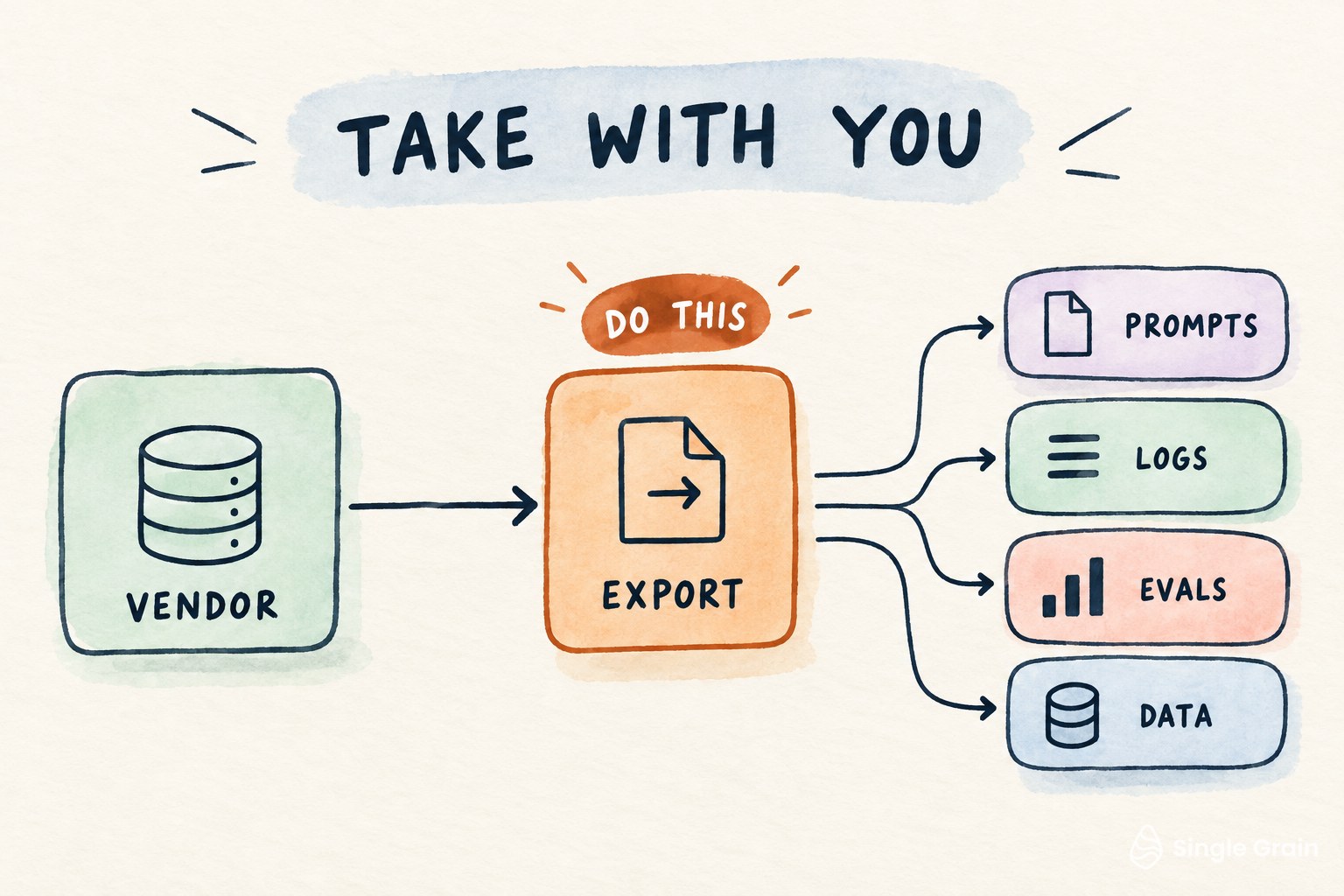
Return to the renewal rehearsal. The AI operations lead requests a complete test fixture: input, expected result or rubric, evaluator version, and recorded outcome. The dashboard cannot provide it. Procurement records the missing artifact as an unresolved acceptance condition rather than accepting another demonstration.
The corrective action is a quarterly portability drill. Export the fixtures and associated prompt versions, load them into a second runtime, and rerun the same cases. Compare results under the original rubric. The requirement is reproducible testing with explainable differences, not identical prose from different models. Record dependencies that prevent execution, including proprietary tools or unavailable retrieval services.
Eric’s discussion of a decision layer for existing agents and checks improved through feedback changes how the team handles gaps. Label thin evidence as thin. A fixture set containing only successful examples does not support a claim of dependable autonomy. Add failures and disputed outcomes before expanding the agent’s authority.
Open Future Forum also names attribution as its leading challenge, appearing in 20 of 96 open answers. That makes source-event identifiers, timestamps, and attribution-rule versions important export fields. Without that lineage, the next operator may inherit conversion totals without being able to explain them.
Worked scene: portability artifacts buyers should demand in the SOW
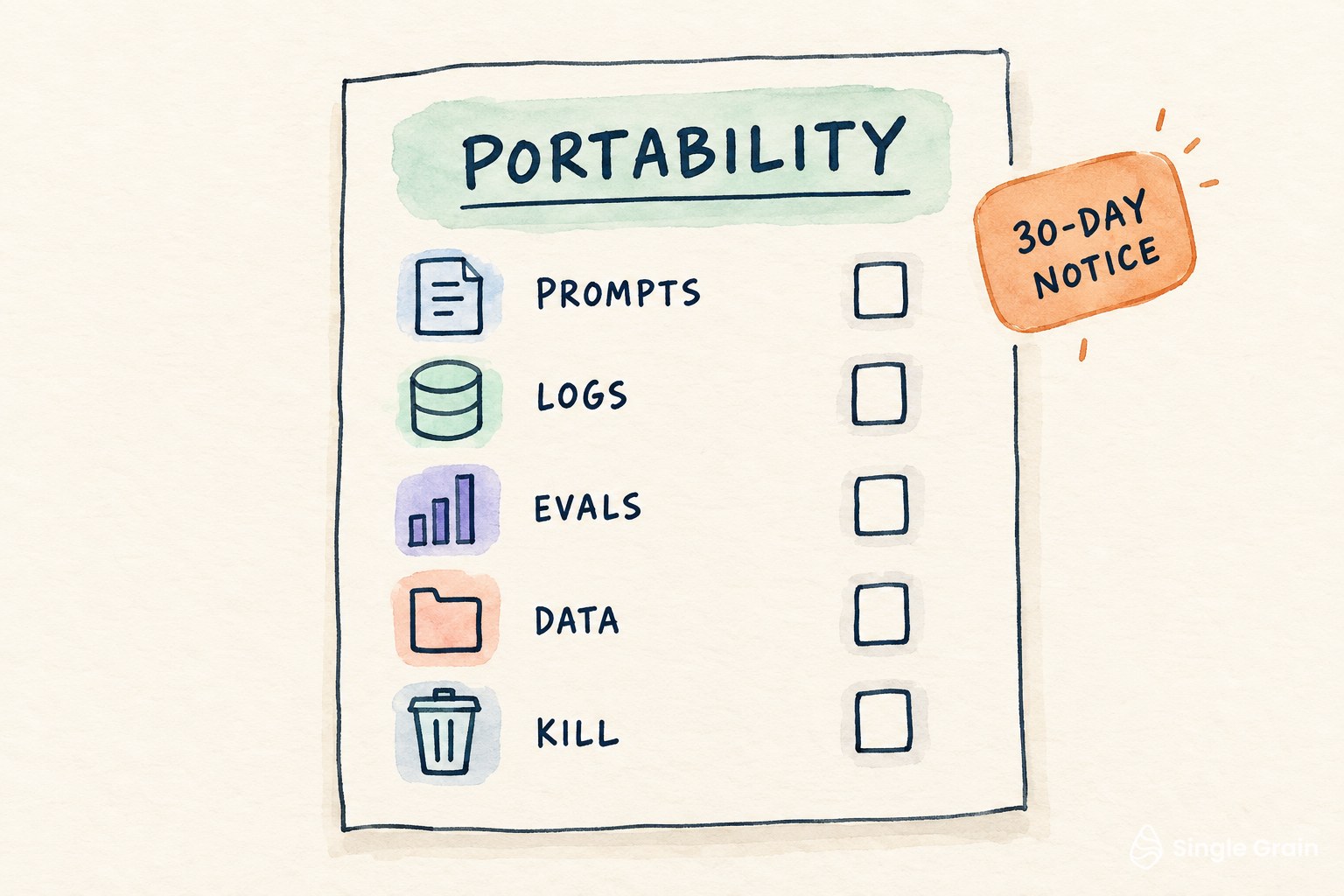
At the contracting review, the procurement lead adds an appendix requiring exportable prompts, eval fixtures, and raw logs on 30-day notice. That is a proposed contract term, not an industry benchmark. The appendix names delivery formats, artifact owners, exclusions, and a restore test. Legal distinguishes buyer-owned materials from licensed vendor components.
The operating logic comes from Eric and Neil’s Leveling Up discussion of turning agency services into AI workflows. They discuss reusable workflows versus custom premium work, with the workflow built and then handed to the team. The practical consequence for this SOW is concrete: the handoff must include a reusable job card, not merely access to an interface. If the workflow remains inside the vendor’s black box, the buyer has rented its execution.
The appendix therefore defines a job card with its input schema, prompt references, tool permissions, output contract, eval rubric, and recovery instructions. For a pipeline-routing job, include the classification taxonomy and exception queue. Eric’s Jev discussion of classification, test criteria, and uncertainty routing makes that exception path part of the portable system, rather than hidden vendor logic.
Use Single Grain’s hire-or-build framework for pipeline agents to assign ownership of this package. Buy managed execution when you need operators. Refuse an arrangement where paying for execution also removes access to your job specification and tests.
Vendor portability checklist (prompts, logs, evals, data, kill)
Put these requirements into the agreement and verify them against an actual export. “Available on request” leaves too much unresolved.
- Prompts: versioned instructions, templates, variables, dependencies, and change history. Identify vendor-owned material that cannot transfer and the replacement interface it requires.
- Logs: machine-readable execution events, tool calls, results, errors, identifiers, and timestamps. Specify retention, redaction, and delivery format.
- Evals: fixtures, rubrics, evaluator configuration, failures, and adjudication history. Exporting a score alone is insufficient.
- Data: source records, retrieval configuration, transformation rules, and deletion obligations. Distinguish data ownership from permission to reuse it elsewhere.
- Kill: documented controls to stop queues, disable triggers, revoke credentials, and confirm scheduled work has ceased. Preserve required audit records before deletion.
Eric’s emphasis that people still supply taste, review, and workflow management determines the ship gate: name the buyer’s marketing operations lead as approver for irreversible writes, uncertain classifications, and teardown. Those actions require a human stamp and must not auto-execute. Capture that responsibility in the marketing-agent RACI.
Test access separately. Forbes reports that Amazon blocked Meta’s Muse shopping agent in September 2026. Exportable prompts cannot guarantee continued platform access. Require an inventory of API permissions, account ownership, and platform restrictions. When a critical dependency lacks an authorized replacement path, exclude that job from the automation commitment.
Single Brain installs the system; Single Grain runs it when you need the team
Single Brain is the AI implementation OS for job-specific agents, evals, and kill switches. Scope the installation around a defined marketing job and its exit package: schemas, versioned instructions, evaluation fixtures, execution evidence, and shutdown controls. Acceptance should include the restore drill, not just a working demo.
Hire Single Grain to install and run that system when you do not want to staff the operating team internally. Bring the proposed SOW, a sample export, and the renewal date. Talk to Single Grain about an engagement that leaves your team with a reusable system and an explicit exit path.


