

ChatGPT Ads vs Perplexity Ads: Comparing AI Advertising Platforms


ChatGPT Ads vs Perplexity Ads is becoming a critical comparison for performance marketers trying to understand where AI-native ad inventory fits into their growth strategy. As large language models shift user behavior from traditional search results to conversational answers, the way ads are delivered, measured, and optimized is starting to look very different from classic Google or social campaigns.
This article breaks down how emerging ad formats in conversational AI products could work, what is currently available, and how to evaluate ChatGPT-style and Perplexity-style inventory next to your existing media mix. You’ll see side-by-side comparisons, planning frameworks, and risk considerations so you can make informed, CFO-friendly decisions about testing these new AI advertising platforms.
TABLE OF CONTENTS:
- AI Answer Engines and the New Advertising Landscape
- Current State of ChatGPT and Perplexity Ad Products
- ChatGPT Ads vs Perplexity Ads Side-by-Side
- Planning Your First LLM Ad Experiments
- Measurement, Risk, and Brand Safety in LLM Advertising
- Balancing Organic and Paid Opportunities in AI Engines
- Choosing the Right Path in ChatGPT Ads vs Perplexity Ads
AI Answer Engines and the New Advertising Landscape
Before diving into specific platforms, it helps to understand what makes AI answer engines different from traditional search and social environments. Instead of returning a list of blue links or a scrollable feed, tools like ChatGPT and Perplexity generate a synthesized answer, often with citations and follow-up suggestions.
That answer-centric experience means ads are likely to sit much closer to the “final” response a user sees, rather than being one option in a long list of results. For advertisers, that raises the stakes: a single sponsored answer can influence the entire user journey for that query.
These systems also rely heavily on context. They use the full conversation history, inferred intent, and sometimes user preferences to shape responses. In an ad setting, this suggests far more contextual targeting and creative matching than traditional keyword-only search campaigns.
At the same time, AI answer engines are still early-stage from a media-buying perspective. Inventory is limited, user behavior patterns are still stabilizing, and most ad products are in beta or conceptual stages. That makes them ideal for experimentation, but risky as a primary acquisition channel.

From Search Results to Conversational Answers
For decades, advertisers have optimized around queries and placements: keywords in search engines, interests and demographics in social feeds, and context on publisher pages. AI answer engines introduce a different unit: the conversation.
Instead of asking, “Which keyword should I bid on?”, advertisers will increasingly ask, “At what point in a multi-turn dialogue does my message add value?” That could be the initial answer, a suggested follow-up question, or a contextual product mention when a user moves from research to action.
This shift from static results to dynamic conversations is what makes ChatGPT Ads vs Perplexity Ads such a strategic decision. Each platform’s approach to integrating sponsored content into conversations will determine whether it behaves more like search, more like display, or something entirely new.
Current State of ChatGPT and Perplexity Ad Products
Because this ecosystem is evolving quickly, it’s important to distinguish between what exists today and what is speculative. As of late 2024, Perplexity has taken more explicit steps toward monetization with ads, while ChatGPT’s monetization has focused primarily on subscriptions and ecosystem features like the GPT Store rather than a mature ads marketplace.
Advertisers evaluating budgets should treat both as experimental channels with different levels of readiness, inventory, and control compared to established networks like Google Ads or Meta Ads.
How Perplexity Ads Work Today
Perplexity positions itself as an “answer engine” that combines LLM-generated responses with citations to web sources. Its early ad experiments have focused on integrating sponsored content into or adjacent to those answer experiences, often in the form of clearly labeled sponsored links or result modules.
In practice, that can look similar to a sponsored answer or a prioritized citation within a response, especially for commercial or high-intent queries. Because Perplexity is built around web citations, advertisers can reasonably expect future ad products to blend native answer placement with promoted links to their own properties.
Targeting your audience on Perplexity is likely to revolve around:
- Query themes and topics (similar to keyword or topic targeting)
- Inferred intent (research, comparison, transactional behavior)
- Context from previous questions in the same session
Measurement in this environment leans heavily on clickthrough to a site or app and downstream conversions tracked via your analytics stack. Because users stay inside the answer engine until they click out, advertisers will need tight tagging and attribution discipline to understand the impact of Perplexity traffic versus other sources.
ChatGPT Advertising: What Exists and What’s Coming
ChatGPT has a massive reach, but, as of the latest widely available information, does not operate a fully fledged self-serve ads platform comparable to search or social networks. Instead, monetization has focused on paid tiers, API usage, and ecosystem monetization such as custom GPTs in the GPT Store.
For advertisers, that means “ChatGPT Ads” is more of a forward-looking concept than a mature product today. However, there are clear signals regarding how advertising could eventually manifest:
- Sponsored suggestions or follow-up questions within chats
- Contextual product or brand mentions in answers, clearly labeled
- Promoted custom GPTs or tools surfaced for relevant queries
- Native units in sidebar summaries or reference panels
Given these possibilities, the strategic question is not just whether to buy ChatGPT inventory once it exists, but also how to prepare your data, creative, and measurement so you can move quickly when beta programs open.

ChatGPT Ads vs Perplexity Ads Side-by-Side
To understand how these AI advertising platforms compare to each other and to existing channels, it helps to look at them in a structured way. The table below highlights how hypothetical ChatGPT Ads and current Perplexity ads would align with Google search ads and Meta social ads across key dimensions.
| Dimension | ChatGPT Ads (conceptual) | Perplexity Ads (early-stage) | Google Search Ads | Meta Social Ads |
|---|---|---|---|---|
| Status/availability | Future/limited experiments, not a mature self-serve platform | Live or testing in select formats and regions | Fully mature, global self-serve | Fully mature, global self-serve |
| Primary surfaces | In-conversation messages, follow-up suggestions, GPT discovery | Answer pages, sponsored links near citations | Search result pages (text ads, Shopping, etc.) | Feeds, Stories/Reels, in-stream video |
| Targeting logic | Conversation context, intent, user history (conceptual) | Query intent, topic, answer context | Keywords, match types, audiences | Demographics, interests, behavior, custom audiences |
| Creative format | Native text answers, tool recommendations, conversational prompts | Text modules with links, possibly native answer elements | Text ads, product listings, responsive formats | Image, video, carousel, lead forms |
| Funnel position | Mid–to–lower funnel, strong for research and solution exploration | Mid–funnel research, some lower-funnel high-intent queries | Full funnel, strongest at mid–to–lower funnel | Full funnel, especially upper and mid funnel |
| Measurement clarity | Likely limited at first, evolving over time | Basic click and conversion tracking via external analytics | Robust conversion and attribution options | Robust conversion, attribution, and lift studies |
| Brand safety controls | To be defined; depends on content and policy enforcement | Early controls; relies heavily on platform guardrails | Keyword exclusions, placement controls, policies | Inventory filters, brand safety partners, policies |
Key Differences in ChatGPT Ads vs Perplexity Ads
From a media buyer’s perspective, the biggest difference between ChatGPT Ads vs Perplexity Ads is timing and readiness. Perplexity already exposes ad inventory in some form, meaning you can experiment in select markets. ChatGPT, by contrast, remains primarily an organic and ecosystem play, with advertising still conceptual for most brands.
Another important distinction is the role of citations. Perplexity’s answer format always points back to sources, which makes it natural to route traffic directly to advertiser sites via sponsored links. ChatGPT’s answers are more self-contained, so future ad units may lean more heavily on native recommendations or on-platform actions before pushing users to external properties.
Finally, the underlying user behavior differs. Perplexity users often frame queries as traditional searches, expecting quick, source-backed answers. ChatGPT users are more likely to conduct multi-step tasks and open-ended brainstorming. That makes Perplexity more analogous to search ads and ChatGPT more analogous to an AI assistant, where ads will need to be especially value-adding and unobtrusive.
Planning Your First LLM Ad Experiments
Even if ChatGPT’s ad products are not fully available yet, you can start building an LLM advertising playbook using Perplexity and other answer engines. The goal is not to chase volume immediately, but to learn how conversational intent, contextual placement, and AI-driven optimization change your performance metrics and creative strategy.
A disciplined, test-and-learn approach will help you justify incremental budget to skeptical finance or leadership teams while protecting core performance channels.
30-Day Pilot Plan for Perplexity Ads
A structured 30-day pilot lets you explore Perplexity’s inventory without overcommitting. Here is a simple framework you can adapt:
- Week 1 – Define scope and instrumentation.
Choose one or two business lines, such as B2B SaaS free trial sign-ups or e-commerce high-margin products, and set a capped test budget. Ensure your analytics stack (GA4, CRM, or attribution platform) is ready to capture UTM-tagged traffic from Perplexity and track it through to revenue events.
- Week 2 – Build intent clusters and creative.
Group queries into intent clusters like “compare tools”, “how to solve X”, and “pricing for Y”. Write answer-like ad copy that directly resolves those intents, and align landing pages to the same language so the transition from Perplexity to your site feels seamless.
- Week 3 – Launch, monitor, and guardrail.
Go live with conservative bids and frequency controls. Monitor early metrics such as clickthrough rate, bounce rate, and early-stage conversion events. Pause any placements that appear next to irrelevant or sensitive content.
- Week 4 – Analyze and decide next steps.
Compare Perplexity-assisted conversions to baseline periods for affected campaigns. Even with low volume, you can assess qualitative indicators like traffic quality, lead-to-opportunity rate, and how often LLM-sourced users progress deeper into your funnel.
Preparing for ChatGPT-Style Conversational Ads
While you wait for more formal ChatGPT ad offerings, you can still prepare your organization for a world where conversational placements become viable. Focus on three areas: data, creative, and experimentation culture.
- Data: Clean up your conversion tracking, event naming, and CRM fields so that new AI channels can plug into a consistent attribution framework.
- Creative: Build a library of conversational copy and answer-style content for your core value propositions, FAQs, and objection handling.
- Experimentation culture: Socialize the idea that early LLM tests are about learning speed, not immediate ROAS parity with mature channels.
AI-driven bid management and creative-first audience matching can deliver measurable conversion lifts even under strict privacy constraints. That same philosophy, leaning on models to match context and creative while you define guardrails, will be crucial when buying media inside conversational AI environments.
Once you have foundational pieces in place, you’ll be ready to move quickly when beta opportunities for ChatGPT Ads or additional Perplexity formats appear.
If you want expert help designing AI-era search and LLM ad experiments across your entire media mix, you can partner with growth specialists at Single Grain to build a cohesive, revenue-focused roadmap.
Measurement, Risk, and Brand Safety in LLM Advertising
Traditional channels benefit from mature measurement frameworks, including last-click attribution, multi-touch models, and incrementality testing. LLM ads are not there yet. That’s why your initial focus should be on directional learning and risk control rather than hyper-precise ROI calculations.
Think of early ChatGPT Ads vs Perplexity Ads testing as similar to exploring a new social platform: some signals will be noisy, but you can still identify whether the audience and context are promising.
What You Can and Can’t Measure Today
With the current Perplexity-style inventory, you can reliably measure:
- Sessions and engaged sessions from LLM ad traffic
- Micro-conversions such as sign-ups, downloads, or add-to-cart events
- Downstream revenue-associated events in your CRM or analytics suite
What’s harder is teasing apart assisted impact. LLM answers may influence brand perception or consideration even when users don’t immediately click your link. To approximate this effect, compare branded search volume, direct traffic, or organic conversions in time windows before and after your tests, while controlling for other campaign changes as much as possible.
Hallucinations, User Trust, and Disclosure
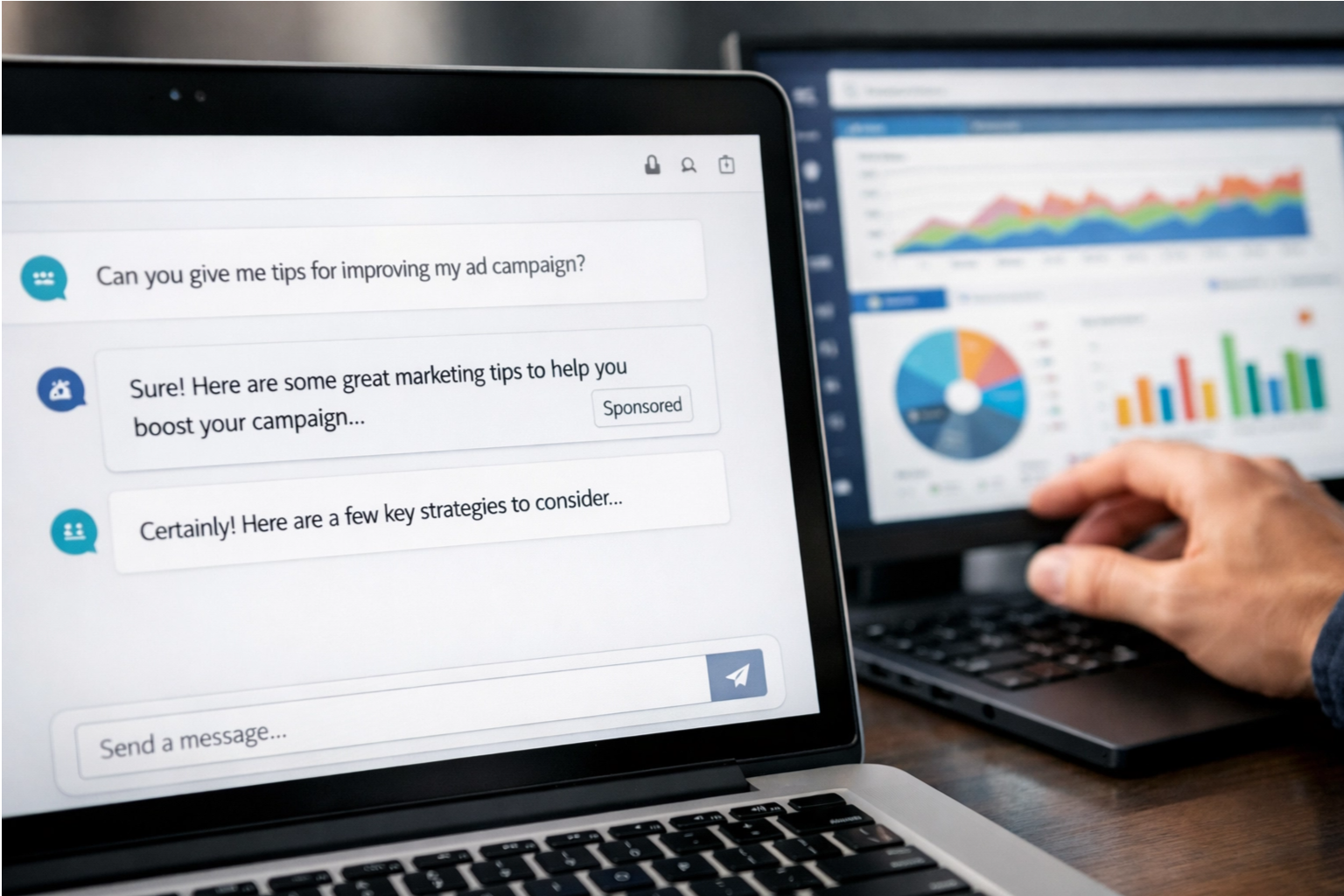
LLMs sometimes generate incorrect or misleading information, a phenomenon often called hallucination. When ads are woven into those responses, there is a risk that your brand appears to endorse or be associated with inaccuracies, even if the ad content itself is accurate.
Mitigating that risk requires strict internal guidelines, including:
- Restricting campaigns to lower-risk topics and clear factual claims
- Regularly reviewing example answers where your brand appears, if the platform provides transparency tools
- Aligning legal and compliance teams on what categories are off-limits for LLM-based placements
Disclosure also matters. Users should be able to clearly distinguish organic answers from sponsored ones. Favor platforms and formats where ad labels and design make this distinction obvious, preserving user trust in both the engine and your brand.
Brand Safety and Contextual Controls
Because answer engines generate content dynamically, traditional placement controls (like domain blocklists) are less relevant. Instead, you’ll want controls centered on topics, intents, and content categories where your brand should or should not appear.
When evaluating Perplexity or future ChatGPT ad offerings, look for the ability to define negative topics, sensitive categories, or regulatory exclusions (for example, healthcare or financial advice). If these controls are immature, adjust your test budgets and campaign scope accordingly, treating the spend more like R&D than core performance investment.
Balancing Organic and Paid Opportunities in AI Engines
Paid inventory is only one piece of the puzzle. There are meaningful organic levers inside these ecosystems that can complement or precede your investment in ChatGPT Ads vs Perplexity Ads.
For ChatGPT, organic opportunities might include building high-quality custom GPTs aligned to your product, optimizing your site content for inclusion in model training and citations, and ensuring your documentation and help content are structured in ways that LLMs can easily use.
Building an AI “Search Everywhere” Strategy
A resilient approach treats LLM ads as one element of a broader “search everywhere” strategy that spans:
- Classic SEO for Google and Bing, with strong technical foundations and structured data
- Answer engine optimization that increases the odds your brand is cited in AI-generated summaries
- On-platform assets like custom GPTs or tools that users can invoke during their workflows
- Paid answer-engine inventory on Perplexity and, eventually, ChatGPT or other LLM platforms
This integrated view helps prevent cannibalization. If you invest in both organic presence and paid units, you can shape how often users see you as an authoritative source in answers and how frequently they see your paid offers when they are closer to purchase decisions.
As you mature this strategy, it can be helpful to align with specialists who understand both traditional SEO/SEM and emerging AI answer engine optimization. Teams at Single Grain focus on this “search everywhere” approach, combining technical SEO, AI-era optimization, and paid media to drive measurable revenue rather than vanity metrics.
Choosing the Right Path in ChatGPT Ads vs Perplexity Ads
For most brands, the pragmatic move is to treat Perplexity as a near-term testing ground while preparing for future ChatGPT ad opportunities. Perplexity offers the first taste of LLM-native ad inventory with measurable, if modest, scale. ChatGPT, meanwhile, should inform your longer-term planning for conversational creative, answer-focused messaging, and AI-integrated attribution.
If your goals are immediate performance and predictable scale, your core budget should remain in proven channels like search and social while you allocate a small, clearly defined experimental budget to AI answer engines. If your goals include learning, defensibility, and category leadership, investing earlier in ChatGPT Ads vs Perplexity Ads experimentation can give you a head start on competitors once these platforms mature.
To navigate this shift effectively, you need a partner that understands both performance marketing fundamentals and the nuances of AI-era search. Single Grain helps growth-focused companies design, test, and scale AI advertising strategies, spanning SEVO, answer engine optimization, and LLM ad pilots, so your brand is visible wherever your customers ask questions. Get a FREE consultation to map out a test plan that fits your goals, risk tolerance, and revenue targets.
Frequently Asked Questions
-
How much budget should I allocate to AI answer-engine ads compared to search and social?
Treat ChatGPT- and Perplexity-style inventory as a small but distinct R&D line item, typically 5–10% of your non-brand search test budget. Start with an amount you’re comfortable fully losing while still gathering statistically directional learnings, then expand only if you see clear signs of high-intent, incremental conversions.
-
Are AI answer-engine ads better suited for B2B or B2C campaigns?
Both can benefit, but B2B brands often see outsized value because complex, research-heavy queries map well to conversational answers. B2C advertisers should focus on high-consideration categories such as finance, healthcare-adjacent products, or premium goods where users actively compare options rather than impulse-buy.
-
How should my legal and compliance teams prepare for advertising on AI answer engines?
Involve legal early to define redline topics, required disclaimers, and approval workflows specific to dynamically generated environments. Ask them to create simplified guidelines for claim substantiation and risk thresholds so your marketing team can quickly determine what’s safe to test without constant case-by-case review.
-
What internal skills or roles do I need to run effective LLM ad experiments?
You’ll need someone fluent in performance analytics, a copywriter comfortable with conversational UX, and a marketing ops specialist who can manage tagging and attribution. As volume grows, consider assigning an “AI search” owner who coordinates organic answer-engine optimization, paid tests, and cross-channel insights.
-
How can I integrate LLM ad traffic into my existing martech and CRM workflows?
Create dedicated source/medium conventions and campaign naming for AI answer engines, so leads and customers can be cleanly segmented in your CRM. Then build automated journeys or scoring models that compare their engagement depth, sales velocity, and retention behavior to users acquired from paid search or social.
-
What creative testing approach works best for conversational ad environments?
Test variations around tone, specificity, and call-to-action placement rather than just headlines or character count. For instance, compare concise, directive answers versus more consultative, educational responses and track which formats drive higher-quality clicks, time on site, or sales-qualified opportunities.
-
Do AI answer-engine ads work for international or multilingual campaigns?
They can, but you should validate language support, local inventory, and regional ad policies before committing to a budget. Start with one or two priority markets, use native-language copywriters who understand local search behavior, and monitor performance by country to avoid overgeneralizing early results.


